
Electronics and semiconductor backend assembly makes up the largest global robotics market—accounting for 24% of new worldwide installations in 2025, according to international robotics figures cited by one collaborative-robot manufacturer—because catching a mis-seated component at the loading station prevents expensive downstream test rework and field failures. Before issuing an RFQ for a compact benchtop vision-guided cobot tray loader, lock down six technical gates with your supplier: end-to-end ESD dissipation, cleanroom-safe vacuum generation, vision lighting and tray-warp alignment, soft seating verification, cobot-versus-SCARA speed trade-offs, and matrix-tray recipe changeover.
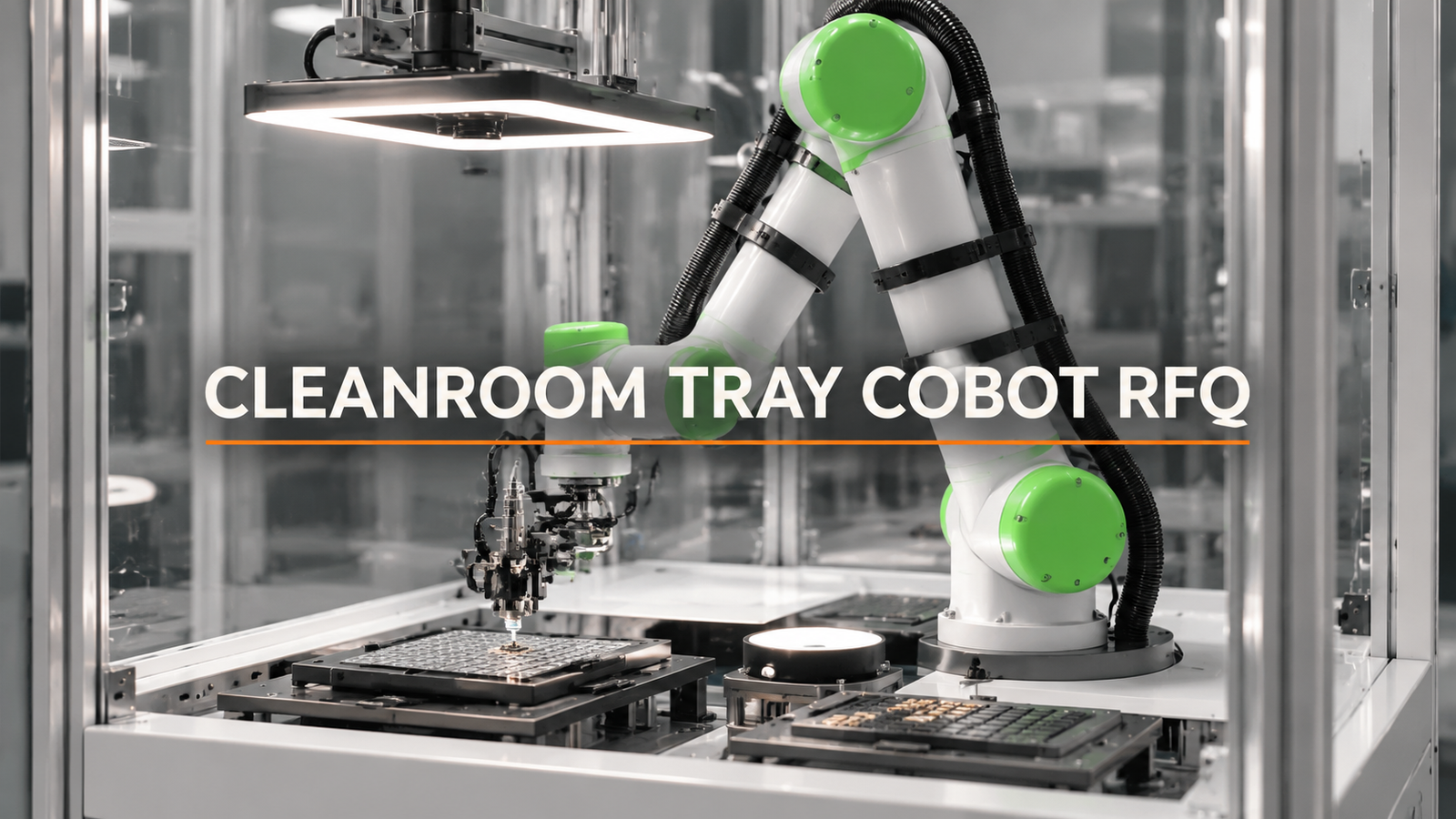
Context From the Filmed Benchtop Vision-Guided Tray Cell
The recorded production unit above illustrates the footprint and subsystem stack electronics buyers typically evaluate: a compact white-and-aluminum enclosed benchtop workcell with clear glass/polycarbonate side panels, an integrated upper HMI panel, and an external display showing monochrome optical alignment circles and pass/fail indicators.
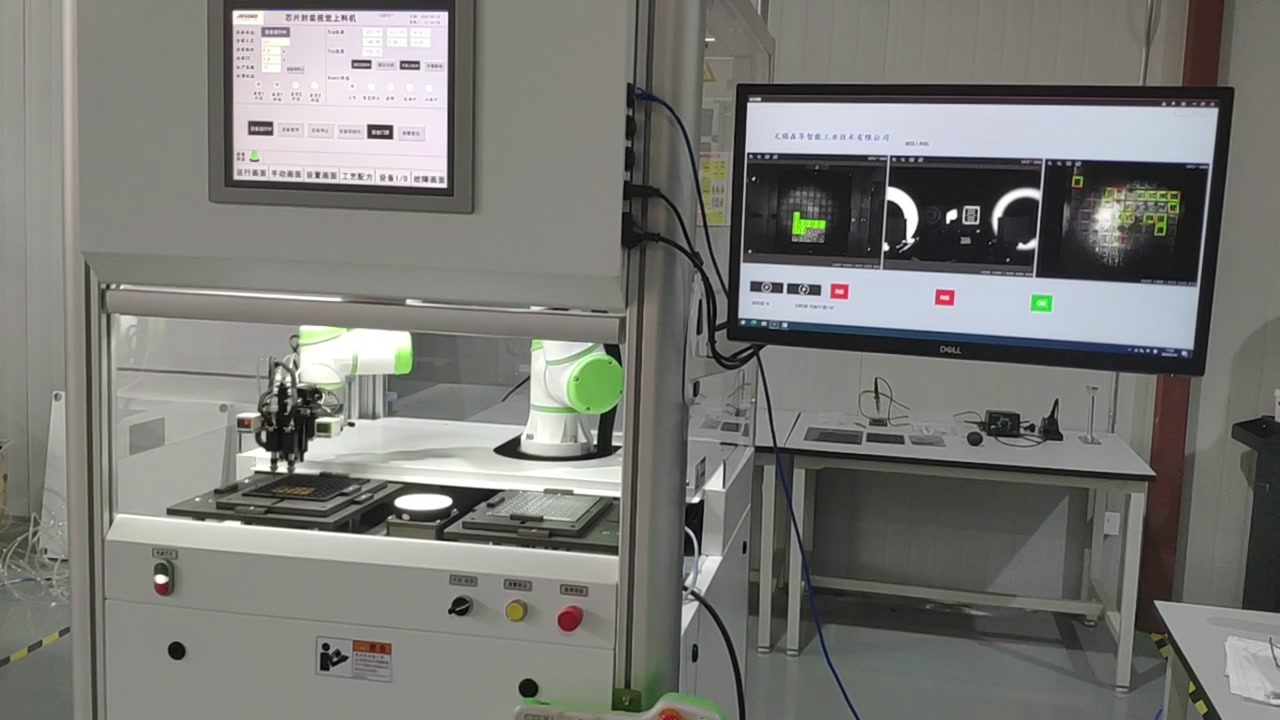
Grouping the cobot, matrix-tray nests, optical stage, and vision monitor onto one self-contained bench lets plants wheel or redeploy the cell as product lines change.
Inside the glass hood, overhead square LED vision lights illuminate black grid-pocket matrix trays seated in locating nests next to a circular backlit alignment stage. The white-and-green six-axis collaborative robot carries a multi-line vacuum micro-nozzle head that lifts components from one matrix tray, passes over the optical inspection stage, and seats them into target pockets of the receiving tray. Because no cleanroom class certificate, surface resistance reading, micron tolerance, or hourly part count appears on screen, treat the video strictly as an architectural reference when reviewing the six buyer questions below.
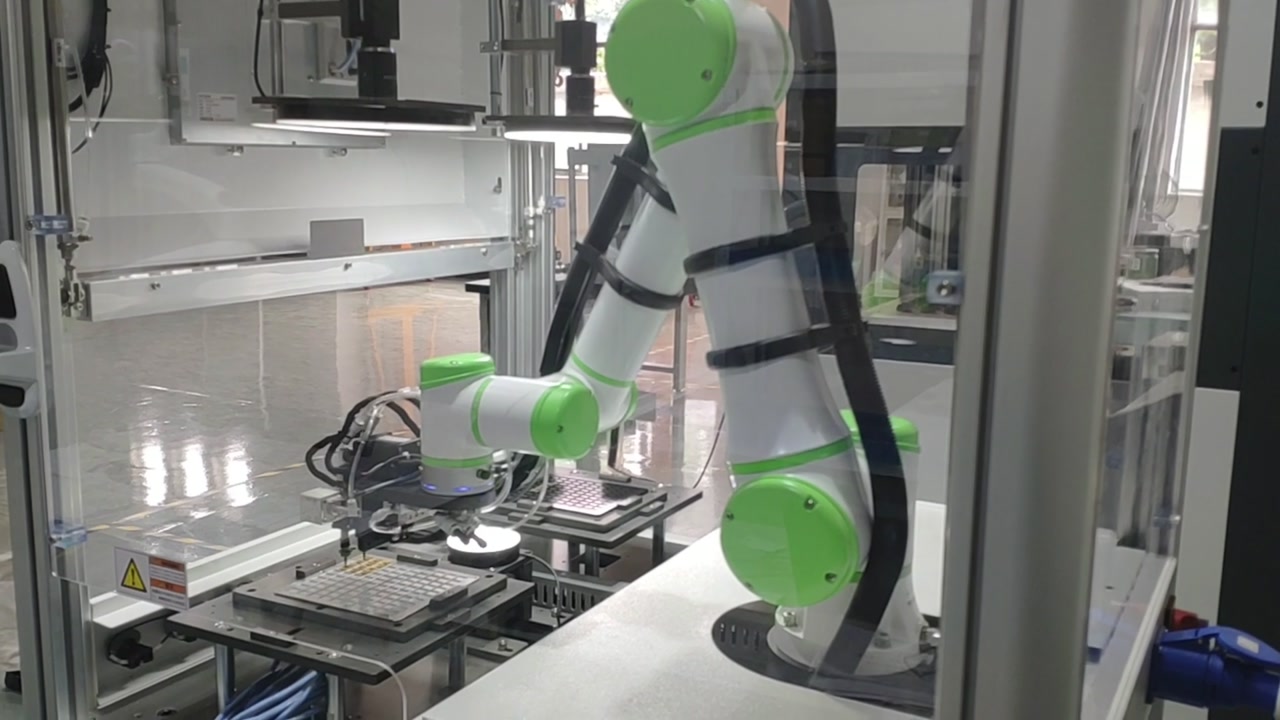
Overhead area lighting paired with a circular optical backlight stage separates pocket-offset alignment from pure mechanical tray tolerances.
Six Buyer RFQ Questions That Prevent Cleanroom Tray-Loader Surprises
1. Is Every Contact Point Grounded and ESD-Dissipative Under IEC 61340 / ANSI/ESD S20.20?
Buying a standard black nitrile suction cup for sensitive semiconductor packages invites latent electrostatic damage that passes initial visual checks and fails in the field. Under international electrostatic-control frameworks (IEC 61340 系列, ANSI/ESD S20.20), ESD protection is a continuous chain—not a single label on the tray. Confirm that suction tips (using purpose-built, wear-resistant ESD-dissipative elastomers rather than standard insulating rubber), vacuum manifolds, tray nests, robot wrist plates, and benchtop frames share a verified dissipative-to-ground path specified by your internal ESD engineer.
2. Should Vacuum Come From Plant Compressed Air or an Integrated Electric Vacuum Pump?
Traditional Venturi vacuum ejectors consume shop compressed air and vent exhaust directly around the end effector—stirring fine particles inside an enclosed benchtop hood unless exhaust air is piped out through filtered manifolds. Integrated electric vacuum grippers eliminate external compressed-air lines altogether and can provide two independent vacuum channels so one wrist handles pick-and-place or load/unload steps within a single travel loop. If your plant uses ultra-compact multi-channel pneumatic ejectors for micro-nozzles instead, require closed exhaust routing outside the clean enclosure plus inline filtration.
3. How Does Vision Compensate for Tray Warp, Specular Glare, and Pocket-Pitch Tolerance?
Injection-molded matrix trays warp slightly after bake or wash cycles, and metallic IC leads or dark epoxy packages create harsh specular reflections under ordinary overhead factory lights. Ask bidders three specific vision questions:
- Does the system inspect both tray-nest fiducials and bottom/top component orientation (as illustrated by the circular backlight stage and overhead LED ring lights in the filmed cell)?
- Can optical zoom and lighting recipes adapt to matte black, glossy ceramic, and bare-metal packages without physically swapping lenses?
- What is the guaranteed cycle-time impact of capture + offset calculation per pick?
4. How Does the End Effector Prevent Crushing Fragile Packages and Confirm Every Pick?
Small dies, thin substrates, and gull-wing leads crack easily under rigid Z-axis touchdowns. Specify two mechanical/sensing safeguards:
- Soft spring-damped plungers mounted behind micro suction tips to absorb slight pocket-depth or component-height differences gently.
- Compact electronic vacuum/pressure switches tied to the controller so every pick verifies sealed vacuum before transit and confirms clean blow-off release before retracting—stopping double-picks and dropped parts immediately.
5. When Does a 6-Axis Cobot Beat a 4-Axis SCARA or Delta Robot for Tray Loading?
Do not pick a six-axis collaborative robot on habit alone. Compare kinematics honestly:
- Choose a 6-axis benchtop cobot when floor footprint is tight, operators share the aisle for manual tray refills, tasks need tilted approach angles or rapid redeployment across seasonal SKUs, and moderate cycle times satisfy your tester or furnace pace.
- Choose a 4-axis SCARA or high-speed Delta when vertical pick-and-place throughput (UPH) is the bottleneck on a dedicated high-volume line and full perimeter guarding is already planned.
6. How Long Do Tray-Recipe Changeovers and Manual Tray Refills Take?
An enclosed cell that loads parts cleanly yet forces an operator to open the safety door every six minutes to swap two matrix trays delivers poor autonomy. Clarify whether your batch run needs simple dual-nest benchtop loading (as filmed) or an automated tray stacker/elevator magazine, and verify whether switching to a new matrix grid (rows, columns, pitch, and vision template) happens via HMI recipe selection without rewriting robot coordinates.
Compact RFQ Specification Checklist for Vision Tray Loaders
| RFQ Section | Required Buyer Input | Supplier Verification Gate |
|---|---|---|
| ESD & Cleanliness | Target ESD standard (IEC 61340 / ANSI/ESD S20.20) and cleanroom class | Dissipative suction-cup material spec, grounding continuity map, filtered or airless vacuum |
| Part & Tray Geometry | Matrix-tray drawing, pocket pitch, part mass, fragile keep-out zones | Soft spring-plunger stroke, nozzle diameter, vacuum-switch pick/release confirmation |
| Vision & Illumination | Surface reflectivity (matte/glossy/metal), rotation/lead tolerance | Sample test on 20 real production parts across warped trays under enclosed LED lighting |
| Kinematics & Autonomy | Target UPH, available bench footprint, desired unattended run minutes | Cobot vs. SCARA cycle simulation and manual dual-nest vs. automatic tray stacker sizing |
Actual cycle throughput, vision repeatability, and cleanroom particle performance depend on your component dimensions, tray flatness, optical contrast, and enclosure air filtration.
Request a Tray-Loading Feasibility Check
Preparing an RFQ for semiconductor or electronics matrix-tray automation? Share your tray drawing (pocket count and pitch), component mass and surface finish, ESD/cleanroom requirements, and target hourly output through the EVST 查询页面 或用您的语言发送电子邮件至 sales@evsrobot.com. EVST engineers can compare vision-guided cobot versus SCARA layout options and review vacuum-gripper and lighting inputs before you finalize vendor specs.