
By ทีมบรรณาธิการ EVST · ตรวจสอบโดย ทีมบรรณาธิการ EVST · Last updated October 19, 2026
Method: bounded case-video analysis and engineering references · นโยบายกองบรรณาธิการ · นโยบายการแก้ไข · ข้อตกลงและเงื่อนไข
A multi-station SCARA cell works as three connected handoffs: present the part at the tray, transfer it through the intermediate station, and place it into the selected orange fixture with a clear gripper exit. The case video keeps all three zones visible as the white SCARA repeats this route with small, slender metal parts. Engineering the cell therefore starts with part support, station permission and withdrawal clearance at every handoff.
Request a multi-station robot-tending concept and cycle-study review with the part drawing, daily output target, fixture layout and required station sequence.
Follow the route across three transfer zones
The black tray presents a row of parts on the left, the intermediate mechanism occupies the centre of the cell, and the orange fixture bank spans the front working area. The SCARA repeatedly moves across this layout. Read the sequence as a chain: pickup condition at the tray, transfer condition at the centre, then placement and withdrawal at the selected fixture.
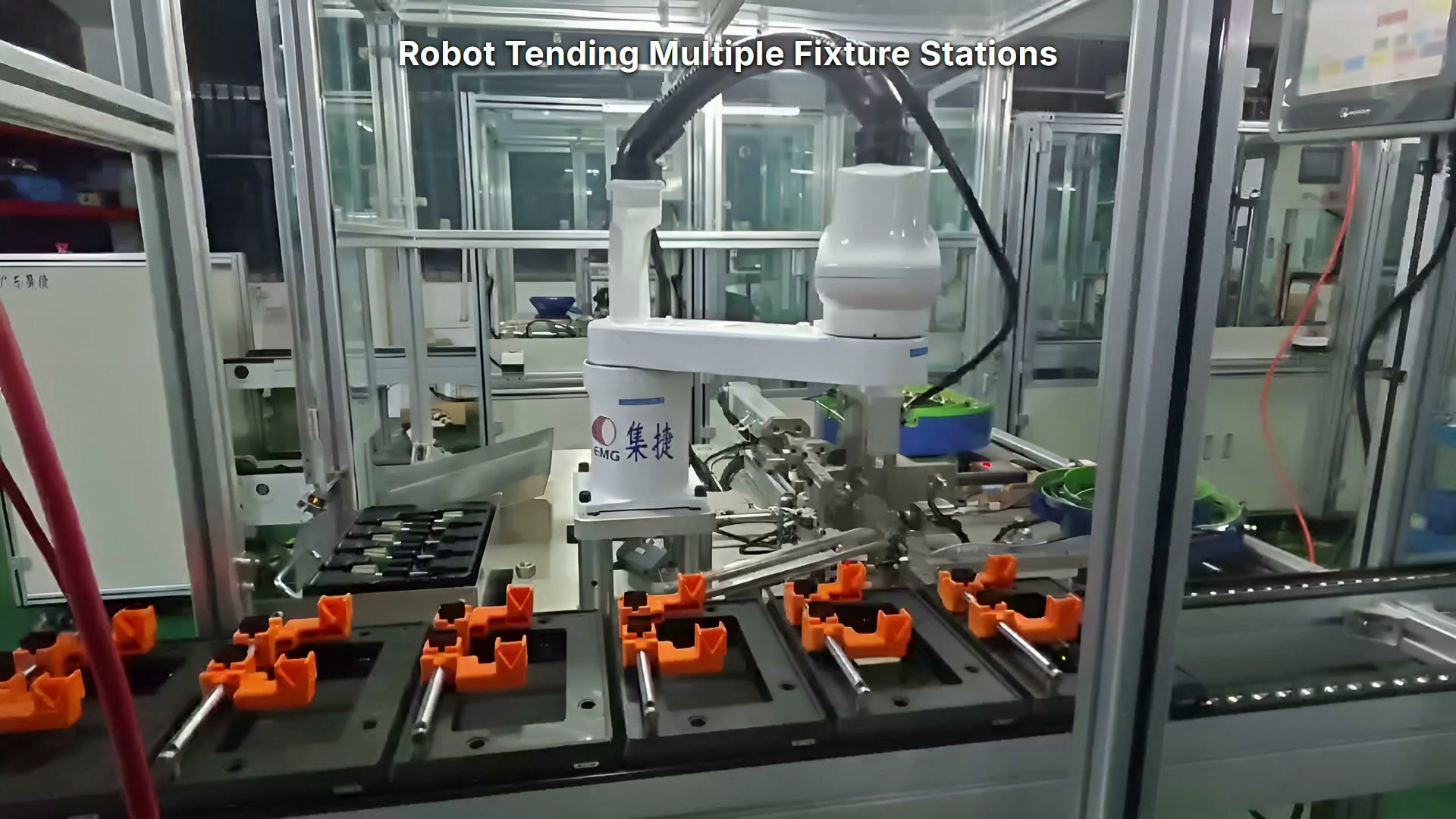
Cell overview: the SCARA, tray, intermediate mechanism and fixture bank share one working layout.
Treat each station as a defined handoff
In a multi-station fixture cell, each handoff needs a known pickup condition, a known placement condition and a clear exit. A robot pose at the destination is only one part of the check. The part must remain supported while the gripper releases, the gripper must leave without catching a locator, and the robot must clear the station before another device changes state.
The October 15 EVST case on tray-to-worktable handoff gives useful related context: repeatability depends on the relationship between part presentation, support and machine state. A second guide on part support and gripper exit focuses on the same boundary from a different machine-tending case.
A practical station definition
For every station, record the following before programming the complete route:
- the part datum that the station establishes;
- the surfaces the gripper may contact;
- the supported state before and after release;
- the permitted approach and withdrawal directions;
- the device state that permits entry;
- the confirmation that permits the robot to leave.
This station definition makes troubleshooting specific. If a trial fails, the team can ask whether the incoming part was presented incorrectly, whether the fixture failed to establish the intended datum, or whether the gripper exit was blocked.
Check the whole route, including the central mechanism
The central mechanism sits between the tray and fixture bank, so its confirmed production function, working state and occupied space belong in the sequence and clearance model. An intermediate device can add a state transition, alter part presentation or create a waiting condition even when the robot motion is short.
For route validation, include the part, gripper body, fingers, cables and robot structure—not only the tool-center point. Review entry and exit at every station and the connecting motion between stations. A route that reaches all programmed points can still be unusable if the fingers pass too close to a locator or if the held part sweeps through nearby hardware.
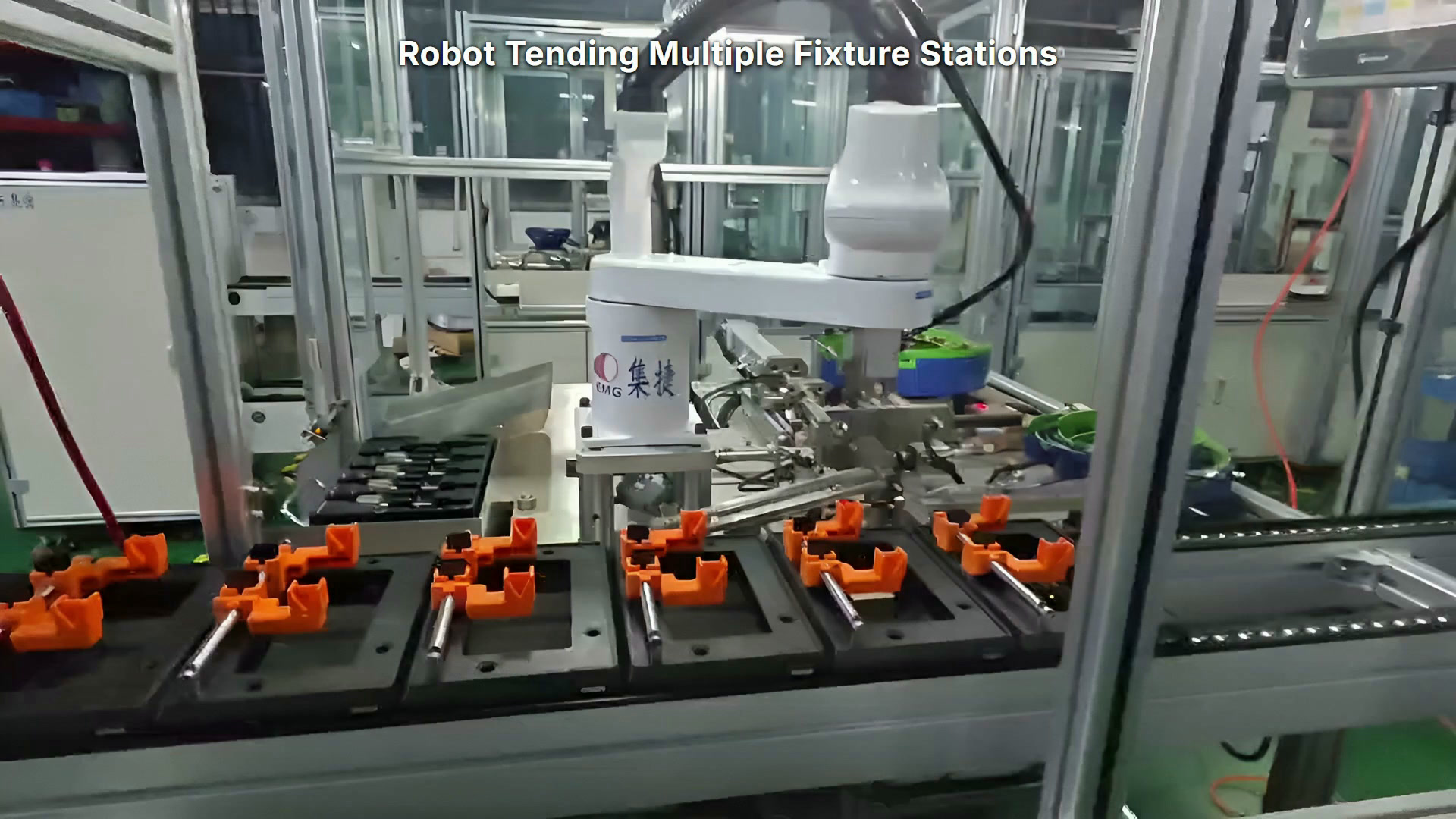
Transfer position: the SCARA stands between the intermediate mechanism and the front fixture bank.
Match each station to the inputs it needs
Use a station input table before programming the complete route.
| Station or decision | ข้อมูลโครงการที่จำเป็น | การตรวจสอบการยอมรับ |
|---|---|---|
| Tray pickup | Part drawing, incoming orientation, available datum and allowed gripping surfaces | The gripper enters, secures the part and withdraws without disturbing adjacent parts. |
| Intermediate handoff | Confirmed device function, working states, occupied envelope and interface signals | The part remains supported and the next state cannot begin until the robot clears the zone. |
| Orange fixture bank | Station identity, locator geometry, fixture states and release condition | The selected fixture accepts the part and the gripper exits without crossing another station’s active space. |
| Route and tooling | Part mass, gripper model, finger geometry, cables and required orientation | The full gripper-and-part envelope clears every locator and nearby device. |
| เป้าหมายการผลิต | Daily output, product mix, planned changeovers and permitted waits | A representative trial measures the complete sequence under agreed conditions. |
| Access and recovery | Operating modes, access tasks, stop states and site safety requirements | The team can identify the part and device state, then execute a controlled restart. |
For project review, treat the tray, intermediate mechanism, fixtures, end effector, controls and safeguarding as one application. Apply the risk assessment to normal operation as well as setup, recovery and maintenance.
This system boundary aligns with OSHA’s industrial robot systems technical guidance, which describes robot applications as integrated systems that can include end effectors, worktables, clamps, process equipment and other machines. The same guidance emphasizes application-specific risk assessment.
Build the sequence from permissions and confirmations
A robust sequence should state what permits each motion and what confirms its completion. Select the sensors and control architecture after defining these six sequence conditions:
- Confirm that the pickup zone is in the expected state and that a part is available.
- Enter the zone, grip the part and verify the grip using the project’s chosen method.
- Withdraw along the validated path and confirm that the part remains retained.
- Confirm that the receiving station is ready before entering its working space.
- Place the part against the intended supports, release it and withdraw fully.
- Confirm the receiving state before allowing the next fixture or machine action.
For several fixtures, use explicit station identities. A generic “fixture ready” bit can hide which station is available or occupied. The control design should also prevent the robot from entering a station whose fixture or associated mechanism is moving.
Plan recovery before chasing cycle time
The most useful recovery question is: where is the part when the sequence stops? It may still be in the tray, held by the gripper, resting in the intermediate mechanism or seated in a fixture. Each state needs a controlled restart decision. Blindly restarting a normal pickup or placement can create a double-load, an empty transfer or a collision with a changed fixture state.
Applicable integration, machine-guarding and hazardous-energy requirements must be established for the actual country, equipment and task by qualified personnel. The recovery plan should cover access to every station and the state of all related equipment, not only the robot program.
For U.S. projects, OSHA’s robotics standards overview is a starting point for identifying robot-system integration, machine-guarding and lockout/tagout references. Other jurisdictions and site rules may require a different compliance path.
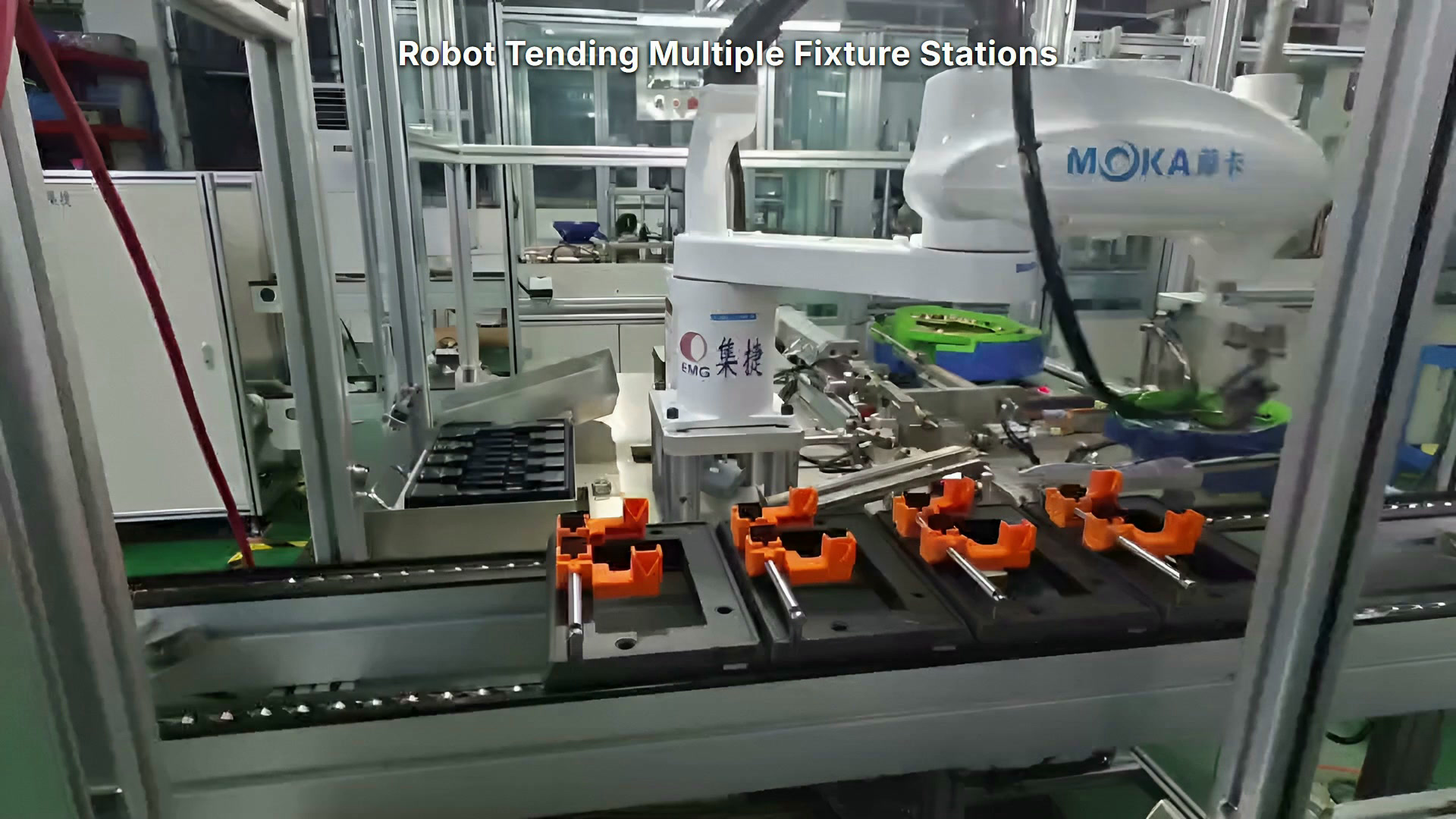
Fixture detail: small, slender metal parts sit in the orange fixtures.
Inputs for a useful concept and acceptance review
Prepare the part drawing and mass, allowed gripping surfaces, incoming presentation, fixture datums, station-state diagram, expected variant range, required production output, available floor space, maintenance access and site safety requirements. Provide the gripper concept and any known restrictions on part orientation.
The acceptance trial should then test representative parts across every station, including normal transfer, missing-part detection, interrupted motion and controlled recovery. Record whether the part remains supported, whether the gripper clears each fixture, whether station permissions prevent conflicting motion and whether operators can identify the actual state after a stop. Measure cycle time and placement performance under the agreed test conditions.
To discuss a multi-station SCARA transfer application, request a project and cycle-study review with the part drawing, daily output target and fixture information above. The broader machine-tending application page provides additional starting points for project scoping.
คำถามที่ผู้ซื้อมักถาม
What inputs should a buyer prepare first?
Start with the part drawing, mass, allowed gripping surfaces, incoming orientation, daily output and fixture layout. Add the required station sequence and product variants so the concept review can connect tooling, layout and timing.
How should station permission be defined?
Give every station a unique identity and explicit ready, occupied and complete conditions. Permit robot entry only when the selected station is ready, and permit fixture or device motion only after the robot has cleared its working space.
What makes recovery practical?
The control and operator interface should identify whether the part is at the tray, in the gripper, at the intermediate mechanism or in a fixture. Recovery then starts from the confirmed physical state rather than replaying a normal transfer step.
When should cycle time be measured?
Measure it after the full route, station permissions and recovery states are working with representative parts. Use defined start and end states and include real device waits, not robot travel time alone.
Footage boundary: the video shows a white SCARA moving among a black tray, a central mechanism and orange multi-station fixtures containing small, slender metal parts. It does not verify the part name, assembly, screwdriving, cycle time, accuracy, payload, sensing method, completed quality or installed safeguarding.