
We estimate an unpacking cell from parts accepted by the receiving station, over a complete box cycle. To make that count meaningful, we first define the gripping confirmation, receiving permission and handoff-complete sequence. Then we include carton replacement, remaining-part handling and recovery in the timing boundary. Robot travel speed alone cannot price or size that supply task.
Watch the carton-to-station movement
The filmed arm lowers a vertical gripping device toward orderly small modules in a carton and moves between the carton and an adjacent station. The visible arrangement gives us two separate integration problems: how the tool addresses the contents of the box, and when the next station is ready to receive them.
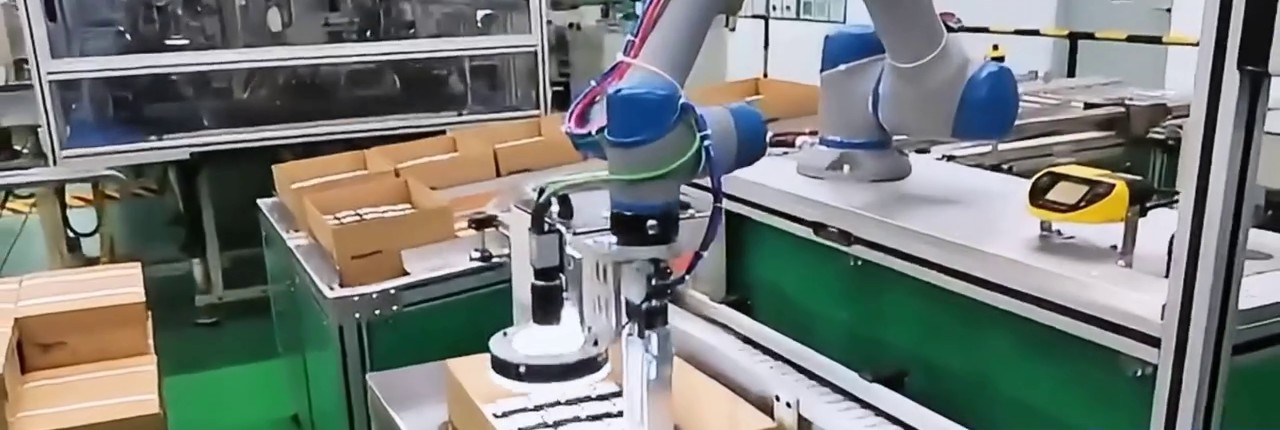
Main film 00:07.28 — The tool is above rows of modules in the front open carton, showing the carton opening and picking area.
Turn a movement into an acknowledged delivery
For a proposed cell, we define a process handshake before assigning a production count. A controller can set a digital output, wait for an input or expression and handle a timeout. We use those functions to connect tool operation to the receiver’s state, with signal names and timing agreed between the devices.
| Proposed step | What the control sequence does | What an exception means |
|---|---|---|
| Command the grip | Set the chosen tool output | The command is an instruction, not confirmation that parts are held |
| Confirm retention | Wait for the selected gripping feedback within a defined time | Stop the normal transfer sequence and handle an unconfirmed grip |
| Obtain receiving permission | Wait for the receiver to accept the transfer | Record receiver waiting separately from robot movement |
| Place and release | Execute the approach and selected release sequence | Do not count a delivery merely because a release command was sent |
| Complete the handoff | Exchange the agreed placement/completion confirmation | Update the delivery count only at the defined acceptance event |
The feedback method depends on the selected tool and receiver. For example, a tool-closed signal and a part-held confirmation can describe different conditions. We specify what each signal actually proves and set wait limits from the equipment’s response and recovery needs. Ordinary process I/O remains separate from the cell’s safety functions.
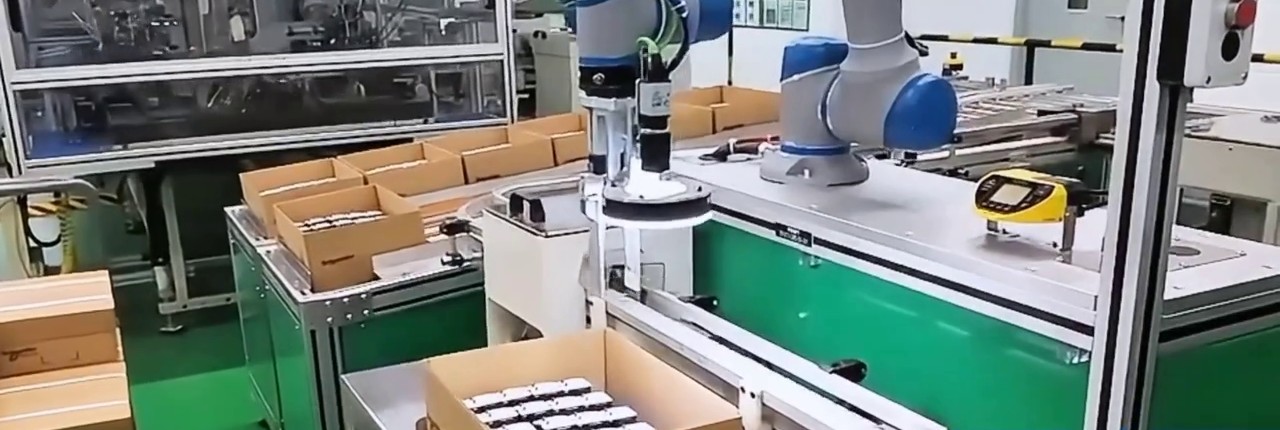
Main film 00:15.5 — The robot tool is near the right-hand worktable, showing the relationship between the carton and the adjacent station.
O conveyor-to-station battery-module handling example shows another receiving arrangement in which a conveyor and a station share the robot’s time. It is useful when discussing where a delivery finishes and which device can make the robot wait.
Give the remaining row its own handling rule
For a regular array, one starting layout is to locate the carton and define the pick positions from its reference. We then trial the wall-adjacent positions and the last remaining modules, using the actual carton and tool. Box movement, wall clearance or a changed remaining pattern can make those positions different from the easy central pickup.
If a proposal carries several modules together, test a complete group and an incomplete final group. Decide whether the selected tool can handle a different remaining quantity, whether a separate final-row path is needed, or whether the remainder goes to an operator-assisted exception. That choice changes both the confirmed quantity and the time per box. A nominal group size is not a valid multiplier for every attempt.
Carton replacement also needs a defined end state: the next box is located and available for picking. A second pick position can sometimes let replacement run while another box feeds the cell. We assess that layout with the control sequence and access arrangement; the estimate includes only the replenishment time that remains uncovered.
Measure the complete box cycle
Use the same logged event at both ends: start when the first picking task for this carton starts, and finish when the first picking task for the next carton starts. Count the parts actually accepted during that same interval. Do not delay the start of timing until the receiver is ready; carton replacement, confirmations and downstream waits must remain inside successive intervals. Then calculate:
Delivered modules per hour = 3600 × N / T
Aqui você encontra N is the number accepted at the agreed receiving point and T is elapsed seconds over the same complete box-cycle boundary. The factor converts seconds to an hour. This is a planning equation, not a performance figure for the filmed arm.
We separate logged time into productive transfer, tool-confirmation waits, receiver waits, carton replacement and exception recovery. If several activities overlap, the complete elapsed time counts that interval once. If multiple boxes are measured, divide total accepted parts by total elapsed time rather than averaging individual box rates.
The record then points to a configuration decision. Repeated receiver waits call for an interface or downstream-capacity discussion. A long uncovered replacement interval calls for a replenishment-layout comparison. Repeated final-row exceptions call for a tooling or remaining-part strategy review. These are different changes, even when each first appears as a low hourly rate.
To discuss the cell with EVST, bring carton and module photographs, the box arrangement and quantities, a full-to-nearly-empty handling video and the receiver’s available signals or operating sequence. If the interface is not documented yet, explain what the next station must receive and when. We can use those inputs to define the handoff, exception rules and a useful cycle trial. Discuss module unpacking integration.