
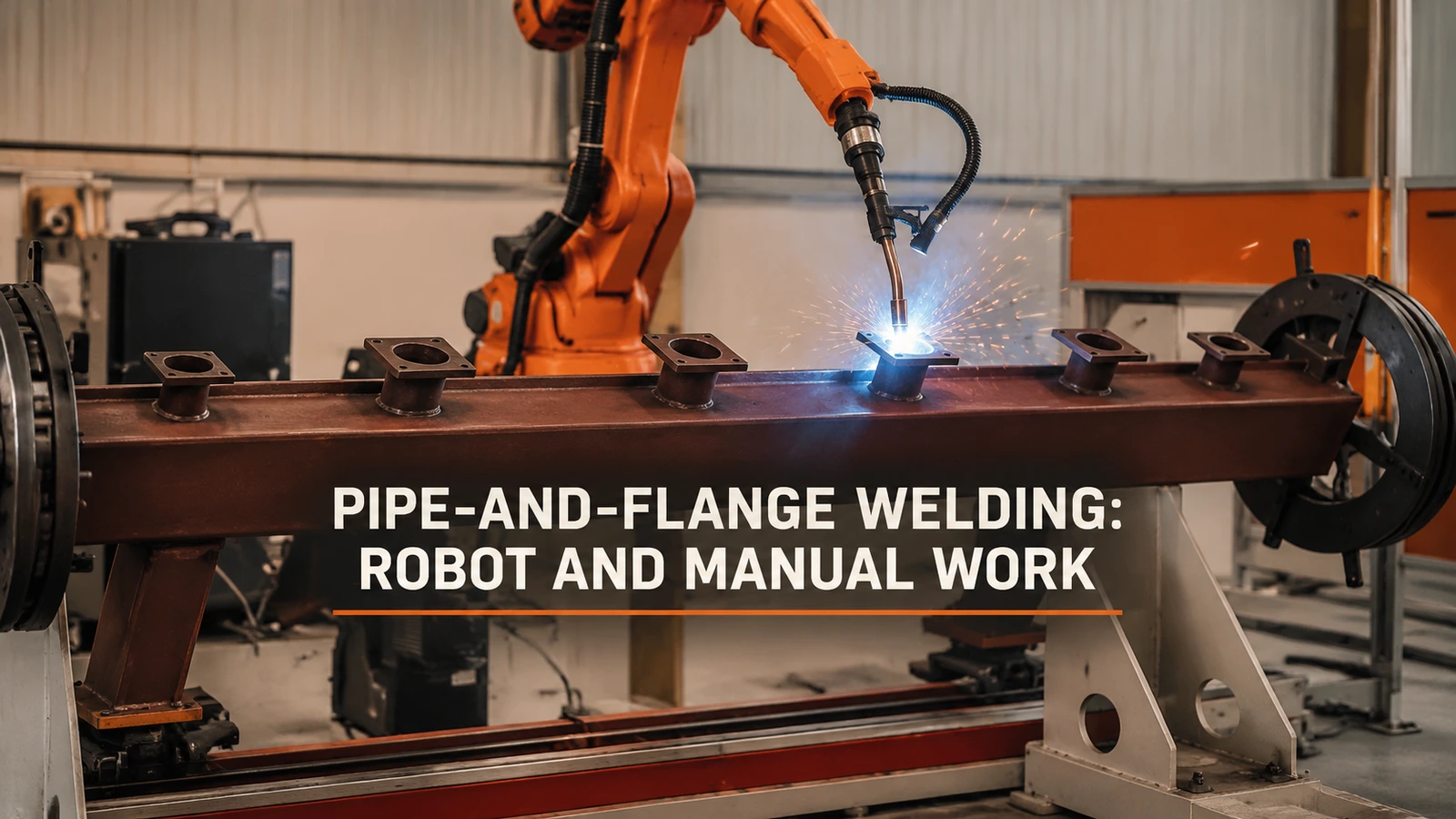
For robotic pipe-and-flange welding, start with the joints that can be presented consistently and reached through a complete welding motion. Keep difficult access, variable fit-up and the work needed to prepare the next assembly in the scope discussion. A useful first automation step can cover a repeatable group of seams without requiring every task on the assembly to become automatic.
Divide the assembly into jobs a cell can actually repeat
A circular joint is a useful shape for discussing repetitive welding, but its outline alone does not establish robot suitability. The torch needs an approach, a usable welding orientation around the required seam, and a way out. A support or clamp may leave the starting point accessible while obstructing another part of the route.
For an initial layout study, mark each joint on the drawing and show the real clamp and support positions beside it. Classify a joint as a candidate only after checking the whole proposed motion with the intended torch. If a joint needs a different presentation, compare repositioning the assembly with leaving that particular weld manual. Do not make the robot reach every corner simply to call the whole part automated.
The accompanying application footage shows robotic circumferential welding at pipe-and-flange connections on a long assembly, with supports at its ends. Close views show the pipe connections and drilled flanges. These are different shots of the operation, a useful starting point for discussing how the assembly is presented to the torch.
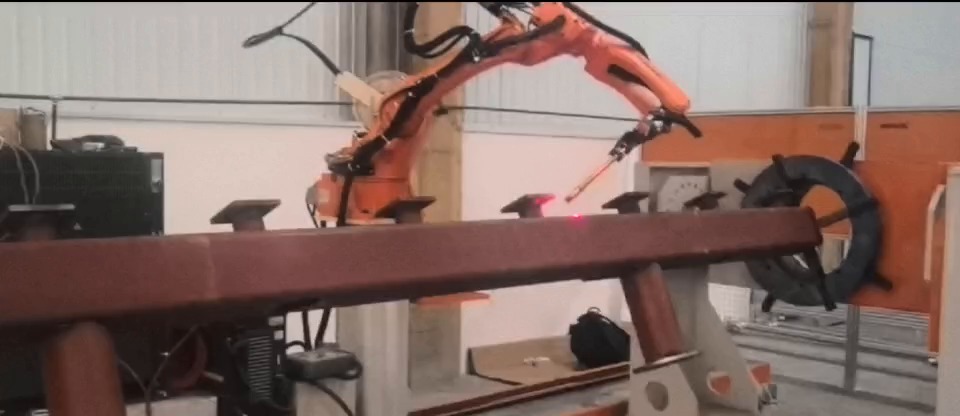
00:05 — A robot torch works at a pipe connection on the supported long assembly.
A repeatable weld still needs a prepared assembly
In robotic arc-welding planning, consistent fit-up matters because a repeated motion expects the joint to be presented consistently. Assess what must happen before that motion: identify the variant, load the components, locate the pipe and flange, establish the agreed fit-up, and secure the assembly. These are proposed tasks to allocate, not a description of how the filmed workstation is staffed.
A sensible division may leave loading and alignment with an operator while the robot performs the qualified seam group. Another application may justify additional handling equipment. The choice changes when preparation occupies the resource needed for welding, or when a new variant requires substantial fixture adjustment. A fast welding movement cannot remove that supporting work from the order.
Use a trial order to record welding, preparation, unloading and changeover separately. Where tasks genuinely overlap, compare the resulting order completion time rather than simply adding every duration. Where one operator or one fixture must perform them in sequence, retain that dependency. This reveals whether the next useful investment is more welding automation, easier location, or a better loading arrangement.
When is retaining a manual weld reasonable?
Retaining a restricted joint can be reasonable when automating it requires disproportionate repositioning or tooling work for the actual order mix. A small batch is not automatically a manual job, either: reusable tooling can change the balance. Compare the setup burden and the remaining manual work for the orders you expect to repeat.
For a proposed split route, agree where the part goes after the robot finishes and how the remaining joints are identified. A plan that removes arc time but leaves an awkward manual handoff has shifted the problem rather than completed the task allocation.
Mark the seam groups you want to automate on a drawing or a clear set of photographs. Bring the loading orientation, locating method and typical variant changes to EVST so we can discuss a welding-cell layout and a representative trial scope.
مرتبط disc-joint fit-up and torch access discussion develops the part-presentation question for a circular joint.