
Choose a tire gripper by the contact region the tire permits and the space available at both ends of the transfer. An internal concept needs usable access through the bore; an external concept needs room around the outside. Either choice can fail at release even when pickup looks straightforward, so compare the complete opening and withdrawal route with actual tire samples.
| otsus | Internal gripping concept | External gripping concept |
|---|---|---|
| Available contact | A permitted region inside the tire must be accessible | A permitted outer region must be accessible |
| Tool entry | The tool must enter and locate without obstructing features in the bore | The opened tool must fit around the tire and nearby supports |
| Deformation to inspect | Changes around the internal contact and the released shape | Changes around the outer contact and the released shape |
| Placement constraint | Check that the support does not trap the tool inside | Check that the rack or adjacent tire does not block opening |
| Variandi muutus | Verify the usable internal geometry, not just nominal tire size | Verify outside geometry and the required open-tool space |
Contact is a part requirement
An inside grip may leave the outside accessible, while an outside grip may preserve access through the bore. That geometric advantage matters only if the chosen contact is acceptable for the actual tire and its production state.
Manufacturer portfolios distinguish green-tire, finished-tire, rim and wheel handling. They also offer internal and external approaches for different tasks. Treat those as alternatives to evaluate, rather than applying a green-tire tool specification automatically to a finished tire or an assembled wheel.
Ask which regions can take contact, what marks or temporary deformation are acceptable and how the tire should sit after release. The trial sample must answer those questions for the intended range. A secure lift alone does not settle whether the handling method preserves the required part condition.
The rack can reverse the preferred choice
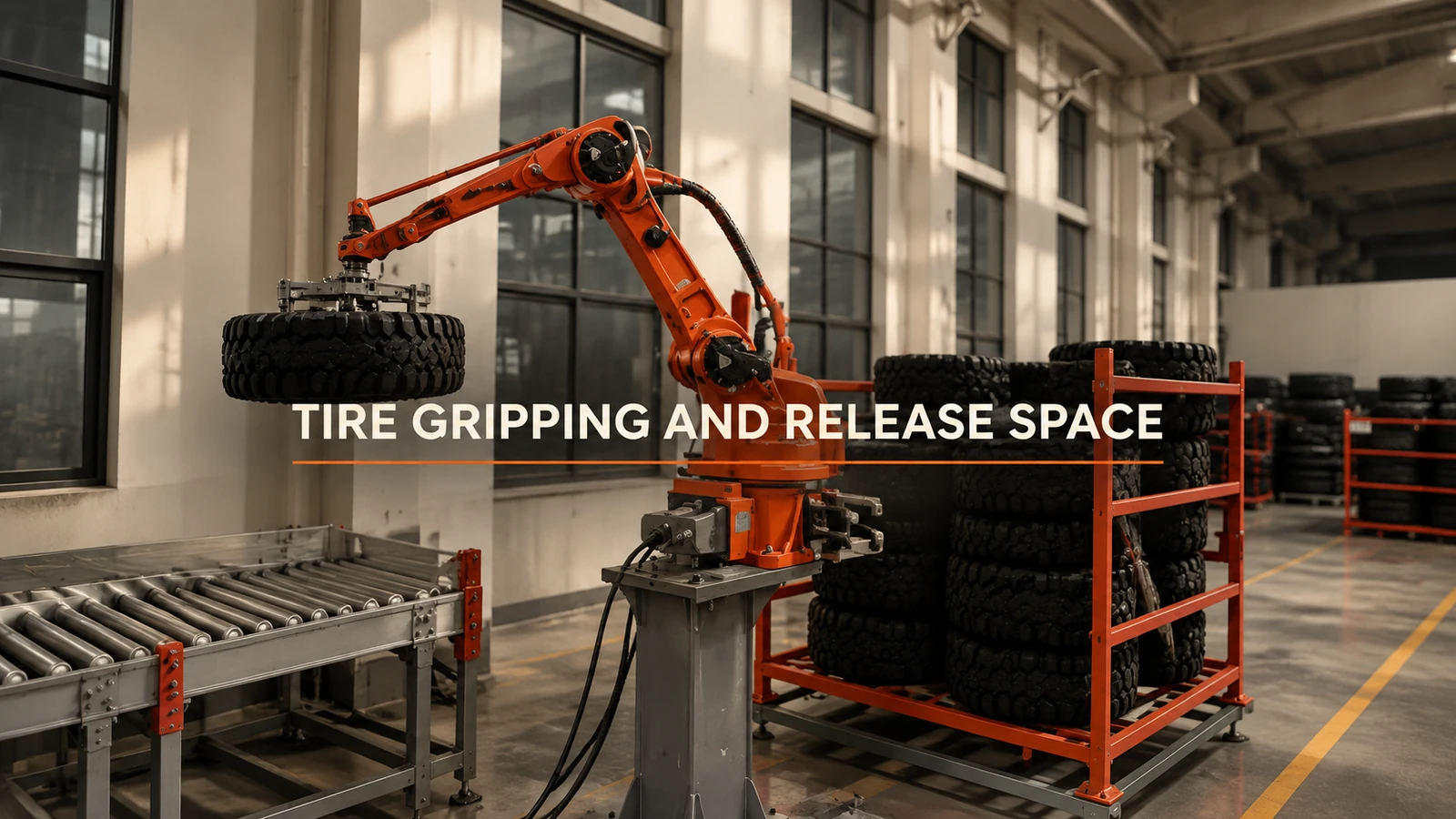
The example shows a robot gripping and moving a tire, with a red rack and a roller conveyor visible nearby. It is a useful reminder to include the receiving arrangement in a handling study, rather than selecting the end effector from a tire drawing alone.
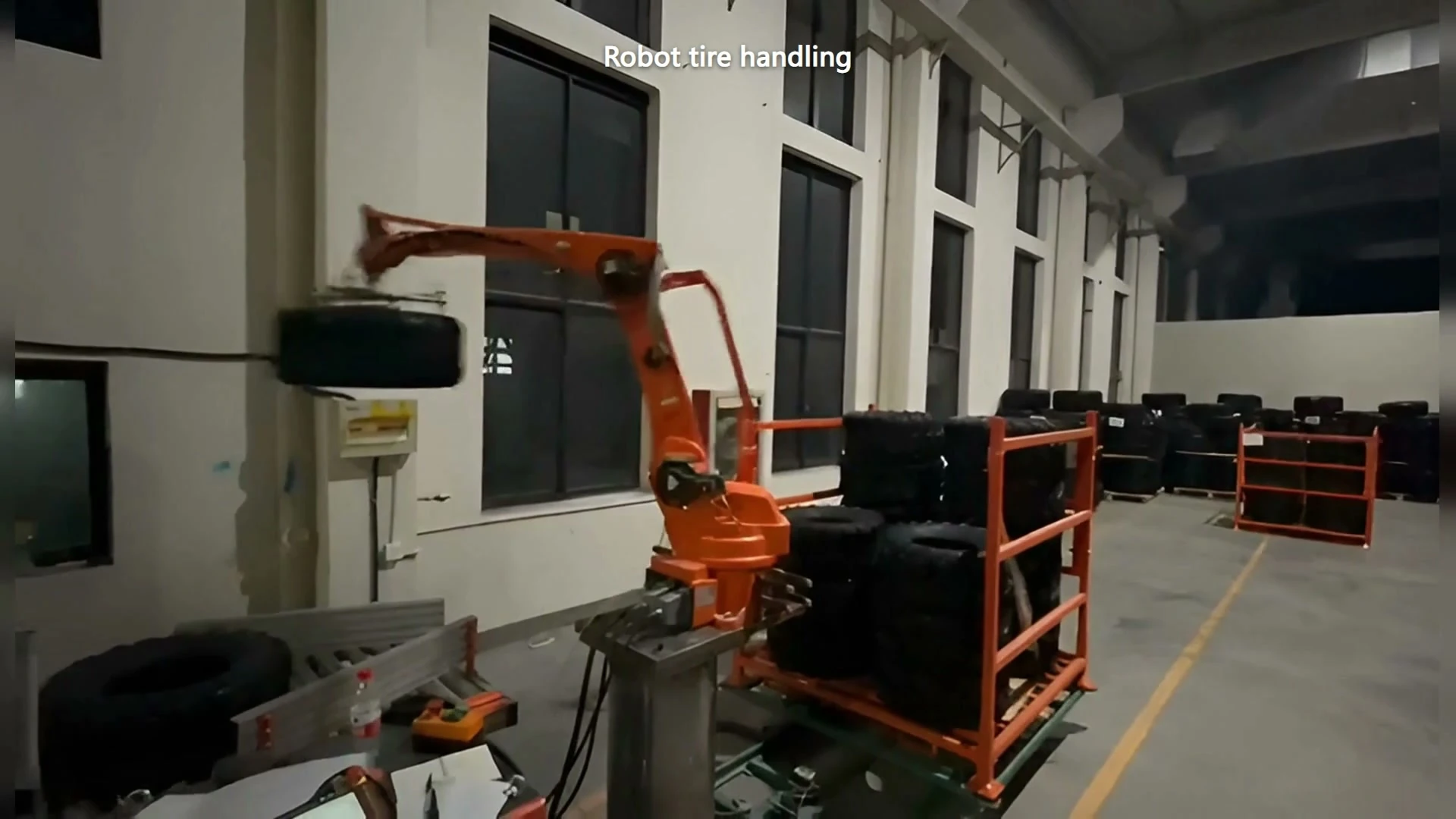
The robot holds a tire above the conveyor, with a red rack to the right. Video 00:08.
Draw the tool fully open at pickup and at placement. For an internal concept, check whether a support, locator or another tire occupies the space needed to enter, release and withdraw. For an external concept, include the jaw opening around the tire and the space consumed beside the rack.
Do the same for the carried tire, not just the empty tool. A route can clear the rack with the wrist and still bring the tire into a rail or neighboring part. If a change in orientation is needed, include it in the transfer trial rather than assuming it can be added after the gripper is chosen.
Compare samples at the difficult positions
Use actual variants that challenge contact and access in different ways. The smallest nominal tire is not necessarily the hardest to handle: the relevant issue may be the opening left for the tool, the contact surface or the way that variant rests in the receiving position.
Run pickup, loaded transfer, placement, release and complete tool withdrawal. Inspect the tire while held and after release using the agreed part-condition criteria. Include a repeat pickup to find whether the first transfer changes how the next operation encounters the tire.
If one concept grips well but cannot release in the rack, compare a different contact arrangement with a revised receiving support. This is a coupled decision. There is little value in optimizing a compact tool while leaving the storage arrangement incompatible with it.
The result should identify which concept fits the allowed contact and the actual route, what changes are needed at the rack, and which tire variants still require a trial. It should not be a blanket claim that internal or external gripping is always gentler or more secure.
Show EVST the tire range, permitted contact regions and both pickup and storage positions to discuss which gripping route deserves a sample trial.