
การส่งต่อหุ่นยนต์ในห้องฝึกอบรม: กำหนดจุดส่งต่อก่อนการตั้งโปรแกรม
A multi-station training cell is useful because it exposes the interfaces that decide whether robot transfer will be stable: how a part is located, when a fixture releases it, where the gripper can enter, and how the cell recovers after an interruption. In this case, an orange industrial robot moves among several fixtures while black and white round or cylindrical components remain visible. The practical design question is not simply whether the robot can reach each station. It is whether every handoff has a repeatable state that the controls can confirm.
Send EVST your part drawing, station layout and daily output target for a preliminary cell and cycle assessment: https://www.evsint.com/contact/#quote
Read the route as a sequence of handoffs
The visible route crosses several compact stations. At the first station, the robot approaches a fixture zone. It then changes posture over stations containing round parts and locating features before returning across the cell. This is best reviewed as a chain of handoffs: present, locate, grip, release, clear and confirm.
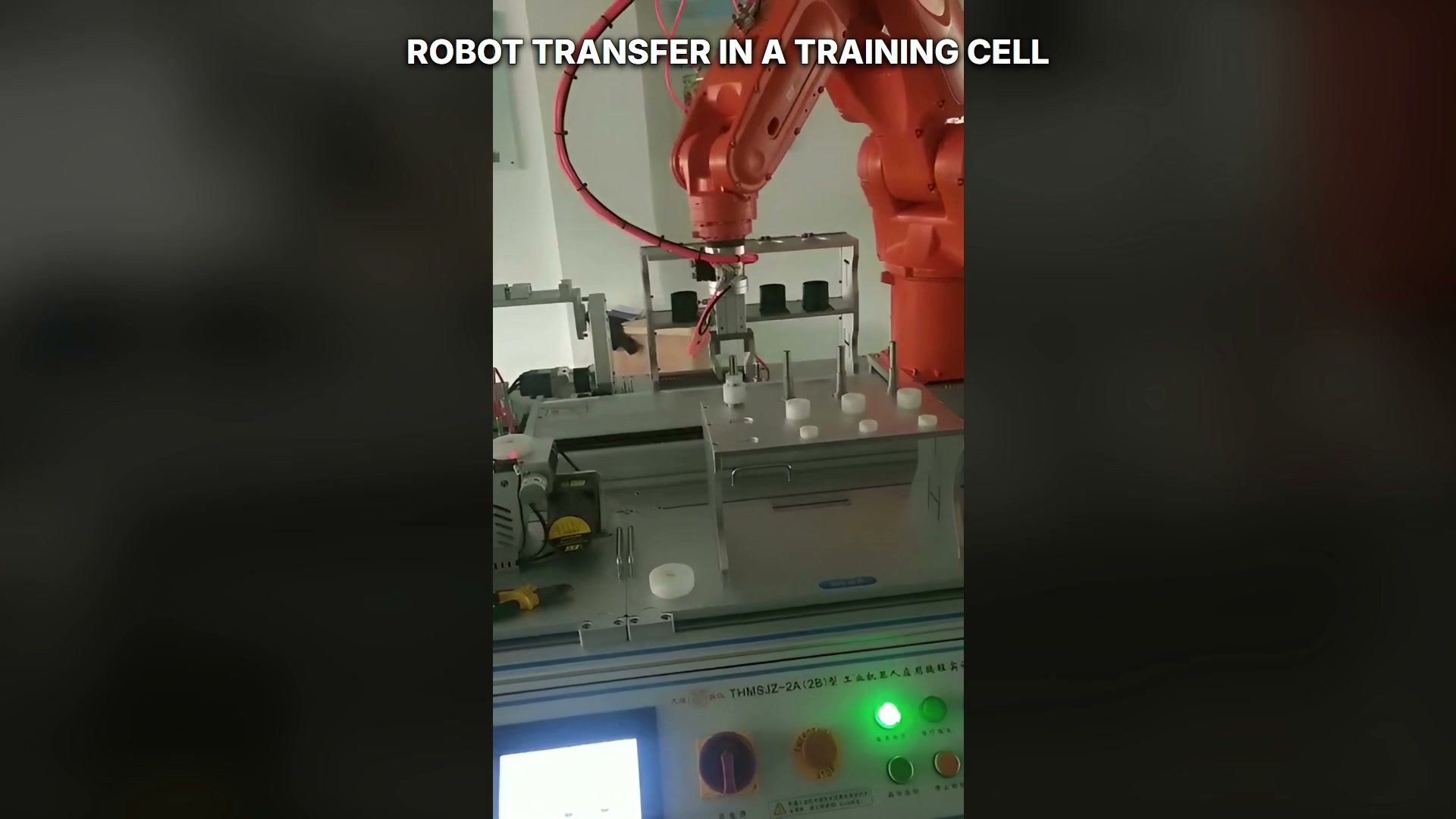
The robot approaches one fixture zone in the multi-station cell.
A buyer should assign ownership to each state. The fixture owns part location and clamp state. The end effector owns grip confirmation. The station controller owns permission to enter and leave. The robot program connects these states, but it should not be asked to compensate for an unstable datum or an ambiguous release signal.
Fix the datum before optimizing motion
Round and cylindrical parts can rotate, sit at different heights or present similar-looking ends. A robust concept therefore starts with the physical datum. Specify which surface controls radial position, which feature controls axial position, and how incorrect seating is detected. If several stations use different datums, document the transformation between them instead of relying on taught points alone.
The same discipline applies to the gripper. Define the permitted contact surfaces, required clearance, acceptable orientation range and the condition that proves a secure hold. General options include jaw-position sensing, pressure or vacuum monitoring, and external presence sensing. Select the sensing architecture from the part geometry, permitted contact surfaces, station interfaces and project risk assessment.
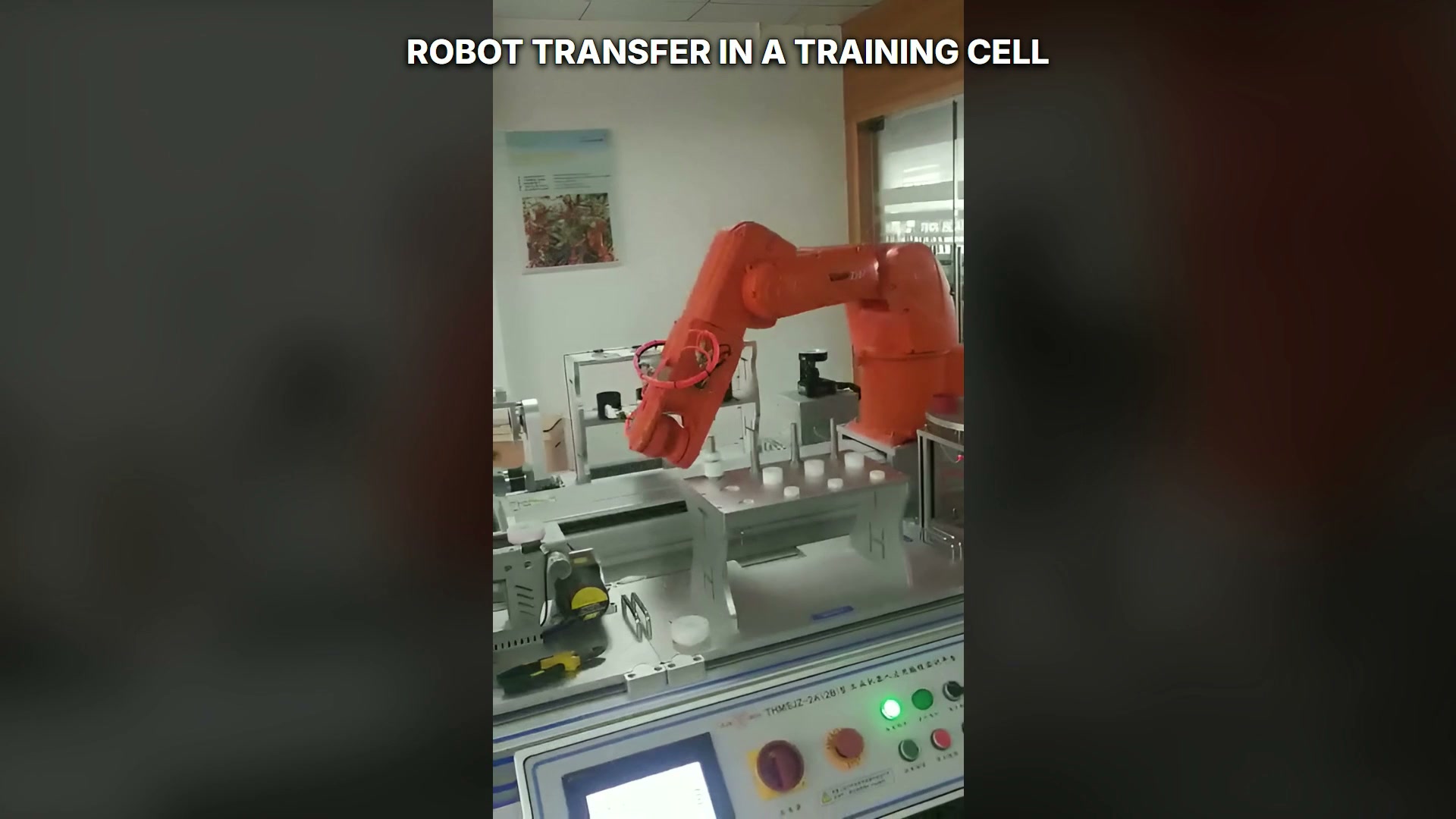
The robot is positioned between adjacent fixtures, where round components and locating hardware are visible.
Build a station permission matrix
A compact cell benefits from a written permission matrix before programming. For each station, list the conditions for robot entry, part pickup, part placement and robot exit. Typical inputs include guard state, clamp state, station-ready status, part-present status and end-effector confirmation.
| แฮนด์ออฟ | Required project inputs | การตรวจสอบการยอมรับ |
|---|---|---|
| Station to gripper | Part datum, release state, entry clearance | Part is retained and fixture release is confirmed |
| Gripper to station | Placement datum, clamp sequence, withdrawal route | Part is seated before the gripper releases |
| Station to station | Allowed orientation, collision envelope, cable route | Robot clears both fixtures through the full path |
| เริ่มใหม่หลังจากหยุด | Known part state, resumable step, safe retreat | Recovery does not duplicate a pick or release |
This matrix turns vague coordination into testable behavior. It also helps controls, tooling and robot teams review the same sequence rather than optimizing separate pieces of the cell.
Treat recovery as part of the transfer cycle
Training cells often demonstrate nominal motion well, but production engineering also needs a recovery plan. The OSHA industrial robot systems chapter provides general risk-assessment context, and EVST’s machine-tending overview shows how part flow and interfaces are reviewed at cell level. Define what happens if the robot stops after gripping but before clearing a fixture, if a station does not confirm receipt, or if an operator removes a part during a controlled intervention.
Use state-based recovery instead of jumping to a program line. The controller should determine where the part is believed to be, whether the gripper is holding it, whether a fixture is open or closed, and which motion is safe from that combination. Manual recovery steps should use the same state definitions as automatic operation.
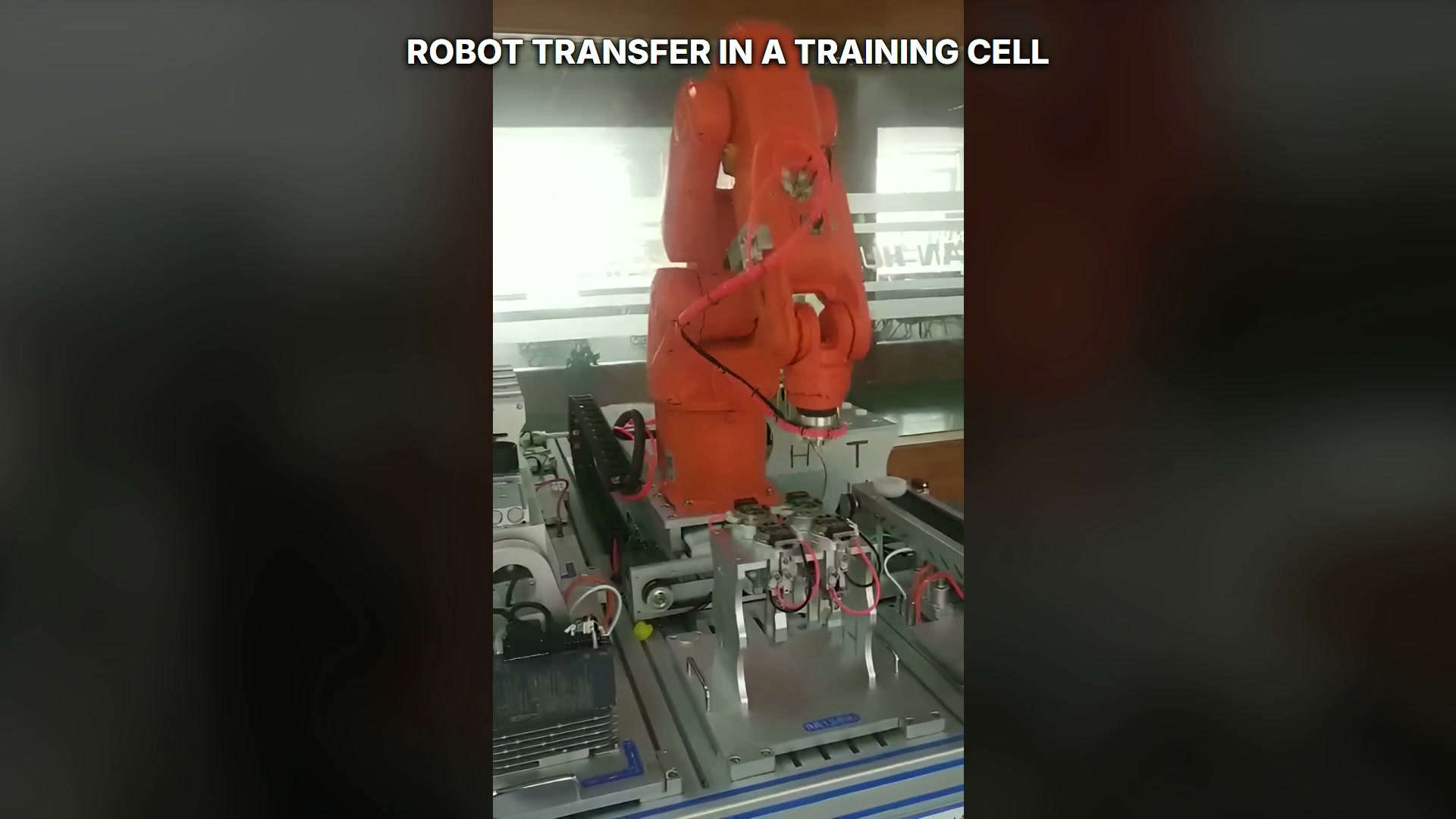
The robot is positioned in the multi-station cell with several fixtures in view.
Measure cycle time at the interfaces
Robot speed is only one part of takt. Measure fixture opening and closing, station processing, signal latency, grip confirmation and waiting between stations. Record these separately during acceptance so that delays can be assigned to the right interface. Measure with the agreed part family, station conditions and recovery rules, then report motion, interface and waiting time separately.
คำถามที่ผู้ซื้อควรหาคำตอบ
ควรให้ข้อมูลอะไรก่อนเป็นอันดับแรก?
Provide part drawings or samples, allowable contact surfaces, station layout, machine or fixture signals, required orientations, changeover range and daily output target.
How should several fixtures share one robot?
Define an explicit permission matrix and priority rule. The robot should enter only when the target fixture is in a known safe state, and every release should be confirmed before withdrawal.
What makes recovery testable?
Create acceptance cases for stops before pickup, after gripping, during transfer and after placement. Each case should define the known state, permitted operator action and safe restart path.
ควรวัดเวลาของรอบการทำงานเมื่อใด?
Measure after part location, gripping, station signals and recovery logic are stable, using the agreed operating conditions and a representative run.
For a project review, send the part drawing, station layout, interface list and daily output target to EVST: https://www.evsint.com/contact/#quote or sales@evsrobot.com.
Case context: a teaching cell demonstrating station-to-station part transfer.