
A useful estimate for a plate with many holes starts with the complete operation list. Count the time spent processing each hole, then add the movements and work needed to finish the plate. A fast-looking spindle movement is a poor basis for a quotation if entry, withdrawal, chip handling or the next setup has disappeared from the calculation.
Give “one finished plate” a clear meaning
First identify what happens at each hole. Drilling a new hole, enlarging an existing one and finishing a hole to a specified condition need different tools and process data. A pattern drawing alone does not identify the operation. Record the starting hole condition and the required finished condition alongside it.
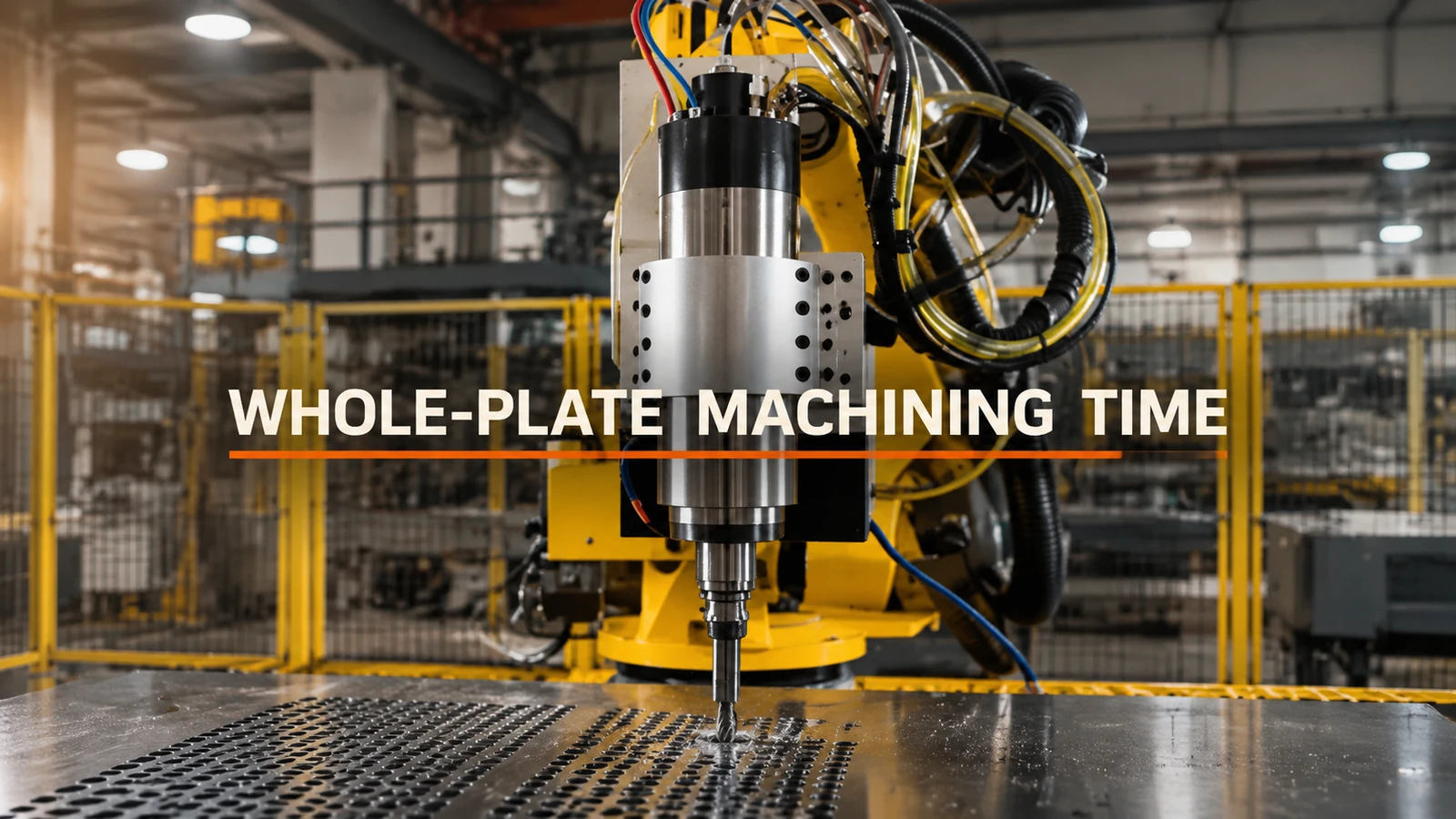
Our example shows a robot-mounted vertical spindle above a plate with closely spaced circular holes. The robot and spindle move relative to the hole region. That arrangement introduces two kinds of work to budget: the operation at a hole and the route that connects it to the next operation.
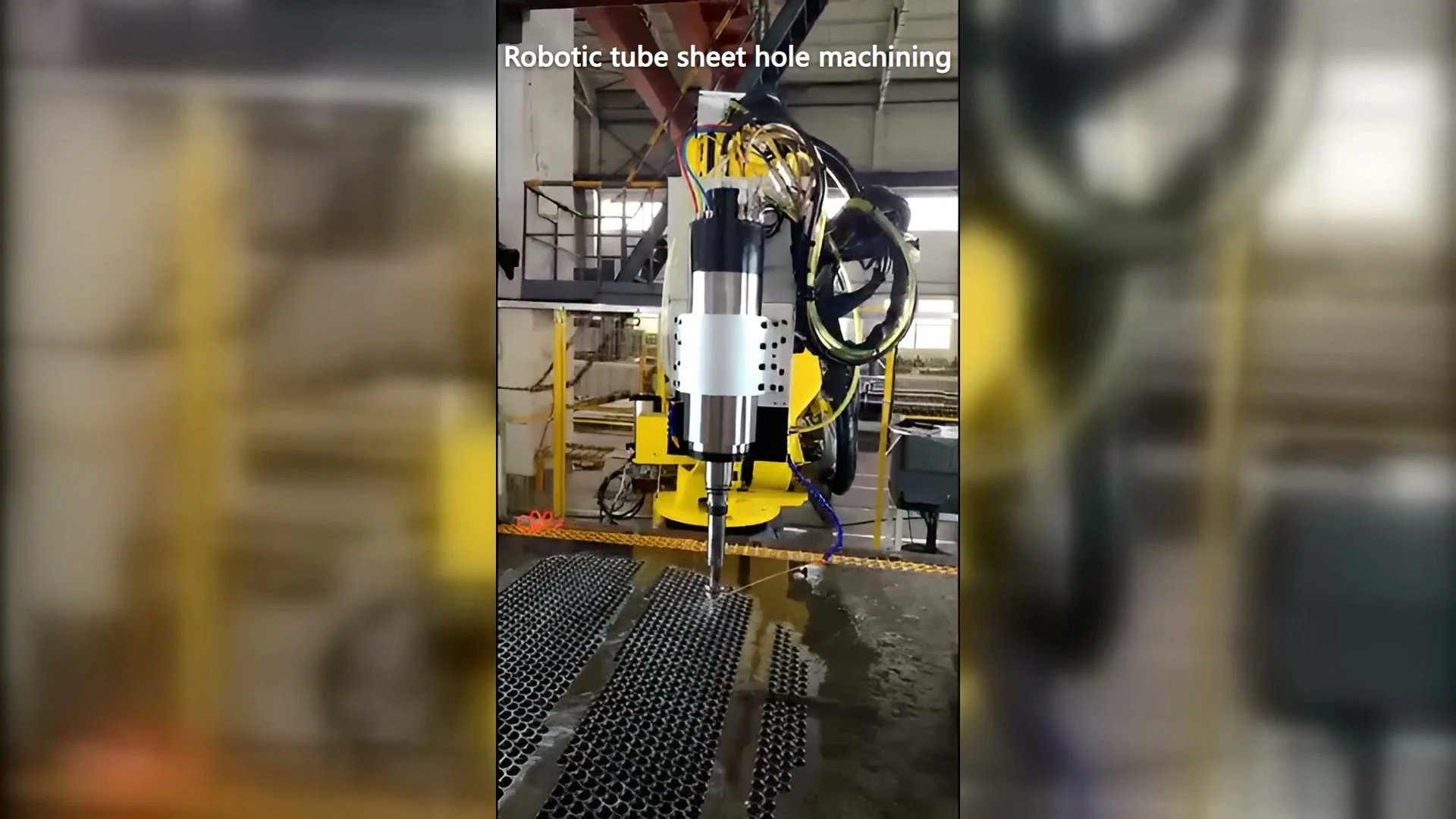
The robot-mounted spindle is positioned above the dense hole region. Video 00:20.
For each hole family, write down its operation, the intended tool, effective processing travel and how completion will be checked. Group only the holes that genuinely share those conditions. A deeper hole or a different finishing operation should not inherit the time measured at a convenient shallow hole.
Use a cutting formula for the cutting interval
For continuous-feed drilling, a basic reference model is:
Cutting time in minutes = drilling depth × number of holes ÷ (spindle revolutions per minute × feed per revolution).
With depth in millimetres and feed in millimetres per revolution, the denominator is a feed rate in millimetres per minute. The formula describes a defined drilling interval. It does not select a safe feed or replace the actual tool maker’s cutting data, and it is not a complete robot cycle.
If the proposed operation retracts for chips, changes feed through the hole or performs another kind of hole finishing, budget that actual sequence. Do not attach a continuous-feed result to a different operation simply because the tools look similar.
| Registro de horário | What the estimate should contain | Onde conseguir? |
|---|---|---|
| Processing at the holes | The applicable operation and its effective travel or measured duration | Validated process data or a representative trial |
| Entrada e saída | Approach, engagement and return to a usable transfer position | The proposed tool and actual part clearance |
| Between-hole work | Transfers, reorientation and any required chip-handling steps | A complete route through the hole pattern |
| Per-part work | Loading, locating, clamping and the agreed inspection | The actual workholding and handling method |
| Per-batch work | Tool preparation, setup changes and first-part checks | The proposed batch and changeover procedure |
Keep setup time visible rather than spreading it across an unspecified production volume. Also mark activities that happen simultaneously: adding both elapsed intervals in full would count the same time twice.
Trial the holes that can change the estimate
Reach is a starting question, not the whole machining test. A spindle-equipped robot can behave differently at different postures. In one published aluminum-drilling study, the researchers measured workspace vibration with the spindle running before selecting the trial position. The useful lesson is the test method, rather than a speed copied from that setup.
For a proposed plate, include the difficult approach, the longest required tool reach and the locations where chips are hardest to manage. Observe the operation under cutting conditions, inspect the resulting holes and record any added retracts or reduced feeds. If those locations need a different sequence, revise the relevant hole family in the ledger instead of hiding the difference in an unexplained allowance.
The estimate becomes reviewable when another engineer can follow one plate through the table and identify which times came from a trial, which came from process data and which still need measuring. That is a stronger purchasing discussion than a single cycle figure without its working conditions.
If you are budgeting a robotic hole-machining cell, share the hole pattern, operation list and a short record of the current sequence with EVST. Those inputs make it possible to discuss the estimate on a complete-part basis.