
A rack with many positions does not by itself tell you how long a lathe-tending cell can run before someone returns. The estimate needs three separate limits: effective raw-to-finished cycles, elapsed time per part, and any task that still requires a person sooner.
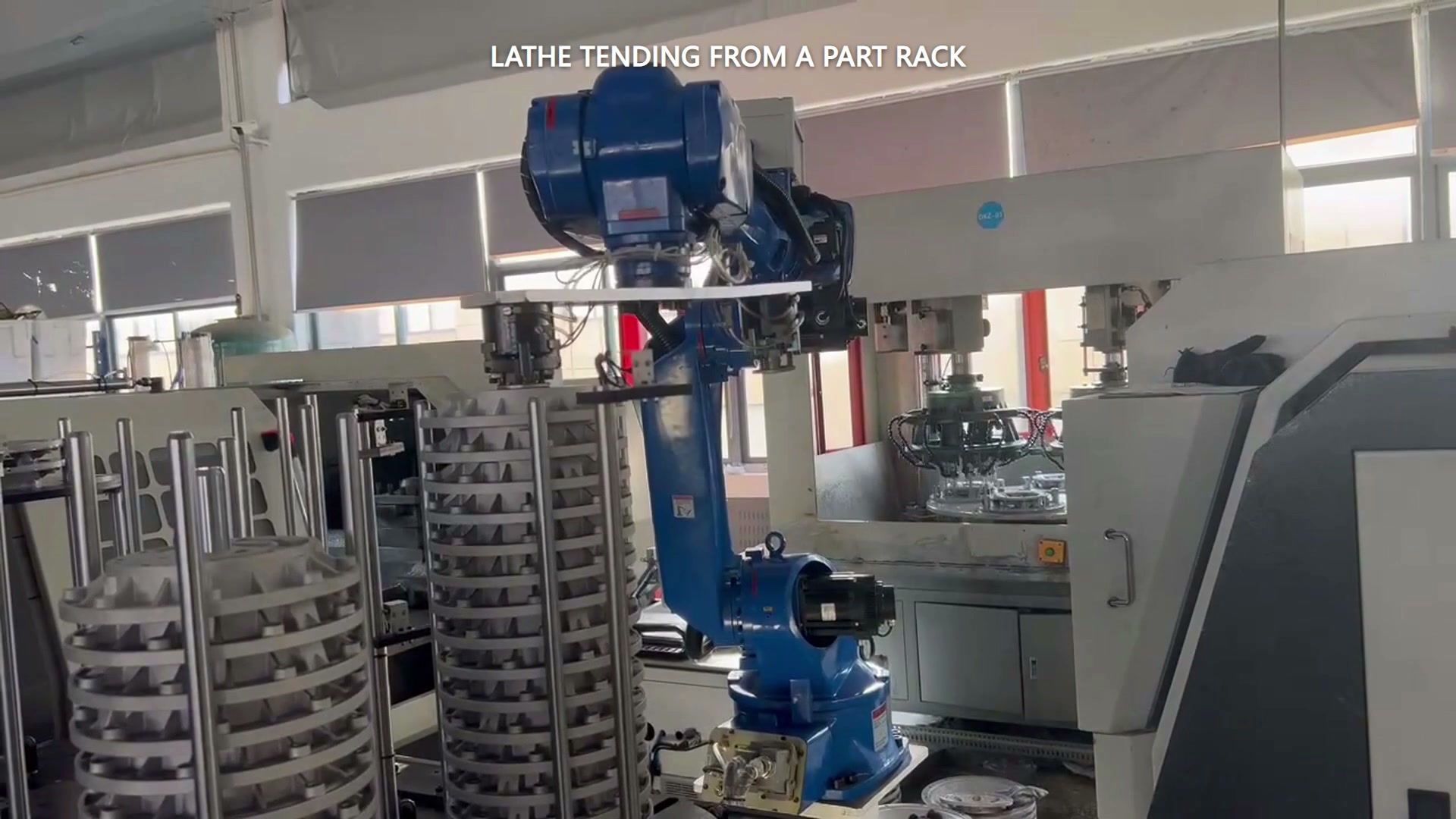
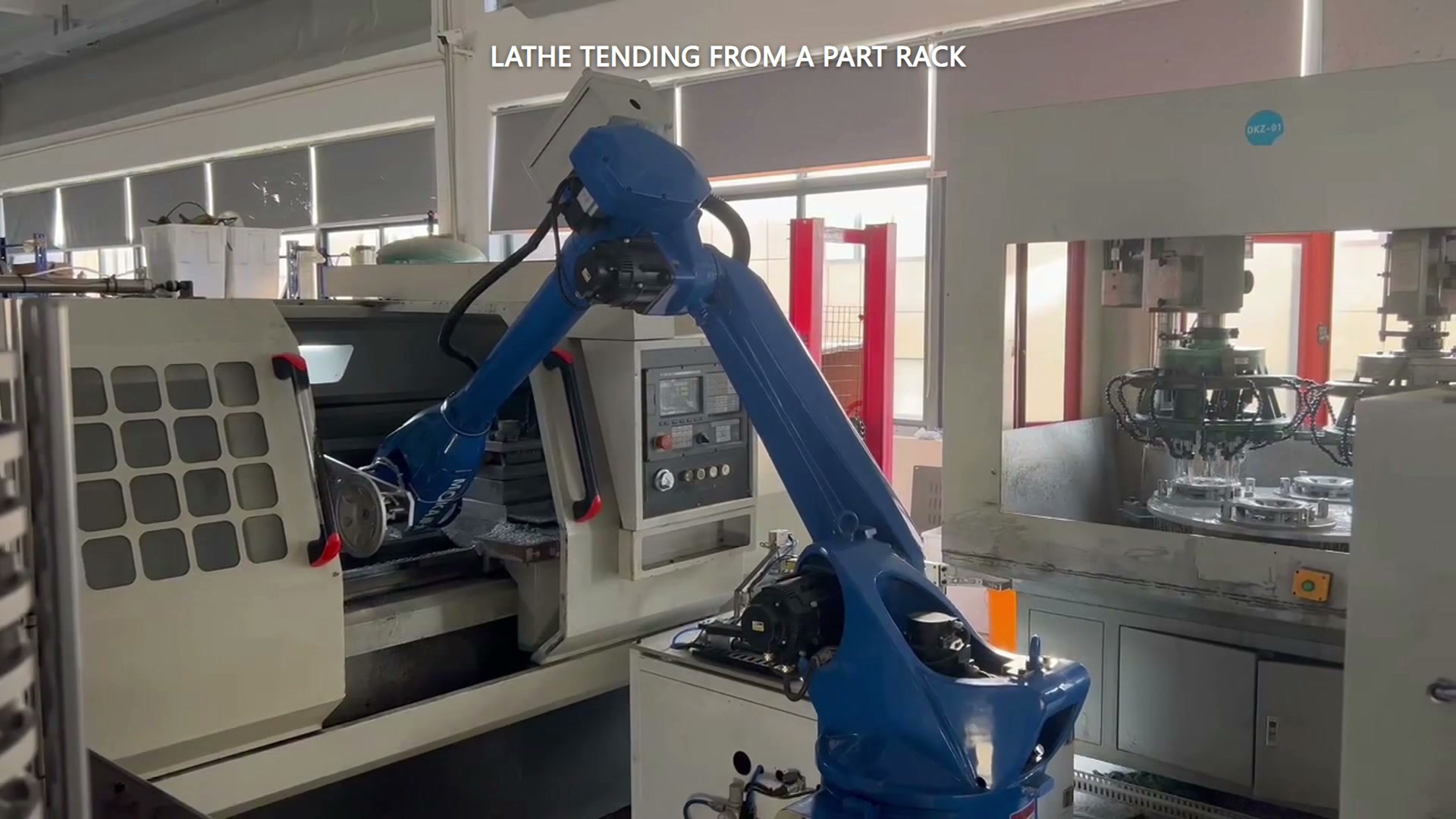
The case video shows a blue robot moving between a multi-level rack of round parts and a lathe opening. The first portion includes rack-side work, machine access, withdrawal and another rack-side operation. Build the estimate with the project’s usable positions, raw/finished assignment and measured times.
Count effective cycles, not visible pockets
Start by drawing the actual storage rule. If every completed cycle consumes one raw part and needs one empty finished-part position, the smaller available quantity controls the buffer:
Effective cycles = the lesser of usable raw-part positions and usable finished-part positions.
Exclude positions reserved for gauge parts, rejected parts, separators, reach restrictions or changeover. If one pocket is reused after a raw part is removed, document that sequence rather than assuming every visible location is independent capacity.
Put overlap on a timeline once
Machine processing and robot service may overlap. Official machine-tending examples describe robots performing other work while a machine processes, but whether that applies—and for how long—must be measured in the proposed cell.
For a simple stable cycle, calculate elapsed time as:
elapsed time per part = machining time + robot service time − verified overlap
The overlap is subtracted once. Do not add the full robot time after already including its overlapping portion, and do not call every robot movement blocking time. Define the boundary consistently, such as “raw part available in its rack position” to “finished part stored and the next machining cycle established.”
A transparent hypothetical example
The following numbers are assumptions for explaining the method, not measurements from the filmed case:
- The rack arrangement supports 12 effective raw-to-finished cycles after both raw and finished storage limits are applied.
- Machining takes 4.0 minutos por parte.
- Robot service takes 1.2 minutos, De los cuales 0.7 minute overlaps machine processing.
- Therefore the non-overlapping robot time is 0.5 minuto, and elapsed time is 4.0 + 1.2 − 0.7 = 4.5 minutes per part.
- Buffer depletion is 12 × 4.5 = 54 minutos, measured from the defined start of the first cycle to completion of the twelfth under these assumptions.
Now add a separate operating requirement: suppose a person must inspect one part after every six completed parts. The attendance-free interval is then capped at 6 × 4.5 = 27 minutos, even though the material buffer would last 54 minutes. Storage duration and permitted unattended duration answer different questions.
Measure interruptions instead of hiding them in an average
The first estimate can use stable-cycle times, but a purchasing decision also needs the events outside that line: door or chuck confirmation delays, part-orientation corrections, gauge checks, chip management, rejected parts and recovery after a stop. Record frequency and recovery time during trials. Do not invent a downtime percentage to make the spreadsheet look complete.
The result should show a range or scenario set when times vary, plus the exact start and end boundary. That lets production staff replace assumptions with observed values without rebuilding the model.
Send EVST the real machining time, pickup and placement times, raw/finished rack arrangement, and mandatory manual checks to discuss the refill window and appropriate automation scope: Contactar con EVST.