
By the EVST Editorial Team · Last updated: June 7, 2026
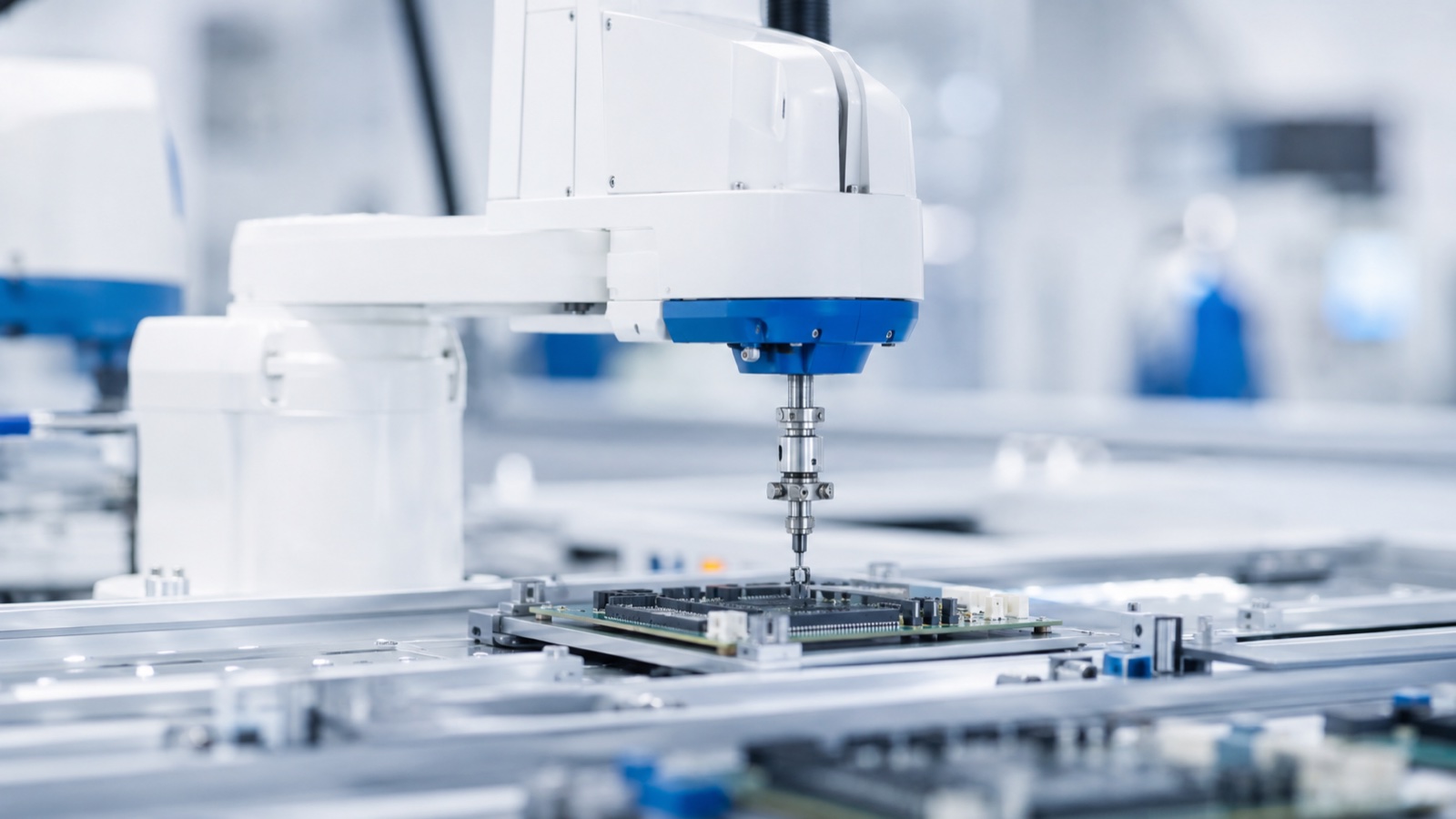
3C electronics manufacturing (computer, communication, and consumer electronics) relies on robots for precision assembly, screwdriving, dispensing, testing, and high-speed handling of small, delicate parts. SCARA robots dominate fast flat assembly, collaborative robots handle flexible and changeover-heavy stations, and delta robots manage high-speed sorting. The drivers are tiny tolerances, short product cycles, and high volumes that manual lines cannot hold consistently.
Why 3C Electronics Needs Robots
Electronic products are small, precise, and built in huge volumes with frequent model changes. Components are placed to fractions of a millimeter, screws are driven to controlled torque, and adhesives are dispensed in exact beads. According to industry observations, manual assembly cannot hold these tolerances at volume, and the short life cycle of electronics products means lines must be reconfigured often, which favors programmable robots over fixed automation.
Which Robots Are Used in 3C
| Task | Robot type | Why |
|---|---|---|
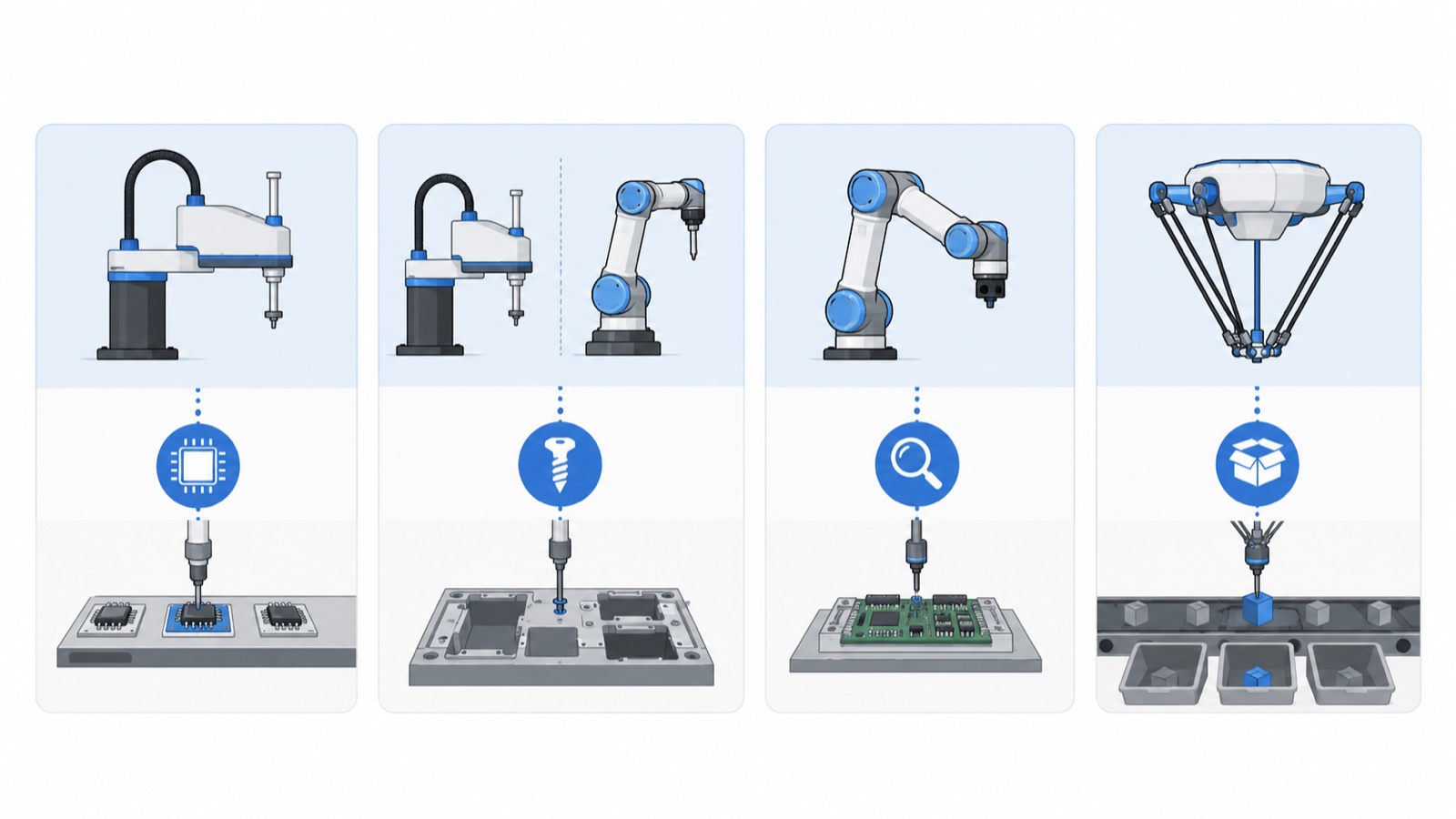
| Component placement, insertion | SCARA | Fast, rigid, accurate in a flat plane |
| Screwdriving, dispensing | SCARA or cobot | Controlled torque and path |
| Flexible assembly, testing | Collaborative robot | Works near people, quick changeover |
| High-speed sorting, packaging | Delta | Top-end pick rate for light parts |
According to industry observations, SCARA robots are the backbone of 3C assembly because their speed and rigidity in a plane match component placement and screwdriving, while cobots are growing for testing and flexible stations that change with each product. EVST builds across these types, the EVS SCARA series (3 to 20 kg), XR collaborative robots, and EVSD delta robots, so a 3C line can be equipped from one supplier.
The Precision and Cleanliness Demands
3C work pushes two requirements harder than most industries: accuracy and cleanliness. Repeatability in the ±0.02 mm range is common for SCARA and cobot models used in placement, because components leave little margin. Many processes also run in cleanrooms or controlled environments, so robots must not shed particles. According to industry observations, specifying repeatability and environment correctly is where 3C robot selection most often succeeds or fails, because a robot that is fast but not precise enough scraps expensive parts.
Handling Short Product Cycles
Electronics models change every few months, so a 3C line is reprogrammed and re-tooled far more often than, say, an automotive line. This favors robots that are quick to reprogram and re-deploy. In practice, after equipping many electronics cells, the lines that age well are those built on flexible, easily reprogrammed robots and modular tooling, rather than fixed hard automation that is obsolete when the product changes. For choosing between robot types, see our SCARA vs delta vs 6-axis comparison, and for payload selection, the cobot payload guide.
Frequently Asked Questions
What robots are used in 3C electronics manufacturing?
SCARA robots dominate fast flat assembly such as component placement and screwdriving; collaborative robots handle flexible, changeover-heavy stations like testing; and delta robots manage high-speed sorting and packaging of light parts. The choice follows the task: speed and rigidity in a plane for SCARA, flexibility for cobots, top-end pick rate for delta.
Why is SCARA the main robot for electronics assembly?
A SCARA is fast, rigid, and accurate in a flat plane with short vertical motion, which matches component placement, insertion, and screwdriving in electronics. Its cycle times for these moves are among the fastest of any robot type, and repeatability in the ±0.02 mm range suits the tight tolerances of 3C parts.
What precision do 3C electronics robots need?
Repeatability in the ±0.02 mm range is common for placement and screwdriving, because components leave little margin and errors scrap expensive parts. Many 3C processes also run in cleanrooms, so robots must not shed particles. Specifying both repeatability and the environment correctly is central to 3C robot selection.
How do robots handle short electronics product cycles?
Electronics models change every few months, so lines are reprogrammed and re-tooled often. Programmable robots with modular tooling adapt to new products far better than fixed hard automation, which becomes obsolete when the product changes. Lines built on flexible, easily reprogrammed robots age well in 3C.
Can collaborative robots be used in electronics manufacturing?
Yes. Cobots suit flexible assembly, testing, and inspection stations where they work alongside operators and change with each product, at safety-rated speed. They complement SCARA robots, which handle the fastest, highest-volume placement and screwdriving, and delta robots, which handle high-speed sorting.
About the author: This guide was prepared by the EVST Editorial Team. EVST (EVS TECH CO., LTD) is a Chengdu-based robotics manufacturer founded in 2018, building SCARA, collaborative, and delta robots for electronics manufacturing, exported to more than 100 countries with CE, SGS, and TUV third-party certification.
Last updated: June 7, 2026. This is a general industry overview; confirm repeatability, payload, and environment against the application before specifying.