Intelligent Programming-Free Spray Painting Robot (Remote Teaching System)
An intelligent programming-free spray painting robot system combines a remote teaching handle and teaching box: an operator demonstrates the spray path once, and the system records that motion for 1:1 robot replay within the stated teaching accuracy, without code editing.
It can automatically generate program code from the demonstrated path, reducing on-site programming and debugging work for suitable applications.
This is control-layer replacement, not a bolt-on teaching accessory
The system replaces the conventional programming pendant and robot controller, then connects directly to the servo drives inside the robot cabinet. The teaching handle and teaching box work together to record the demonstrated path.
 Industrial computer
 Teaching handle
 Teaching box
 IO modules
Demonstration becomes robot motion
Three ways to create a robot spray path
The practical difference is what the operator must move, how the path is described, and whether code editing is part of the task.
| Comparison | Teaching pendant programming | Drag teaching | Programming-free remote teaching |
|---|---|---|---|
| Path input | Point-by-point code editing | Manually move the robot end | Demonstrate with the remote handle |
| Operator interaction | Programming knowledge is required | Operator physically guides the robot | Operator and robot remain physically separated during teaching |
| Operator handling load | Path creation happens in the pendant | Robot inertia and resistance remain present during the demonstration | The handle does not add robot-arm inertia or resistance |
| High-mix / complex shapes | Longer path-development work | Complex manual guidance still carries the robot's inertia and resistance | A natural spray pass can be captured without code editing |
| Boundary | All methods still require application engineering, robot safeguarding and process validation. | ||
Robot arm reach is not the same as effective spraying range
A 30°, 45° or 90° spray-angle requirement produces a different set of effective points. Increasing suitable degrees of freedom can expand that usable region.
Teaching and communication parameters
These values describe the remote teaching system. They are not robot repeatability, coating thickness or finished-part quality specifications.
| Parameter | Approved value | Interpretation |
|---|---|---|
| Teaching displacement accuracy | About 2–5 mm in the core area; about 10 mm near the edge | The core and edge figures must be read together. |
| Posture | Accuracy within 1°; range ±60° | Describes measured teaching-handle posture. |
| Servo communication | EtherCAT; RJ45 | Direct communication with EtherCAT servo drives. |
| PLC communication | TCP/IP; RJ45 | For communication with a PLC or host system. |
| Teaching range | For an inverted installation, the theoretical range is half a spherical space | The usable range is slightly smaller in real applications. |
| Installation orientation | e.g., inverted or horizontal | Final position depends on the robot, operator and workcell. |
Selection note: dynamic behavior, robot kinematics, process settings and workcell constraints require project-specific validation.
Coordinate robot motion with a changing production line
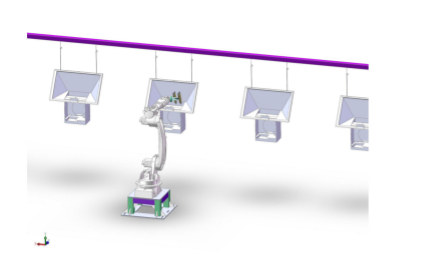
In the line-tracking version, the system follows changes in hanging-line, ground-line or other line speed. If the line stops because its speed falls to zero, the robot pauses with it and turns off the sprayer; when movement resumes, the spray task continues. The documented stop/resume sequence is designed so there is no spraying joint mark.
Track speed
Robot motion follows the active line.
Pause and close
At zero line speed, pause and turn off the sprayer.
Resume
Continue when the line returns to motion.
Separate J4/J5 signals coordinate air, coating and electrostatics
Independent control lets the process sequence air and coating instead of switching everything at once. A typical sequence opens air before coating, then closes coating before air to help avoid splashing and dripping.
What the system does—and what it does not replace
Clear boundaries make retrofit and integration decisions more reliable.
Programming, not vision
The system records and replays demonstrated paths. It does not identify changing workpieces by itself.
Mixed lines need vision
Mixed-model production requires a separate vision-recognition system to send the workpiece result through TCP/IP.
EtherCAT servo only
The robot servo architecture must use EtherCAT. Pulse-type and other bus types are not currently supported.
Scope-of-supply boundary: The remote teaching system does not include the robot body or spray gun. Compatibility, robot safeguarding, coating equipment, hazardous-area requirements and process validation remain part of the complete cell review.
See a spray painting robot replay a manually taught path
Both demonstrations are from the EVST YouTube channel.
New Feature! Spray Painting Robot with Remote Control Teaching System
Remote-handle teaching demonstration.
How Spray Painting Robots Learn from Manual Teaching
Manual path capture and robot replay.
Built for changing parts and complex spray paths
Programming-free teaching is most relevant where operators already understand the spray process but conventional path creation slows changeover.
Programming-free spray painting robot questions
What does “programming-free” mean?
The operator demonstrates the spray path with a remote handle, and the system records motion for robot replay without editing robot code. Application setup and engineering validation are still required.
Can the system retrofit an existing spray painting robot?
A retrofit may be possible only when the robot uses a compatible EtherCAT servo architecture. The robot cabinet, servo drives, safety system and cell interfaces must be reviewed before selection.
How is remote teaching different from drag teaching?
Drag teaching requires the operator to physically move the robot end. Remote teaching uses a separate handle, so the demonstration is not affected by robot-arm inertia or resistance and the operator remains physically separated from the robot.
Does programming-free mean no operator training?
No. It removes code editing from path teaching, but operators still need brief system training and must understand the spray process, workpiece and robot operating boundaries.
Can it be used for powder coating?
The teaching system creates robot motion; it does not by itself define the coating process. Powder applicators, electrostatics, booth conditions and hazardous-area requirements must be reviewed as a complete system.
Can it support mixed-model production?
Yes, with an important boundary: a separate vision-recognition system is required to identify the workpiece and communicate the result through TCP/IP so the corresponding stored path can be called.
Is teaching accuracy the same as robot repeatability?
No. The stated 2–5 mm core-area and about 10 mm edge values describe teaching displacement measurement. Robot repeatability and coating results are separate specifications.
What is the difference between an end-of-arm extension and a robot track?
An end-of-arm rotary extension adds orientation freedom at the robot end. A robot track, often called a ground 7th axis, moves the whole robot along a rail. They solve different reach and orientation constraints.
Define the robot, process and workcell before selection
Send the robot model and servo architecture, workpiece geometry, spray gun and coating process, required path, production-line behavior, available teaching area and cell layout. EVST can review whether programming-free remote teaching fits the application.