
By the EVST Editorial Team · Last updated: July 24, 2026
SCARA robot applications cluster around four process types: screw driving and fastening, small-parts pick-and-place and transfer, dispensing, and test or machine load-unload. SCARA wins these jobs when the motion is largely planar, the part is light, and cycle time matters more than reach, which is also exactly where it loses ground to a 6-axis arm or a Delta robot.
If you need the core definition first, our SCARA robot guide covers the RRP joint structure and working principle. If you already know you want a SCARA and need to size one, our sizing guide walks through payload, reach, and cycle time step by step. This article sits between the two: it breaks SCARA use down by process type rather than by industry vertical.
How SCARA’s Geometry Determines Where It Fits
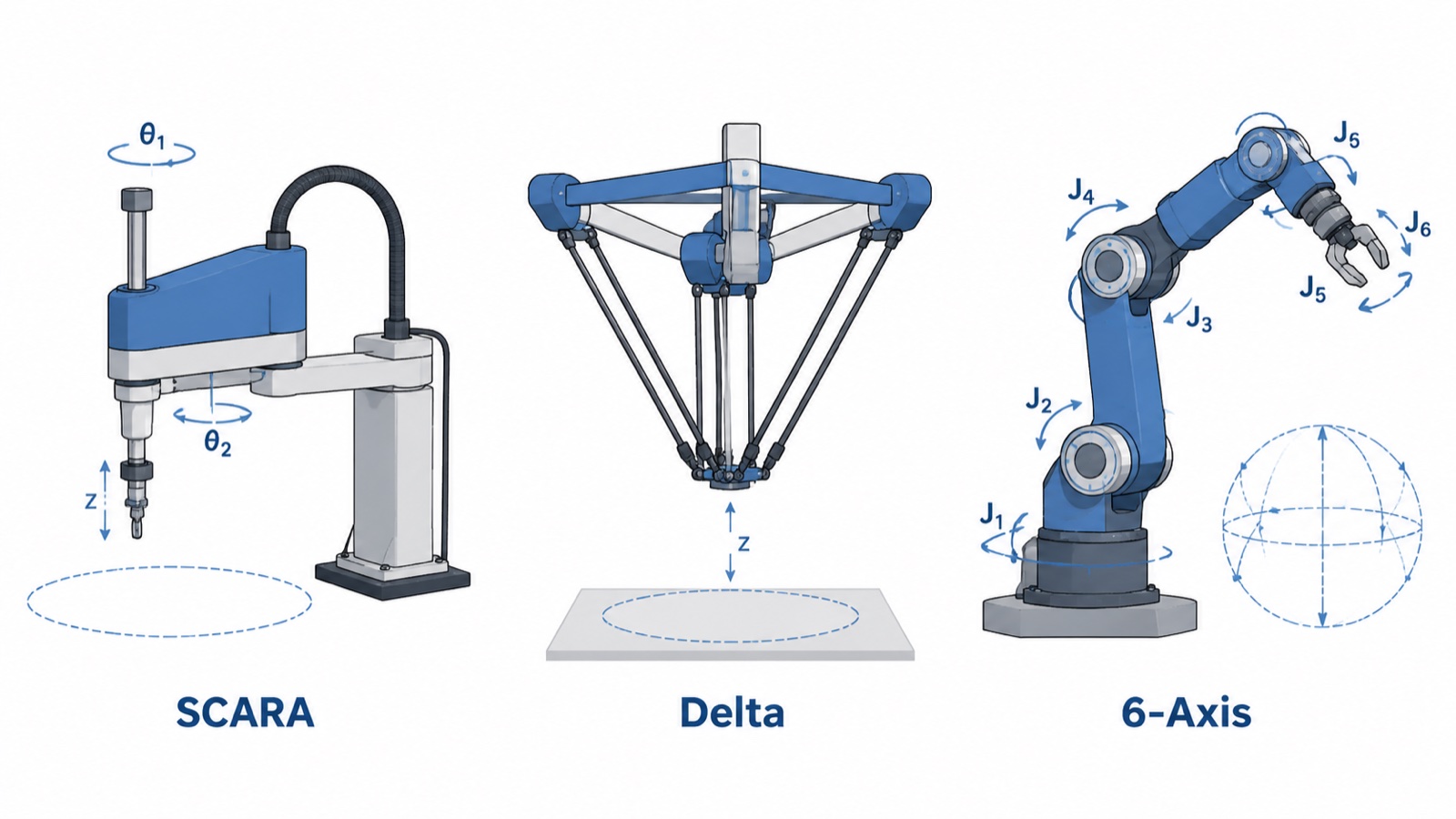
A SCARA has three revolute joints in a horizontal plane plus one vertical stroke at the wrist, which is why it moves fast in X-Y and comparatively little in Z. That geometry is stiff against side loads and soft against a need to reach around, above, or underneath a fixture. Every process type below inherits that same trade-off.
The practical filter is simple before any spec sheet gets involved: if the part enters and leaves a station from roughly the same horizontal plane, with a short vertical dip to engage or release it, a SCARA is a candidate. If the tool has to tilt, rotate around more than one axis, or reach into a shielded or angled cavity, the process usually belongs to a 6-axis arm instead.
Screw Driving and Fastening
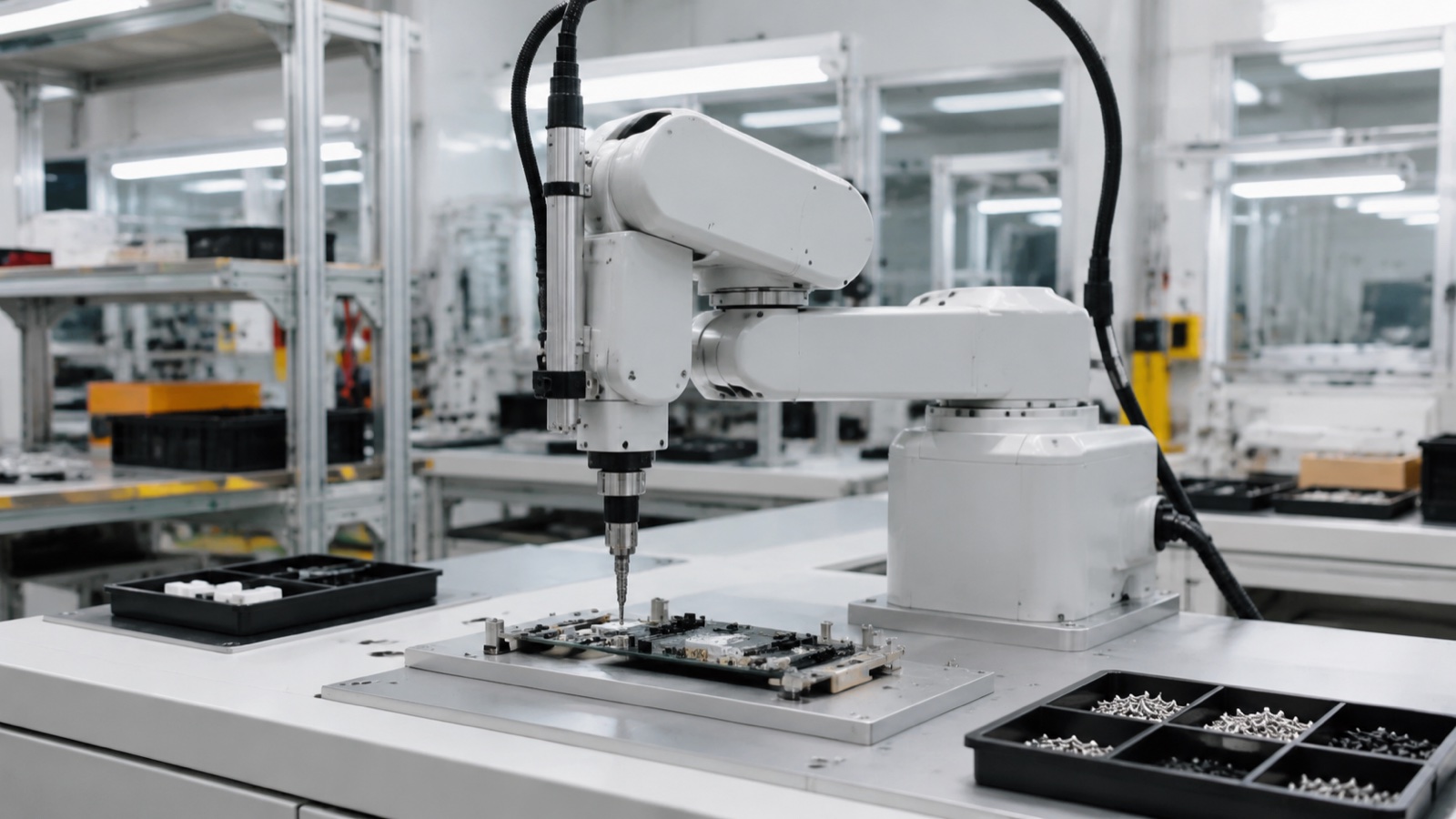
Screw driving is the process type SCARA robots were arguably built for. Vertical insertion with a straight-down bit, repeated at a fixed pattern of hole locations, is close to the ideal motion for a four-axis arm: fast planar moves between holes, a short Z-plunge for engagement, and a return stroke. According to industry data, well-tuned SCARA screw-driving cells commonly reach cycle times in the 0.8-1.5 second range per fastener for standard M2-M4 electronics screws, including bit pickup, seating, and torque verification.
The integration work sits in the tooling, not the arm. A screwdriving end-effector needs torque and depth feedback wired into the controller so a stripped thread or a missed pickup stops the cycle rather than passing a bad part downstream, and most cells carry a small bit-changer magazine so one arm can service two or three fastener sizes without a manual tool swap.
When it is not the right process for SCARA: angled fasteners, fasteners on more than one face of the part, or blind screws that need the driver tilted to clear an obstruction all push the job toward a 6-axis arm, because a SCARA’s wrist rotation cannot compensate for anything but a straight vertical approach.
Small-Parts Pick-and-Place and Transfer
Moving a light part from a tray, conveyor, or feeder bowl to a fixture or carrier is the highest-volume SCARA application by unit count, and it is also the process type most often contested by Delta robots. Both excel at short, light, repetitive moves; the difference is layout and part variety.
A SCARA transfer cell typically handles parts in the 0.1-5 kg range with cycle times commonly quoted in the 0.5-1.2 second range for a standard pick-move-place sequence over a 200-400 mm travel, once vision confirmation and gripper actuation are included rather than robot motion alone. Vacuum end-of-arm tooling dominates for flat or curved-surface parts; two-finger grippers take over once the part needs a positive mechanical grip to survive a subsequent press or clamp step.
When Delta wins instead: if the part is under roughly 0.5 kg, the travel distance is short and constant, and throughput above one part per second matters more than flexibility, a Delta’s parallel-arm geometry usually beats a SCARA on raw cycle time. SCARA regains the advantage once the pick pattern varies station to station or the travel distance grows past what a Delta’s smaller work envelope comfortably covers.
Dispensing and Adhesive or Sealant Application
Dispensing a bead of adhesive, solder paste, or sealant along a defined path asks for smooth, continuous planar motion at a controlled speed, which plays to a SCARA’s strength in X-Y interpolation. Straight lines, simple arcs, and rectangular perimeter beads on a flat or near-flat surface are routine SCARA work; complex 3D paths around a contoured housing are not.
Path speed, not point-to-point cycle time, is the number that matters for this process type, since the arm is drawing a continuous bead rather than jumping between fixed points. A dispensing valve typically runs at a constant travel speed set by bead width and material viscosity, commonly in the 50-150 mm per second range for standard sealants and adhesives, and the robot’s job is to hold that speed steady through corners without the bead thinning or pooling.
In practice, dispensing cells pair the SCARA with a vision system that locates the actual part edge before the bead starts, because incoming part tolerance stacks up faster on a dispensing path than on a simple pick-and-place move, and an offset bead is a defect that is easy to miss visually but expensive once it reaches the next station. Needle height control and pressure-time-distance calibration on the dispense valve matter as much as the robot’s path accuracy here.
When it is not the right process for SCARA: dispensing on a part with compound curvature, or a bead path that needs the nozzle held at a changing angle to the surface, requires the wrist orientation control that only a 6-axis arm provides.
Test, Inspection, and Machine Load-Unload
Loading a part into a test fixture, a CNC chuck, or an optical inspection station and unloading it afterward is a lower-speed, higher-precision cousin of pick-and-place. The value here is repeatability and clean handoff, not raw cycle time, because the station’s own dwell time (test cycle, machining time, image capture) usually dominates the total station cycle regardless of how fast the robot moves.
Because the test or machining step sets the pace, buyers sometimes oversize the robot on the assumption that a faster arm will speed up the whole station, which rarely holds. The more useful design target is minimizing handoff time and eliminating misloads, since a single misload that trips a fault and stops the test station for a manual reset costs more than a slightly slower but more consistent transfer motion ever would.
According to the International Federation of Robotics, industrial robot deployments in electronics and precision manufacturing continue to lean on repeatable, planar-motion arms for exactly this kind of tend-and-transfer work, where the robot’s job is to be consistent rather than fast. SCARA repeatability in the 0.1-5 kg payload class is commonly specified in the ±0.01-0.03 mm range under ISO 9283 test conditions, which is tight enough for most electronics test handling and light-machining load-unload work.
When it is not the right process for SCARA: if the fixture or chuck sits at an angle, or the part must be flipped or reoriented between load and unload, a 6-axis arm’s extra wrist axes handle that reorientation in one motion instead of requiring a secondary flip station.
Process-Level Decision Matrix: SCARA vs 6-Axis vs Delta
The table below organizes the decision by process type rather than by robot family, which is the more useful order for a buyer who already knows what the station needs to do and is trying to decide which arm should do it.
| Process type | Suited for | Typical cycle time* | Robot to consider instead |
|---|---|---|---|
| Screw driving / fastening | Straight vertical approach, fixed hole pattern | 0.8-1.5 s per fastener | 6-axis if fasteners are angled or on multiple faces |
| Small-parts pick-and-place | Part 0.1-5 kg, moderate travel, layout varies by station | 0.5-1.2 s per cycle | Delta if part is under ~0.5 kg and travel is short and constant |
| Dispensing / sealant application | Flat or near-flat bead path | Path-speed dependent, not fixed | 6-axis if the surface has compound curvature |
| Test / inspection load-unload | Repeatable planar handoff, station dwell dominates cycle | Set by station dwell, not robot | 6-axis if the fixture is angled or the part must be flipped |
*Typical values drawn from industry practice for arms in the 3-20 kg payload class, offered as planning ranges rather than a specific product’s guaranteed performance; confirm against a datasheet and, where cycle time is contractual, an acceptance test.
Integration Checklist for Each Process
The robot is rarely the variable that determines whether a SCARA cell hits its target cycle time. These five items are, and they apply across all four process types above, whether the station is driving screws, transferring parts, dispensing a bead, or loading a test fixture. Skipping any one of them tends to show up first as an intermittent fault rather than a clean failure, which makes the root cause harder to trace once the cell is already running production.
- End-of-arm tooling matched to the part: vacuum cups sized to surface area and porosity, gripper jaw geometry matched to the part’s grip features, or a bit-changer magazine sized to the fastener mix.
- Vision guidance where incoming part position is not fixture-certain, since a SCARA’s speed advantage disappears if the arm has to search for the part on every cycle.
- Fixturing with a repeatable datum, because a SCARA inherits whatever positional uncertainty the fixture hands it, regardless of the arm’s own repeatability spec.
- Safety guarding sized to the actual cell footprint and access points, documented against the applicable ISO 10218-1 industrial robot safety requirements before the cell runs production.
- Controller I/O for torque, force, or vision confirmation feedback, so a bad cycle stops the line instead of passing a defect downstream.
Cycle Time and Precision Benchmarks Across These Applications
It helps to separate what the robot contributes from what the station contributes, because buyers routinely confuse the two when comparing a SCARA quote against a 6-axis or Delta alternative. Robot motion time is only one term in the total station cycle; part presentation, tool actuation, and any vision or measurement dwell are the others, and they do not shrink just because the robot is fast.
According to industry data, a compact SCARA in the 3-20 kg payload class typically completes a 300 mm point-to-point move in roughly 0.3-0.5 seconds of pure robot motion, which is why screw driving, transfer, and load-unload cycle times above tend to run higher than that figure once tooling and part presentation are added. Repeatability, tested per ISO 9283, is the more decision-relevant number for test and inspection work; a ±0.01-0.03 mm class SCARA holds tolerance stack-up tight enough for most electronics test fixtures and light-machining chucks without needing the absolute accuracy of a calibrated 6-axis arm.
Common Mistakes When Matching SCARA to a Process
Three mistakes account for most of the SCARA cells that underperform their quote. The first is sizing the arm to the part’s weight alone and forgetting the tooling weight, which quietly eats into the usable payload margin and can push a marginal cycle time out of spec. The second is assuming vision guidance is optional because the first few sample parts arrived in a fixed orientation; production parts rarely stay that consistent once a supplier or batch changes.
The third, and the one buyers catch latest, is treating the four process types above as interchangeable because they all look like “SCARA applications” on a brochure. A cell built for screw driving with a torque-feedback driver does not automatically dispense adhesive well, and a transfer cell tuned for speed is not automatically precise enough for test load-unload. Specifying the process type, not just “SCARA,” before ordering avoids a rework cycle after the first production run.
Where This Leaves an Integrator
Choosing SCARA for a given station is a process-type decision, not an industry decision. The same electronics line can run SCARA for screw driving and transfer, a Delta for a lighter, higher-speed pick step upstream, and a 6-axis arm for a load-unload station that needs to reach into an angled test fixture, and none of that mix is a compromise; it is matching each station’s geometry demand to the arm built for it.
EVST (EVS TECH CO., LTD), a Chengdu-based robotics manufacturer and integrator founded in late 2018, delivers automation projects across 100+ countries, with turnkey integration support from a global field-engineer network and IATF16949 automotive-grade certified production lines behind its SCARA lineup. Teams scoping a specific process type and wanting a second opinion on tooling or cycle time assumptions can reach our team through evsrobot.com.
Frequently Asked Questions
What are the most common SCARA robot applications?
Screw driving and fastening, small-parts pick-and-place and transfer, dispensing or sealant application, and test/inspection machine load-unload account for most SCARA deployments. All four share a largely planar motion pattern, which is the geometry a SCARA is built to move through quickly.
When should I choose a 6-axis robot instead of a SCARA for an application?
Choose 6-axis when the process needs the tool reoriented, such as angled fasteners, dispensing on a curved surface, reaching into a tilted fixture, or flipping a part between load and unload. A SCARA’s wrist has only one rotational axis and cannot substitute for a true multi-axis reach.
Is a SCARA or a Delta robot better for pick-and-place?
Delta robots generally win for very light parts (under roughly 0.5 kg) moved over a short, constant travel distance at very high speed. SCARA robots hold the advantage once the part is heavier, the travel distance is longer, or the pick pattern varies from station to station rather than repeating identically.
What cycle time should I expect from a SCARA screw-driving cell?
Industry-typical ranges run 0.8-1.5 seconds per fastener for standard electronics screws once bit pickup, seating, and torque verification are included, though the number is heavily tooling-dependent. Treat any vendor’s cycle time claim as a datasheet figure until it is confirmed against your actual fastener, torque spec, and part tolerance in an acceptance test.
How precise is a SCARA robot compared to a 6-axis arm?
Repeatability for SCARA arms in the 0.1-5 kg class is commonly specified in the ±0.01-0.03 mm range under ISO 9283 test conditions, which is comparable to or tighter than many 6-axis arms in the same payload class for repeated-point work. Where 6-axis arms tend to pull ahead is absolute accuracy across a large, irregular work envelope, not point-to-point repeatability in a fixed cell.
Key Takeaways
- SCARA applications cluster into four process types: screw driving, small-parts pick-and-place, dispensing, and test/inspection load-unload, all sharing a largely planar motion pattern.
- SCARA loses to 6-axis whenever the tool needs reorientation: angled fasteners, curved dispensing surfaces, tilted fixtures, or part flipping.
- SCARA loses to Delta on the lightest, fastest, most repetitive pick-and-place work, and regains the advantage once parts get heavier or pick patterns vary.
- Tooling, vision guidance, fixturing, and safety guarding determine real cycle time far more than the robot’s own spec sheet.
- Specify the process type, not just “SCARA,” before ordering: a screw-driving cell and a dispensing cell need different tooling even on the same arm.
About the author: The EVST Editorial Team writes about industrial automation for engineering teams selecting the right robot type for a specific process. EVST is a robotics manufacturer and integrator headquartered in Chengdu, delivering automation projects across 100+ countries, with IATF16949 automotive-grade certification and CE / SGS / TUV third-party certification across its product lines.
Author: EVST Editorial Team
Reviewed by: EVST Editorial Team
Last updated:
Method: EVST Process-Type Fit Screen — a buyer-side planning aid for matching a process to a robot type before ordering, not a substitute for a supplier’s application-specific test run.
Editorial policy · Corrections policy · Terms of use