
By the EVST Editorial Team · Last updated: June 4, 2026
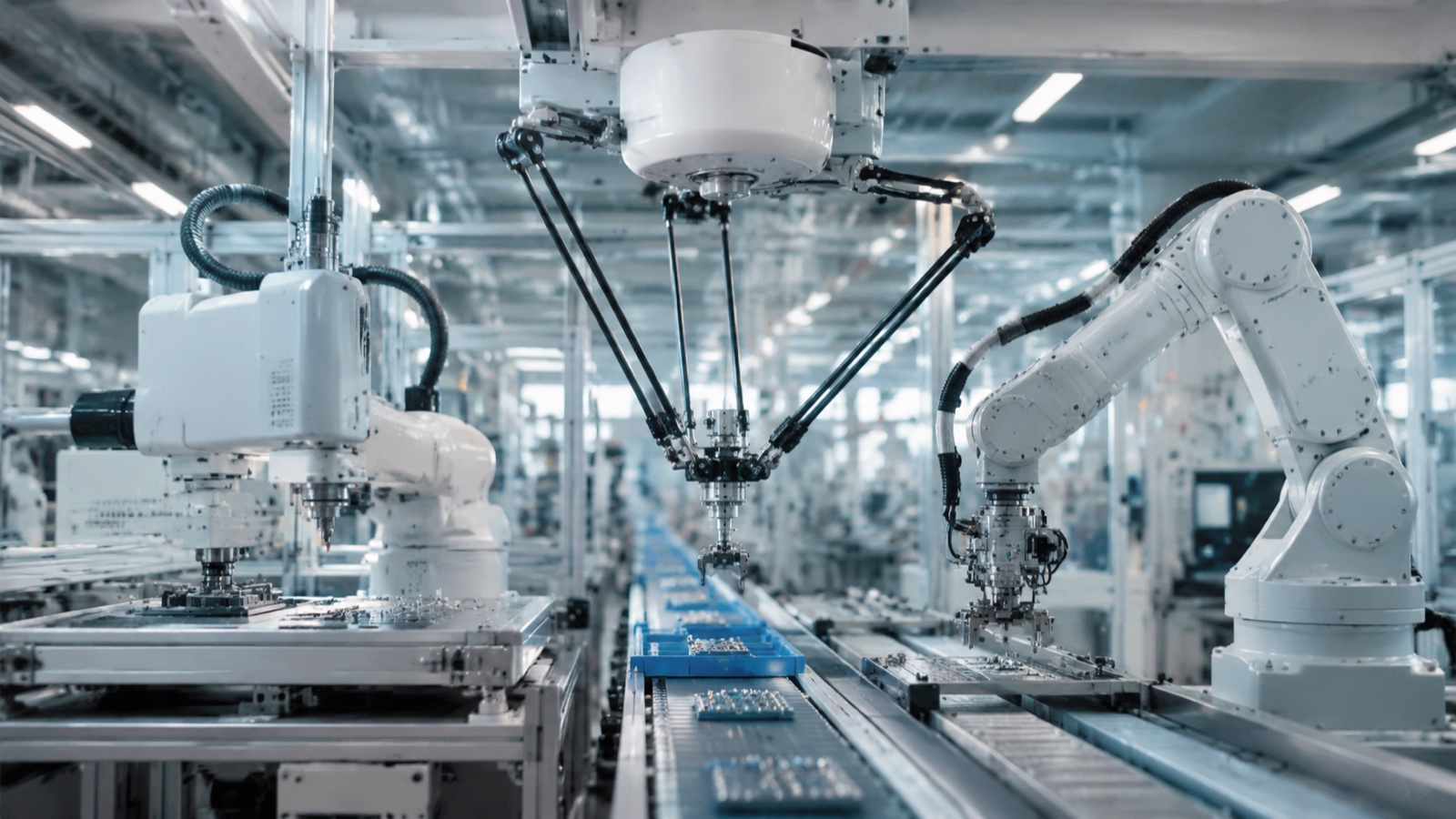
SCARA, delta, and 6-axis robots solve different problems: SCARA is fastest for flat, high-precision assembly and pick-and-place with short vertical motion; delta is fastest for very light, high-speed sorting and packaging; and 6-axis is the general-purpose type for complex paths, orientation, and heavier work. The right choice follows the part’s weight, the motion the task needs, and the cycle time, not a single ranking.
The Three Types at a Glance
| Type | Axes | Strength | Typical payload | Common use |
|---|---|---|---|---|
| SCARA | 4 | Fast, rigid, accurate in a plane | 3-20 kg | 3C assembly, screwdriving, pick-and-place |
| Delta | 3-4 | Very high speed, light parts | 1-15 kg | High-speed sorting, packaging |
| 6-axis | 6 | Full orientation, complex paths | 3-800 kg | Welding, handling, machine tending |
According to the International Federation of Robotics, 6-axis articulated robots remain the largest installed type, while SCARA and delta hold strong shares in electronics and packaging respectively. Each exists because it is the most efficient geometry for a class of motion, so matching geometry to task is what drives cost and throughput.
SCARA: Speed in a Flat Plane
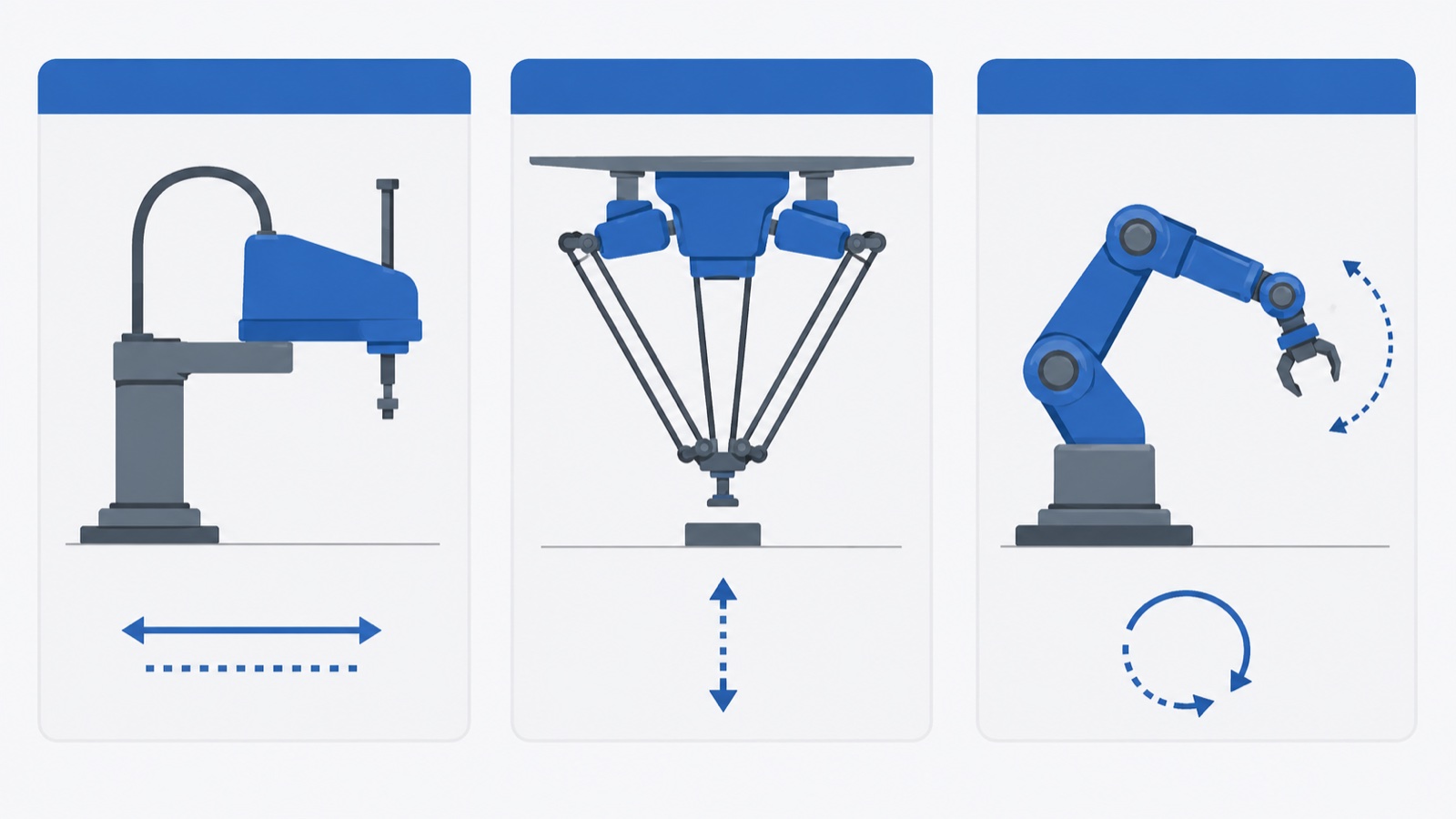
A SCARA robot has two parallel rotary joints for fast horizontal motion plus a vertical and rotational axis at the wrist. This makes it rigid and quick for tasks that live in a plane: inserting components, driving screws, and moving small parts between fixtures. According to industry observations, SCARA cycle times for short pick-and-place moves are among the fastest of any robot type, which is why electronics assembly leans on them. The limit is flexibility: a SCARA cannot tilt a part or reach around an obstacle.
Delta: Speed for Light, High-Volume Picking
A delta robot uses three arms driven from overhead to move a light end-effector at very high speed, often well over 100 picks per minute. It excels at sorting and packaging small, light items from a moving belt. The trade-off is payload and reach: deltas handle low weights in a limited dome-shaped envelope, so they suit high-volume picking rather than heavy or complex work.
6-Axis: Flexibility and Reach
A 6-axis articulated robot can reach any position and orientation within its envelope, which is why it dominates welding, machine tending, and general handling. It spans the widest payload range, from a few kilograms to several hundred. In practice, after specifying many cells, the 6-axis is the default when a task needs to tilt the part, follow a contour, or change between jobs. It is usually not the fastest for a simple flat pick, where a SCARA or delta wins on cycle time.
How to Choose Between Them
- Flat assembly, short Z-motion, high precision: SCARA.
- Very light parts, very high pick rate, from a belt: delta.
- Complex orientation, contoured paths, heavier parts, frequent changeover: 6-axis.
- Mixed line: combine types, for example delta picking feeding a 6-axis packing station.
According to industry observations, the most common over-specification is using a 6-axis robot for a task a SCARA or delta would do faster and cheaper, simply because the 6-axis is familiar. Run the decision from the motion the task actually needs. A full-range supplier such as EVST builds SCARA, delta, and 6-axis platforms, so the same vendor can recommend the right geometry rather than fitting every job to one type. For the wider selection logic, see our industrial robot selection guide. For SCARA fundamentals see the SCARA robot guide, and to shortlist specific models compare the Top 10 SCARA robot manufacturers.
Frequently Asked Questions
What is the main difference between SCARA and 6-axis robots?
A SCARA is a 4-axis robot built for fast, rigid, accurate motion in a flat plane with short vertical travel, ideal for assembly and pick-and-place. A 6-axis robot can reach any orientation and follow complex paths, making it the choice for welding, tilting, and contoured work, but it is usually slower than a SCARA for simple flat picks.
When should I use a delta robot instead of a SCARA?
Use a delta when parts are very light and the priority is extremely high pick rate from a moving belt, as in sorting and packaging. A SCARA is better when the task needs higher payload, more rigidity for assembly forces, or precise insertion. Deltas trade payload and reach for top-end speed.
Which robot type is fastest?
For very light, high-volume picking, a delta is typically fastest, often exceeding 100 picks per minute. For short flat pick-and-place and assembly, a SCARA is among the fastest. A 6-axis robot is the most flexible but usually not the fastest for simple repetitive picks, so speed depends on the task, not the type alone.
Can one production line use more than one robot type?
Yes, and many do. A common pattern is a delta robot performing high-speed picking from a belt while a 6-axis robot handles packing or palletizing downstream, and a SCARA does precise assembly upstream. Matching each station to the right geometry maximizes throughput across the line.
What payload do these robot types cover?
SCARA robots typically cover 3 to 20 kg, delta robots roughly 1 to 15 kg, and 6-axis robots span the widest range from a few kilograms to several hundred. EVST builds across all three types, so payload and reach can be matched to the task within one product line.
About the author: This guide was prepared by the EVST Editorial Team. EVST (EVS TECH CO., LTD) is a Chengdu-based robotics manufacturer founded in 2018, producing SCARA, delta, 6-axis industrial, and collaborative robots exported to more than 100 countries, with CE, SGS, and TUV third-party certification.
Last updated: June 4, 2026. Comparison is general; confirm payload, reach, and cycle against current product data before specifying.