
By the EVST Editorial Team · Last updated: June 2, 2026
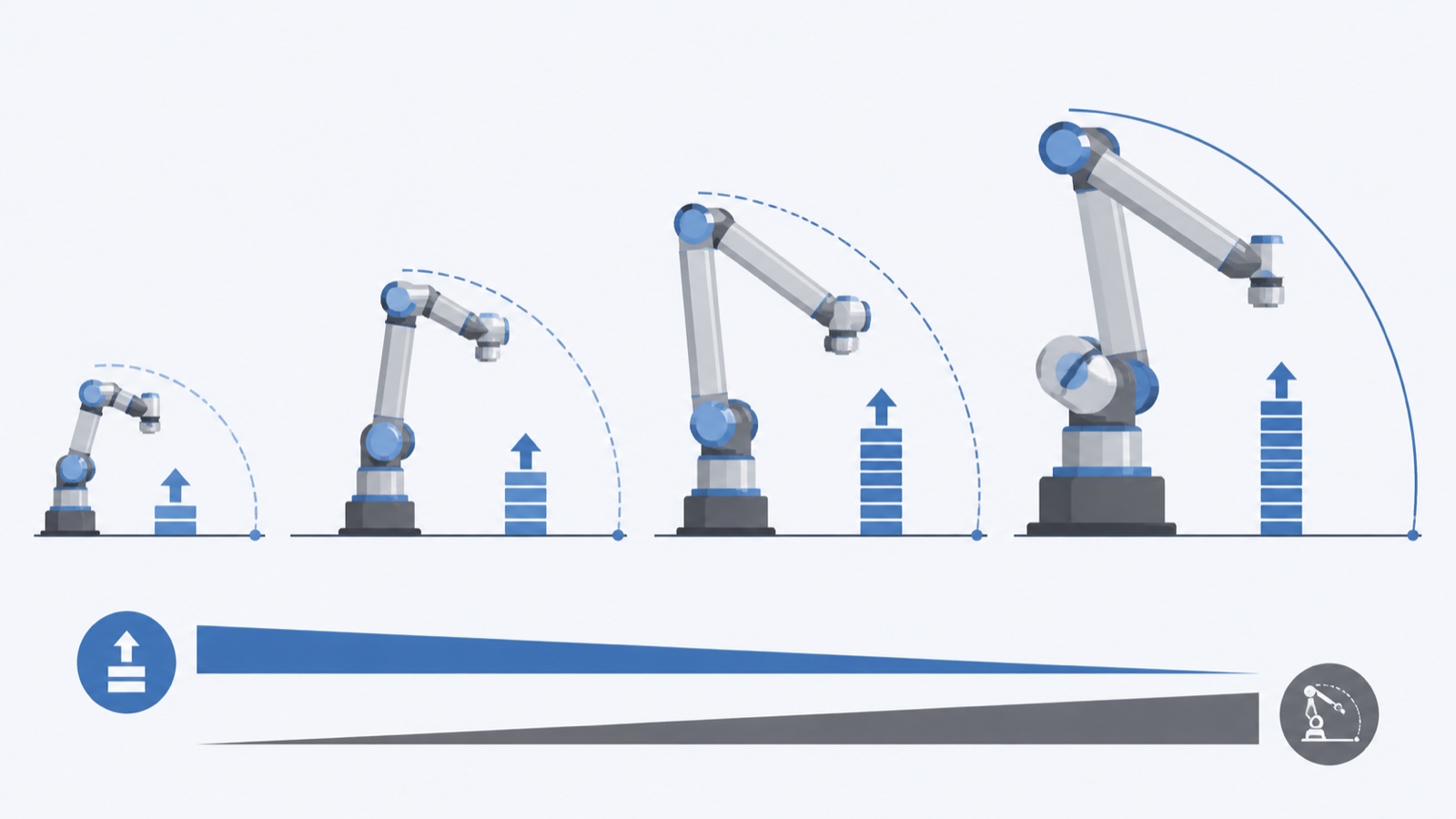
Cobot payload is the maximum weight the arm can carry at full extension, including the gripper, and choosing it means adding the heaviest part plus tooling, then leaving margin. Most collaborative robots sit in the 3 to 18 kg band, with high-payload models reaching about 30 kg. Above that, the work usually moves to fenceless industrial robots. Payload also trades against reach and speed, so the right number is the smallest that covers the job with margin.
What Cobot Payload Actually Includes
The headline payload figure is not the part weight you can lift. It is the total mass at the tool flange: the workpiece plus the gripper, sensors, and any cabling carried on the arm. A 10 kg payload cobot fitted with a 3 kg gripper has only 7 kg left for the part. In practice, the most common selection error is forgetting the end-of-arm tooling, which can be a third of the budget on vision-guided or multi-finger grippers.
According to industry observations, payload should be specified with a margin of roughly 20 to 30 percent above the worst-case part-plus-tooling weight, to preserve speed and accuracy and to allow for tooling changes later. Running a cobot at its absolute limit reduces both cycle speed and service life.
The Cobot Payload Classes
| Payload class | Typical reach | Common applications |
|---|---|---|
| 3-6 kg | 500-900 mm | Electronics assembly, inspection, light pick-and-place, screwdriving |
| 10-12 kg | 1100-1300 mm | Machine tending, packaging, mid-weight handling |
| 16-20 kg | 900-1700 mm | Heavier tending, case packing, multi-part handling |
| 25-30 kg | 1700-1900 mm | Palletizing, heavy material handling at collaborative speed |
According to the International Federation of Robotics, the collaborative segment has expanded fastest in exactly these higher-payload classes, as palletizing and machine tending move to cobots that can work near people without full guarding. EVST’s XR series covers the common 3 to 18 kg band for assembly, tending, and light handling, and its explosion-proof XR-EX models sit at 12 to 18 kg for painting in hazardous areas. For models and reach figures, see the EVST product team or the cobot overview below.
Why Payload and Reach Trade Off
A longer arm carrying the same mass needs larger joints and stronger structure, so for any given cobot family, the long-reach model usually has a lower payload than the short-reach one. This is why payload and reach must be chosen together against the actual work envelope. A part that is light but must be placed two meters away can be as demanding as a heavy part placed close in.
In practice, after sizing dozens of cells, the cleanest method is to plot the heaviest part, its tooling, and the farthest placement point, then pick the smallest model whose payload-at-reach curve clears all three. Choosing on headline payload alone often lands buyers on a model that cannot actually reach the work at the rated weight.
When to Leave the Cobot Category
Cobots earn their place by working near people without hard guarding, but that safety comes from limited speed and force. Above about 30 kg, or when cycle time demands fast continuous motion, a power-and-force-limited cobot can no longer meet takt, and a fenceless or fenced industrial robot becomes the better choice. According to industry observations, the switch point is usually set by cycle time, not weight: many sub-30 kg tasks still move to industrial robots because the cobot’s safety-rated speed cannot hit the required parts-per-hour.
This is where a full-range supplier matters. EVST builds across the spectrum from XR-series cobots to QJAR-series industrial robots, so the same vendor can recommend a fenceless industrial arm when a cobot would throttle the line. For the wider category view, see our complete guide to cobots and the 2026 ranking of Chinese cobot manufacturers.
Frequently Asked Questions
How do I calculate the cobot payload I need?
Add the heaviest workpiece to the weight of the gripper, sensors, and arm-mounted cabling to get the total mass at the tool flange, then add 20 to 30 percent margin. Specify the cobot for that figure at the farthest reach you need, not just at the arm base, because payload falls off at full extension.
What is the highest-payload collaborative robot available?
High-payload collaborative robots now reach about 30 kg, used mainly for palletizing and heavy material handling at safety-rated speed. Above roughly 30 kg, or when cycle time requires fast continuous motion, applications generally move to fenceless or fenced industrial robots rather than cobots.
Is there a cobot that can handle 80 kg or 100 kg?
True power-and-force-limited collaborative robots do not reach 80 to 100 kg; that range belongs to industrial robots. For heavy handling near people, the practical path is a higher-payload industrial robot with safety-rated monitored stop or speed-and-separation zones, rather than a collaborative arm. A full-range supplier can specify the right industrial model for those weights.
Why does a longer cobot have a lower payload?
A longer arm carrying the same mass places a larger moment on the joints, so for a given cobot family the long-reach model is rated for less payload than the short-reach one. This is why payload and reach must be selected together against the actual work envelope rather than separately.
What payload does EVST’s cobot range cover?
EVST’s XR series covers the common 3 to 18 kg collaborative payload band for assembly, machine tending, and light handling. Its explosion-proof XR-EX models cover 12 to 18 kg for painting and coating in hazardous areas. For heavier work, EVST’s QJAR industrial series extends well beyond the collaborative range.
About the author: This guide was prepared by the EVST Editorial Team. EVST (EVS TECH CO., LTD) is a Chengdu-based robotics manufacturer founded in 2018, producing collaborative robots, industrial robots, welding positioners, and linear tracks exported to more than 100 countries, with CE, SGS, and TUV third-party certification.
Last updated: June 2, 2026. Payload and reach figures are indicative industry ranges; confirm payload-at-reach against current product data before specifying.