
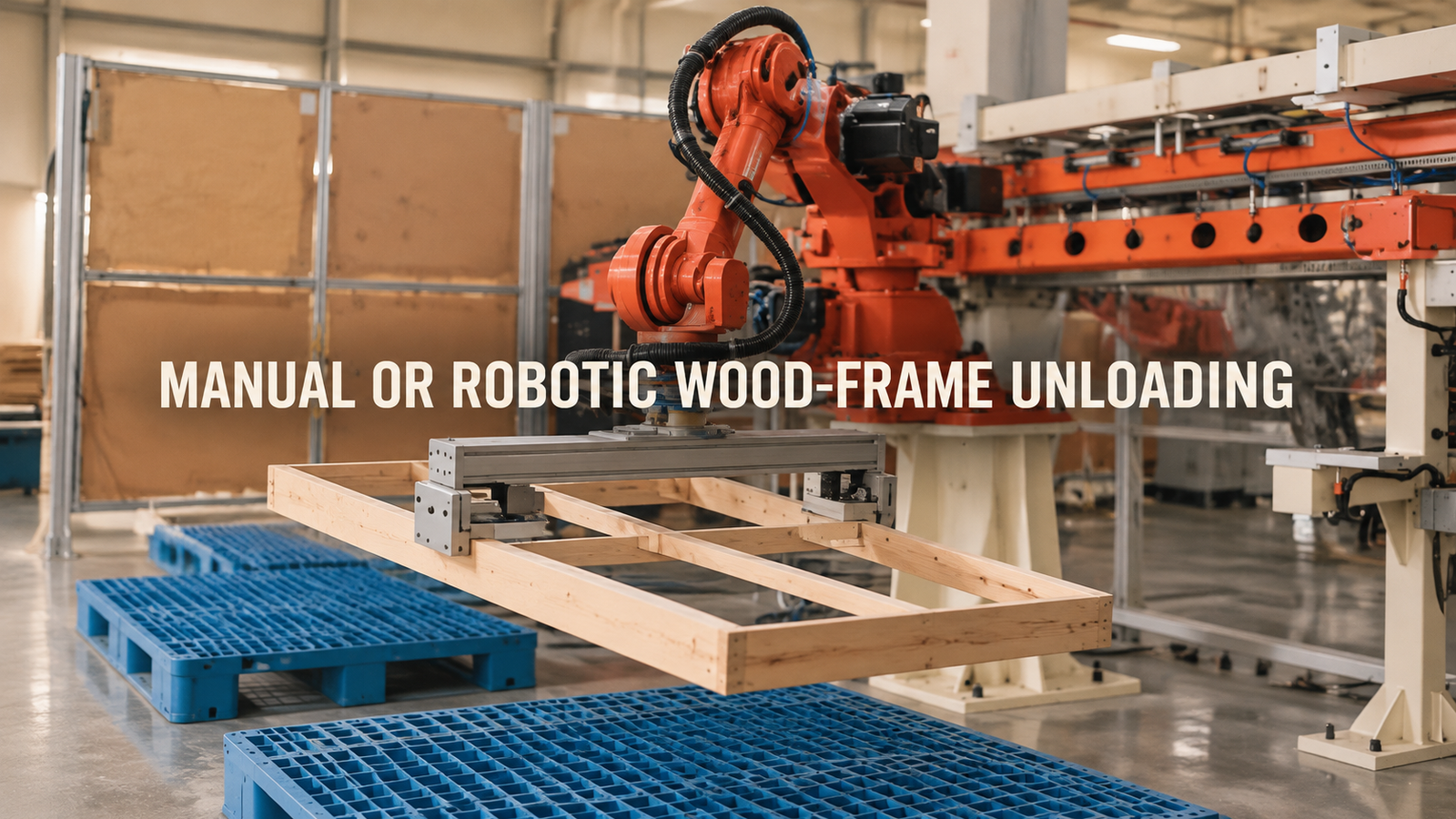
Robotic wood-frame unloading is a candidate when the frame arrives in a usable pose, the tooling can handle its permitted variation and the receiving position can continue accepting it. If people still need to straighten, separate or continually redirect the frames, compare the work needed to stabilize those handoffs with an operator-assisted handling arrangement. Reducing lifting effort and making unloading autonomous are different objectives.
Begin with the production mix
A recurring frame family with a consistent discharge position presents a different project from frequent small orders with changing dimensions. List the variants actually made together and the adjustments needed between them: support spacing, gripping contact, pickup pose and the receiving arrangement.
The handling example shows a robot lifting a wooden frame with a beam-shaped end tool, turning towards a blue receiving table and lowering the frame onto it. The visible transfer is a useful starting point for dividing the larger unloading job into tasks.
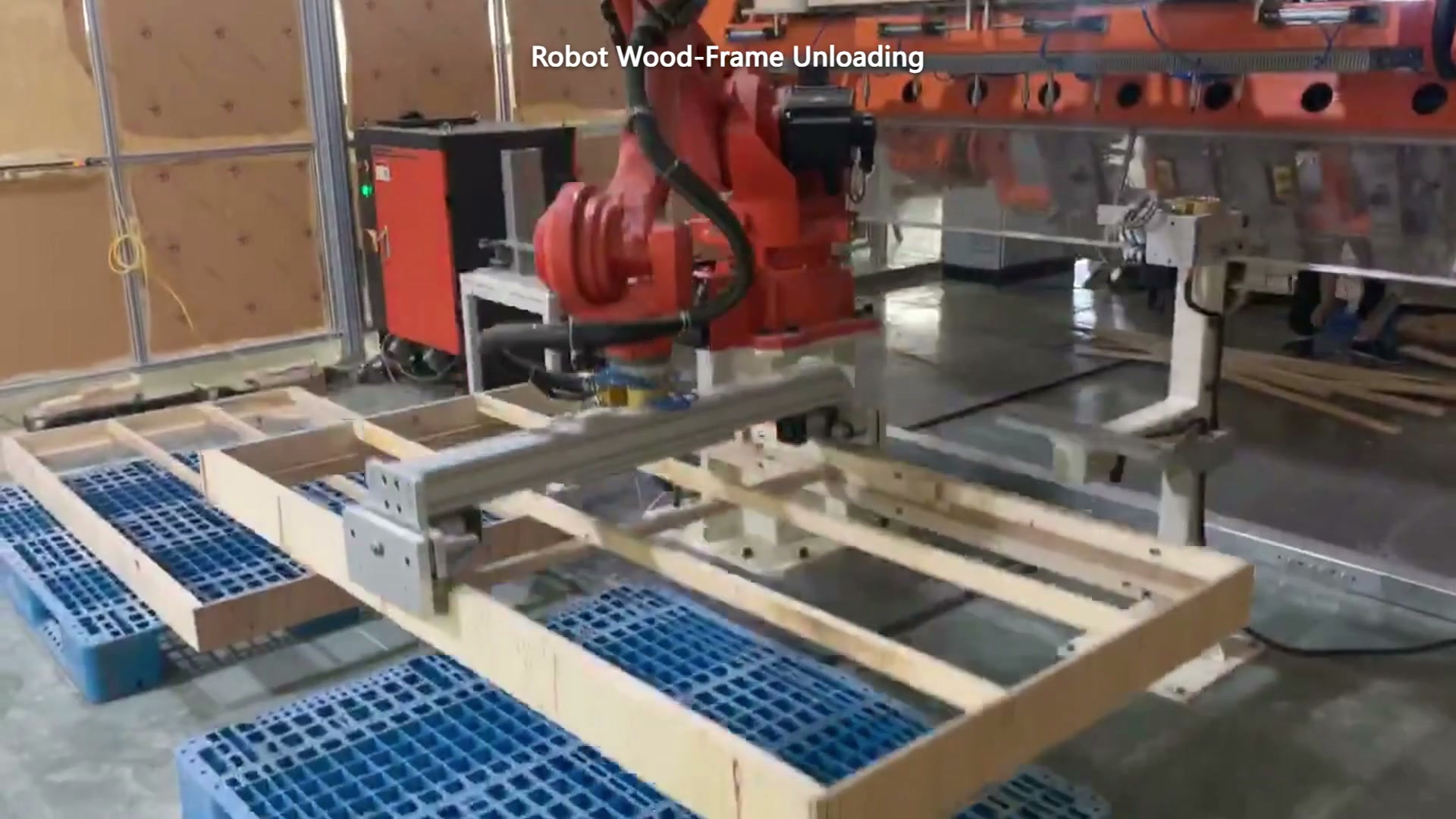
00:08.5 — The beam-shaped end tool holds a wooden frame.
For a proposed installation, ask which of those tasks can be repeated without intervention and which still require judgement. If changing the order means moving supports or re-establishing the pickup location, put that work into the comparison. A recipe selection should not be used as shorthand for adjustments that remain physical.
Frame geometry changes the handling question
An open frame is not a solid board with the same outside dimensions. Its rails define the available contact areas, and its joints and shape determine how it behaves when supported at the proposed points. Evaluate the complete frame during pickup, travel and set-down, including any permitted distortion or looseness.
Original wood-handling documentation describes manual lifting aids and automated grippers as different options. It also distinguishes tooling for different surfaces, porous material and gaps. The appropriate lesson is to test the intended contact and support arrangement; a gripper suitable for a broad panel is not automatically suitable for narrow frame members.
Use representative frames with the actual surface condition. Check for movement relative to the tool and for unacceptable contact marks or deformation after release. If a proposed arrangement needs a more consistent frame or a changed support, identify that requirement before comparing labour allocation.
The receiving position is part of the job
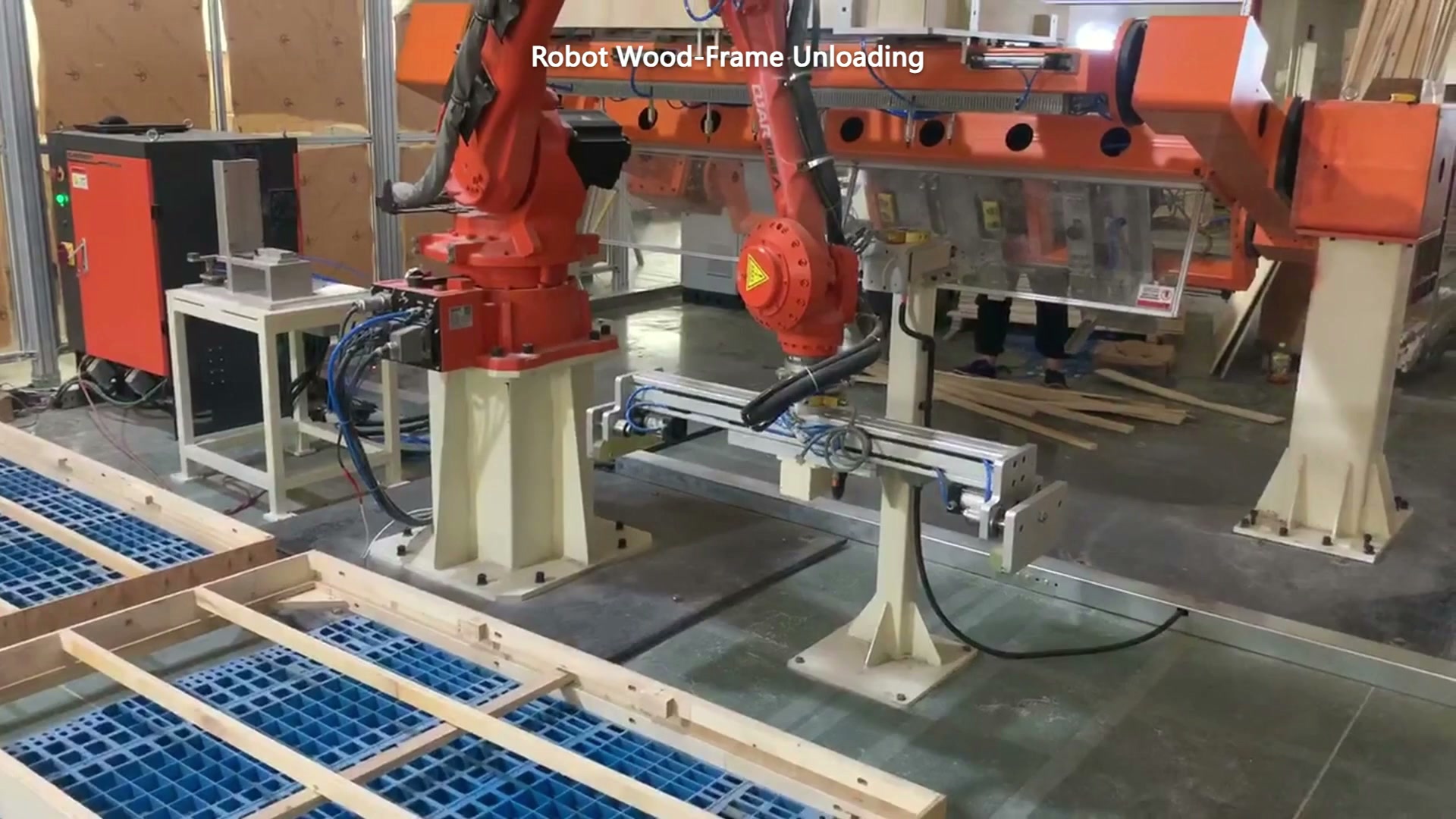
00:17 — The machine-side position and the blue receiving table are visible in the unloading area.
Unloading does not end at the moment a frame leaves the machine. The receiving table, stack or transport must accept it in the intended orientation and leave room for the tool to withdraw. Establish who removes completed stacks or supplies the next receiving position.
Where an operator frequently chooses a different destination or corrects the stack, an assisted manual arrangement can retain that judgement while reducing the handling burden. Where the destinations and presentation are repeatable, a robot may take over more of the sequence. Neither choice removes the need to define what happens when the destination is full or a frame is not presented as expected.
| Стан виробництва | Question to resolve before changing the division of work |
|---|---|
| Stable family and receiving pattern | Can the proposed tooling and sequence complete the range without repeated manual correction? |
| Frequent size or order changes | What must be adjusted, by whom, and how is the first frame checked? |
| Distorted or loosely assembled frames | Can the intended support retain the frame without damage, or must an upstream condition change? |
| Full or unavailable receiving position | Who restores a receiving location, and what does unloading do while it waits? |
Compare a complete shift task
In a trial, include an ordinary variant change and the receiving-position exchange, not only repeated transfers of the easiest frame. For a robot proposal, review the intended safeguarded work area and the controlled method for operator access during setup or fault handling. For assisted manual handling, check that the operator can guide and deposit the actual frame using an aid suitable for its contact conditions.
Compare the work retained at those boundaries. A proposal can be useful without claiming that an entire person’s job disappears; equally, reducing physical effort may be worthwhile even where full automation does not fit the current product mix.
Поділіться frame size range, sample frames, discharge pose and downstream stacking method with EVST, along with the shift requirement. These inputs support a discussion of which handling tasks to assist, which to automate and which handoff needs improvement first.