
By Équipe éditoriale d'EVST · Examiné par Équipe éditoriale d'EVST · Dernière mise à jour : 8 octobre 2026 · Politique éditoriale · Politique correctionnelle · Termes
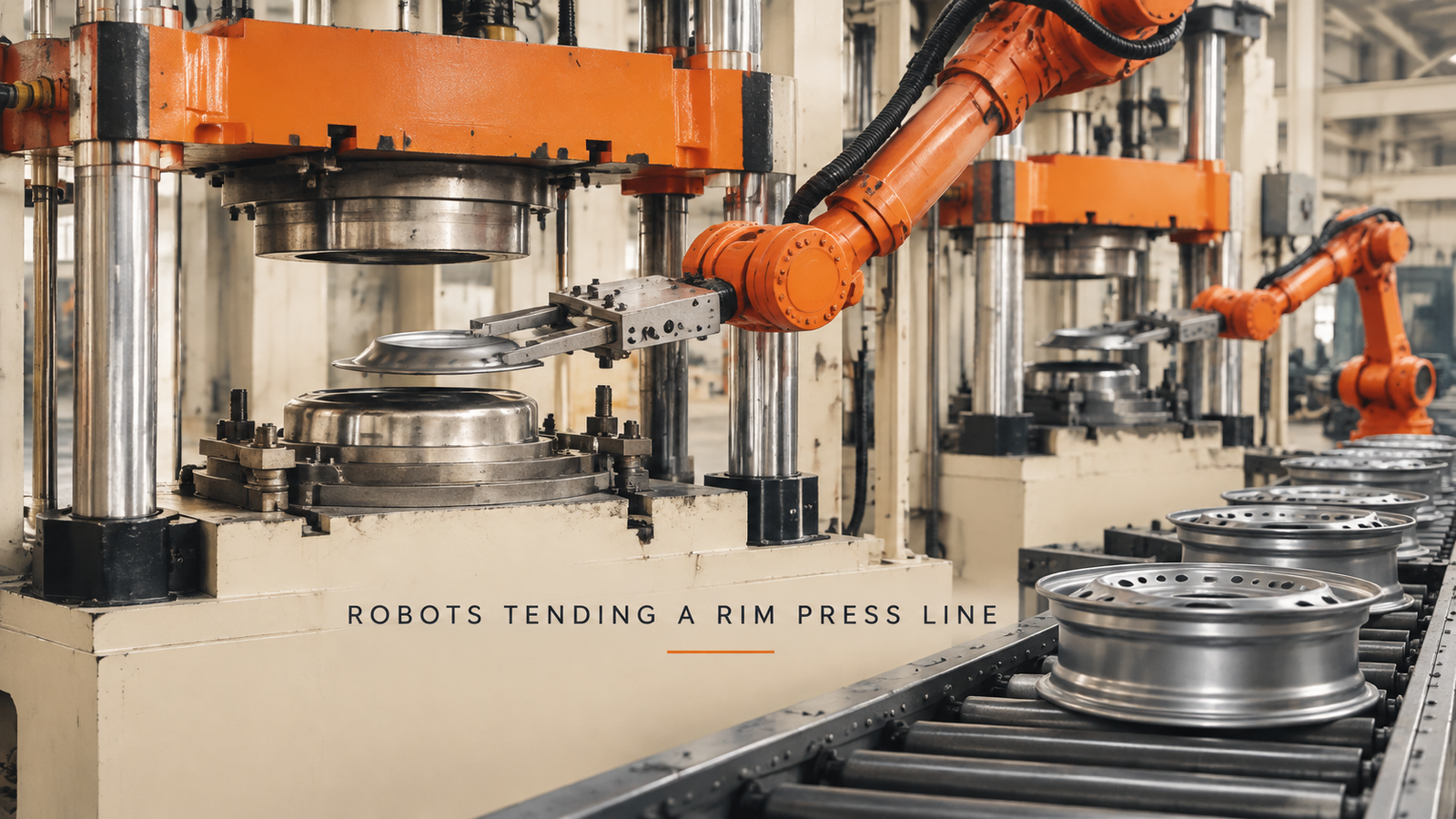
Press tending on a rim line can be handed to robots when three constraints are settled together: the part is carried into the die without shifting, the press can only close once the robot is clear of it, and the part ends up in the same place in the die every cycle. Payload and reach matter, but they rarely decide the case. In the cell described here, six-axis robots stand between a row of four-column hydraulic presses and rim stations, and the robots handle two quite different parts: a round steel blank at the presses and a rim with a ring of holes at the stations.
Looking at press tending on a rim line? Send us the part drawing for each station and your daily outputet nous vous répondrons avec un concept de cellule et une estimation du temps de cycle.
Why presses are the hard end of a rim line
A press differs from the rest of a rim line, because the operator has to put a hand, or at least a part, into the space between the dies. Doing that by hand thousands of times a day is tiring and carries real risk, and every press you add means another person at another station. That is why press tending is among the first jobs a plant looks at when it considers robots.
It is also why the job is not simply “pick and place”. The robot enters a space that is about to close, and the part it puts down has to be in exactly the right spot when it does. Those two facts drive everything below.
One press cycle, step by step
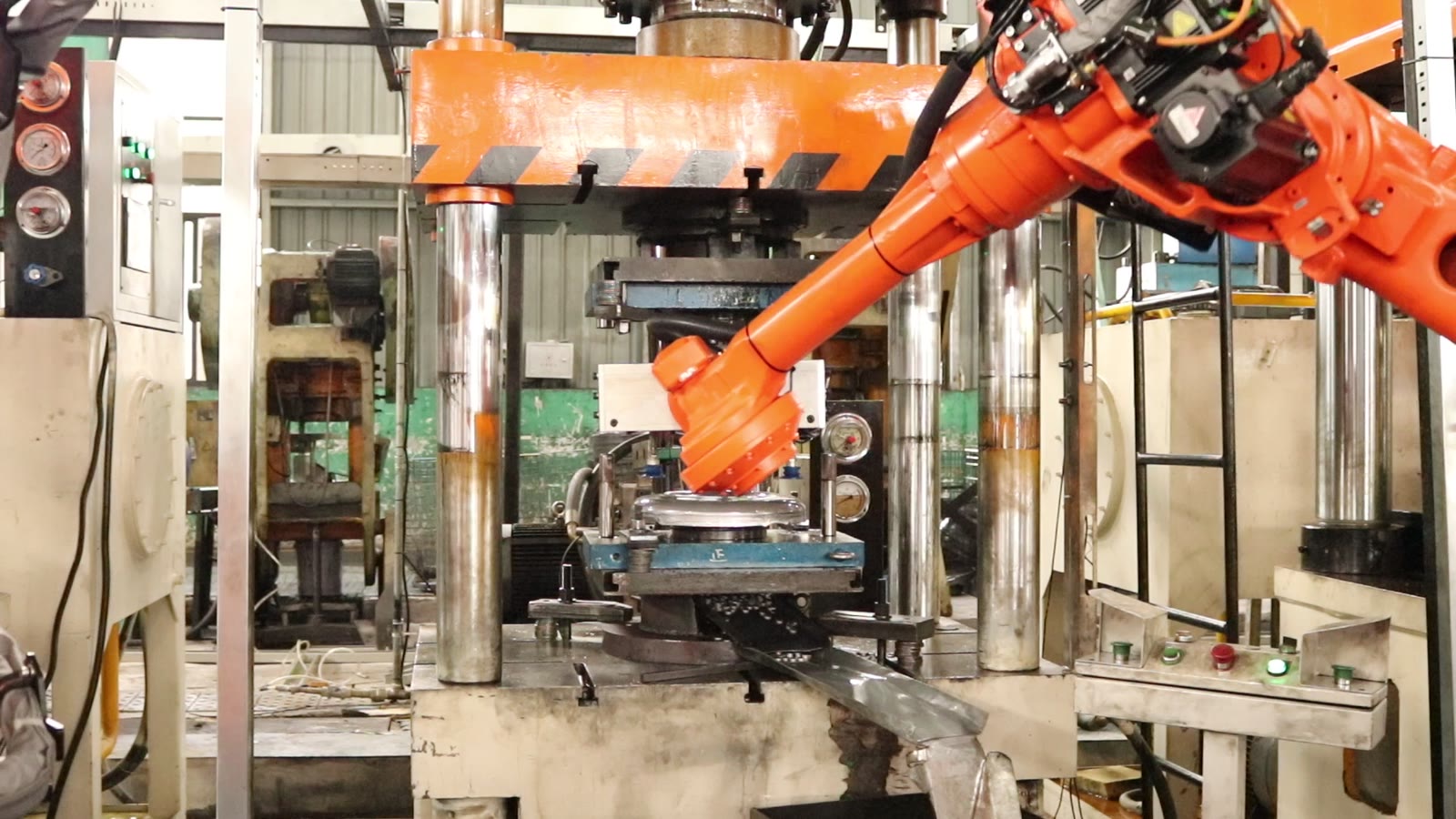
At the presses, the cycle looks like this:
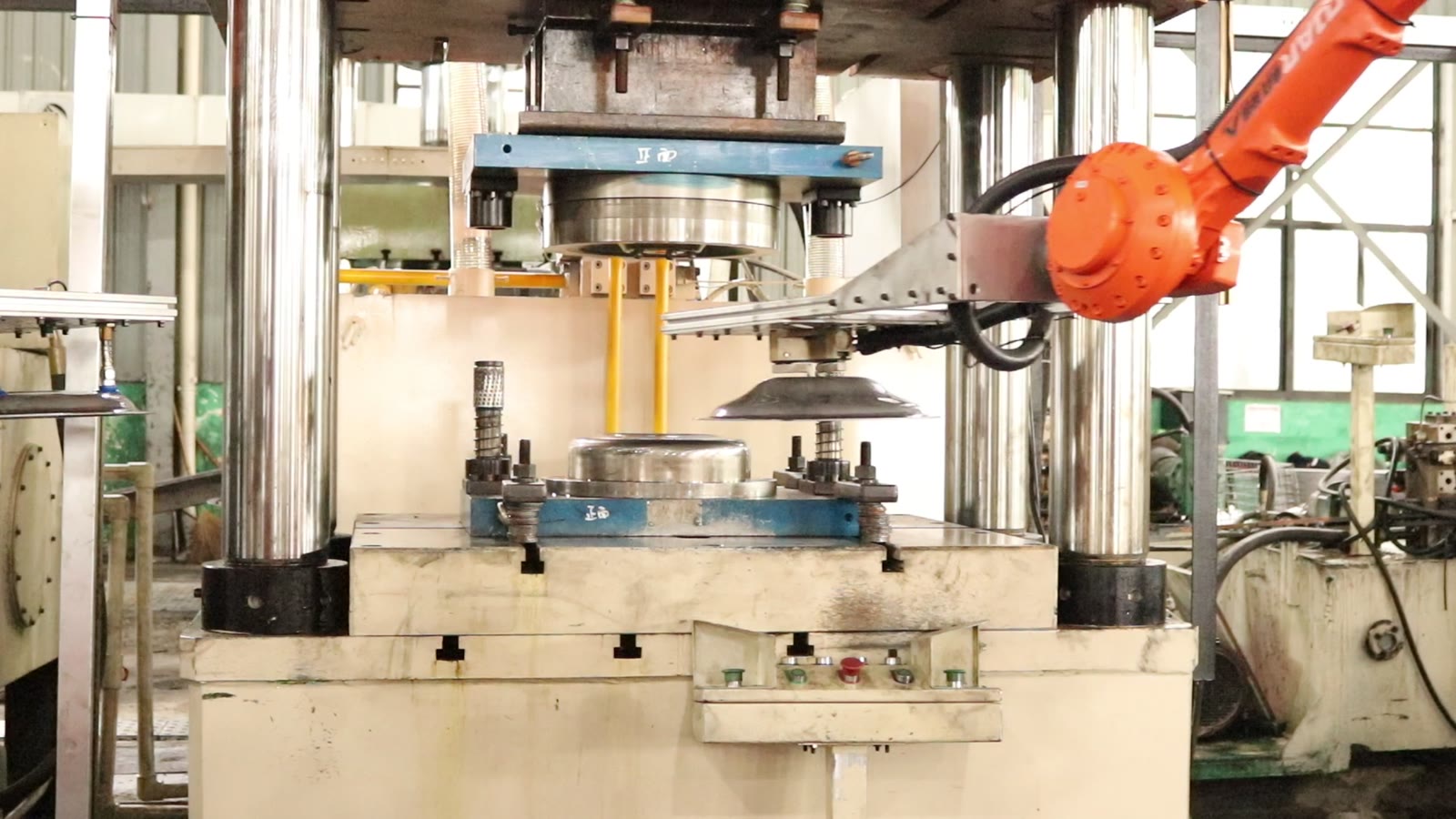
- The robot carries a round steel blank on a flat, forked gripper.
- It reaches between the upper and lower die.
- It sets the blank down on the lower die.
- It backs out of the press.
- Only then does the orange upper beam of the press come down and rise again.
- The robot reaches back in and lifts the part off the lower die.
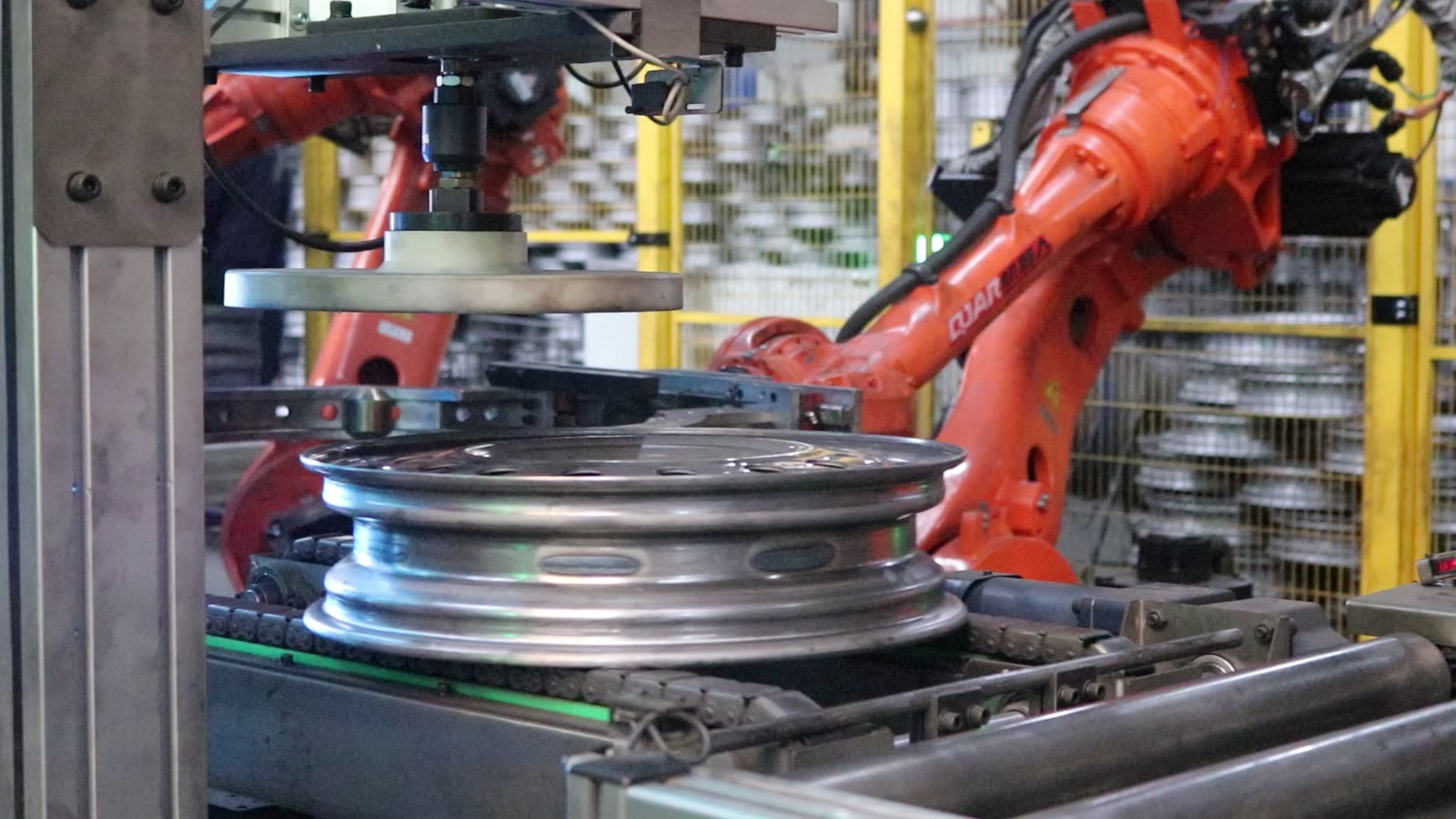
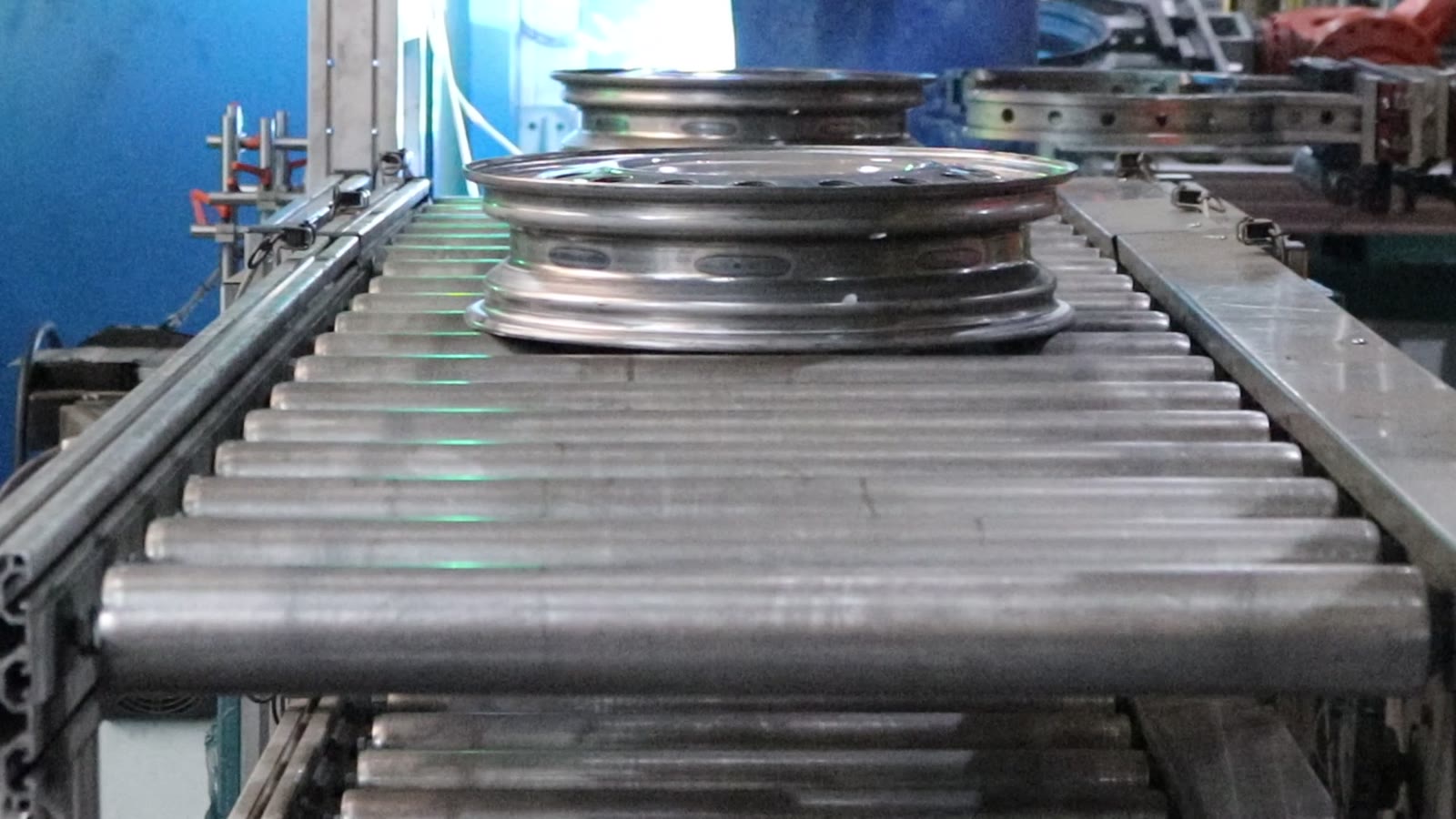
Further along the line, a different handling job takes over. At a rim station a robot with a ring-shaped gripper holds a rim, a ring with a row of holes, and sets it on a vertical fixture. A round pressure plate above the fixture comes down onto the rim, and when that is done the robot takes the rim off again. Beside a roller conveyor, two robots stand next to each other and pick rims up to move them across, and the rims then travel along the conveyor one after another.
Three constraints that hold each other up
Carrying the part in without shifting it
A blank carried on a fork is supported from below rather than clamped, so it can slide during the move if the robot accelerates, brakes or turns too sharply. What the fork needs is a seat that the blank cannot slip off, and a path whose speed is gentle where the part is least restrained. A shifted blank is not a small error: the next constraint assumes it is where you think it is.
The press closes only when the robot is clear
The sequence in the cell is simple: the robot backs out, then the press comes down. The design principle behind it is that this order should not depend on good timing alone. A robot–press interlock gives the press a signal that the robot is outside the die area, and gives the robot a signal that the press is open before it goes in. Both directions matter, since a press that closes too early and a robot that enters too early are different faults with the same outcome.
Locating the part in the die
Putting a blank on the lower die only helps if it ends up in the same spot each time. Where the die has locating features, such as a recess, pins or a shaped seat, the robot only has to bring the part close and let it settle. Where it has none, the robot must be accurate enough to place the part directly, and any shift in the pick-up position carries straight through to the die.
The three are linked in a chain. A secure fork grip makes a repeatable placement possible, the placement only counts if the robot is demonstrably clear before the stroke, and a locating feature in the die absorbs the small variation that remains.
From one press to a row
Along the line the robots stand between the presses, and the presses are served in the same rhythm: in, out, stroke, in again. As a design principle, treating one press with one robot as the unit makes a line easy to scale. A new press brings its own robot, its own interlock and its own part-handling cycle, and the cell does not have to be re-planned as a whole.
The trade-off is cost per press. The alternative, one robot serving two presses, saves a robot but ties the press timing together and makes each press wait for the other. Which is better depends on how long each stroke takes compared with a robot’s trip, and that is exactly what a cycle-time estimate from the drawings is for.
Blanks and rims need different grippers
The cell uses two grippers for two parts: a flat fork for a round blank that has to reach between the dies, and a ring gripper for the rim. That matters when a customer wants one robot to handle both: either the tool is changed between jobs, which needs a tool changer and a place to park each gripper, or the robots are dedicated to one part each. Dedicated robots are simpler but cost more per line; a changeover design is cheaper in hardware but adds changeover time and one more thing to check.
Où cela s'inscrit, et où examiner de plus près
Press tending fits well when parts are stable in shape, the presses are in a row with room beside them, and the production rate is steady enough to justify a robot per press. Look closer when parts vary a lot in size, when the die has no way of locating the part, or when the press layout leaves no space for a robot to stand and reach into the die.
Questions we are often asked
Does the press have to be modified? Typically it needs signals for the interlock and sometimes a guard layout that allows robot access. We check this against the press layout you send.
Can one robot serve more than one press? It can when the stroke time leaves enough idle time for the robot to travel and load the second press. A cycle-time estimate shows whether it does.
Can the same robot handle blanks and rims? Technically yes, with a tool changer, but it adds changeover time. Whether it is worth it depends on how often the parts alternate.
Que nous envoyer
For each station, the part drawing; the press layout, including where the robots could stand and how the dies open; and the daily output you need. With these we can tell you which of the three constraints will be the hardest one in your line, and what a cell concept and cycle-time estimate would look like.
Want a concept for your presses? Contactez-nous ici or write to sales@evsrobot.com with your drawings and daily output.
This article describes how press and rim handling work in general and what is visible in one cell; it does not state tonnage, part sizes, materials, cycle times or any forming step.