
By the EVST Editorial Team · Last updated: July 22, 2026
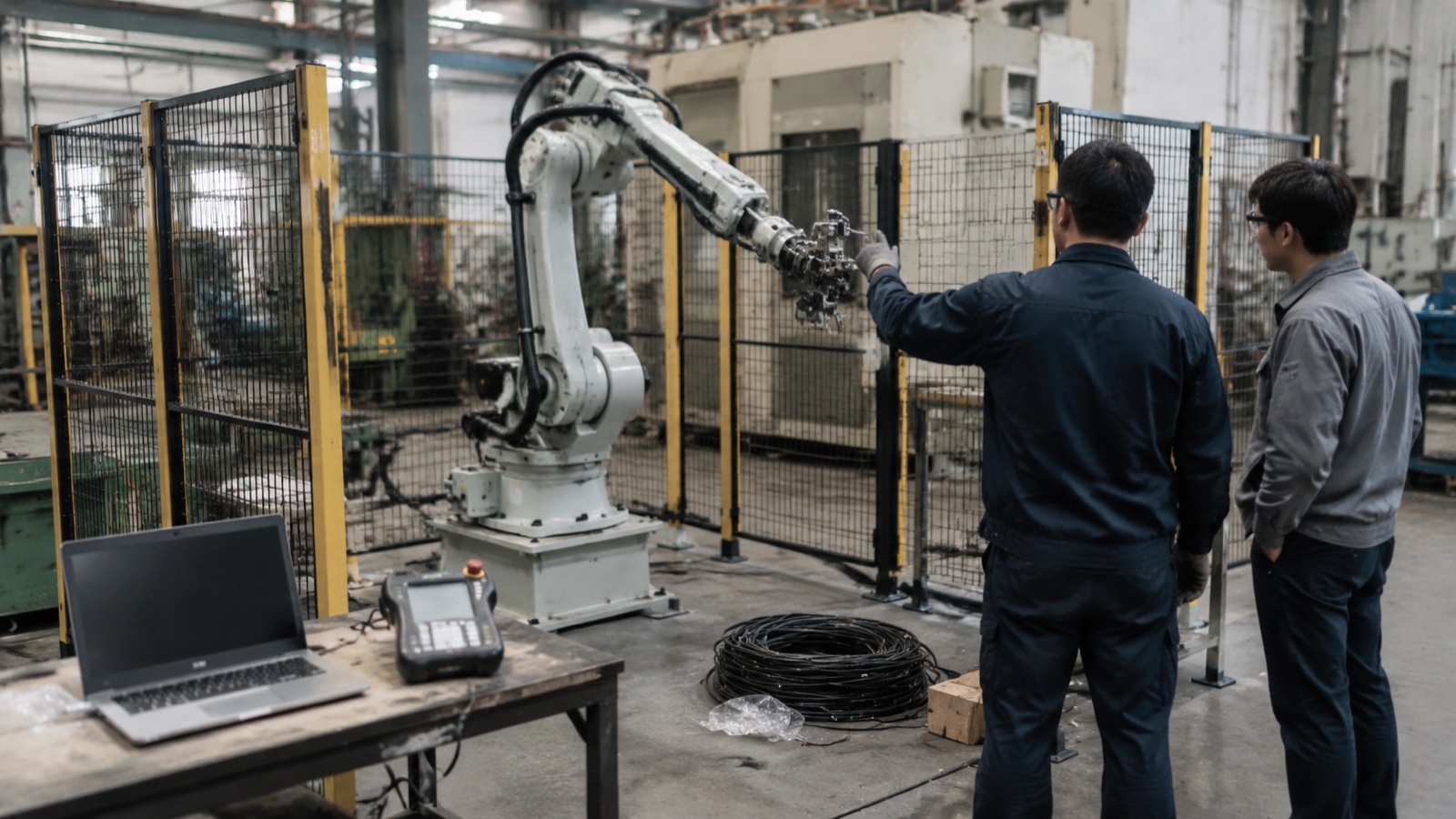
Automation projects rarely fail because the robot is bad. Why automation projects fail is almost always a post-delivery story, and five causes cover most of it: underestimated end-of-arm tooling, cycle time taken from the robot spec sheet, high-mix changeover, a plant that was not ready around the cell, and no one owning the cell after handover.
This is a buyer-side analysis. If you are still at the shortlist stage, our supplier evaluation checklist covers vendor due diligence; this article picks up where that one ends.
Why Automation Projects Fail Once the Hardware Is Already There
There is a specific moment in a first automation project when the mood changes. The crate is open, the arm is bolted down, the teach pendant powers up, and it moves. Everyone takes a photo. Then somebody asks when it will start making parts, and the honest answer is six to ten weeks away, not next Tuesday.
That gap is where budgets get eaten. The arm was never the hard part. According to the International Federation of Robotics, the worldwide operational stock of industrial robots has passed four million units, and robot hardware itself has become a fairly standardized, widely available commodity across price tiers. What has not become standardized is everything that turns an arm into a cell: the tool on the end of it, the parts fed into it, the fence around it, and the people who keep it running. Those are project-specific every single time, and they are where schedule and cost actually live.
The five causes below are not exotic. Each one is visible before a contract is signed, if the buyer knows which question to ask.
Cause 1: The Gripper Was Treated as an Accessory
On a quote, end-of-arm tooling (EOAT) often appears as one line near the bottom, sometimes without a price, sometimes as “TBD pending part sample.” That line is frequently the longest-lead, highest-risk item in the whole cell.
The reason is that a robot arm is a catalog product with a known repeatability figure, while a gripper is a custom-designed mechanism that has to survive contact with a real, variable, sometimes oily or hot workpiece thousands of times per shift. Vacuum works until the surface has a draft mark. A two-finger clamp works until the casting has flash on the grip face. A magnetic tool works until someone runs an aluminum variant through the same line.
In practice, our delivery team plans EOAT as if it were a small machine-design project rather than an accessory, because that is what it is. Design, manufacture, and debug on a non-trivial gripper regularly runs four to eight weeks on its own, and it is normal for the first physical tool to need one revision after seeing real parts. A project plan that assumes the gripper arrives finished alongside the robot has already lost a month it did not budget.
Avoid it before signing: require the supplier to quote EOAT as a separate, priced, scheduled deliverable with its own lead time, and send real production samples (not CAD, and not the good ones) before the tool design is frozen. Ask explicitly who pays for the second revision if the first tool does not hold the part.
Cause 2: Cycle Time Came Off the Spec Sheet
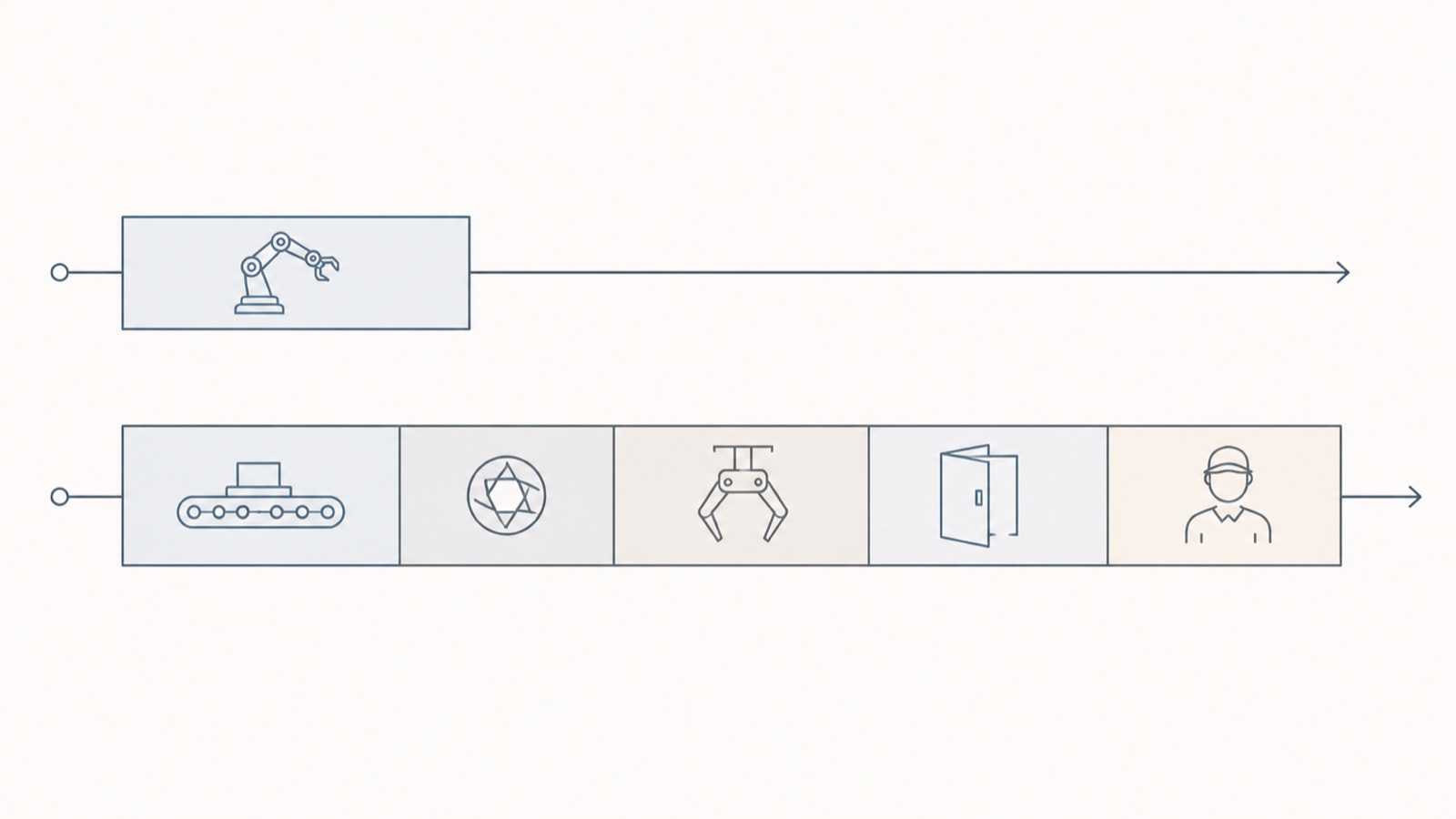
Robot datasheets publish motion performance under ideal conditions with a nominal payload. Sales calculations built on those figures produce throughput numbers that a real cell will not reach, and the buyer does not discover the shortfall until acceptance testing.
A cell’s real cycle time is the sum of robot motion, part presentation, any vision or measurement dwell, tool actuation, machine handshake wait, and operator intervention. Only the first of those is on the datasheet. A pick-and-place move that takes 2.1 seconds of robot motion can easily become a 5-second station cycle once the conveyor indexes, the camera captures and processes, the gripper closes and confirms, and the CNC door finishes opening. None of those steps is a defect. They are simply not robot motion, and they were not counted.
Human intervention is the least-counted item of all. If an operator has to reorient one part in twelve, or clear a jam twice a shift, that time belongs in the cycle calculation, and it usually is not there.
Avoid it before signing: make the supplier state throughput as a guaranteed parts-per-hour figure at the cell boundary, measured over a continuous run of defined length, with the acceptance test conditions written into the contract. Ask what happens to the number when incoming parts arrive at the tolerance limit rather than nominal. A supplier who only quotes robot motion time is quoting a different machine than the one you will own.
Cause 3: A High-Mix Plant Bought a High-Volume Solution
Most published robotics ROI arithmetic assumes a plant runs one part in long batches. A great many plants, particularly job shops and contract manufacturers, run 40 part numbers in batches of 80. Those are different problems, and the second one is much harder to automate profitably.
The arithmetic is unforgiving. Take a cell that needs 40 minutes to change over: swap the gripper jaws, reload the fixture, call up the program, re-verify the first article. If the average batch runs 60 minutes of production, that cell spends roughly 40 percent of its available time not producing, and the labor “saved” is partly consumed by a setup technician who is now more skilled and more expensive than the operator who was replaced. The business case that looked strong at a theoretical utilization rate collapses at the real one.
This is not an argument against automating high-mix work. It is an argument that high-mix work needs to be automated differently: quick-change tooling with repeatable datums, zero-point fixture systems, program libraries organized by part family rather than by part, and often a collaborative robot that can be redeployed rather than a fenced cell that cannot. The design target is changeover minutes, not cycle seconds.
Avoid it before signing: give the supplier your actual part mix and batch size distribution, not your top three parts, and require a stated changeover time between two named, genuinely different parts. Then check whether the payback model uses that changeover time. Our automation payback period analysis walks through how changeover and utilization move the payback number.
Cause 4: The Plant Around the Cell Was Not Ready
A robot is a precision device that assumes the world is repeatable. Factories usually are not, and the cell exposes that with unusual clarity.
Incoming part consistency is the most common gap. Manual assembly absorbs variation invisibly because a person compensates without thinking about it. A robot does not compensate. Castings that vary by three millimeters between suppliers, laser-cut blanks with inconsistent burr, or bar stock delivered in mixed lengths will each stop a cell that ran perfectly during the factory acceptance test on nominal parts.
Fixturing and datum strategy is the second gap. If the part’s location in the fixture depends on how carefully someone seats it, the robot inherits that uncertainty and the process runs at whatever precision the loading step allows, regardless of the arm’s stated repeatability.
Safety is the third, and it is the one that most often delays sign-off rather than production. Under ISO 10218-2:2025, cell-level risk assessment and safeguarding are the responsibility of the system integrator, not the robot manufacturer. A delivered robot arm is never a compliant cell on its own. Fencing, interlocked access gates, area scanners, safety-rated logic, and the documented risk assessment behind them all have to exist before the cell can legally run in production, and for collaborative applications the force and pressure limits described in ISO/TS 15066 have to be validated against the actual tool and workpiece, not the bare arm. Buyers who assume “collaborative robot” means “no risk assessment required” are consistently surprised. Our guide to ISO 10218-2:2025 cell integration sets out what falls on the integrator and what falls on the end user.
The unglamorous fourth gap is utilities. Supply voltage and frequency, available compressed air volume at the required pressure, floor flatness and load rating, network drops, and fume extraction all have to be confirmed against the cell’s requirements. Air is the recurring one. A plant compressor that comfortably runs hand tools can starve a cell with a multi-zone vacuum tool, and the symptom looks like a dropped-part fault rather than an air problem.
Avoid it before signing: ask for a written site-readiness specification as a contract deliverable, covering incoming part tolerance assumptions, utility requirements, floor and space conditions, and who owns the risk assessment. Then ask which of those items voids the throughput guarantee if unmet.
Cause 5: No One Owned the Cell After Handover
The commissioning engineers leave. Six months later a servo pack fails, or a new part number arrives and the program needs editing, and the question becomes who does that. In a lot of plants, the answer is nobody.
Two things create this. The first is that operator and maintenance training gets scheduled during commissioning week, when the cell is still being debugged and the people who need training are busy running the rest of the plant. It happens, it is signed off, and almost nothing is retained. The second is that spare parts and support were never specified, only assumed.
Cross-border support deserves being said plainly, because it is where imported automation genuinely underperforms domestic supply. Spare parts are usually a customs and paperwork problem before they are a manufacturing problem: a controller board that ships in two days can still sit for two weeks in clearance, and a cell down for two weeks costs more than the part by a wide margin. Time zones compound it. A morning fault in Europe or the Americas reaches an Asian supplier at the end of their day, which turns what should be a two-hour diagnostic conversation into a two-day exchange.
Avoid it before signing: negotiate a critical spares kit held on your site as part of the original order rather than ordered when something breaks, get a written response-time commitment with named local support (not an email address), and schedule training as a separate paid session two to four weeks after production start, when the operators have real questions.
The Five Causes at a Glance
| Failure cause | Early warning signal | Question to ask the supplier before signing |
|---|---|---|
| EOAT treated as an accessory | Gripper is a single unpriced line item, or “TBD pending sample” | What is the EOAT lead time and price as a separate deliverable, and who pays for the second revision if the first tool does not hold the part? |
| Cycle time from the spec sheet | Throughput quoted as robot motion seconds, no acceptance test defined | Will you guarantee parts per hour at the cell boundary over a continuous run, with the test conditions written into the contract? |
| High-mix work in a high-volume design | Payback model assumes one part and high utilization | What is the changeover time between these two specific part numbers, and is that number in your ROI calculation? |
| Plant not ready around the cell | No written site-readiness spec; risk assessment ownership unclear | What incoming part tolerance, air volume, and power does the cell assume, and who is responsible for the ISO 10218-2 risk assessment? |
| No ownership after handover | Training bundled into commissioning week; no spares list | What is in the recommended on-site spares kit, what is your named local response commitment, and can training be scheduled after production start? |
What Chinese Suppliers Are Genuinely Worse At
Buyers sourcing from China—which the International Federation of Robotics’ World Robotics report identifies as the world’s largest market for industrial robots—are usually shown a list of advantages and no list of trade-offs, which makes the advantages harder to believe. The honest version is more useful.
Absolute accuracy at the demanding end. For the large majority of welding, palletizing, machine tending, and handling work, Chinese-built arms hold repeatability figures that are entirely adequate and comparable to the established Japanese and European brands in the same payload class. At the top of the precision range, particularly in applications needing calibrated absolute accuracy for offline-programmed paths rather than taught points, the established brands still have an edge in calibration tooling and long-term thermal stability. If your application lives there, that should decide the purchase.
Documentation quality. Manuals translated into English vary in quality, and the gap widens as you move from the arm manual to the controller’s fault-code reference and the fieldbus configuration notes. Maintenance staff feel this before anyone else. It is worth asking to see the actual English service documentation, in full, before ordering rather than after.
Time-zone and communication friction. Real, and not solvable by good intentions. It is manageable with a named support contact, an agreed daily overlap window, and one escalation path, but a buyer who expects same-hour answers across an eight-hour offset will be frustrated.
Spare parts lead time. Discussed above, and the single most consequential item on this list. It is also the one most improved by planning: an on-site spares kit specified at order time converts a two-week outage into a two-hour one.
Resale and residual value. Secondary markets price established brands higher. If a five-year exit or asset-backed financing matters to your finance team, that discount is real and should be in the model.
None of these argue against sourcing from China. They argue for pricing them in. A buyer who negotiates spares, documentation, response commitments, and local support into the original purchase order usually ends up with a lower total cost of ownership than one who compared machine prices alone and discovered these items later, at retail.
Where This Leaves a Buyer
Every cause on this list is a scoping problem, not a technology problem, and every one of them is cheaper to fix in a specification than in a commissioning week. The pattern in projects that go well is unremarkable: EOAT designed against real parts, throughput guaranteed at the cell boundary, changeover time treated as a design target, a written site-readiness spec, and support terms negotiated before the purchase order rather than after the first breakdown.
EVST (EVS TECH CO., LTD), a Chengdu-based robotics manufacturer and integrator founded in late 2018, delivers automation projects across 100+ countries, and the pattern is consistent enough that our delivery team now treats those five items as scope gates rather than as optional extras. Buyers working through a specification and wanting a second opinion on tooling, throughput assumptions, or support terms can reach our team through evsrobot.com.
Frequently Asked Questions
Why do automation projects fail even when the robot works fine?
Because a working robot is not a working cell. The common post-delivery failures are end-of-arm tooling designed too late against incomplete part information, throughput calculated from robot motion time instead of full station cycle time, changeover time that erases the business case in high-mix plants, incoming part variation and safety or utility gaps the plant did not prepare for, and no defined ownership of maintenance, spares, and reprogramming after the integrator leaves.
How long does robot commissioning actually take after delivery?
Longer than most first-time buyers plan for. Mechanical installation is fast, but tool debugging against real parts, program tuning, safety validation, and acceptance testing are what set the schedule, and end-of-arm tooling alone commonly needs four to eight weeks of design and build time plus at least one revision after it meets production parts. Ask the supplier for a schedule broken out by installation, tooling, programming, safety validation, and acceptance rather than a single commissioning line.
What questions should I ask a robot supplier before signing the contract?
Five carry the most weight: what is the priced lead time for end-of-arm tooling as a separate deliverable; will you guarantee parts per hour at the cell boundary under defined acceptance conditions; what is the changeover time between two specific part numbers from my actual mix; what site-readiness conditions does the cell assume and who owns the ISO 10218-2 risk assessment; and what spares kit, named local support contact, and response time come with the order.
Is it risky to buy industrial robots from China?
The risks are specific and manageable rather than general. Hardware quality and repeatability in mainstream welding, palletizing, and handling applications are broadly comparable to established brands in the same payload class. The genuine gaps are English service documentation quality, spare parts customs lead time, time-zone response friction, absolute accuracy at the most demanding end of the precision range, and lower secondary-market resale value. Each can be priced or contracted around at purchase, which is considerably cheaper than discovering them during a line stoppage.
Who is responsible for robot cell safety, the robot maker or the integrator?
Under ISO 10218-2:2025 the cell-level risk assessment and safeguarding are the system integrator’s responsibility, not the robot manufacturer’s. The robot arm is a component; the fencing, interlocks, area scanners, safety logic, and documented risk assessment belong to whoever integrates the cell. For collaborative applications, the force and pressure limits described in ISO/TS 15066 have to be validated with the actual tool and workpiece fitted, not with the bare arm.
Should a high-mix, low-volume shop automate at all?
Often yes, but with a different design target. High-mix plants should specify against changeover minutes rather than cycle seconds, which pushes the design toward quick-change tooling with repeatable datums, zero-point fixturing, program libraries organized by part family, and frequently a redeployable collaborative robot instead of a fixed fenced cell. A payback model built on single-part utilization will not survive contact with a 40-part-number mix.
Key Takeaways
- Automation projects rarely fail on robot hardware. They fail in the gap between a delivered arm and a running cell, and that gap is a scoping problem that is visible before signing.
- End-of-arm tooling is a custom machine-design project, not an accessory. Quote it separately, schedule it separately, send real production samples, and agree in advance who pays for revision two.
- Insist on throughput guaranteed as parts per hour at the cell boundary under written acceptance conditions. Robot motion seconds from a datasheet are not a throughput commitment.
- In high-mix plants, changeover time is the design target, not cycle time. Give the supplier your real part mix and check that the stated changeover appears in the payback model.
- Under ISO 10218-2:2025 the cell-level risk assessment and safeguarding belong to the system integrator, and a delivered robot arm is never a compliant cell on its own.
- Negotiate the on-site spares kit, named local support contact, response commitment, and post-startup training into the original purchase order. Bought later, during a stoppage, all four cost more.
About the author: The EVST Editorial Team writes about industrial automation for engineering and operations teams specifying their first or next robot cell. EVST is a robotics manufacturer and integrator headquartered in Chengdu, delivering automation projects across 100+ countries, with IATF16949 automotive-grade certification and CE / SGS / TUV third-party certification across its product lines.
Author: EVST Editorial Team
Reviewed by: EVST Editorial Team
Last updated:
Method: EVST Five-Cause Post-Delivery Screen — a buyer-side planning aid for scoping a robot cell before signing, not an acceptance test or a substitute for a system integrator’s risk assessment.
Editorial policy · Corrections policy · Terms of use