
Plan long-sheet feeding around the sheet’s changing contact with the support system. An intact sheet can span the feeder, machine entrance and receiving area at the same time. An interface drawing should therefore show where its leading edge, body and trailing edge are supported during transfer, including the length outside the machine.
Draw the sheet at the handover positions
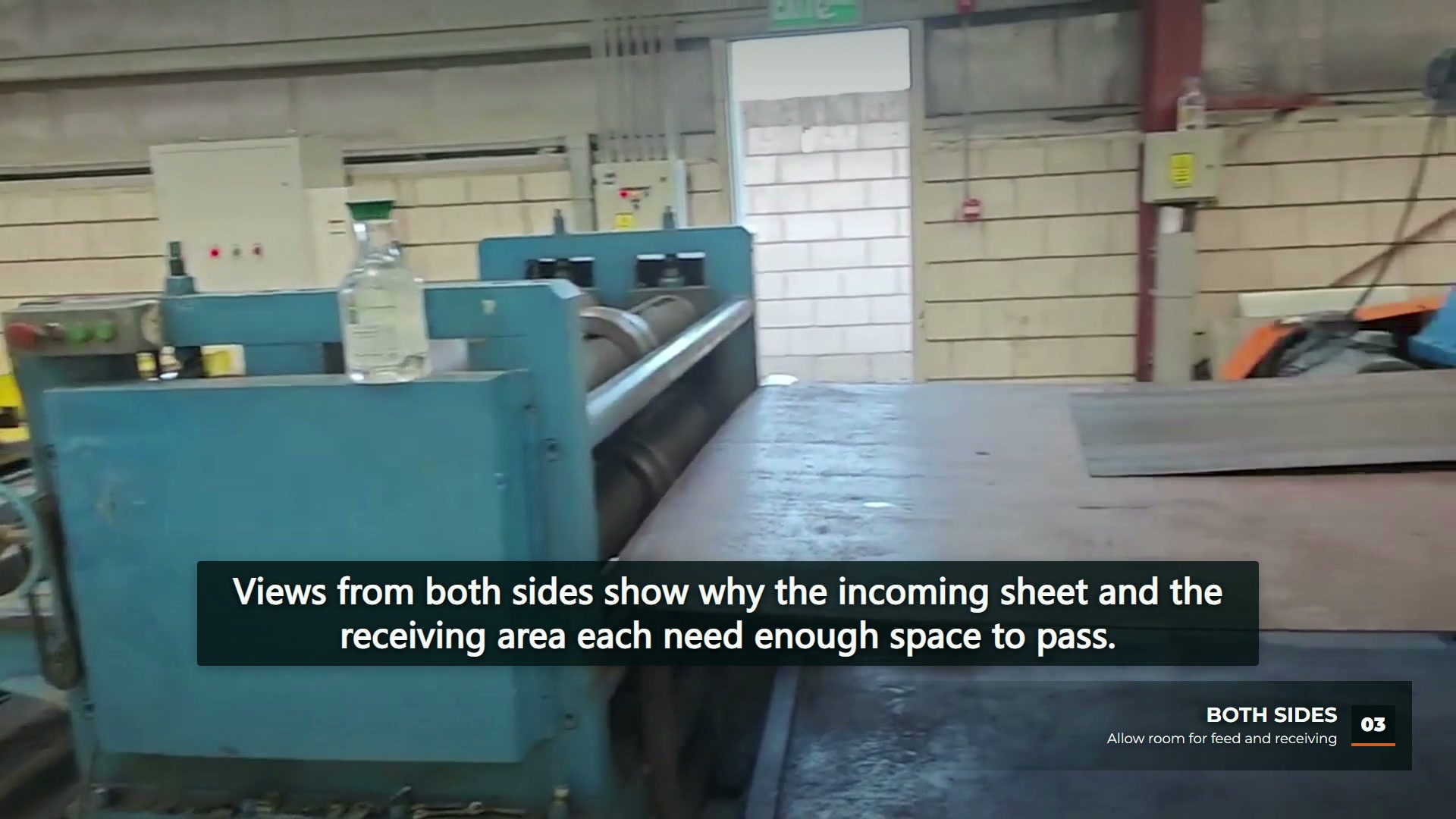
At 00:04, a long sheet and the blue roller structure are visible before the machine. The view at 00:19 shows the entrance from another side. These selected moments help identify the interfaces to measure. They do not establish roller load rating, sheet deflection or processing accuracy.
A centerline-only floor plan hides the sheet’s width and its changing overlap with each support. For an application review, add the actual sheet outline at the first contact with the next section, at an intermediate transfer position and when the trailing edge leaves the previous section. These are proposed planning views, not measured states extracted from the video.
Separate material interfaces from machine footprints
The published TRUMPF SheetMaster arrangement distinguishes a loading station, machine table and unloading platform. Its handling method differs from the visible roller-fed arrangement. The useful comparison is the separation of interfaces: a machine footprint alone does not describe where material waits, changes support or is received.
Document which surfaces receive the sheet at each handover and which dimensions still require a site measurement. A height difference or open span cannot be reliably estimated from perspective video. Keep those values unresolved until measured, rather than filling the drawing with plausible numbers.
| Proposed transfer view | Show on the drawing | Follow-up question |
|---|---|---|
| Leading edge reaches the next section | First receiving contact and remaining upstream support | What carries the sheet as contact begins? |
| Sheet bridges the interface | Both support ends and the intervening span | Does this material remain adequately supported? |
| Trailing edge leaves the feeder | Remaining downstream contacts | Which support condition now governs the transfer? |
| Another sheet size is introduced | Its own outline through the same positions | Does the earlier review still apply? |
Avoid borrowing a roller rule from a different load
Interroll’s roller guidance discusses unit loads such as cartons, totes and pallets, including their support on multiple rollers. A flexible sheet is a different object. The page is useful for recognizing support as a selection condition, but its unit-load rules do not establish a suitable pitch or capacity for this sheet.
Sheet dimensions, stiffness, incoming condition and contact behavior belong in the proposed application’s evidence. Where these are unknown, flag the interface for a representative check. A visually smooth feed in one recording cannot qualify every sheet size.
Keep feeding distinct from what happens after cutting
This article concerns transfer of an intact sheet between supports. Our long-sheet cutting acceptance guide follows the different problem created when cutting separates the material into retained parts and scrap. Neither discussion should silently stand in for the other.
For EVST’s application planning, the useful deliverable is a measured interface drawing accompanied by sheet-range information and a list of unresolved contact states. It gives the next review a concrete object, while leaving dimensional accuracy and later forming or cutting results to their own evidence.