
For finishing supervisors choosing the first automation scope. The useful comparison is rarely “a person or a robot for every part.” A finishing bench may receive repeat parts with a defined edge, occasional heavy burrs, several part families, and one-off repairs. Those are different jobs. The first robotic task should have a workpiece location, contact route and acceptance condition that can be repeated across the real incoming range. Keep exceptions visible instead of averaging them into a promising demonstration cycle.
Separate what changes before you select the robot
When an experienced operator changes angle or dwell, ask why. Was the burr larger, the part seated differently, the abrasive worn, or the required appearance different? These causes demand different remedies. A location error calls for better presentation or sensing. A wide incoming burr range may need an upstream process limit or a separate heavy-removal pass. Abrasive wear may require a defined replacement or compensation method. A cosmetic repair with a new judgment on each part may remain manual until it can be described as a narrower task.
| Work arriving at the bench | First process route | Evidence that would change the route |
|---|---|---|
| Repeated part family, stable datum, defined area and acceptance | Trial an automated finishing pass | Worst expected incoming stock, poor seating or worn abrasive breaks the acceptance window |
| Mostly repeated parts with occasional severe burrs or returns | Automate the stable pass; route exceptions separately | Exceptions consume enough time or changeovers that the supposed robot capacity no longer meets demand |
| One-off geometry or finish that changes with each job | Keep skilled manual work, or define a smaller repeatable family | A shared datum, repeatable contact area and testable finish criterion emerge |
These are route conditions, not universal lot-size cutoffs. The economic comparison needs the actual mix and the cost per accepted part, not a made-up payback period.
Choose whether the robot brings the part or the abrasive
A robot can carry a small, safely gripped part to a fixed wheel or belt. This concentrates the abrasive stations in one place, but makes the part’s gripping face, fixture datum, presentation angle and safe release central to the design. Alternatively, the robot can carry the abrasive tool to a larger fixed part; that changes the reach, tool-load, cable and compliance problem. One arrangement cannot be selected solely from a robot payload number.
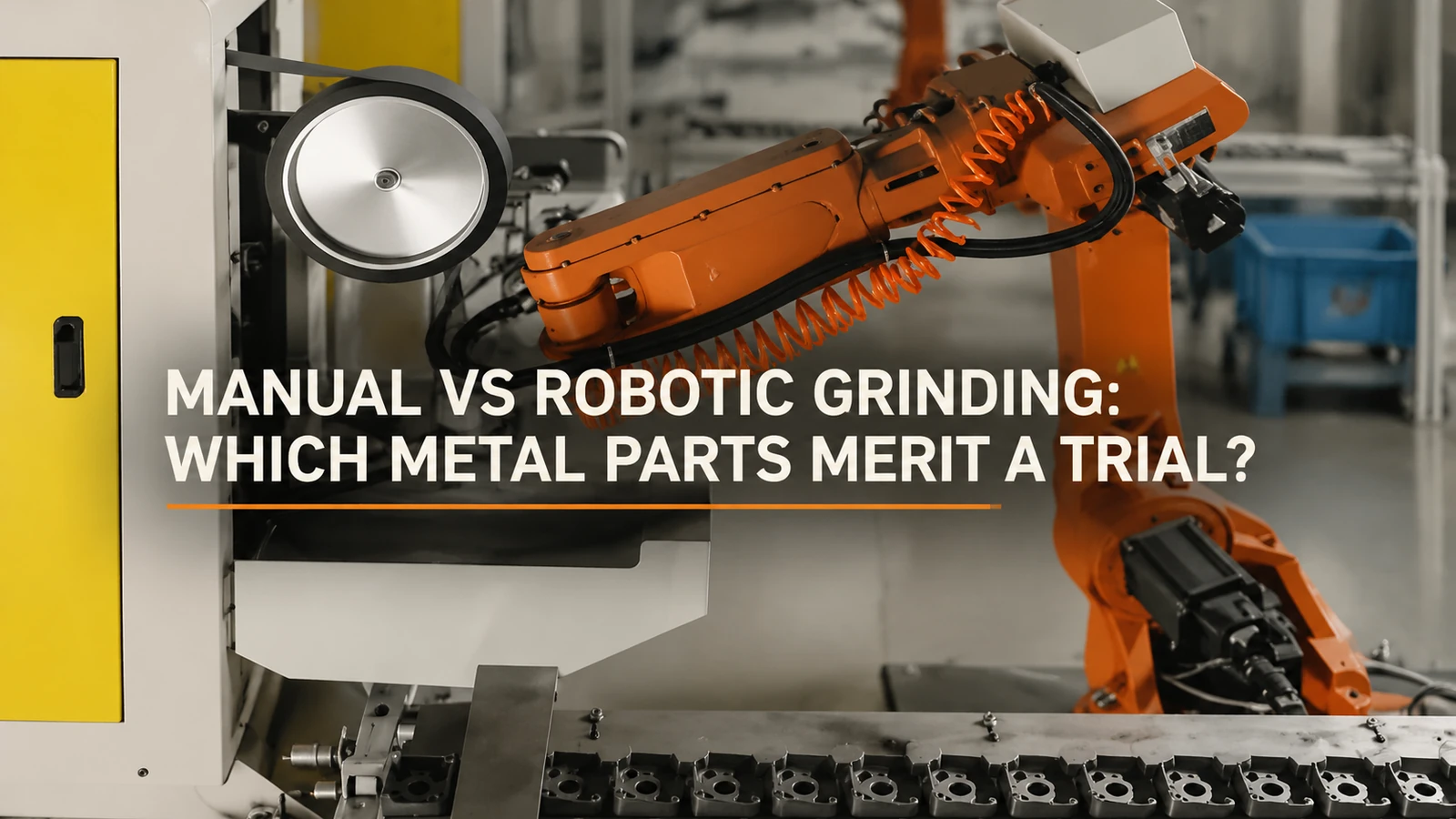
The application footage shows an orange robot changing its end position beside fixed wheel- or belt-style grinding equipment, with small metal pieces nearby. It is a useful illustration of the part-to-fixed-abrasive design question. The clip does not show the finished surface, the amount removed, a force-control system or the result of a manual comparison.
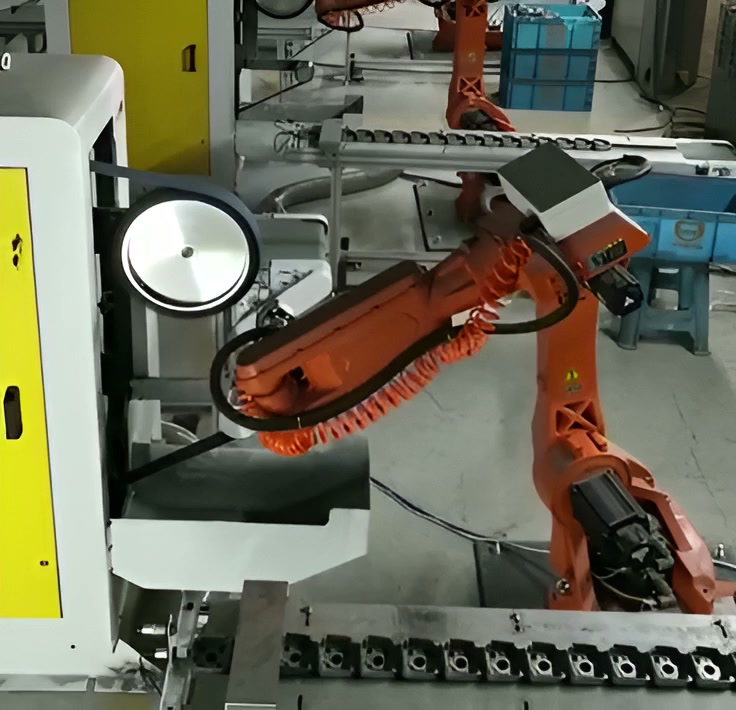
00:05 — An orange robot is positioned beside a fixed abrasive station; small metallic pieces are visible below.
For a proposed part-held route, ask what locates and retains the part and which surfaces the gripping method hides. For a tool-held route, ask how the abrasive reaches the required area without losing contact control. A compliant or actively controlled contact device may be placed in different parts of a cell; its presence and effect must be specified and tested. Smooth robot motion alone says nothing about constant grinding force.
Define a process window, not a perfect sample
Abrasive finishing depends on contact force, angle, speed and the abrasive itself. Wear can change the wheel or belt’s geometry and cutting behavior. The acceptance window therefore needs both incoming part variation and abrasive-life variation. A proposal that passes a fresh, easy sample has answered only one corner of the problem.
Start with the buyer’s actual part drawing and finish requirement. Identify the location/edge to treat, allowed remaining burr or finish appearance, and any dimension that must not be harmed. Gather ordinary incoming parts and the agreed high-burr or position-variation examples. For each, record how the part sits in the fixture, what contact arrangement is used, and the state of the abrasive. Inspect the result by the same acceptance method used for production. If the method is visual, agree on reference samples and lighting; if it is dimensional or surface measurement, record the instrument and limits.
| Trial question | Observation needed | Meaning for the route |
|---|---|---|
| Can the part be located and held repeatedly? | Seat/hold failures and which datum moved | Fix presentation or narrow the family before tuning a grinding path |
| Can the contact remove the required material without harming the part? | Accepted, under-finished and over-finished results at ordinary and severe incoming states | Adjust contact/abrasive/process scope or keep the exception on a separate route |
| Does the result survive abrasive life and changeover? | New, used and near-change abrasive results; time and errors at a real family change | Specify wear handling and changeover work in the capacity estimate |
The trial record should separate accepted first pass, accepted after rework, scrap, and not presented safely. This distinction prevents a fast robot motion from being mistaken for fast accepted output. A failure at the worst agreed incoming condition does not automatically reject all automation: it may justify an upstream burr limit, a separate heavy-removal step or manual exception path. Conversely, a high exception rate may erase the benefit of automating only the easy pieces.
Compare the right unit of capacity and cost
For each part family, record the present manual touch time and inspection/rework time; proposed robot loaded cycle and operator attendance; fixture, programming and abrasive-change time allocated to its batch; changeover frequency; and first-pass acceptance for both routes. Then compare accepted parts per scheduled hour and total cost per accepted part using that plant’s rates. A short robot grinding stroke is not a low-cost result if every part needs manual repair or every small batch requires a long changeover. Without those observed inputs, label the concept “sample first” rather than claiming a return on investment.
EVST can discuss a first automation scope from part photos/drawings, the areas to finish, representative incoming variation, current acceptance samples and the batch/changeover mix. The useful output is a defined process window and an exception route.
Related EVST reading: The grinding and polishing workstation guide describes available layouts and model families. The contact and wear guide goes deeper into process controls. This article addresses which slice of the current manual work merits an automated trial first.