
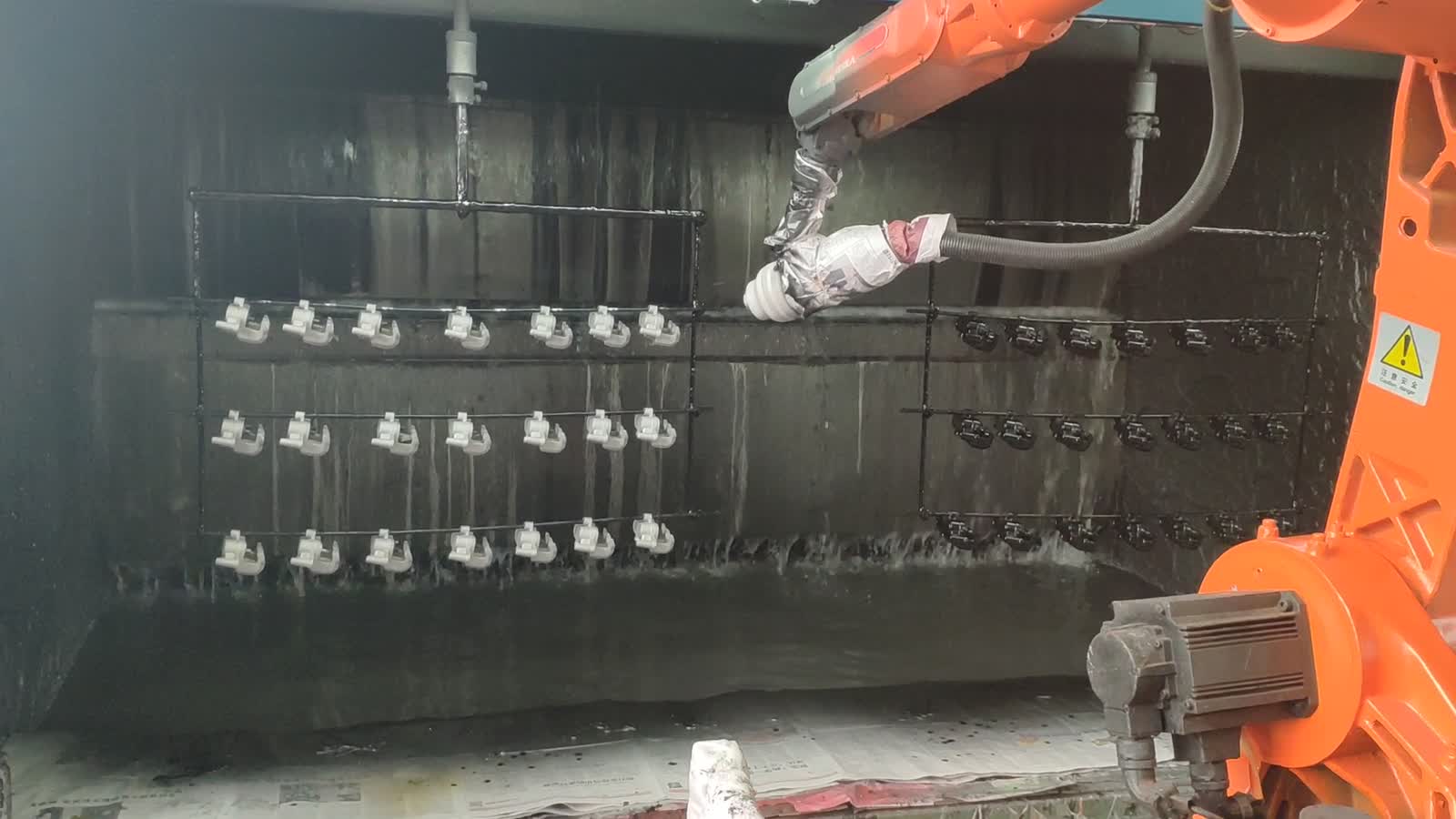
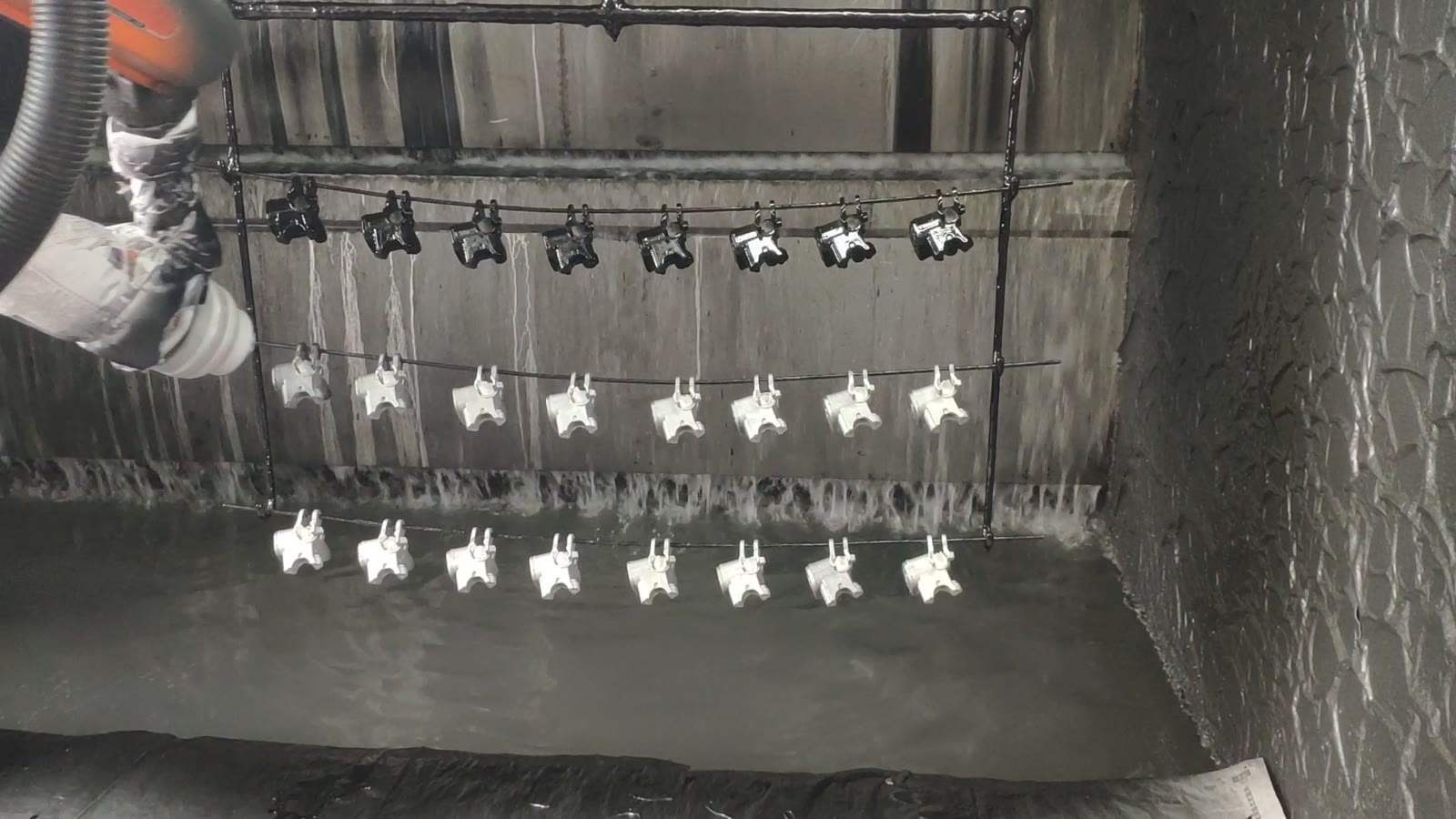
In short: This paint booth finishes small motorcycle brake parts as they hang in rows on a hanger line. A six-axis robot carries a spray gun and sweeps it back and forth across each row, following the parts as they move through the booth. The gun is masked in cloth and tape, and a water curtain down the back wall carries the overspray into a floor trough. Three decisions carry a setup like this: how the parts hang, how the gun travels across a moving row, and where the overspray ends up so the booth stays clean. Planning a similar line? Send us your part drawing.
At a glance
| Part | Small motorcycle brake-type metal parts |
| Process | Paint spraying |
| Automation | One six-axis robot carrying a spray gun |
| Part supply | Parts hung in rows on horizontal bars that move through the booth |
| Locating | The hanger and the line set the spacing; the robot follows the row |
| Workholding | Parts hang from the bar, no clamping needed |
| Operator role | Loads and unloads hangers and tends the booth |
| Cell layout | One robot inside a water-wash booth |
The problem this cell addresses
Paint is the process where consistency is hardest to buy from a person. Film thickness, edge coverage and the rhythm of the pass all change with the operator’s hand, and on a line of small parts the difference between the first part and the last one is exactly what the customer notices.
A robot removes the hand from the equation. It makes the same pass, at the same distance and the same speed, every time. The challenge is not the spraying itself; it is hanging the parts so the gun can reach every face, planning the gun’s path across a row that keeps moving, and managing the overspray so it ends up in the water instead of on the next part.
How the cell runs
- Parts arrive on hangers. Small metal parts hang in rows from horizontal bars, one row after another moving into the booth.
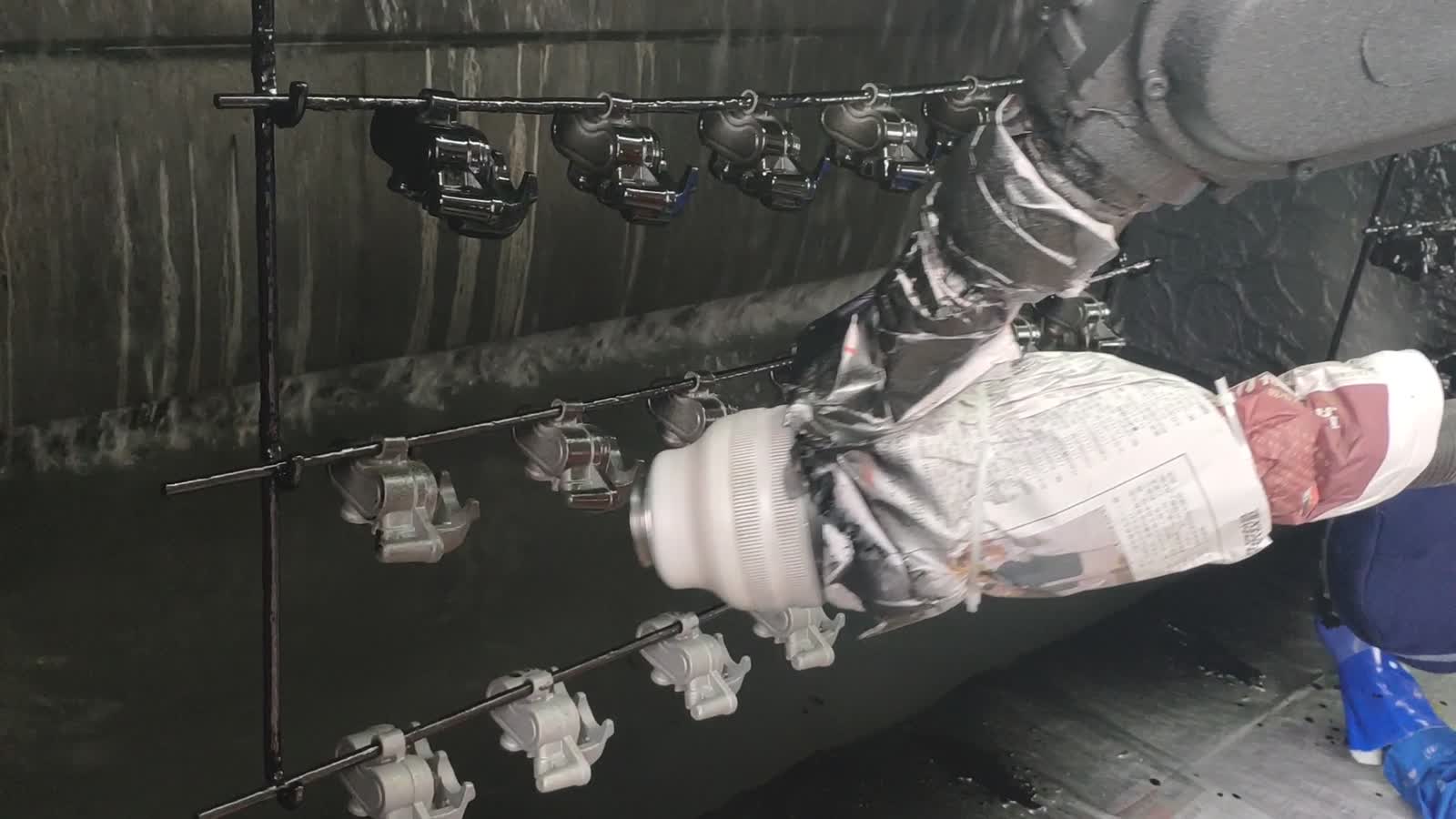
- The robot takes position. A six-axis robot stands in the booth with a spray gun at the end of its arm, the gun wrapped in cloth and tape to keep paint off its body.
- Sweep the row. The robot brings the gun to the first part in the row and sweeps across, coating each part in turn.
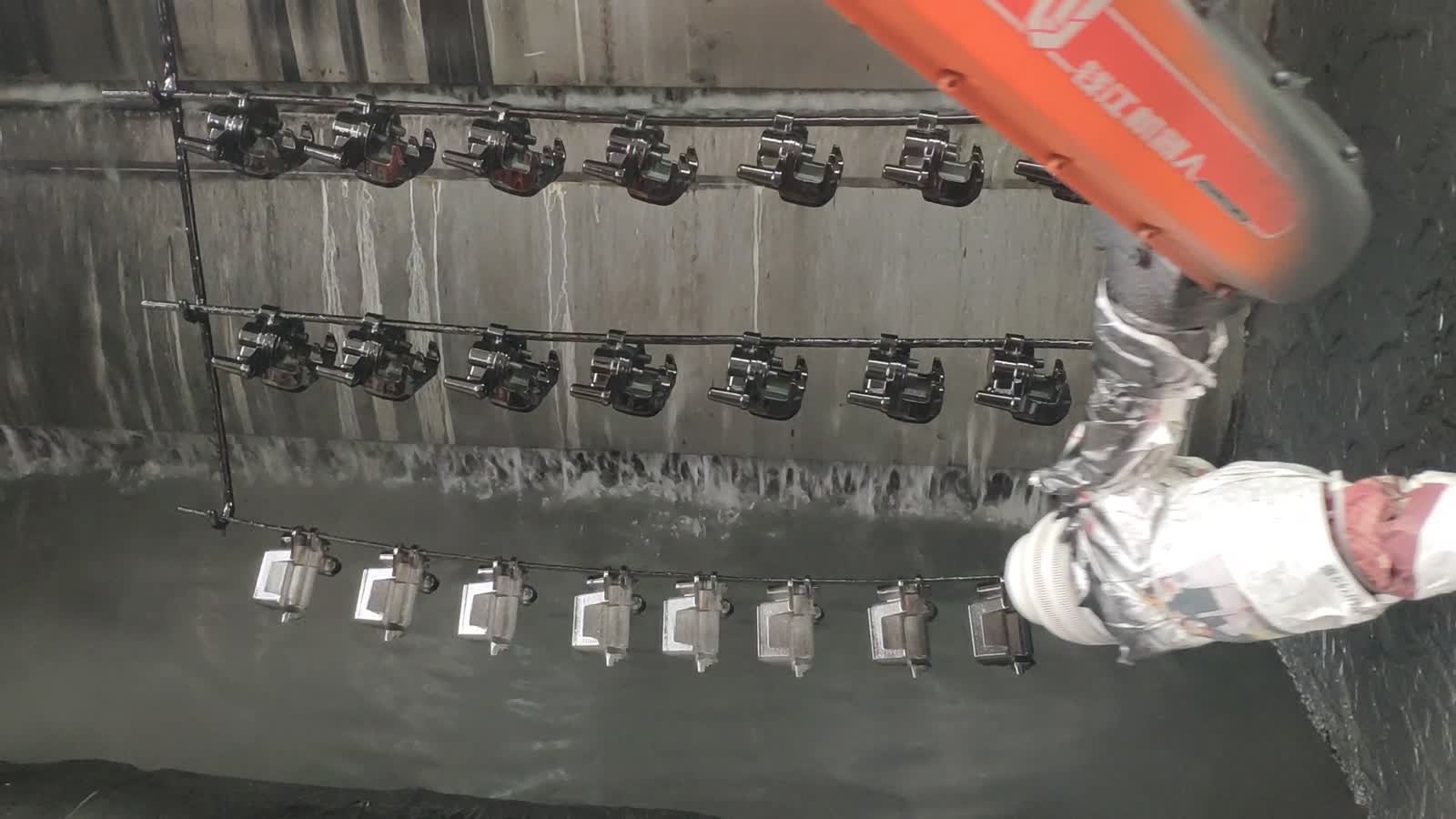
- Follow the line. As the hanger carries the row forward, the robot keeps its pass in step with the moving parts.
- Catch the overspray. A water curtain runs down the back wall into a floor trough, so what misses the parts ends up in the water rather than on the walls, ready for the next pass.
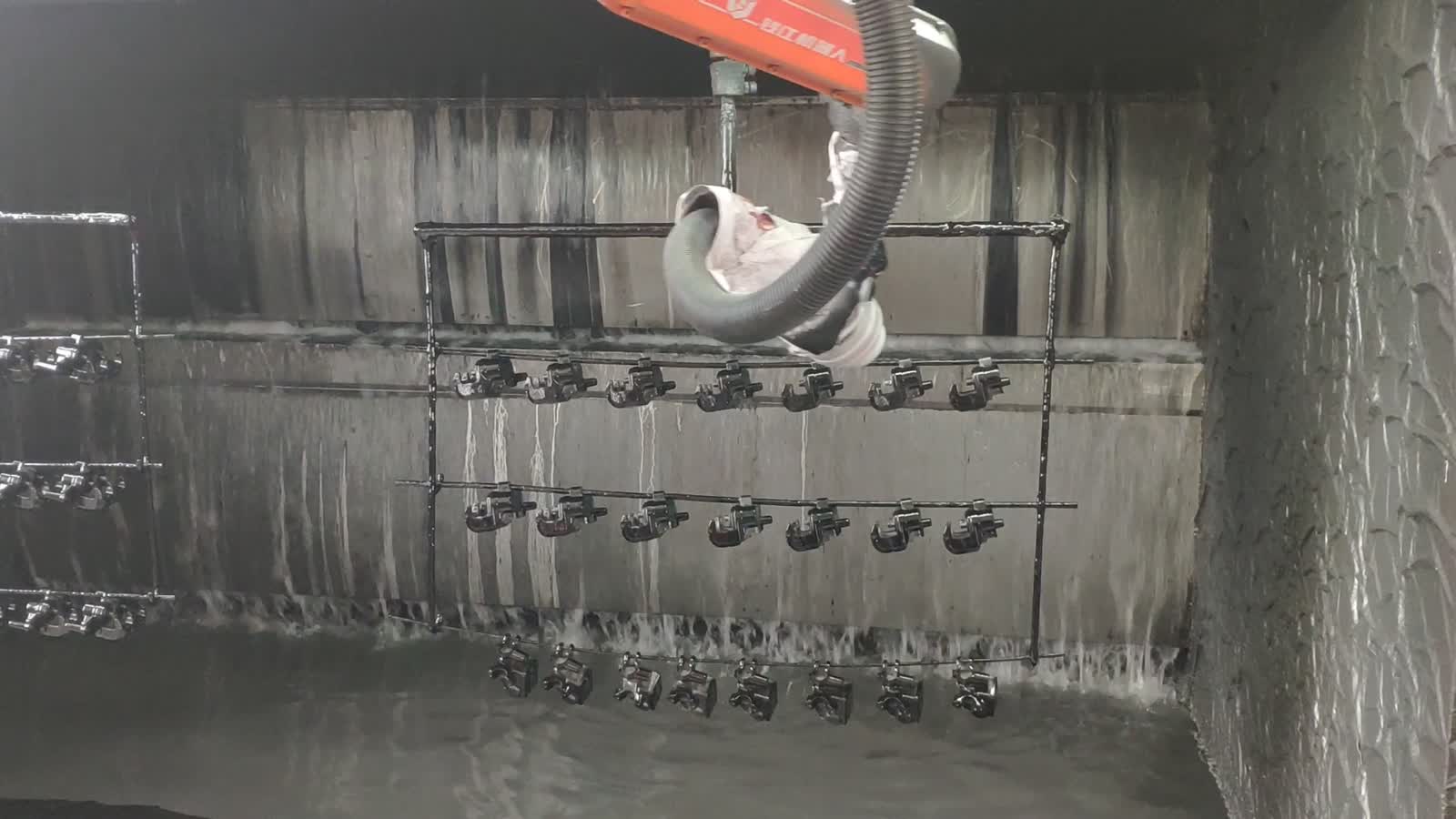
- Next row. The finished row moves on and the next one comes into reach, and the robot begins the pass again.
Three design decisions
1. Hang the parts so every face is reachable
A hanger line only works if the robot can coat what the customer sees. If parts hang too close together, the faces between them stay shadowed; if they are angled badly, an edge or a recess never gets paint.
The question to settle is spacing and orientation: how far apart the parts hang, whether they are angled toward the gun or face it squarely, and whether every surface the spec requires is exposed to the spray. Hanging is the cheapest place to fix coverage — once the line is running, a shadowed face means a manual touch-up.
2. Plan the gun’s path against a moving row
Painting a moving row is a coordination problem. The gun has to match the line’s travel while it sweeps, or the pass stretches on one part and thins on the next. The robot’s path is not a single sweep; it is a sweep that drifts with the hanger.
What helps: keep the pass rate steady relative to the line, overlap each part the same amount, and leave a consistent standoff distance so the fan stays even across the row.
3. Decide where the overspray ends up
Everything the gun throws that does not land on a part has to go somewhere. In an open booth it settles on the walls, the hangers and the robot itself, and it ends up as dust on the next parts. The water curtain on the back wall is what keeps the process clean.
The practical points: whatever catches the overspray — a water curtain here, an extraction system elsewhere — has to take it away without disturbing the spray fan, and the gun masking has to survive the environment — paint creeping into the gun body or the arm joints is a maintenance problem, not a quality problem.
When this layout fits — and when to look closer
- Good fit: batches of small parts that can hang, a limited number of shapes that all take the same pass, and a booth that already moves parts through on hangers.
- Evaluate further: many part shapes (a new shape usually needs a new hanging pattern and a new gun path), faces that cannot be reached from one side, parts too delicate to hang, and colours or coatings that need a change of gun or a wash between runs.
FAQ
Why not paint these parts with a reciprocator instead of a robot?
A reciprocator does one straight pass well. A robot earns its place when the pass has to follow a part’s shape — turning the gun at an edge, pausing on a recess, or matching a moving row — and when the line runs more than one part shape that each need a different path.
How do the parts stay in place while the gun passes?
They hang from the bar, and their own weight keeps them steady. The trick is the hanging pattern: parts are spaced and angled so the gun’s fan reaches every exposed face without the parts swinging or touching each other as the line moves.
What decides the cycle here?
How fast the line moves the rows through the booth, and how long the robot needs to coat a full row at the required thickness. Send the part drawing with the faces you need coated and we can estimate it.
Get a layout and cycle-time estimate
Send us:
- Part drawing with the faces you need coated marked
- Material and required finish or film thickness
- Number of part shapes and how often you change over
- Daily or annual volume and line speed
- Photos or dimensions of the booth and hanger layout
We will reply with a booth layout proposal and a cycle-time estimate.
Send your part drawing → or email sales@evsrobot.com
Footage filmed at a partner’s production site. Cycle time, current and consumable figures from that site are not public and are not given here.