
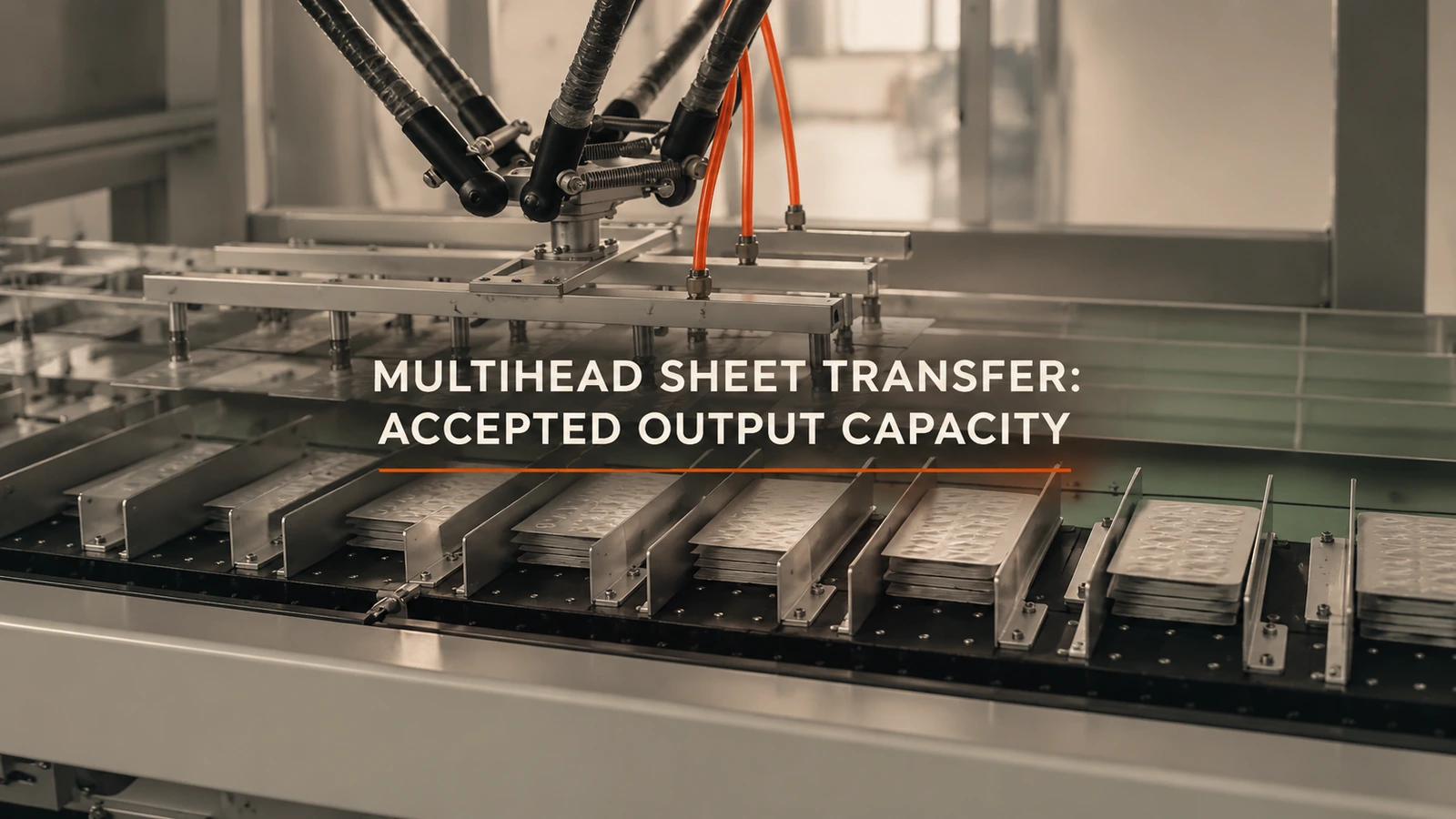
Multihead sheet transfer capacity should be expressed in accepted pieces delivered across an agreed boundary, not in robot moves or the number of contact heads. Divide the pieces actually accepted per complete cycle by the complete cycle time. Then distinguish a running-hour estimate from a planned-hour estimate before comparing the station with the rest of the line.
Define the unit before measuring speed
The accompanying footage shows a parallel mechanism carrying a crossbar with multiple contact heads above separated lanes of stacked sheet-like pieces. That arrangement makes the counting question important: a head position is not itself evidence that an acceptable piece has been transferred.
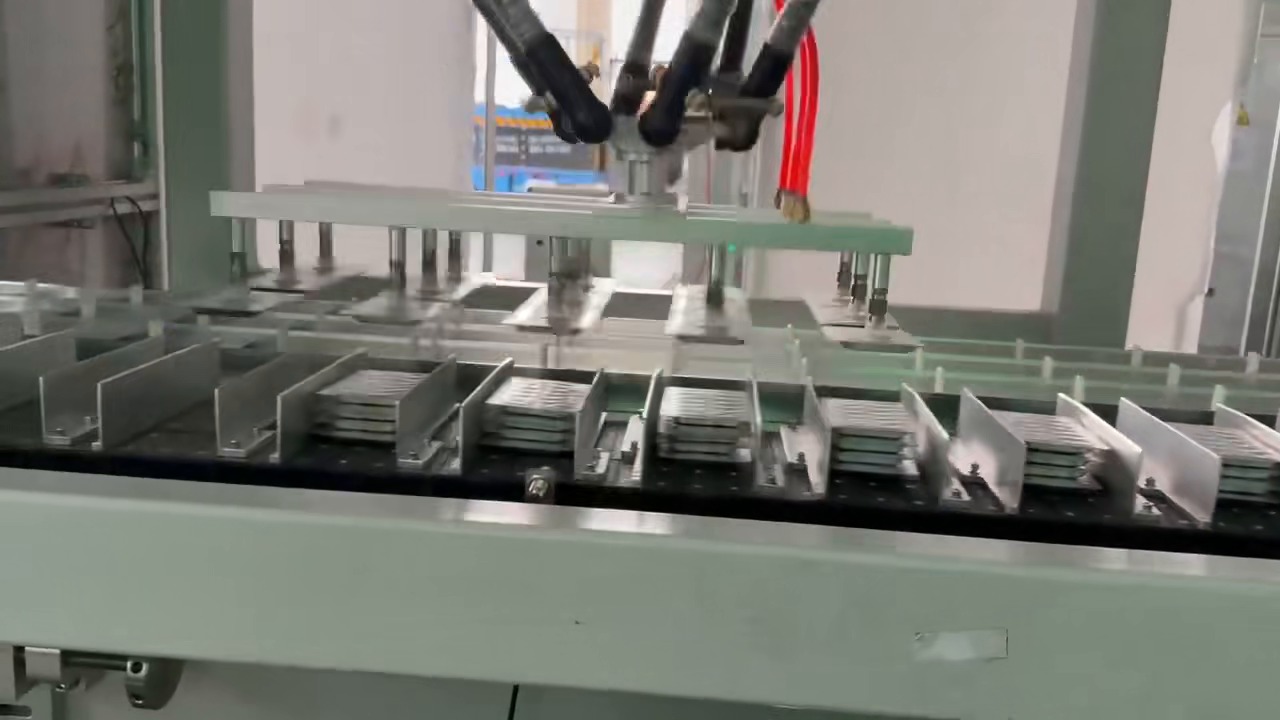
00:06 — The crossbar and its multiple contact heads sit above separated lanes of sheet-like pieces.
For a capacity trial, choose the receiving boundary and define what counts as one accepted piece. Use the same definition for the transfer station, the supply stage and the next operation. If one stage reports groups while another reports individual pieces, convert them before comparing rates.
Measure complete cycles from an agreed event to its next occurrence. Include the motion and running-cycle activities needed to reach that same state again. Record actual received pieces beside the time record so that an empty pickup position or an unsuccessful handover cannot silently become counted output.
A model with explicit time and count boundaries
For a representative steady running period, let n_good be the average accepted pieces per complete cycle and c_full the average seconds per complete cycle. The transfer rate is:
R_transfer = 3600 × n_good ÷ c_full, in accepted pieces per running hour.
The constant converts seconds to an hour; it is not a production assumption. This is a dimensional planning model, not a measured result from the clip. If cycles vary substantially, calculate accepted pieces divided by the total observed running time rather than averaging separate cycle rates.
| Recorded item | How it enters this model |
|---|---|
| Empty positions or rejected transfers | Reduce accepted pieces when calculating n_good |
| Retries included in timed complete cycles | Already increase c_full |
| Slower running movements included in the observation | Already increase c_full |
| Stops excluded from the running-period timing | Need a separate allowance when converting to planned time |
Do not multiply this measured running rate by another quality or speed factor for losses already included. Conversely, a trial that only times successful, uninterrupted cycles must not be presented as a whole-shift forecast. State which waits and stops were excluded.
If availability is measured as running time divided by planned production time, multiplying the running rate by that availability gives a planned-hour estimate under the same conditions. If the rate already uses all planned time, applying availability again would double-count the stopped time.
The line may accept less than the transfer station can move
After converting each stage to the same accepted-piece and time basis, compare upstream supply, transfer capacity and downstream acceptance. Their lowest sustainable rate is a planning ceiling for the connected flow. Actual output may be lower because starvation, blocking, buffers and recovery behavior affect how the stages interact.
A trial should therefore include the normal supply and receiving arrangements. Record whether the crossbar waits for material or for the next operation, and keep those intervals consistent with the time boundary used in the calculation. Increasing motion speed will not remove a receiving constraint.
For an investment discussion, first establish whether the shortfall belongs to transfer, supply or reception. Only then compare equipment or labor costs against the proposed change. Without that separation, a cost-per-piece estimate can assume additional saleable output that the line cannot receive.
Share the material arrangement, received-piece counts, cycle records and upstream/downstream rhythm with EVST. Those records let us discuss the handling cell’s capacity boundary and the trial needed to check it.
A different example of a station waiting on another process is why machine-tending cycle time differs from robot speed, where handling time and machine processing need separate budgets.