
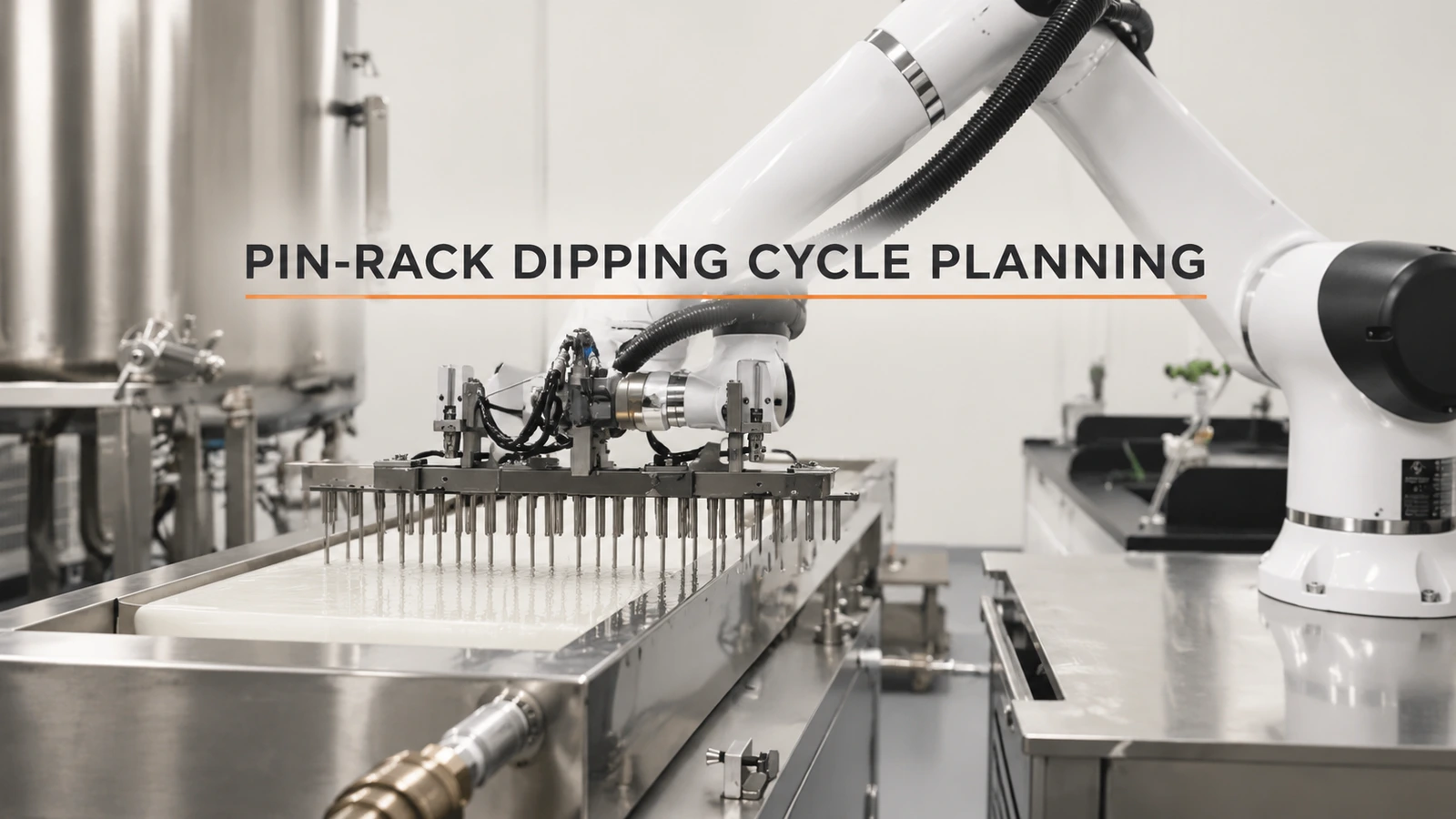
A robot’s dipping time is not a finished-capsule production rate. Start by counting one pin rack through a defined handling sequence, then check how often the next operation can accept it. When we plan this type of integration, those are separate capacities: a faster movement helps only if robot handling limits the agreed transfer interval.
Give the timing a repeatable boundary
Choose a state that can be recognised on successive racks: for example, a loaded fixture ready for the robot, ending when the robot is ready for the next equivalent fixture. Include the return and handover required by the proposed layout. Do not end the stopwatch at the attractive dipping motion while leaving the reset outside the estimate.
The accompanying example shows a white collaborative arm carrying a pin rack towards a trough, lowering it, lifting it and changing its orientation. It illustrates the handling operations to discuss, rather than a measured repeating production cycle.
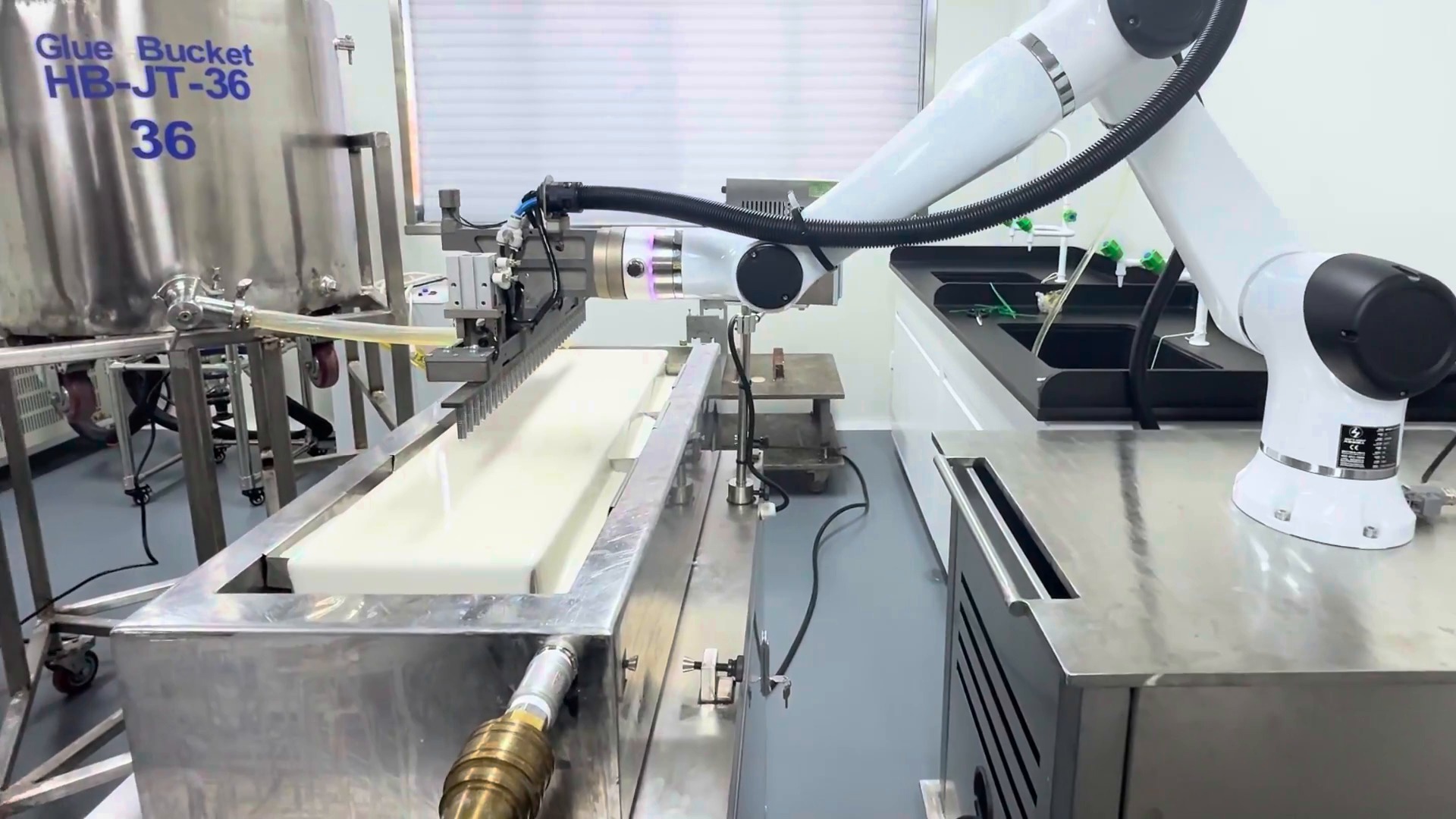
00:10 — The pin rack is lowered towards the trough opening.
For the proposed sequence, separate motion from process-dependent time. Entry, immersion or holding, withdrawal, rotation and handover may each have different limits. The material-process owner needs to establish which speeds and holds are acceptable; they are not spare seconds that can automatically be removed from a robot quotation.
A fixture-capacity example, with explicit assumptions
Consider an entirely hypothetical serial handling sequence. The times below are assumed planning inputs, not measurements from this recording or recommended capsule-process settings.
| Element | Assumed time |
|---|---|
| Entry | 4 seconds |
| Process hold | 5 seconds |
| Withdrawal | 5 seconds |
| Reorientation | 4 seconds |
| Handover and reset | 4 seconds |
| Non-overlapping wait | 2 seconds |
| Total per pin rack | 24 seconds |
Under the additional assumptions of one rack per sequence, continuous supply and no other interruptions, the handling ceiling is 3,600 ÷ 24 = 150 racks per hour. Suppose the downstream interface accepts only one rack every 40 seconds. Its ceiling is 3,600 ÷ 40 = 90 racks per hour. With compatible handovers, that slower interval limits the combined flow. Reducing handling to 20 seconds would raise the handling ceiling to 180 racks per hour but leave that downstream ceiling unchanged.
The point of the calculation is to locate the constraint. It does not say the application should use these times, nor convert racks to accepted capsules. The number and type of pins, cap/body matching, later operations and quality release would require their own verified basis.
Decide where the robot must remain occupied
If a process hold requires the robot to support the rack, it occupies the robot. If a validated method allows the rack to be handed to another fixture, that hold may overlap the next handling sequence. This changes the tooling and transfer scope, not just the program’s speed setting.
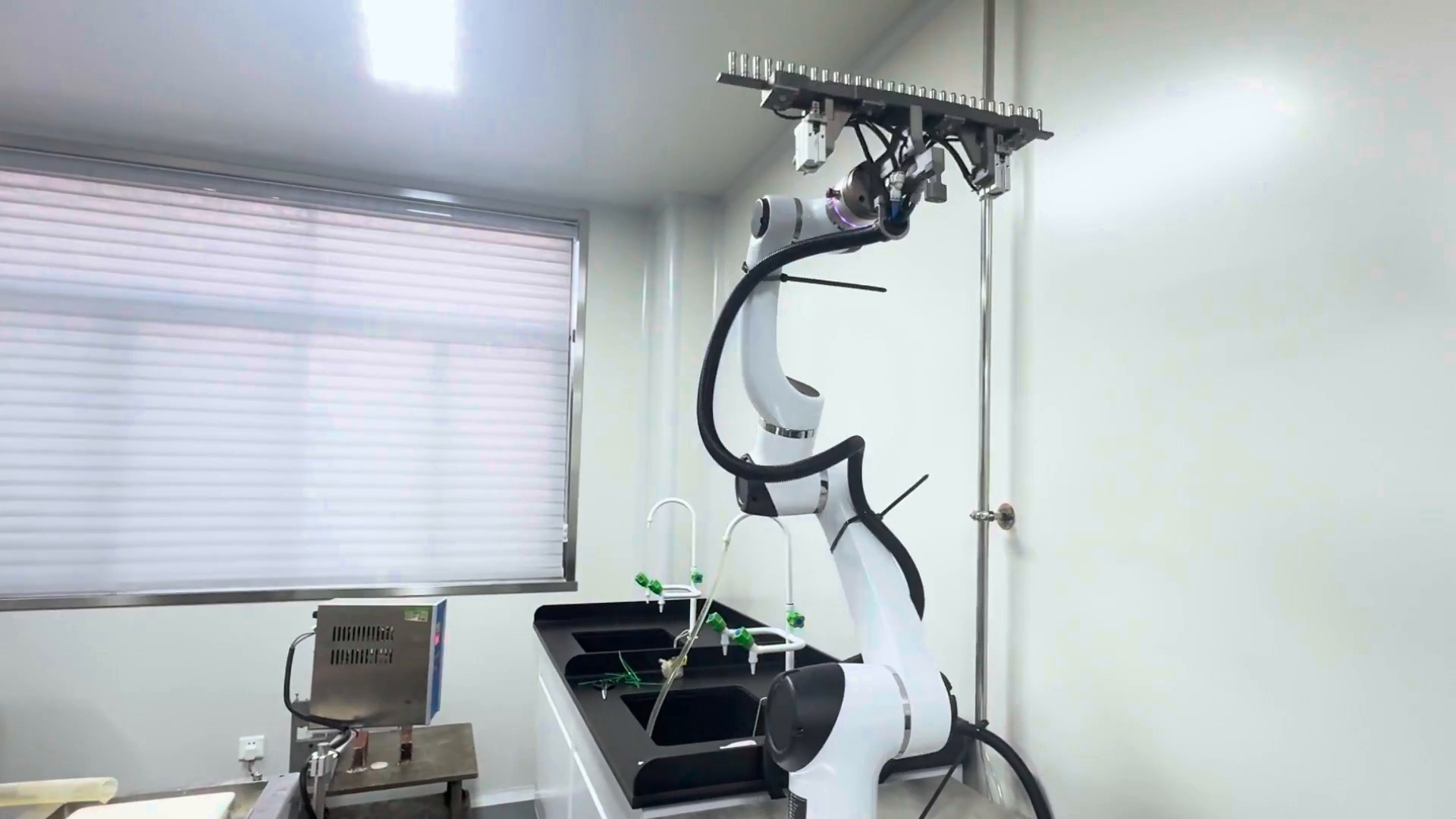
00:24 — The arm changes the rack’s orientation after lifting it clear of the trough.
More racks help only when their route and return are workable. A buffer can absorb a temporary mismatch; it cannot indefinitely overcome a downstream operation that accepts racks more slowly than they arrive. For each candidate layout, identify where a rack waits, who or what releases it, and whether that wait blocks the next transfer.
Public hard-capsule manufacturing descriptions include setting and drying after dipping, followed by stripping, cutting and joining cap and body. The visible pin-rack operation therefore needs its own timing boundary. Our discussion of why machine-tending cycle time differs from robot speed explores the related handling-versus-process distinction in a different application.
Record the times that change the layout
For a trial, record the rack-ready signal, each motion segment, any required holding period, downstream acceptance and the return to the next starting state. Mark which activities can actually overlap. A normal run and a delayed downstream handover are both useful: together they expose whether the proposal needs more handling speed, a different transfer arrangement or more capacity after the robot.
Share the fixture dimensions and pin arrangement, current sequence timings, downstream occupancy and the intended shift requirement with EVST. We can use them to discuss the robot-to-fixture interface and an appropriate trial-timing scope.