
Most press-tending ROI spreadsheets start in the wrong place: they plug a robot’s brochure peak speed into a formula and assume output will jump dramatically overnight. In real hydraulic and die-casting press tending, total cycle time is governed first by the press’s fixed forming and dwell cycle, and second by how cleanly your robot’s reach, gripper design, and hardwired safety interlocks compress the open-die window. Payback is rarely won by buying an oversized ultra-fast arm; it is won by steady multi-shift cadence, reduced hot-zone operator turnover, and avoiding hidden commissioning overruns on press-to-robot electrical handshakes.
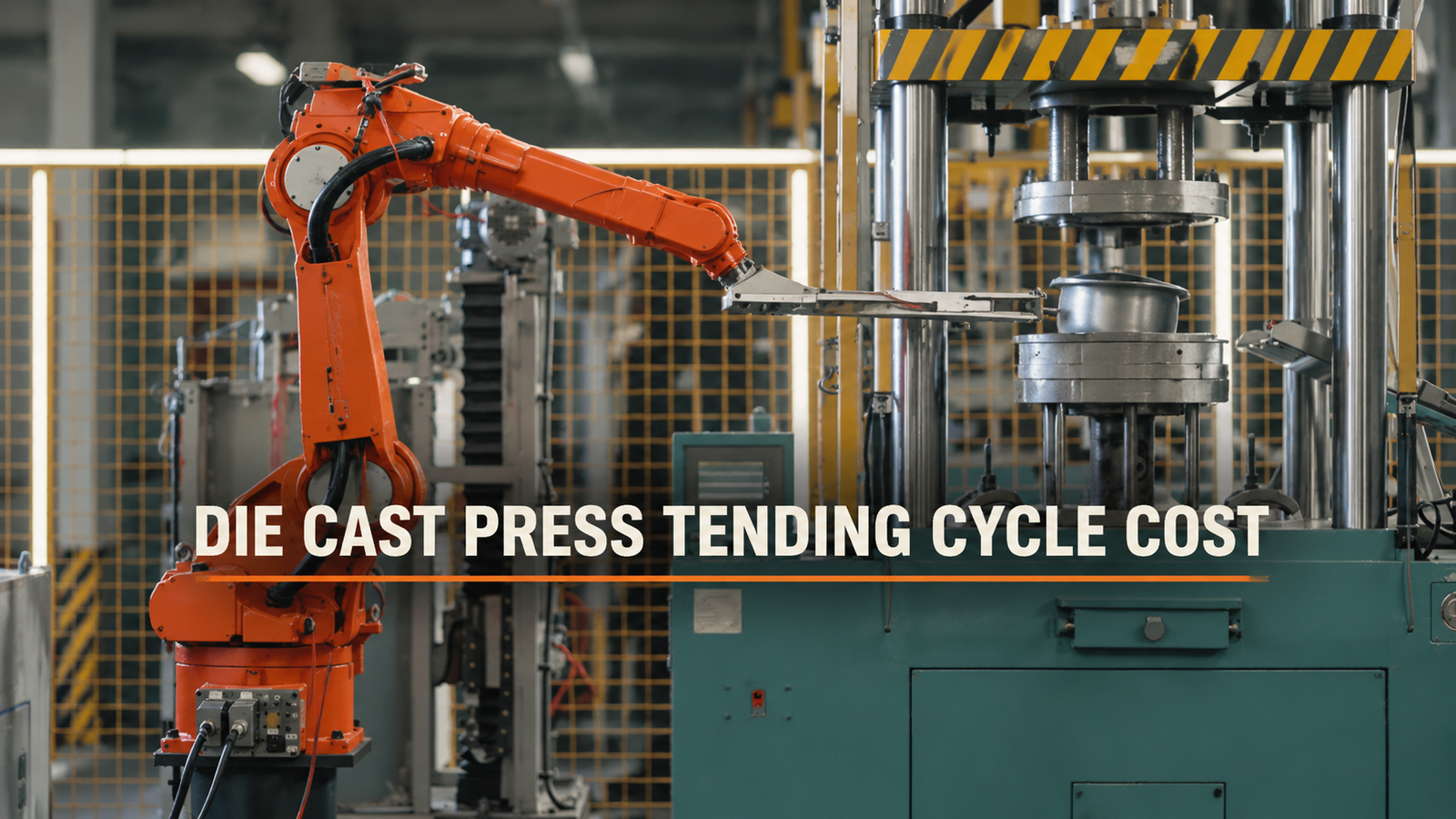
In the tripod-locked cell shown below, a pedestal-mounted six-axis industrial robot tends a four-column vertical hydraulic press forming round metal cookware bodies. Watch the rhythm across consecutive cycles: the robot waits completely still in a clear standby posture while the upper platen closes and dwells, then extends an elongated flat pneumatic fork straight between the press tie bars the moment the die opens, extracts the casting, and clears the press zone before the next stroke initiates.
Where Every Second Actually Goes: The Five-Part Cycle Budget
Before asking an integrator for a throughput guarantee, split one complete press cycle into five measurable buckets using a stopwatch on your existing manual press:
| Cycle Segment | Who Controls the Clock? | What Compresses It Safely? | Common Estimation Mistake |
|---|---|---|---|
| 1. Press Close + Forming / Solidification Dwell | Press hydraulics & metallurgy (fixed floor) | Only die thermal management or press-side process tuning—a faster robot cannot shorten this | Assuming robot automation speeds up solidification or hydraulic dwell |
| 2. Die Open + Ejector Advance & Confirm | Press PLC & safety-rated limit switches | Reliable dual-channel die-open confirmation so the robot starts moving immediately at full-open | Leaving sluggish mechanical limit switches or unverified timer delays in the handshake |
| 3. In-Die Reach, Grip & Part-Present Check | Robot path + elongated fork EOAT design | Keep the forearm outside the tie bars with a slim extended fork; verify grip with fast reed/pressure sensors | Using a bulky wrist mount that forces slow joint re-orientation between tie bars |
| 4. Retract Clear of Die + Press Re-Close Trigger | Safety-rated clear-of-die interlock | Send a verified out-of-zone safety bit as soon as the fork exits the press perimeter so closing starts early | Waiting for the robot to finish downstream drop-off before releasing the press to close |
| 5. Downstream Transfer (Quench / Trim / Conveyor) | Robot during press dwell (masked time!) | Execute cooling, blow-off, or conveyor drop-off o the press is closed and forming the next part | Adding downstream transfer time on top of press dwell instead of overlapping them |
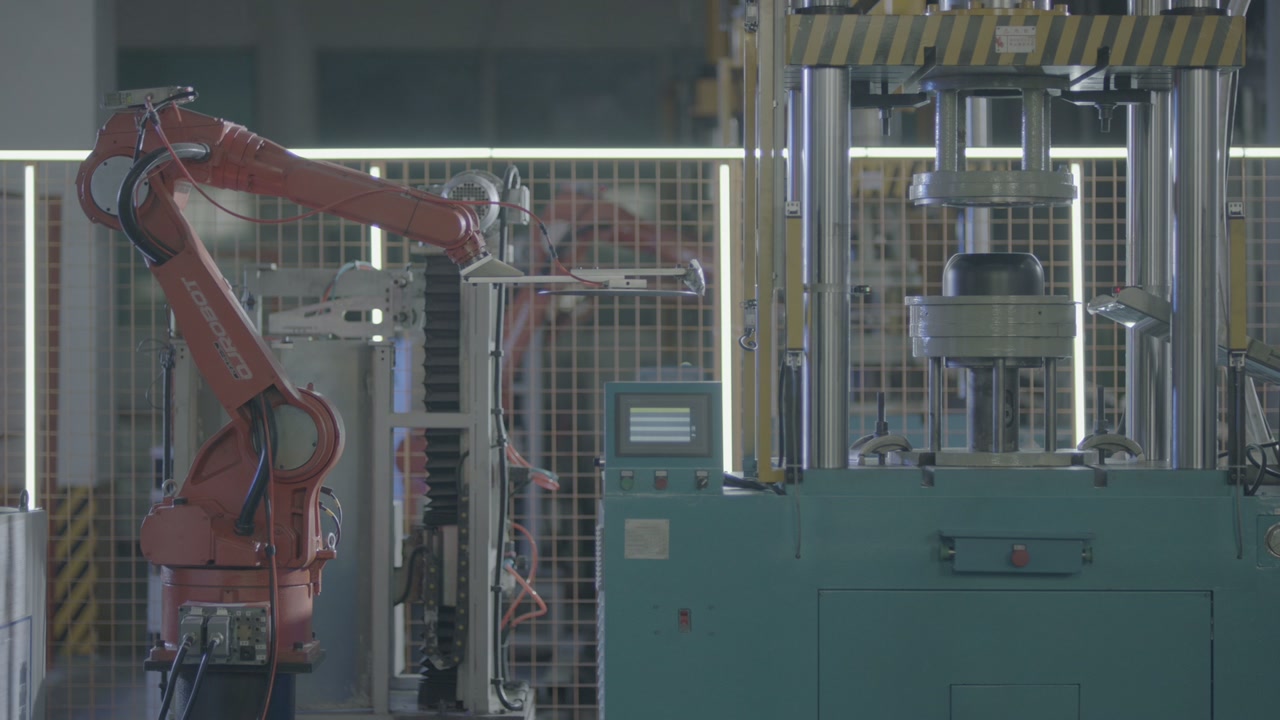
Extending a slim fork end-of-arm tool horizontally between the four press columns lets the arm clear the die window rapidly without squeezing the robot forearm into the crush zone.
Full Cell Cost Structure: Look Beyond the Bare Robot Arm
One of the most frequent budget surprises in robotų preso aptarnavimas is pricing only the six-axis manipulator and forgetting the safety and tooling infrastructure required to run unattended shifts. When building your internal budget estimate, separate capital cost into four transparent line items:
- Manipulator, Pedestal & High-Temp Dress Pack: Sized for casting weight plus the leveraged bending moment of an elongated fork reaching deep into the press platen—plus heat-resistant cabling and protective sleeving if working near molten or high-temperature dies.
- Custom Elongated Fork EOAT With Fail-Safe Sensing: Includes heat-tolerant jaw fingers, grip-confirmed proximity or pressure switches, and check-valve / spring-lock air-loss protection so a utility pressure drop never releases a heavy metal casting onto an expensive die surface.
- Press-to-Robot Safety PLC & Electrical Interlocks: Hardwired dual-channel
Die-Open Confirm,Robot-Clear-of-Die,Ejector Interlock, cascaded Emergency Stop loops across both controllers, and perimeter wire-mesh fencing with interlocked access gates (as visible behind the press in the cell view below). - Upstream/Downstream Presentation & Maintenance LOTO: Part cooling or discharge conveyor, pneumatic/hydraulic dump valves for safe Lockout/Tagout maintenance, and operator HMI recovery screens for clearing a mis-seated casting without calling a controls engineer.
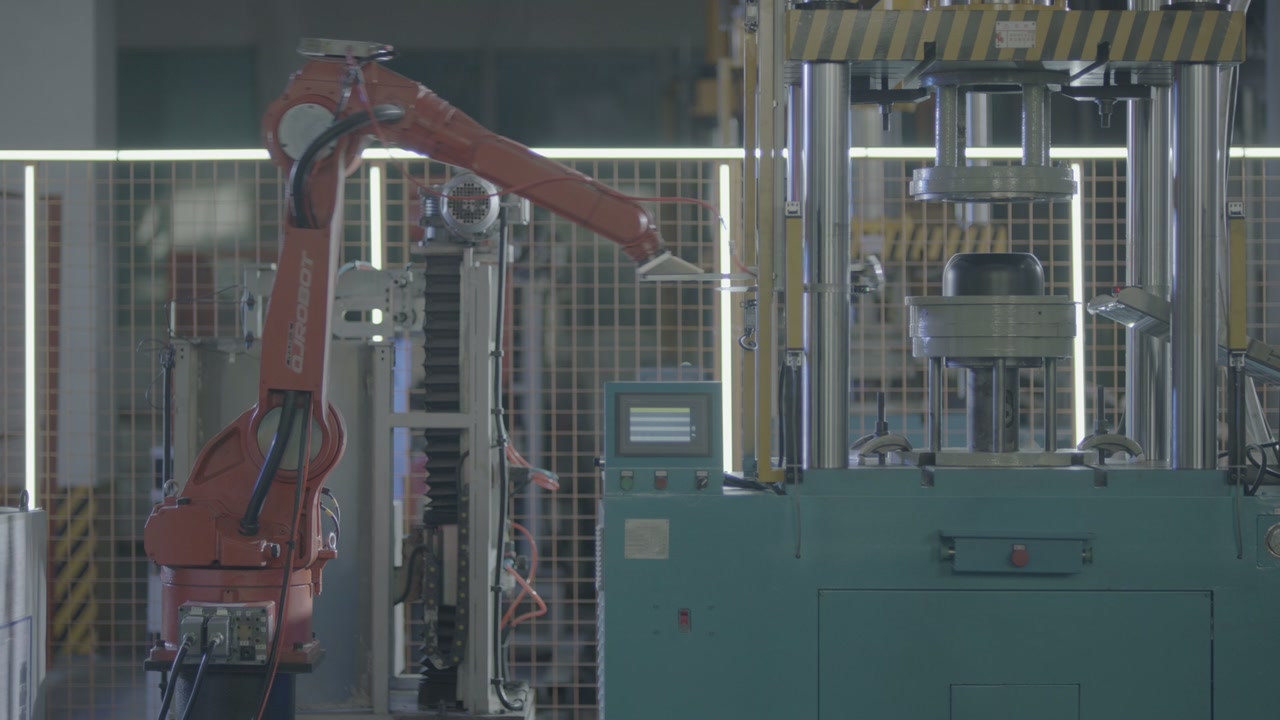
Rear wire-mesh safety fencing, hazard striping on the moving press beam, and clear standby zones belong in the initial budget—not as last-minute change orders.
Three Real-World Boundaries That Decide Payback Speed
Because the footage above displays no live cycle counter, press tonnage, or plant wage data, avoid trusting generic “6-month payback” claims. Instead, test your own press against three practical payback boundaries:
- One shift vs. two or three shifts: On a single 8-hour shift with low part volume and frequent die changeovers every two hours, a dedicated robotic press-tending cell often struggles to recover integration costs quickly. Once the same press runs two or three shifts on steady part families—especially in hot, noisy, high-turnover cookware or automotive die-casting bays—the economics shift sharply in automation’s favor.
- One robot serving one press vs. dual-machine tending: Look back at Step 1 in the cycle table. If your press’s closed dwell window is long (for example, heavy-wall castings requiring extended cooling), a single six-axis robot sitting idle for most of each cycle can often tend two adjacent presses or perform secondary trim-press loading / part quenching inside that masked dwell time—nearly halving capital cost per press.
- Hidden scrap and thermal consistency gains: Manual operators inevitably vary their open-die pause time across an 8-hour hot shift, causing die temperature drift, sticking, and uneven flash. Consistent automated extraction timing stabilizes die thermal rhythm, which often matters just as much to net margin as direct headcount savings.
Dažnai užduodami klausimai
How fast does a robot need to be for hydraulic or die-casting press tending?
Fast enough to complete die entry, grip confirmation, and clear-of-die retraction inside your target open-die window—not faster. Buying a heavier-duty arm with strong wrist rigidity for an elongated fork nearly always beats chasing peak empty-arm speed ratings.
Can an older hydraulic press be integrated with a robotic tending cell?
Yes, provided its electrical cabinet can be upgraded to output reliable, safety-rated Die-Open bei Ejector-Home confirmation signals and accept a safe Cycle-Start / cascaded E-stop interlock. Always budget a controls audit of the press cabinet before signing a fixed-price quote.
What happens if the robot fails to confirm part extraction from the die?
A properly engineered cell halts immediately before issuing the next press-close permissive. Part-present verification on the fork gripper (or a dedicated part-check sensor outside the die) prevents the catastrophic cost of double-stamping or closing a die onto a stuck casting.
Build Your Press-Tending Cycle & Budget Estimate With EVST
Ready to move from rough rules of thumb to a real engineering worksheet for your hydraulic or die-casting presses? Explore our industrial robot lineup or send your press open-die window, casting weight, shift schedule, and two press-bay photos to EVST to receive a realistic cycle-budget and cell integration layout.