
A clear-container infeed trial should show whether the container reaches the agreed receiving position after the tool releases and withdraws. Keep manual presentation where the incoming condition still requires changing decisions; consider robotic pickup where representative arrivals and releases repeat acceptably. If the same spacing or support problem keeps causing a disturbance, test a presentation change before automating that disturbance.
Give the trial a defined arrival condition
Use the actual rectangular containers and the range of arrival positions the proposed infeed is expected to accept. Include the product variations that will genuinely run on the system. Agree which conditions are acceptable input and which should be corrected or rejected before pickup.
At each trial, record the container’s incoming position, the candidate tool contact and its position after release. This separates a presentation problem from a transfer problem. If a container is already overlapping its neighbor or arrives in an unaccepted orientation, a failed transfer does not answer whether the same tool works with correctly presented input.
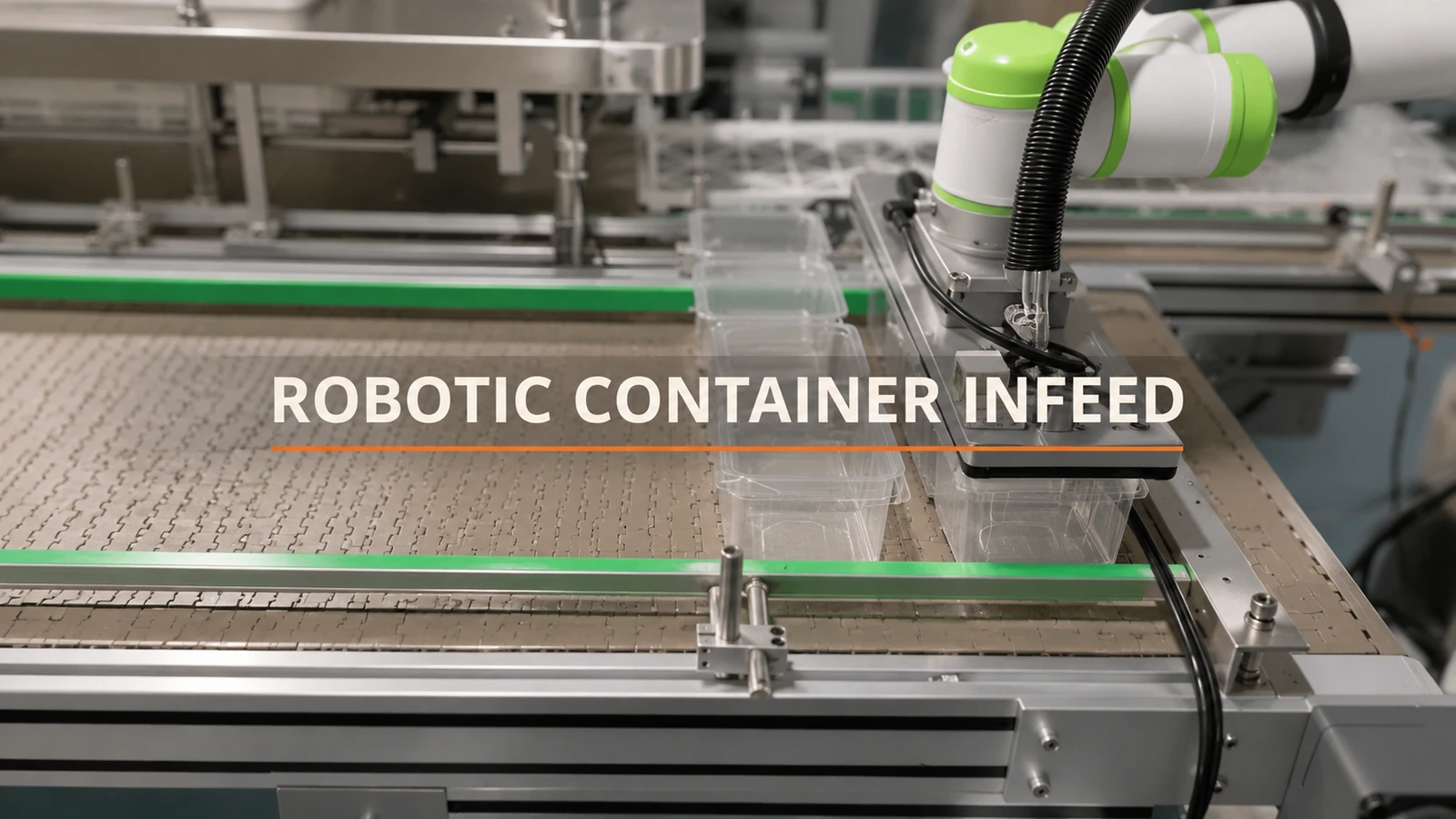
In the filmed example, the foreground conveyor brings clear rectangular containers from left to right to the pickup end. A white-and-green robot uses a rectangular plate-like tool to transfer them to the rear receiving area.
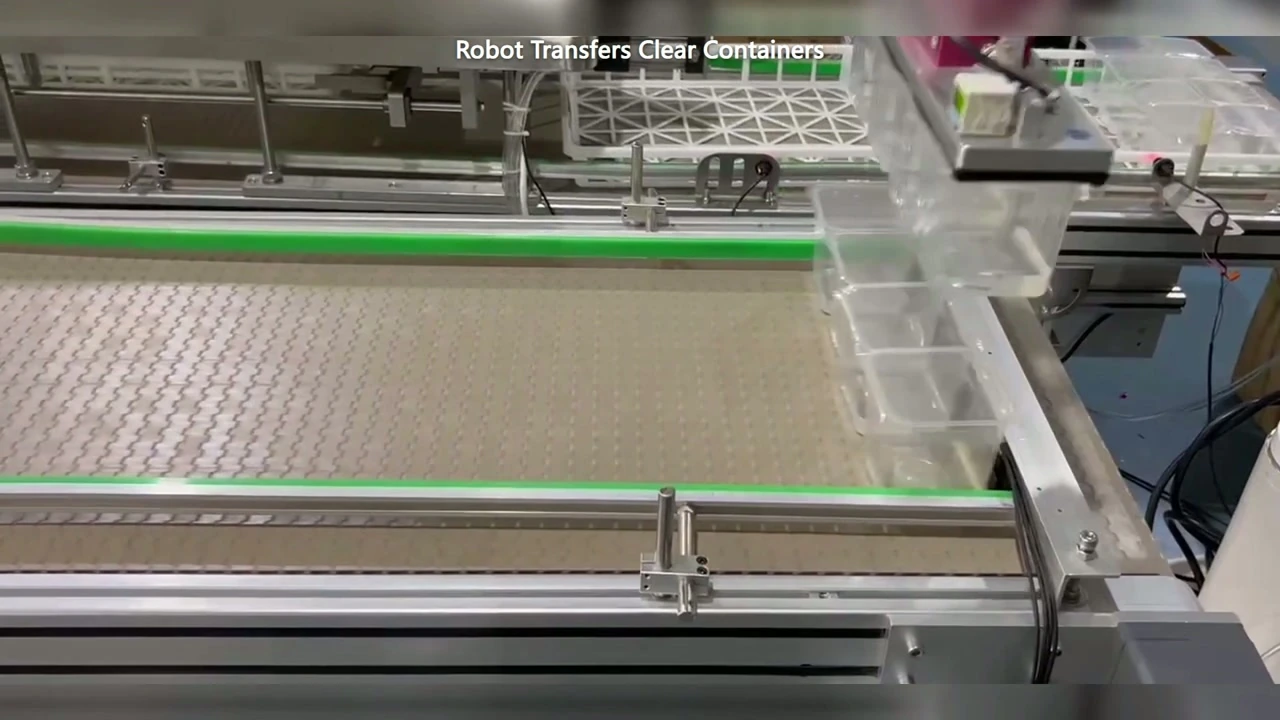
Plate-like tool and clear rectangular containers at the conveyor handoff.
Watch release and withdrawal, not just pickup
A successful pickup is only an intermediate observation. Follow the container through tool release, tool withdrawal and the start of downstream travel. Check its final orientation and location against what the next operation accepts.
If a sample changes position during release, first identify when the disturbance occurs. Is it already misplaced as the tool arrives, does it move as contact ends, or does it change position as the conveyor carries it away? Those observations point to different trial changes: presentation, the candidate release sequence, or the receiving support and conveyance condition.
Packaging gripper design is workpiece-dependent. When a candidate method relies on a seal, a particular contact region or support of the container, test that condition on the actual samples. Transparency alone does not select a gripping principle, and a setting that lifts a sample does not establish an acceptable conveyor handoff.
Let the observed result change the work allocation
| Bandomasis stebėjimas | Arrangement worth considering | What still needs to be defined |
|---|---|---|
| Incoming containers require changing separation or orientation decisions, with no repeatable presentation yet provided | Retain manual presentation while the input condition is being resolved | Which decisions remain with the operator and what a future prepared input would look like |
| Agreed input variations can be picked, released and conveyed in the accepted pose | Evaluate a robot for that defined transfer | Replenishment, product setup and the response to inputs outside the accepted range |
| Disturbances recur at a specific spacing, approach or support condition, and a staging change removes them in the trial | Improve the infeed or receiving arrangement before specifying the robot task | The revised presentation condition and a repeat trial of the complete handoff |
These are conditional choices, not results claimed for this example. A useful manual-versus-robot comparison states what the trial made repeatable and what still needs an operator, rather than assuming a faster arm solves the arrival condition.
Pradėti, show EVST the container dimensions and a short sequence covering arrival, release and the receiving posture. Include the disturbance that prompts someone to straighten or separate a container. That makes it possible to discuss whether the first step is robotic transfer, retained manual presentation or an infeed change.