
Estimate a corrugated tank’s cycle by counting welding events and the movements between them, then adding the agreed loading and completion work. Total weld length divided by welding speed gives only travel time along the welds. It does not account for repeated starts, changes of welding position or the handoff that makes the cell ready for the next tank.
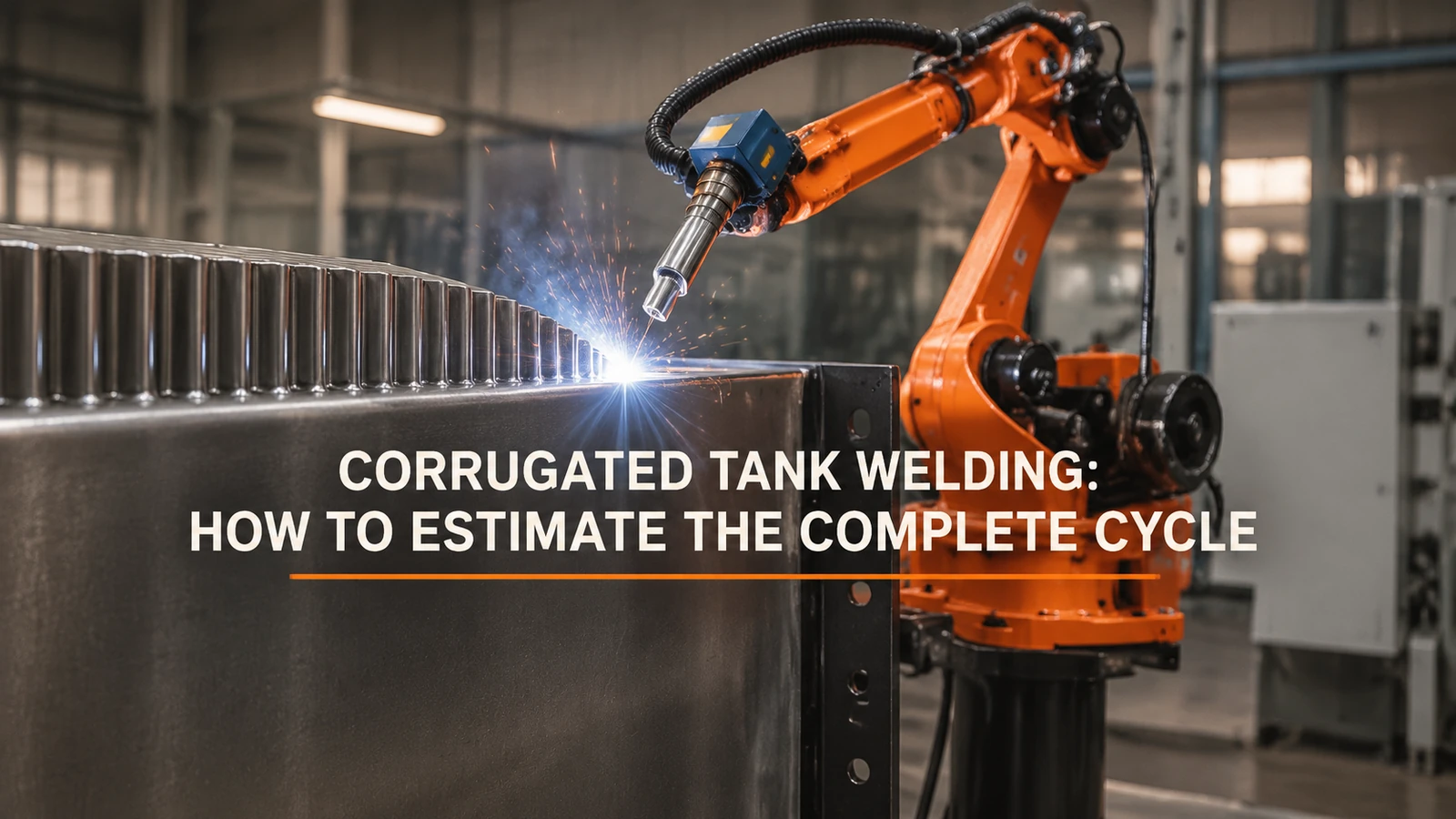
Make the estimate follow one tank
Use a repeatable start and finish state. For a single loading position, one practical boundary is “fixture empty and ready to load” to the next occurrence of that state. Loading, clamping, the programmed sequence, release and unloading then belong to the same record. If inspection takes place elsewhere, state that separately rather than silently including it in one supplier’s number and excluding it from another’s.
The recorded case shows a robot arc welding a box-shaped assembly with multiple vertical ribs, with work presented in different positions. It is a useful visual anchor for a multi-seam estimate. The production record still needs the complete sequence, including work outside the selected footage.
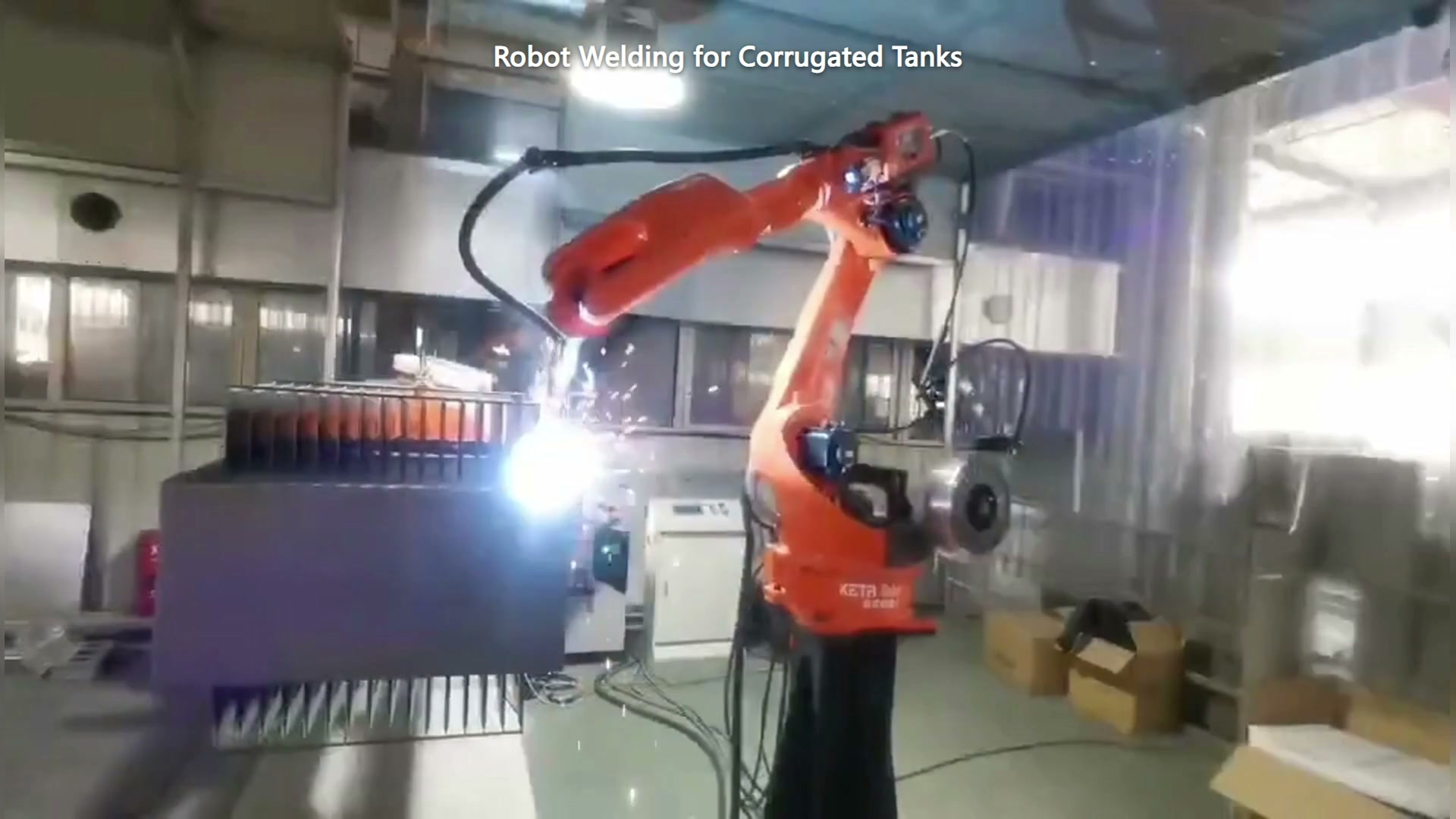
00:20 — Arc light is visible at the ribbed box-shaped assembly.
Separate the stable welding travel from the other events. Robot-welding interface documentation distinguishes cycle start, arc establishment and stop stages; those intervals are not all represented by movement along a seam. A short-seam job repeats these events more often than a job with the same total length in fewer seams.
Build a time ledger, not a single allowance
| įrašas | Ką gauti | How to avoid a misleading total |
|---|---|---|
| Welding travel | Length and applicable travel speed for each segment or pass | Use consistent units; include every required pass |
| Start and stop overhead | Events outside the counted travel interval | Do not add a start or crater-fill interval twice if it is already in the measured weld event |
| Air moves | Torch movement between completed and next welds | Use the real route around the part and fixture |
| Pozicijos pasikeitimai | Indexing, presenting another face and any separate settling or confirmation | Count coordinated motion once, not once for each moving device |
| Other routine work | Applicable locating, torch service and checks | Include only the operations actually specified, at their real frequency |
| Load and completion | Loading, clamping, release, unloading and agreed checks | Match the same start/finish boundary throughout |
For serial, non-overlapping intervals, the repeat cycle is their sum. When actions overlap, use a timestamped sequence and count the elapsed interval once. Manufacturer cycle-simulation guidance likewise works from the programmed sequence and a model calibrated to the real system; a generic percentage added to arc time is a weaker basis.
A worked example with stated assumptions
The following is an invented estimating exercise, not a measured result for the filmed tank or an industry benchmark. Assume a single loading position, serial actions, eight weld segments totalling 3,600 mm and a constant travel speed of 6 mm/s. Assume no additional passes or routine torch-service event in this particular repeat.
| Numatomas komponentas | Skaičiavimas | Laikas |
|---|---|---|
| Stable weld travel | 3,600 mm ÷ 6 mm/s | 600 ai |
| Extra start/stop time outside that travel | 8 events × 3 s | 24 ai |
| Air moves | Assumed separate total | 64 ai |
| Pozicijos pasikeitimai | Assumed separate total | 42 ai |
| Loading, clamping, release, unloading and agreed checks | Assumed separate total | 100 ai |
| Repeat total | 600 24 + 64 42 + 100 XNUMX + XNUMX + XNUMX | 830 ai |
That is about 13.83 minutes per completed repeat, or 4.34 repeats per hour if the cycle runs continuously. It is not an accepted-tank production rate. The non-travel portion is 230 seconds: a proposal that improves welding speed leaves that work to be addressed separately. For a real tank, replace the assumptions with the actual seam schedule and recorded events.
Ask what “finished” means in the capacity claim
Weld-count and duration records can help identify omitted or incomplete weld events. They do not replace the product’s specified acceptance checks. Distinguish program completion, completed welded assemblies and accepted tanks before comparing output figures.
For shift planning, record changeovers, first-part setup, routine servicing, interruptions and rework on an explicitly stated basis. Do not apply an additional allowance for losses already included in an observed average. The point is a traceable capacity estimate, not the most optimistic seconds-per-part figure.
If a cycle quotation needs checking, send EVST the weld map, segment lengths and counts, loading method and the time basis of the production requirement. These inputs make it possible to discuss where time is consumed and which assumptions need a representative trial.