
If you send three automation integrators a one-line request for a “robotic vision inspection cell,” you will get three wildly different prices—and almost certainly a painful change order during commissioning. To get an accurate, apples-to-apples quote on an inline robotic vision inspection system, lock down seven engineering answers before issuing your RFQ: eye-in-hand vs. fixed cameras, pallet positioning tolerance, reflective-metal lighting control, checkpoint cycle budget, hand-eye verification, PLC pass/fail handoff, and your exact good-vs-defect sample boundary.
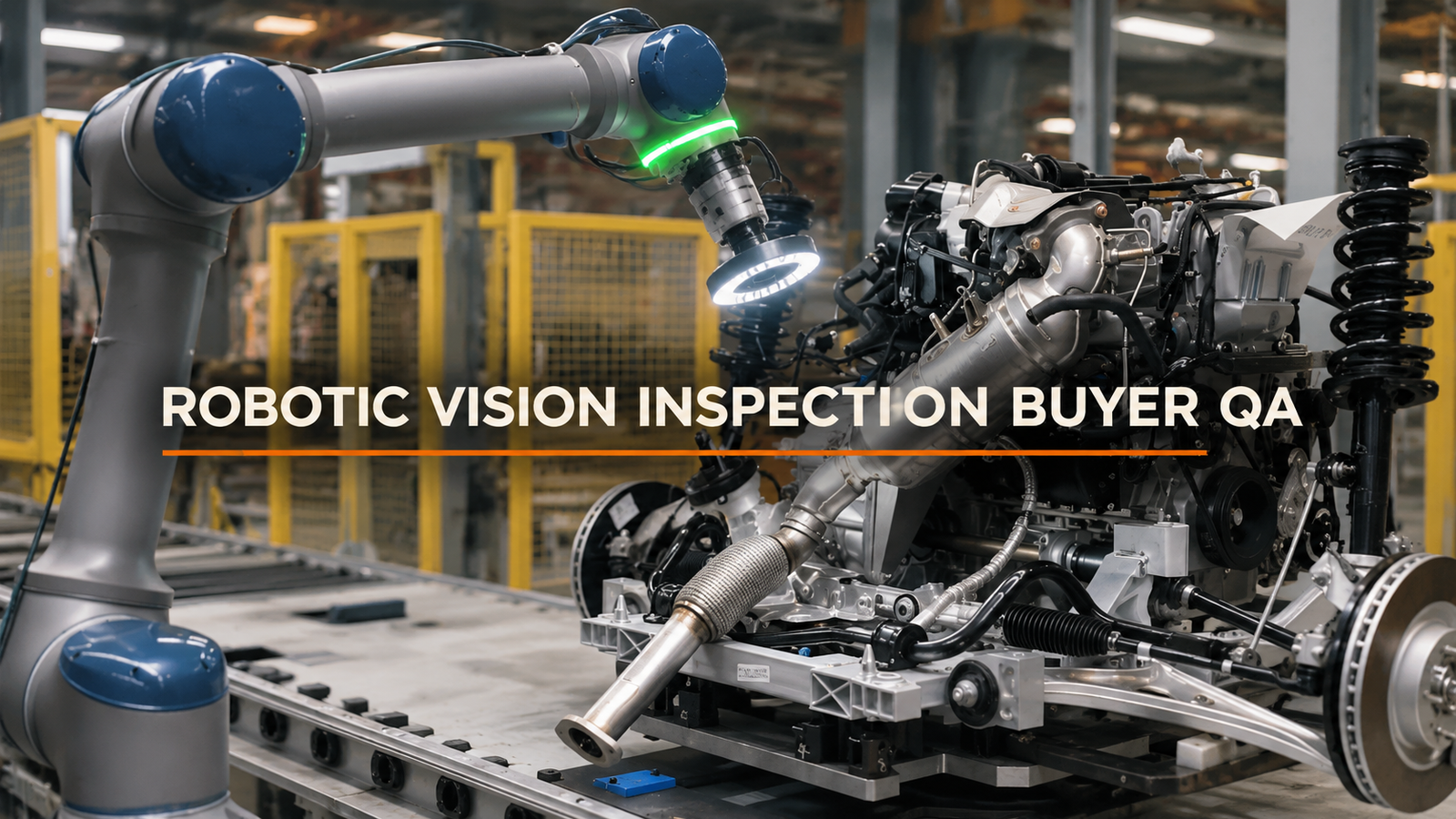
In the automotive assembly line recorded below, a grey-and-blue six-axis collaborative robot stands beside an indexed conveyor pallet holding a complete metallic powertrain and subframe assembly—complete with stainless exhaust piping, suspension coil springs, brake rotor, and cast aluminum housing. Carrying a compact camera encircled by a bright LED ring light on its wrist flange, the cobot sweeps cleanly around protruding components to inspect upper, mid-side, and lower checkpoints in sequence.
Q1: When Does an Eye-in-Hand Cobot Camera Beat Fixed Stationary Cameras?
Vyberte si eye-in-hand (robot-mounted) camera when inspection targets sit on multiple 3D faces, recessed flanges, or angled brackets across a large assembly—like the automotive subframe shown above. Covering ten angled fasteners, clips, and exhaust joints with stationary cameras would require a forest of overhead frames, ten lenses, and complex wiring that blocks maintenance access. One collaborative robot arm can move a single calibrated camera-and-light package to every angle cleanly.
Zůstat s fixed stationary cameras when line takt is extremely short (just a few seconds per part) and every feature faces the same direction—because fixed cameras eliminate robot travel time, cable flex fatigue, and joint settle dwell.
Q2: How Tight Does Conveyor Pallet Positioning Tolerance Need to Be?
Tighter than most buyers initially assume. With standard industrial lenses, even a few millimeters of unexpected shift in pracovní vzdálenost (the gap between lens and target) changes image magnification and pixel-to-millimeter scaling—turning good parts into false rejects. Make sure your conveyor stop uses rigid locating pins or mechanical pallet clamping so every assembly arrives at a repeatable datum before the cobot begins its scan sequence. If part height still varies across variants, specify either telecentric optics for precision gauging or an optical distance check/feature-locator routine before measuring.
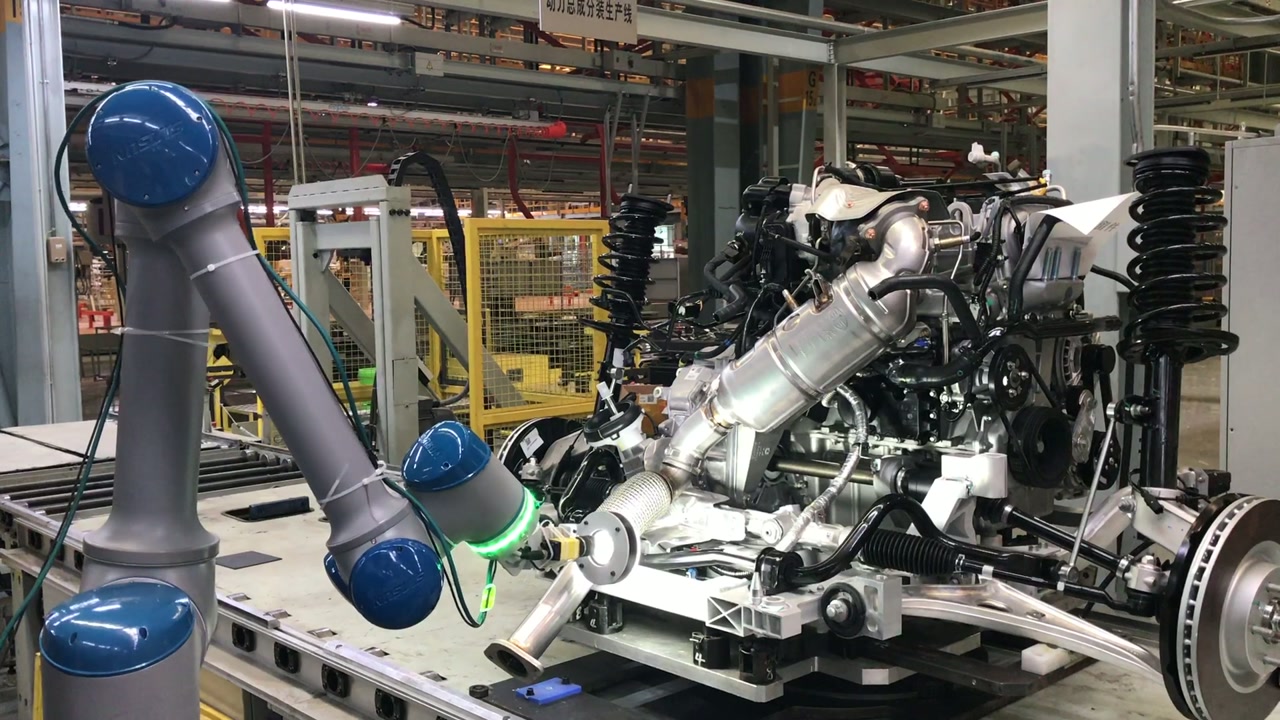
Holding a consistent working distance and approach angle over reflective metal castings keeps image contrast predictable across every indexed pallet.
Q3: Why Do Shiny Aluminum Castings and Oily Brackets Cause False Rejects—and How Do You Stop Them?
Across industrial vision deployments, ambient lighting shifts and specular glare on bare metal account for the vast majority of nuisance false rejects—far more often than camera resolution limits. Overhead skylight changes from morning to afternoon or glossy reflections off cast aluminum housings can fool simple threshold rules.
Look closely at the cobot wrist in the footage: an integrated circular LED ring light travels directly with the lens so illumination geometry stays locked to each checkpoint. On highly reflective machined steel or aluminum, buyers should verify during sample trials whether diffuse coaxial lighting, low-angle darkfield illumination, or high-intensity strobed light synchronized to camera shutter—paired with an overhead light shroud—is needed to blank out plant ambient light.
Q4: How Many Checkpoints Can One Cobot Inspect Inside Our Line Takt?
Never divide your line takt by camera exposure time alone. Real inline inspection cycle time is the sum of five distinct intervals:
- Pallet arrival, locating-pin lock, and vibration settle on the conveyor.
- Robot transit time between checkpoints (respecting collision clearance around exhaust pipes, springs, and harnesses).
- Arm settle dwell at each capture pose—typically a brief fraction of a second so wrist vibration stops before exposure.
- Image capture and algorithm execution (plus any multi-light recapture on shiny surfaces).
- PLC pass/fail handshake and cobot return to clear-of-conveyor home.
If your checkpoint count pushes total cycle past line takt, split the work across two collaborative arms on opposite sides of the pallet rather than running a single arm at aggressive speeds that induce camera blur.
Q5: What Is Hand-Eye Calibration—and How Does Maintenance Check for Drift?
Whenever a vision system guides motion or maps defect coordinates back to a 3D assembly, hand-eye calibration links the camera’s 2D pixel frame to the robot’s base coordinate frame. Mount the camera on a rigid, cross-braced anodized bracket rather than thin sheet metal, and ask your integrator to include a simple master verification routine (checking a fixed reference target or golden part at shift start) so technicians can immediately detect if a wrench bump shifted the camera bracket.
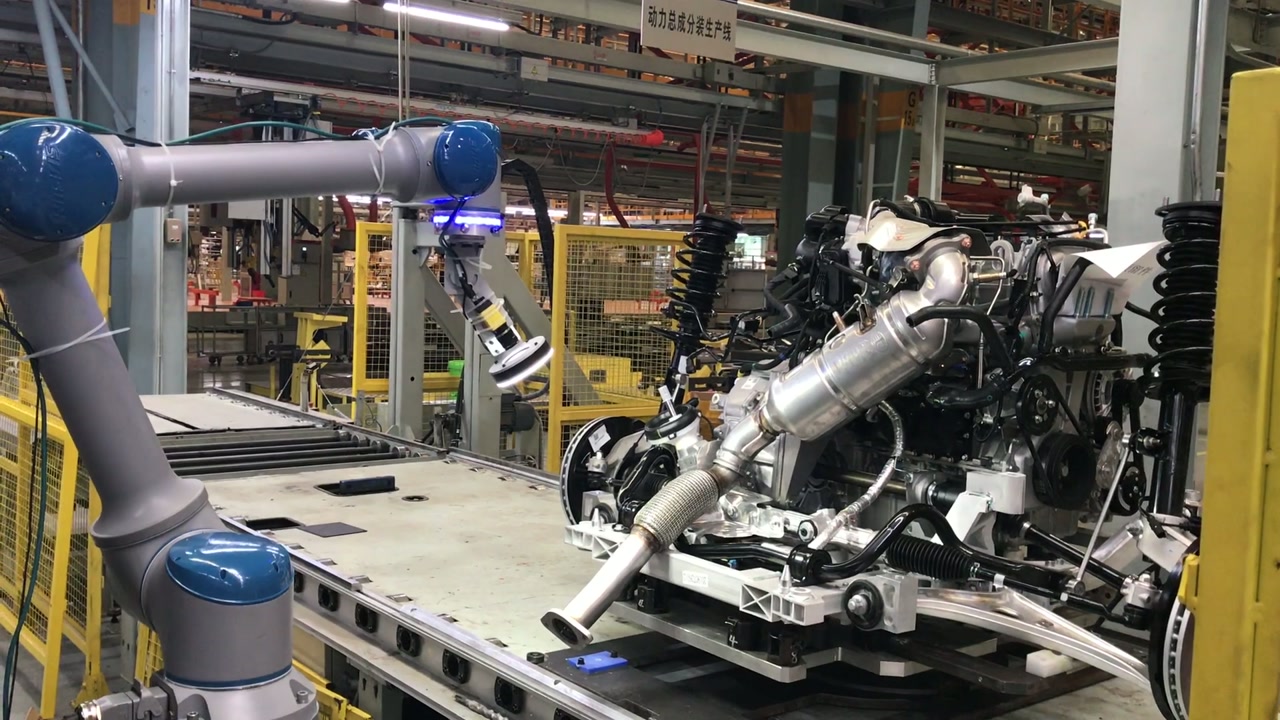
Clear cable routing along the collaborative arm prevents umbilical snagging as the wrist pivots between lower subframe joints and upper manifold checkpoints.
Q6: How Should the Vision Cell Hand Off Pass/Fail Decisions to Our Line?
An inspection station only protects outgoing quality when its decision is wired cleanly into line control. Confirm three rules upfront:
- Deterministic PLC interlock: The conveyor pallet release remains locked until the vision controller sends a verified
PASSorFAILresult tied to that pallet’s serial/barcode ID. - Image archiving for traceability: Store failed-checkpoint images (and optionally sampled passing images) indexed by part ID so quality engineers can audit borderline calls and tune thresholds without stopping production.
- Explicit rework routing: Define whether a
FAILtriggers an immediate audible alert for on-line verification or diverts the pallet into a locked quarantine spur so an unverified assembly can never roll downstream.
Q7: What 6-Item RFQ Package Gets You an Accurate Quote Without Hidden Change Orders?
Hand integrators this concise six-item package on day one so every proposal prices the same scope:
| RFQ Input Item | Co dodat | Why It Prevents Quote Surprises |
|---|---|---|
| 1. Defect & Checkpoint List | Marked photos of every feature to check (missing clip, unseated bolt, wrong label, orientation) | Prevents under-sizing camera resolution or missing hidden backside angles |
| 2. Good & Bad Sample Parts | Real production assemblies (including worst-case surface oil/glare and borderline defects) | Lets engineers test lighting and contrast on real reflections, not CAD models |
| 3. Pallet Positioning Tolerance | Measured X/Y/Z repeatability of the conveyor pallet at the stop pin | Determines whether simple fixed poses work or 3D/datum re-localization is required |
| 4. Target Takt Ceiling | Total seconds available from pallet-in-position to pallet-release | Dictates single-arm vs. dual-arm layout and checkpoint count |
| 5. Plant Ambient Lighting Notes | Skylights, overhead LEDs, or nearby welding arcs near the inspection station | Clarifies upfront whether a light tunnel or strobed illumination is mandatory |
| 6. PLC & Traceability Interface | Line PLC protocol, barcode/RFID trigger, and pass/fail quarantine rule | Eliminates late-stage controls integration change orders |
Review Your Inline Vision Inspection Scope With EVST
Because the footage above displays no detection-rate percentages, false-reject metrics, or cycle readouts, every reliable cell design starts from real sample parts and your actual defect list. Explore our možnosti kolaborativních robotů a full industrial automation portfolionebo send your checkpoint list, pallet repeatability, and target takt to the EVST engineering team for a grounded pre-quote review.