
A medical device packaging line takes devices that are already in their primary pack, such as a blister or an inner pouch, and puts them into cartons with the leaflet and cards, prints and checks UDI (Unique Device Identification) data on the specified packaging levels, inspects the configured steps with cameras, and rejects any non-conforming pack. EVST builds these lines as custom cartoning lines for CGM sensor kits, Class III devices such as implants and contact lenses, and regenerative membranes. Dental instrument kits use a different line, which sorts loose instruments, places them into trays with robots and packs the shipping case. Each line is configured for the device, the carton and the data your quality system requires.
Discuss your device packaging line
What does a medical device packaging line do, step by step?
The cartoning configurations described here follow one core sequence: feed, open the carton, insert, code, inspect, reject. On a Class III device line we have built, the steps are:
- Product feeding and counting: blisters or pouches are fed and counted into position.
- Carton opening: a rotary mechanism opens each flat carton.
- Servo cartoning with the leaflet: servo-driven pushers place the device in the carton and insert the leaflet in the same motion.
- Laser coding: batch and code data are marked on the carton.
- Print-on-demand labeling: labels are printed and applied on the line.
- Vizuální kontrola: cameras check that the device faces the right way and that the laser code and label are correct.
- Error-proof rejection: any non-conforming pack is rejected automatically.
- Out-feed and storage: finished cartons collect on an out-feed table.
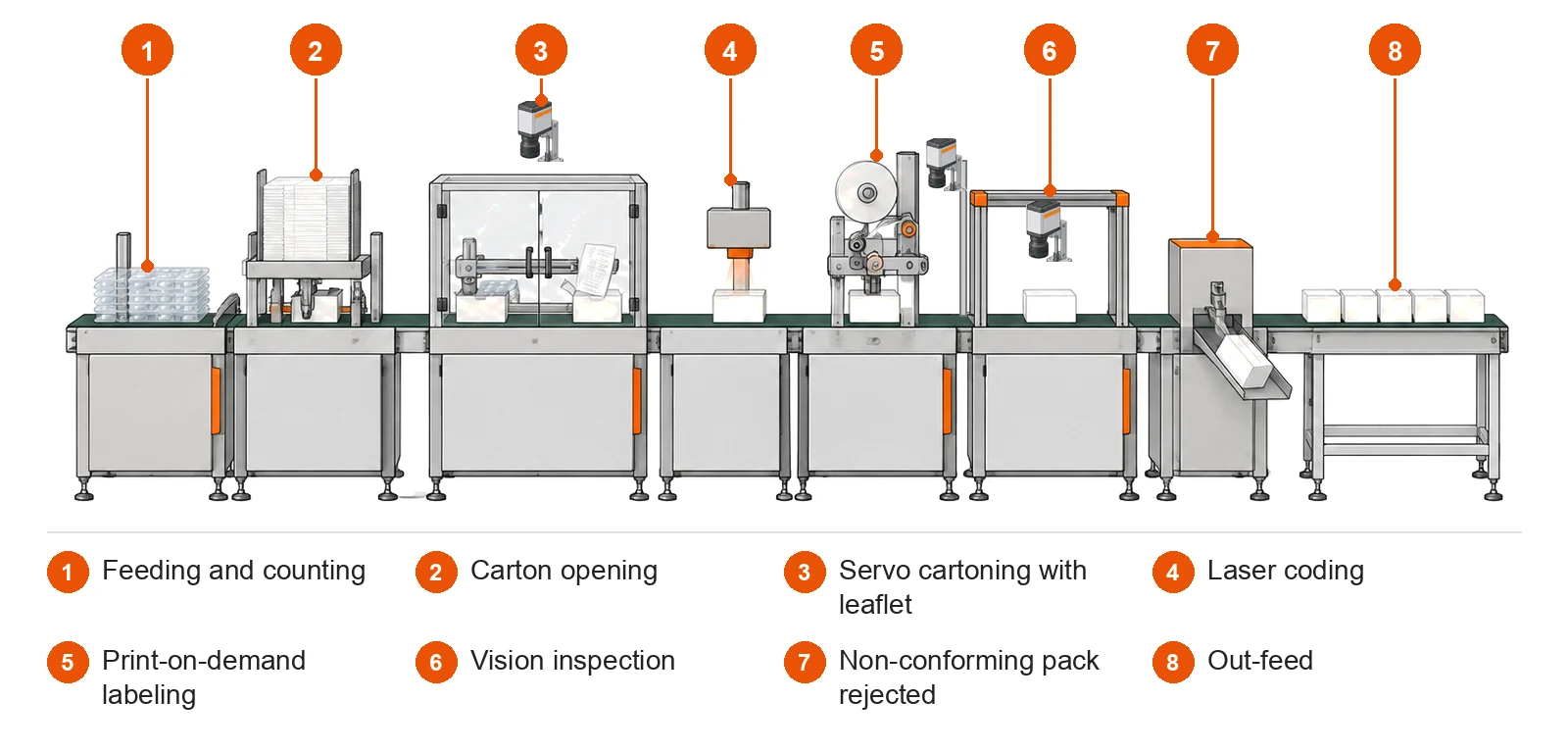
The exact process steps are configured for each device and project. Other lines we have built add hot-melt glue carton sealing, a checkweigher with reject, or a carton turning station before labeling. The cartoning station itself is a horizontální kartonovací stroj; vidět kartonovací stroje for how the cartoner types compare.
How does UDI coding work on the line?
On these lines, UDI coding is a closed loop between your ERP system, the printers on the line and the cameras that read the result. A UDI coding and verification system is connected to the ERP and sends each work order to the printers at the line. The printers mark UDI data on the specified packaging levels; on one Class III configuration, three printers in total are installed on the line for this. The line links the data of the outer carton, the inner pouch and the traceability card, or on other devices the leaflet and quick-start card, so they belong to the same unit. Cameras then check the specified codes, and any pack whose code is missing, unreadable or does not match is rejected.
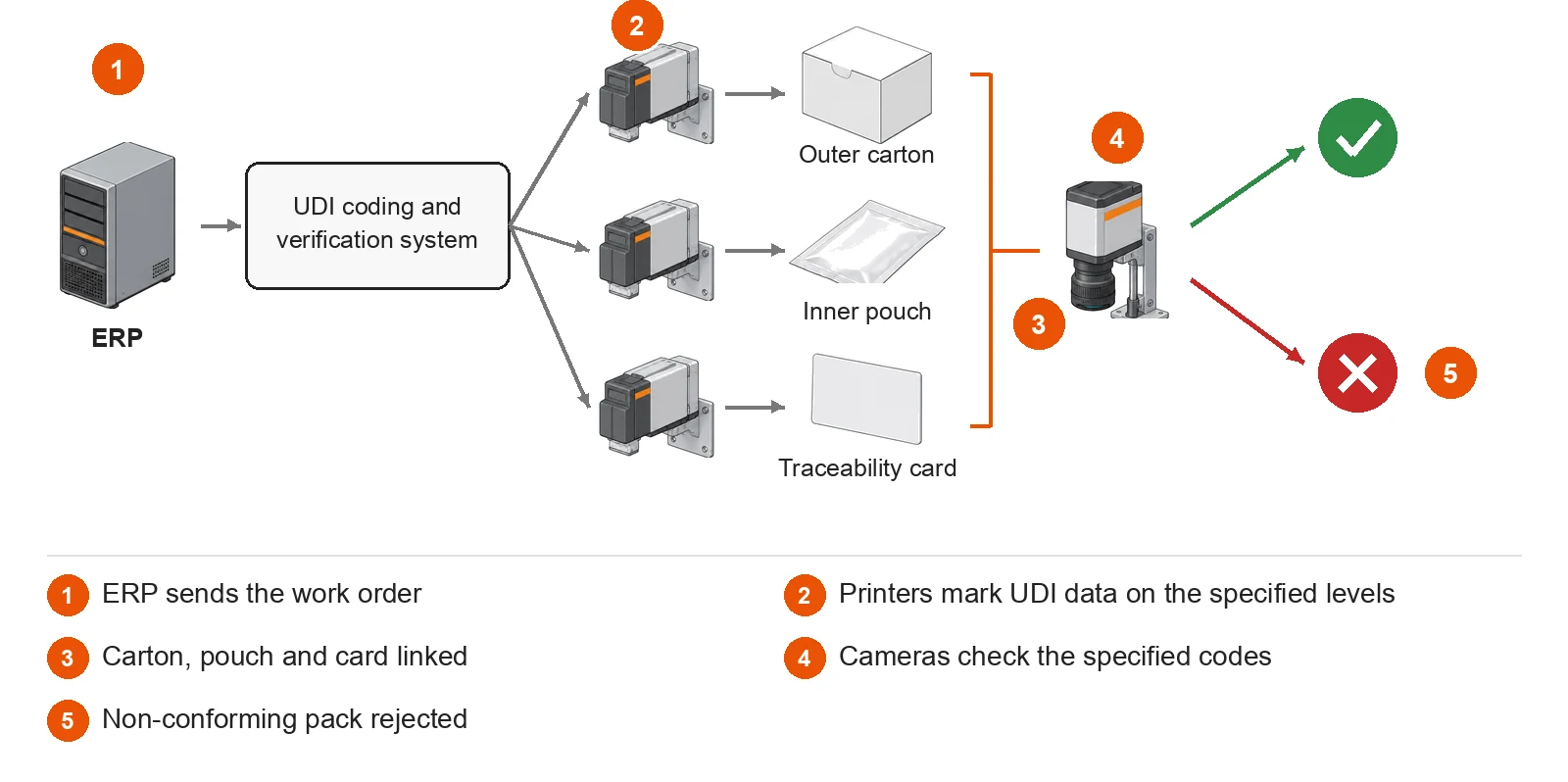
The UDI content itself, and the regulations it follows, are defined by the device manufacturer. The line prints, links and verifies the data it receives from your system.
Why are there so many cameras on the line?
On the Class III lines described here, the requirement was that nothing leaves the line incomplete, so the steps that can go wrong are checked by cameras. On one regenerative-membrane line we built, a single machine uses 19 cameras. Cartons whose printing fails are diverted straight onto a separate belt, so they never mix with good product.
The checks we build in include:
- device presence and orientation in the carton;
- leaflet and card presence;
- laser code and printed label content;
- UDI code readability and match on the outer carton;
- carton weight, on lines with a checkweigher.
All of this inspection sets the pace. The Class III lines we have built do not run at high speed, because the inspection steps take time. We size the line to your required output with the inspection included, rather than quoting a cartoner speed on its own.
What records does the line keep?
The line records each inspection result and each reject in a database, together with the operator responsible at each station. When a question comes back from the field, these records are what answers it. Data retention is agreed for each project. On one Class III line, units that had been rejected for incomplete codes and were later put back by hand at the end of a shift were traced through these reject records.
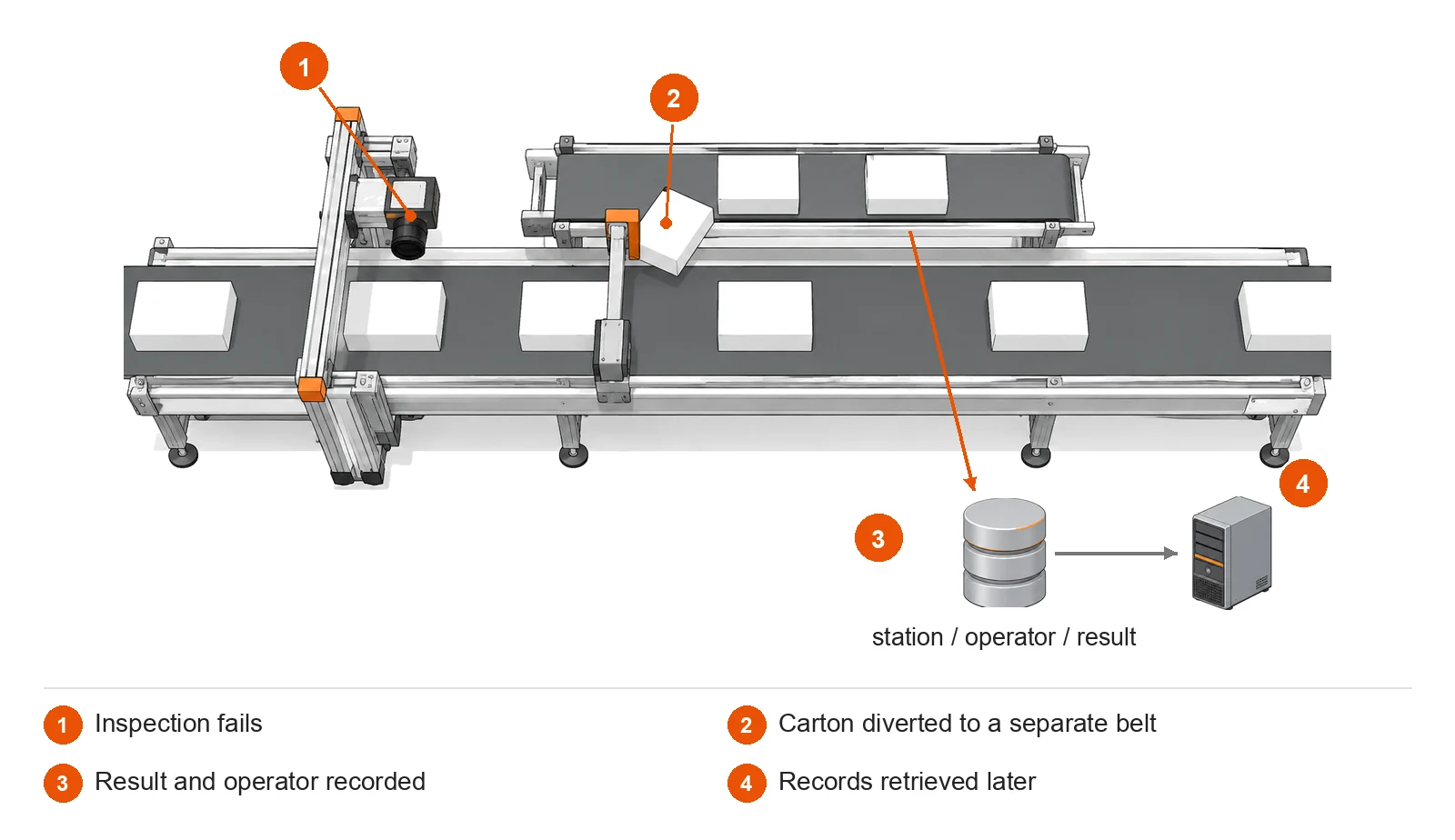
How the records connect to your quality system is agreed for each project.
Which devices have these lines packed?
CGM sensor kits
For continuous glucose monitoring (CGM) sensor kits, one line we built opens the carton, cartons several kit variants on the same servo-driven machine, places the leaflet and the quick-start card, checks the leaflet, prints and verifies the UDI, inspects the device orientation, the laser marking and the printed label, rejects failures, and closes the carton with hot-melt glue. Equipment data is monitored in real time on the line.
Class III devices: implants and contact lenses
For Class III devices such as dental implants and contact lenses, the line described above feeds and counts blisters, cartons them with the leaflet, codes, labels and inspects. A balcony-style frame makes the machine easier to clean and adjust. On the contact lens line we built, every lens pack is scanned, and a change of lens power runs over without stopping the line, because the outer cartons look identical and only the data tells them apart.
Regenerative membranes: dural patches and skin repair membranes
For absorbable dural patches and skin repair membranes, the line cartons the product, laser codes the carton, prints and applies the label, compares the device orientation, laser code and label against the expected data, and rejects mismatches. The line is laid out in six guarded sections, and maintenance software tracks the equipment.
Dental implants in blisters of different heights
Implant blisters are not all the same height, so on implant lines the blister is lifted to a fixed height before it is cartoned. A small label is placed at a fixed position to keep it accurate. Earlier implant lines were spread out and took a lot of floor space; current lines are built as compact as the contact lens lines.
Dental instrument kits
For kits of dental hooks, mirrors and tweezers, loose instruments are separated on a vibratory feeder, two robots, one high and one low, place them into the tray, and an all-in-one machine erects, packs and seals the shipping case.
What else to plan for
- kvalifikace: Qualification scope and responsibilities are agreed for each project.
- Future material supply: lines can be designed with a docking point for automated guided vehicles, so material that is pushed in by hand today can be delivered by AGV later.
- The team behind the line: a line like this needs software, vision, electrical and mechanical engineers on the same project. If any one of these disciplines is missing, the line cannot be done well.
- More on medical automation: vidět automation for medical and pharmaceutical production.
What to send for a medical device packaging line quote
- The device in its primary pack (blister, pouch, tray) and the carton: samples or drawings
- Every item that goes into the carton: leaflet, quick-start card, traceability card
- The UDI and label content for each pack level, and how your ERP will send work orders
- The inspections your quality system requires, and how rejects must be handled
- Target output per shift and the number of product variants and changeovers
- Cleanroom class and floor space at the site
Sample devices and cartons help confirm the feeding, cartoning and inspection setup before the line is fixed.
Běžné otázky
What is a medical device packaging machine?
A medical device packaging machine, in the sense used here, is a cartoning line that places devices already in their primary pack into cartons with the leaflet and cards, prints and verifies UDI data on the specified packaging levels, inspects the configured steps with cameras and rejects non-conforming packs. EVST builds them for CGM kits, Class III devices such as implants and contact lenses, and regenerative membranes. Dental instrument kits run on a separate tray-loading and case-packing line.
How does the line link the UDI on the carton, the pouch and the traceability card?
A UDI coding and verification system connected to your ERP sends each work order to the printers on the line. The printers mark the UDI data on the outer carton, the inner pouch and the traceability card, the line links them as one unit, and cameras check the specified codes. Packs with missing, unreadable or mismatched codes are rejected.
How fast does a Class III device packaging line run?
Not fast by packaging standards. The Class III lines we have built check most steps with cameras, and the inspection steps set the pace. EVST sizes the line to your required output per shift with the inspection included, and confirms it on your devices.
Can one line pack several products or contact lens powers?
Yes. On the CGM line, one servo-driven cartoner handles several kit variants. On the contact lens line we built, a change of lens power runs over without stopping the line, because every pack is scanned and the line manages the data. How many variants share one line is assessed on your product list.
Does EVST certify the line for medical device regulations?
The line is built to the specification your quality system defines: the inspections, the UDI data handling and the records. Regulatory approval of your device and your process stays with you. Qualification scope and responsibilities are agreed for each project.
PODOBNÉ ČLÁNKY
- Automated packaging lines: filling, cartoning, inspection and case packing
- Cartoning machines: horizontal and vertical
- Horizontální kartonovací stroj
- Automatic bottle labeling machine
- Automation for medical and pharmaceutical production
Line configurations on this page are those built to date; the line for your device is configured and confirmed for each project.