
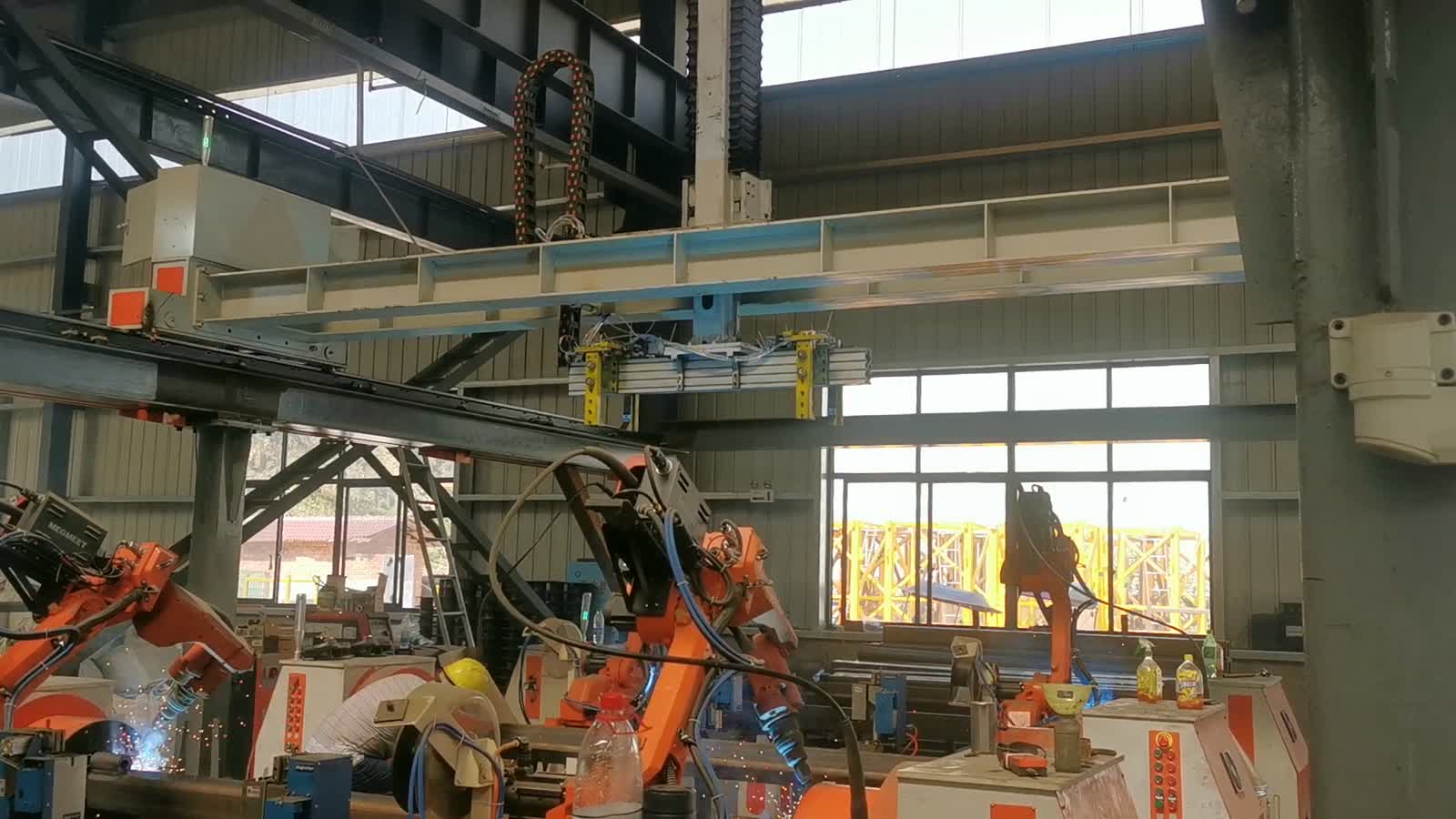
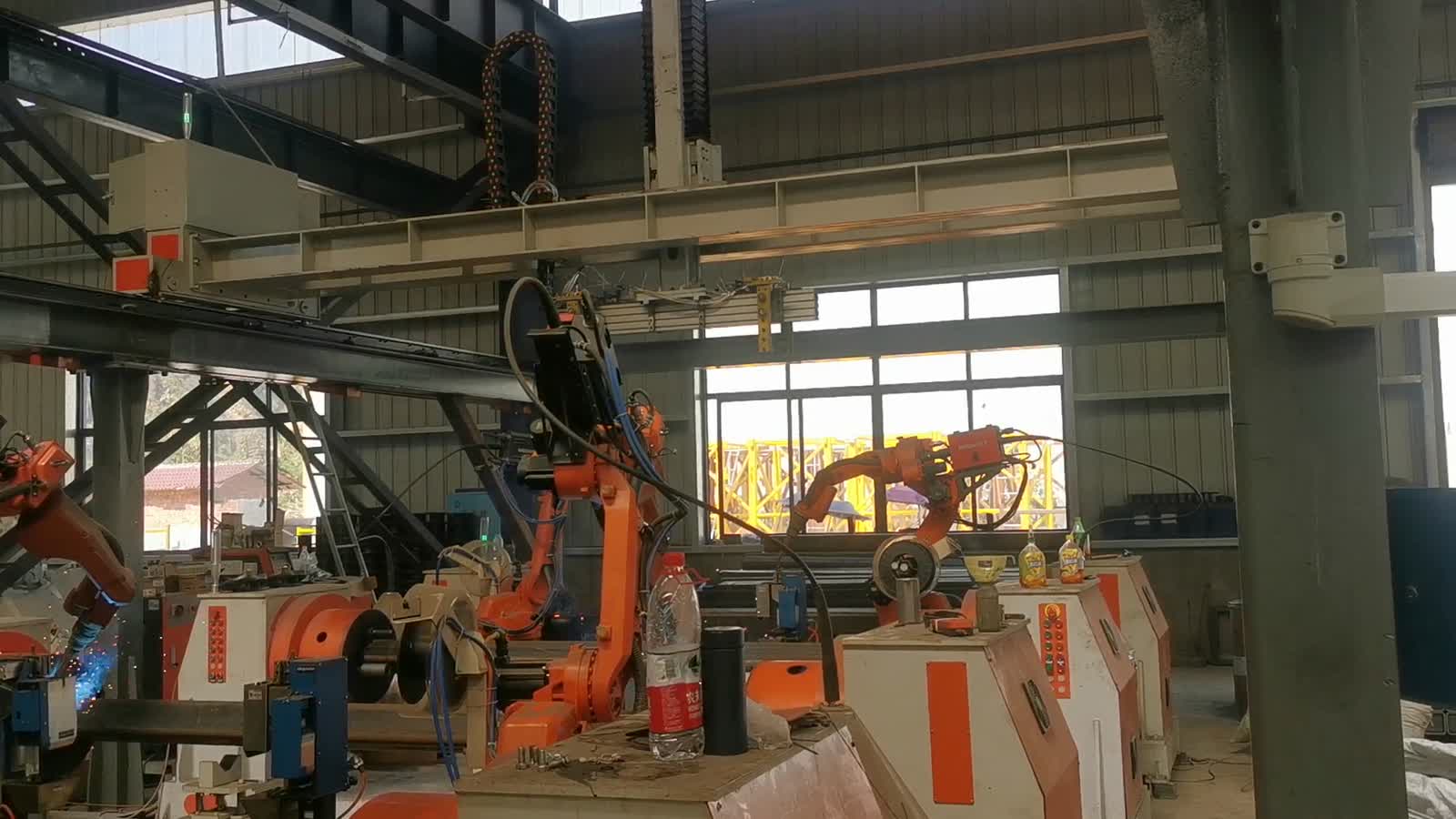
In short: This shop welds large steel structural members — box and angle sections with flange plates and rows of bolt holes — by splitting the work across stations. Each station puts a six-axis robot in front of a fixture and positioner, and the robot welds its way along the seams while several neighbouring stations run at the same time. The heavy members travel in and out on an overhead crane. Three decisions carry a line like this: how the member is clamped and turned, whether the torch can reach every seam on a big part, and how the robots divide the work so no station waits on another. Planning a similar line? Send us your part drawing.
At a glance
| Part | Large steel structural members — box and angle sections with flange plates and bolt holes |
| Process | Arc welding |
| Automation | Several six-axis robots, one per station |
| Part supply | Members are carried in and out by an overhead crane |
| Locating | Members laid and clamped on circular fixtures and positioners |
| Workholding | Fixture and positioner hold the member and turn it toward the torch |
| Operator role | Loads, aligns and moves members; robots run the seams |
| Cell layout | Parallel stations across the shop floor |
The problem this cell addresses
A structural member is not a small part that can be turned by hand. It is long, heavy and covered in seams that run along its length and around its flanges. Welded manually, the work depends on the welder holding the torch steady over a long pass and climbing around the member to reach the far side — and the crane waits while that happens.
Automating it means letting the fixture take the weight and letting the robot take the arc. The payoff is that several members can be welded at once, each at its own station, instead of one welder working through them in turn. The hard part is not the welding itself; it is holding a large part squarely, reaching every seam without a collision, and balancing the stations so the robots are all busy.
How the cell runs
- Bring the member in. An overhead crane lifts the steel member and sets it onto a station’s fixture.
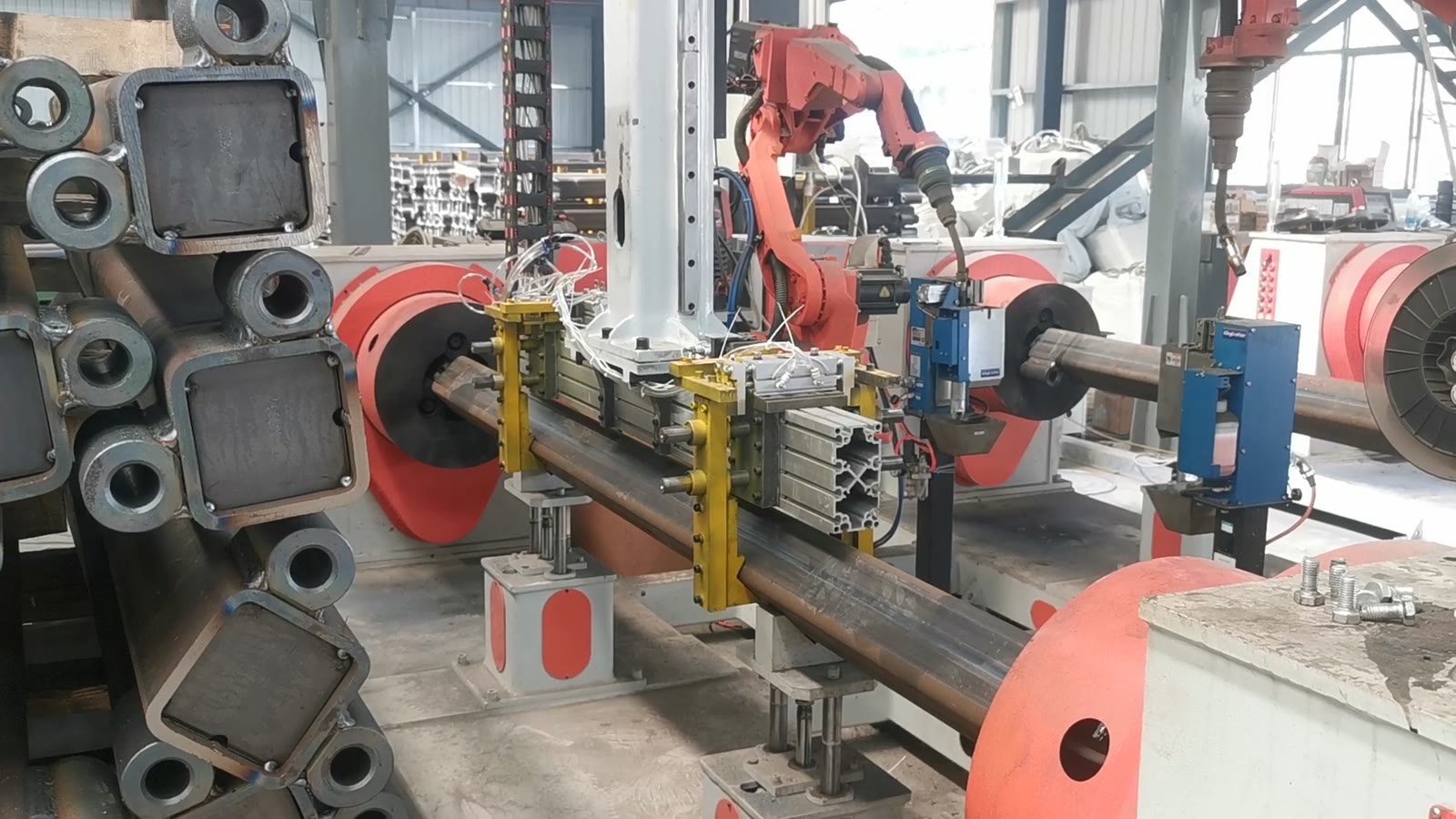
- Clamp it down. The member is clamped against the fixture; the fixture and positioner, not the operator, now hold the geometry.
- Turn it toward the torch. The positioner rotates the member so the seam the robot needs is presented at a reachable angle.
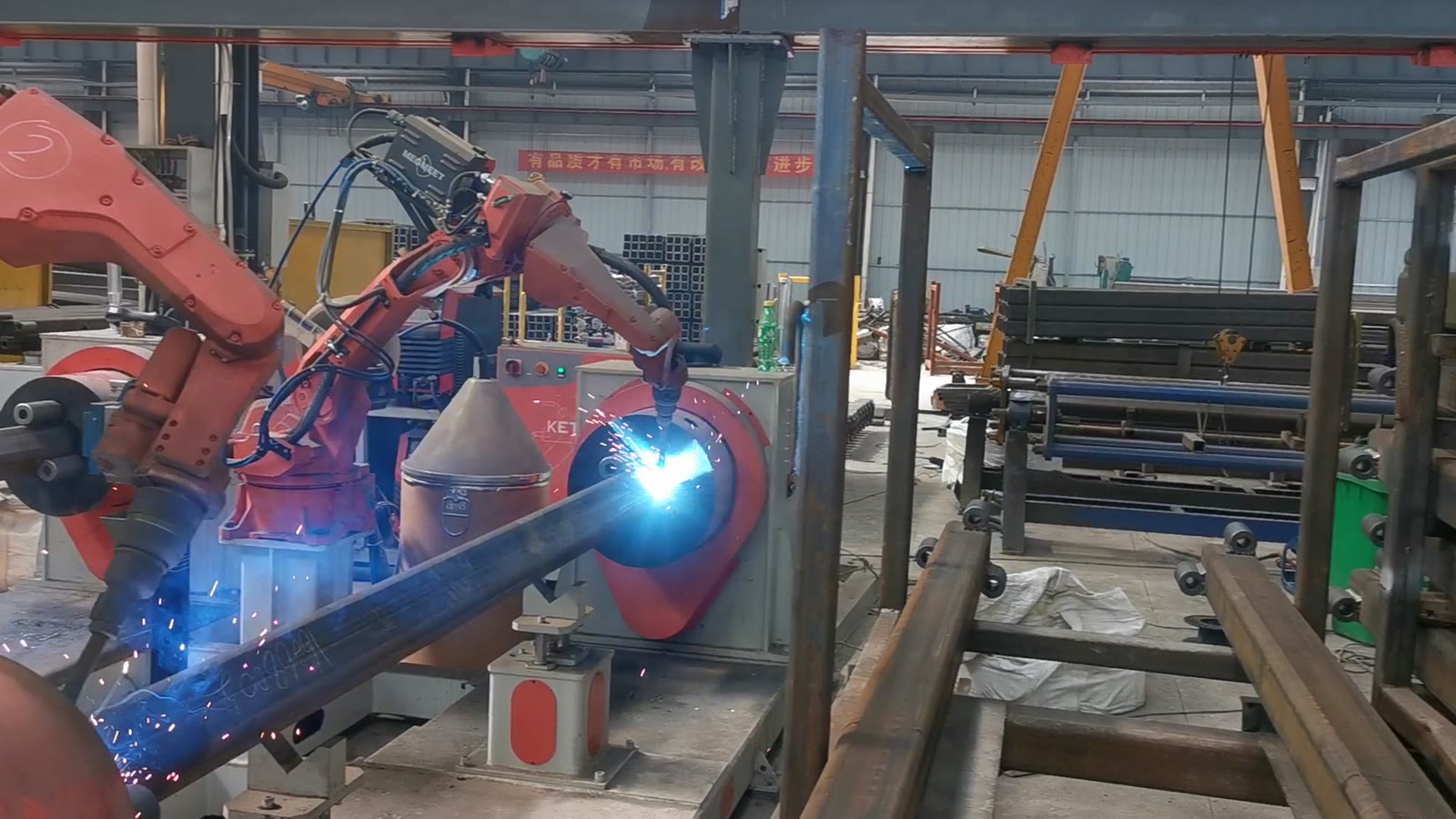
- Arc on. The robot brings the torch down on the seam and the arc strikes with a blue-white flash.
- Run the seam. The torch moves along the seam while the robot changes pose to follow it.
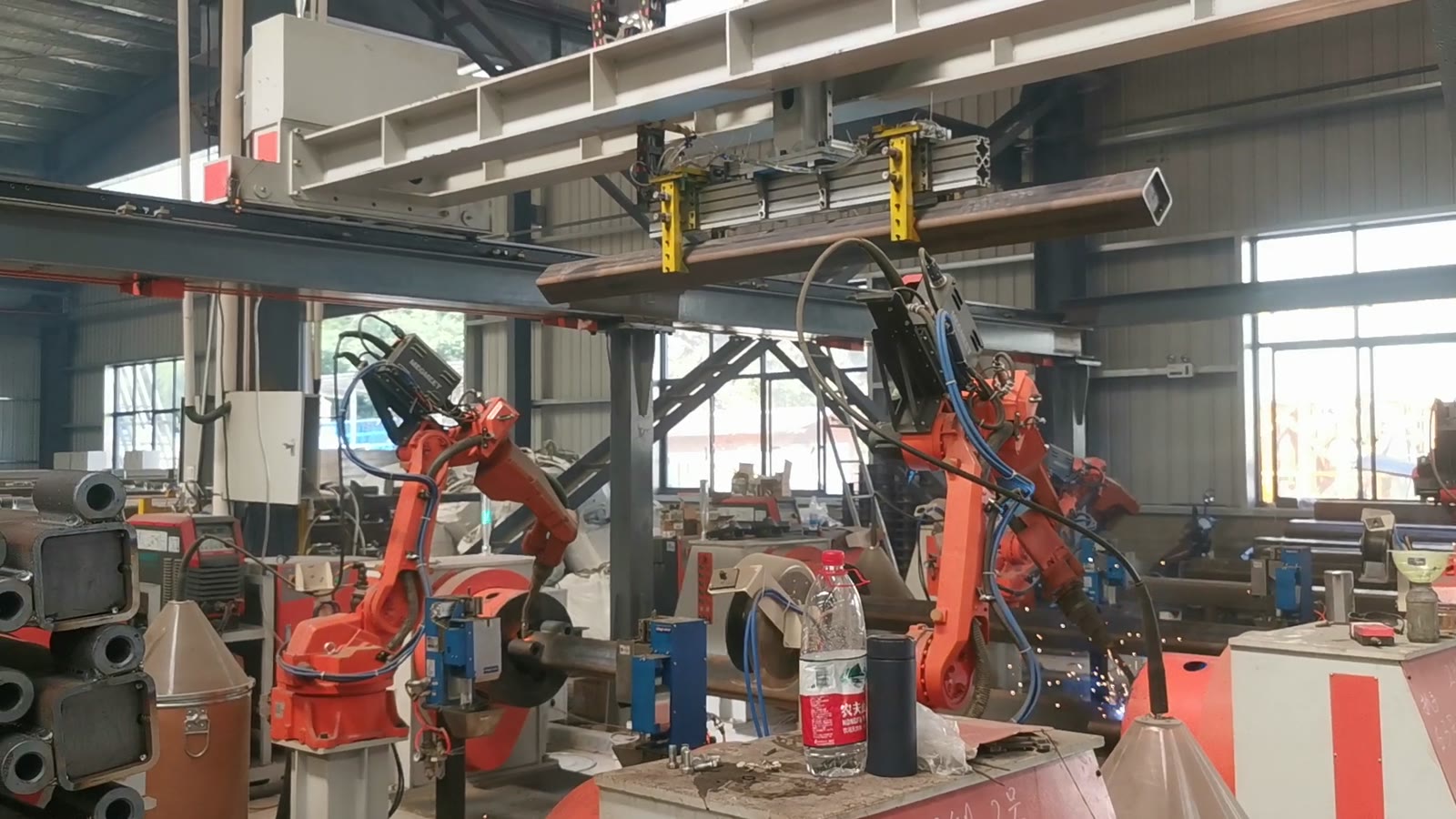
- Reposition. When a seam is done, the robot lifts, the positioner turns, and the next seam is brought into reach.
- Work in parallel. While this station welds, the neighbouring stations run their own members at the same time, each robot on its own part.
Three design decisions
1. Let the fixture and positioner take the weight
On a large member, the fixture does two jobs at once: it holds the part in the right relationship to the torch, and it turns the part so the robot does not have to reach around it. Both jobs have to be settled before the torch is ever lit.
The question to settle first is how the member is located — which faces and holes it is aligned from — and whether the positioner can bring every seam into the robot’s working envelope without the operator having to re-clamp halfway through.
2. Prove the torch can reach every seam
On a long member, reach is not one question, it is one question per seam. The usual failure is a cell that welds most of a part beautifully and then finds the last seam sits behind a flange or a clamp where the torch cannot get a clean angle.
What helps: check the torch angle at every seam during fixture design, including the torch body and cable rather than just the tip; keep a spare wrist orientation for seams near the fixture frame; and decide early whether a seam the torch cannot reach stays manual or gets re-fixtured.
3. Divide the work so no station waits
Parallel stations only pay off if the robots are all busy. That means matching the stations to the flow of members — the crane has to be able to load and unload one station without interrupting another, and no single operator should become the bottleneck for several robots.
The practical questions: how long each seam set takes against how long loading takes, whether one person can load several stations, and whether the members arrive in a rhythm the stations can absorb.
When this layout fits — and when to look closer
- Good fit: repeating structural members, long seams along a part’s length, batch sizes that justify dedicated fixtures, and parts heavy enough that the crane is moving them anyway.
- Evaluate further: many different member sizes (can one fixture carry several part numbers, or do you need quick-change fixtures?), seams on the underside that a single positioner cannot present, and tolerances that vary between cut members so the gaps shift from part to part.
FAQ
Do these members need a positioner, or can the robot reach around?
A positioner earns its place on heavy parts. Turning the member is usually easier and safer than asking the robot to climb over or under a large structure, and it keeps the torch on the seam at a clean angle instead of reaching around flanges.
How many robots can one operator run?
It depends on how long loading takes against the welding. If the fixture clamps quickly and the crane handles the heavy lifting, one person can load and align several stations while the robots weld; if each member needs a lot of manual setup, the operator becomes the bottleneck and the extra robots wait.
What decides the cycle here?
The length of the seams, how many times the positioner has to turn between them, and whether the stations can all run at once. Send the member drawings with the seams marked and we can estimate it.
Get a layout and cycle-time estimate
Send us:
- Member drawings with seams and inspected dimensions marked
- Section sizes, wall thickness and material
- Number of variants and how often you change over
- Daily or annual volume and shift pattern
- Photos or dimensions of the floor space and crane layout
We will reply with a station layout proposal and a cycle-time estimate.
Send your part drawing → or email sales@evsrobot.com
Footage filmed at a partner’s production site. Cycle time, current and consumable figures from that site are not public and are not given here.