
A small-part handling layout has two reference problems to describe: the feature that identifies an incoming part and the physical location where the part should arrive. A clear image at the pickup area does not, by itself, define the receiving fixture or establish a successful placement.
Describe both ends of the movement
At 00:03, the video shows a white SCARA robot above a worktable with an incoming area to the right and an illuminated rotary station to the left. At 00:12, the tool is over the rotary station, with the surrounding table structure still visible. These observations establish the relationship of the working areas. They do not report recognition accuracy, inspection results or rejected-part handling.
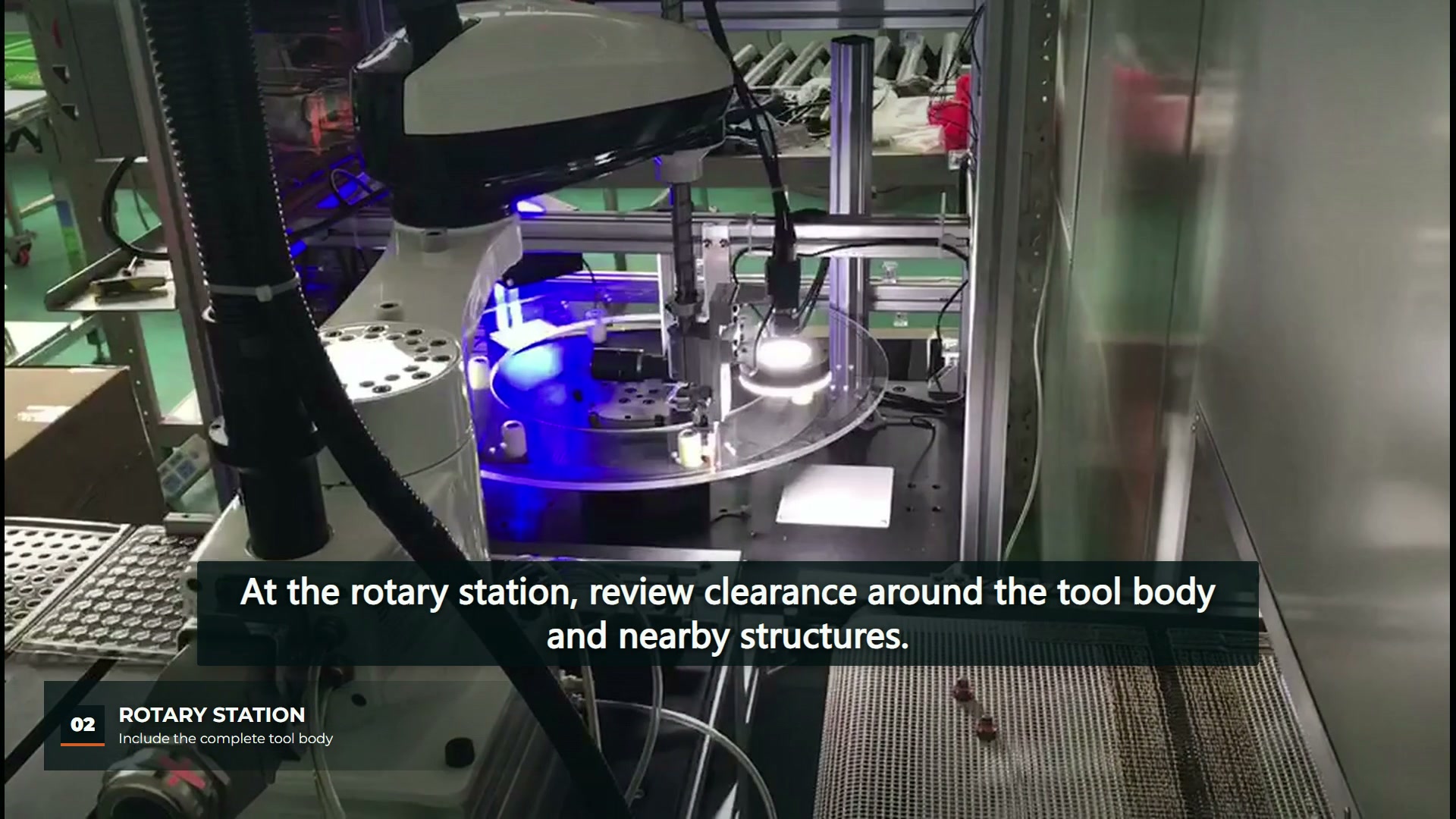
Start an application description by naming the part feature used for orientation and the destination feature used for placement. For example, a visible outer contour and a receiving pocket are different references. Their relationship has to be described even when the robot movement looks straightforward.
Choose lighting for the feature being observed
Basler’s illumination guide explains that backlighting can emphasize an object’s outline while losing surface information. The relevant lesson is to choose an illumination arrangement around the feature to inspect. The lights visible in this footage do not establish which algorithm, illumination method or acceptance threshold is in use.
For a new part, collect images of the actual feature under the intended viewing conditions. Include plausible orientation changes and surface variation. If the decision depends on a face marking or a surface defect, an outline alone may leave the required information unavailable. If it depends on the outline, define which edges must remain visible.
Connect image positions to physical positions
Basler’s Calibration vTool documentation describes conversion from image coordinates to physical coordinates. That is the scope of the cited reference; it is not a calibration record for this cell.
For project review, identify the camera reference, the robot reference and the receiving fixture reference on one layout. Describe what must be rechecked when the camera, table or part height changes. Keep the image result and the final placed-part observation in the same sample record so a placement discrepancy can be investigated with both ends of the movement available.
| Input to preserve | What the review can distinguish |
|---|---|
| Representative incoming-part images | Whether the intended feature is visible |
| Camera and fixture reference description | How image positions relate to the layout |
| Receiving pocket or locating geometry | What defines the final placed condition |
| Images and observations for unusual samples | Whether the same decision applies to flipped or obscured parts |
Inspect the receiving condition separately
The rotary-station view at 00:12 helps frame questions about the complete tool body and nearby structures. It cannot show the dimensional acceptance of every placement. If the next operation depends on orientation, seating or separation, specify how that condition will be checked after the part arrives.
The related article on vision-guided SCARA sorting and coordinate mapping discusses the wider mapping and pick-verification problem. Here, the narrower task is to document the incoming visual feature and the receiving physical reference before evaluating a candidate layout.
A useful review packet therefore contains representative parts, feature images, the receiving geometry and paired pickup/placement observations. Visible robot motion supplies context; the sample records supply the evidence for the required result.