
A fastening spindle flashing green on an automotive engine line does not automatically mean the oil pan or housing flange is clamped tight. A bolt that cross-threads three turns short of seating can hit target peak torque and trigger a “false OK”—passing visual inspection and only surfacing later as an oil-pan leak on hot test or in the field. Preventing dual-cobot fastening failures requires engineering five specific safeguards before launch: isolating tightening reaction torque from compliant cobot joints, absorbing pallet and casting drift with floating alignment, replacing torque-only shutoff with combined torque-and-angle monitoring, sizing the arm and end effector cleanly against real fastener geometry, and interlocking dual-arm dress packs with No-Faults-Forward line gates.
Pitfall 1: Treating Compliant Cobot Joints Like a Rigid Spindle Press
Unlike heavy floor-mounted industrial arms bolted into massive cast frames, collaborative robots use lightweight linkages and joint torque sensing designed to stop on unexpected external contact. When an electric nutrunner reaches peak rundown torque on an engine flange, equal and opposite reaction torque pushes straight back into the wrist and forearm. If the cell relies on the cobot joints alone to resist higher rundown torques, arm flex shifts bit alignment and nuisance protective stops break line takt time.
Nasıl önlenir: Verify peak tightening torque against the cobot’s wrist torque rating with generous dynamic headroom, or mount a dedicated reaction arm or linear compliance slide so the fixture—not the cobot’s safety-rated wrist joints—absorbs peak rundown torque.
Pitfall 2: Expecting Blind Positional Repeatability to Survive Conveyor Pallet Drift
Cobot catalogs emphasize sub-millimeter repeatability, yet real powertrain assembly lines introduce cumulative tolerance stack-up: conveyor pallet wear, locating pin clearance, cast-aluminum boss variation, and slight thermal expansion across shifts. A bit approaching a threaded boss strictly by blind coordinates can stub on the hole edge, skate off the fastener head, or start the bolt crooked.
Nasıl önlenir: Pair rigid pallet clamping at the workstation stop with compliant bit-floating tooling (and, where flange tolerances vary across castings, presence/alignment verification before rundown) so minor positional offset seats smoothly instead of forcing side load into the thread.
What the Filmed Dual-Cobot Powertrain Station Reveals
In the automotive engine assembly line recorded above, two light-gray and blue six-axis collaborative robots stand side by side on rigid white pedestals right beside a dual-rail palletized transfer conveyor carrying cast-aluminum engine assemblies. Thick black corrugated hose and cable dress packs loop cleanly overhead from each pedestal to the vertical nutrunner spindles, while HMI screens and vertical green/red stack lights monitor station state.
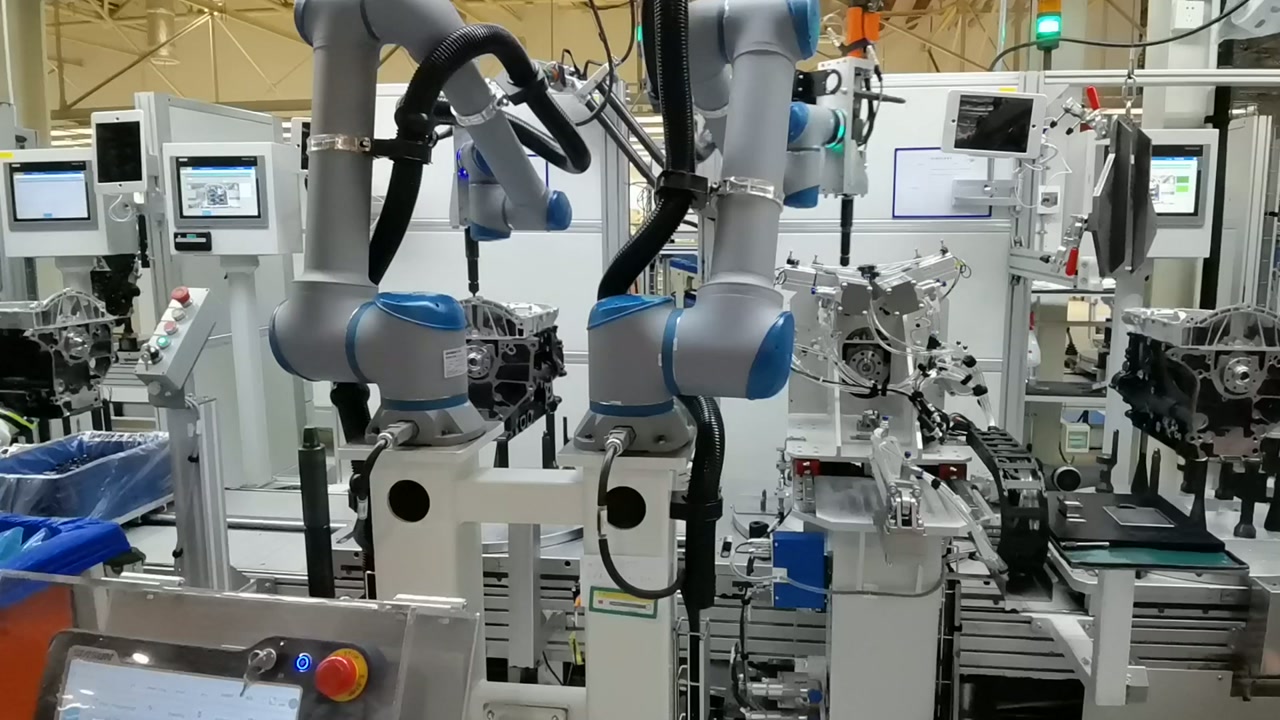
Placing twin cobots side by side divides multi-bolt engine flange patterns cleanly across two arms—provided overhead dress packs and work zones stay coordinated.
Because the footage shows no readable torque setpoint, rotation-angle window, bolt grade, or cycle counter on screen, treat the video strictly as physical context for twin-pedestal cobot layout and overhead dress-pack routing rather than as evidence of a specific torque class or first-pass yield rate.
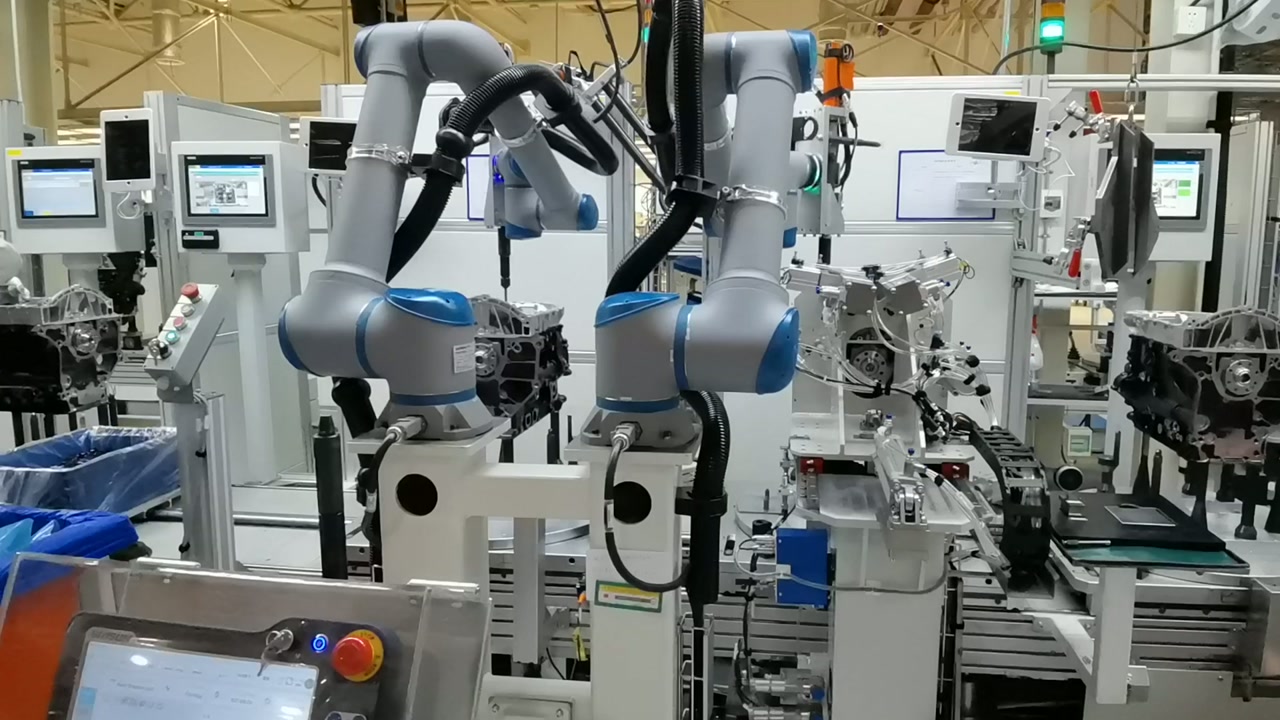
Vertical spindle alignment and suspended overhead dress packs keep wrist drag consistent across multi-hole rundown patterns.
Pitfall 3: Relying on Torque-Only Shutoff Instead of Torque-and-Angle Monitoring
Automated assembly quality guides highlight why torque-only shutoff misses the most expensive fastening defects: cross-threading, burred tapped holes, or a washer left out can generate a steep resistance spike that satisfies the final torque threshold before the bolt ever reaches full clamp load.
Nasıl önlenir: Require smart tightening controllers configured for combined torque-and-angle monitoring. By checking both final torque and the exact angular rotation required to reach it, the controller immediately flags a bolt that hits torque too early (cross-threaded or bottomed on debris) or rotates too far (stripped thread or soft gasket anomaly).
Pitfall 4: Over-Tasking One Cell or Mismatching Screw-Feeding End Effectors
Automated screwdriving specialists warn that a robot’s flexibility often tempts engineers into packing too many screw sizes, angled holes, or feeding chores into a single station—or selecting a vacuum/blow-feed nosepiece ill-suited to fastener head geometry. Using a structured LOSTPED sizing audit—Load, Orientation, Speed, Travel, Precision, Environment, and Duty—forces every mechanical boundary onto paper before hardware is ordered, while confirming screw-arrival sensors at the nosepiece prevent dry-cycling air rundowns.
Pitfall 5: Skipping No-Faults-Forward Interlocks and Dual-Arm Envelope Checks
When two collaborative robots share tight frontage over a single palletized engine block, two system-level mistakes cause painful line stops:
- Passing defective assemblies downstream: Without a strict No-Faults-Forward rule tying tightening controller results and SPC logs to each engine serial ID, a pallet with one missed or NOK bolt can index out to the next station—where teardown costs multiply.
- Dress-pack snagging between adjacent arms: Overhead corrugated power/air bundles stiffen over thousands of cycles; test worst-case corner-bolt poses with both cobots running simultaneously so hoses never tangle or pull lateral force onto the wrist.
Pre-Acceptance Test Matrix Before Line Sign-Off
| Hata modu | Deliberate Factory Acceptance Test | Pass Condition Before Sign-Off |
|---|---|---|
| Cross-Thread False OK | Feed one intentionally damaged or short-started test bolt into a scrap block | Controller rejects via torque-angle window and blocks pallet release (No-Faults-Forward) |
| Pallet / Hole Offset Drift | Introduce worst-case allowable pallet clearance offset on test fixture | Compliant nosepiece/alignment routine seats cleanly without bit stubbing or elevated torque gradient |
| Torque Reaction Overload | Run full consecutive multi-bolt flange sequence at nominal line speed | Zero cobot protective stops, no visible wrist deflection, and stable final torque-angle SPC distribution |
| Dual-Arm Dress-Pack Interference | Run opposing outer-corner coordinates simultaneously across both pedestals | Clear physical separation between corrugated cable bundles across the full envelope |
Review Your Fastening Cell Scope With EVST
Actual cycle time, torque capability, and safeguarding class depend on your bolt specification, joint hardness, and line takt time. Before committing a multi-bolt powertrain or housing station to collaborative robots, send your bolt size, target torque range, hole-pattern photo, and pallet repeatability details to EVST for a reaction-torque and fastening-risk assessment.