
A food packaging line, as EVST builds it, is the part of a food plant where finished snacks, cookies, biscuits and candy go into cartons. Products that arrive in no fixed order are located by vision, picked by robots, counted or weighed, loaded into cartons, closed, inspected and passed on for case packing. EVST builds these lines for snacks, cookies and biscuits, bagged candy and gummies, and seasoning sachets. Products can come in unwrapped, such as crisp snacks picked straight from the belt, or already in their primary pack from upstream; the machines that form the primary pack, such as flow wrappers or bag makers, are not part of these lines. Each line is configured for your product, your cartons and your hygiene plan.
Discuss your food packaging line
What does a food cartoning line do, step by step?
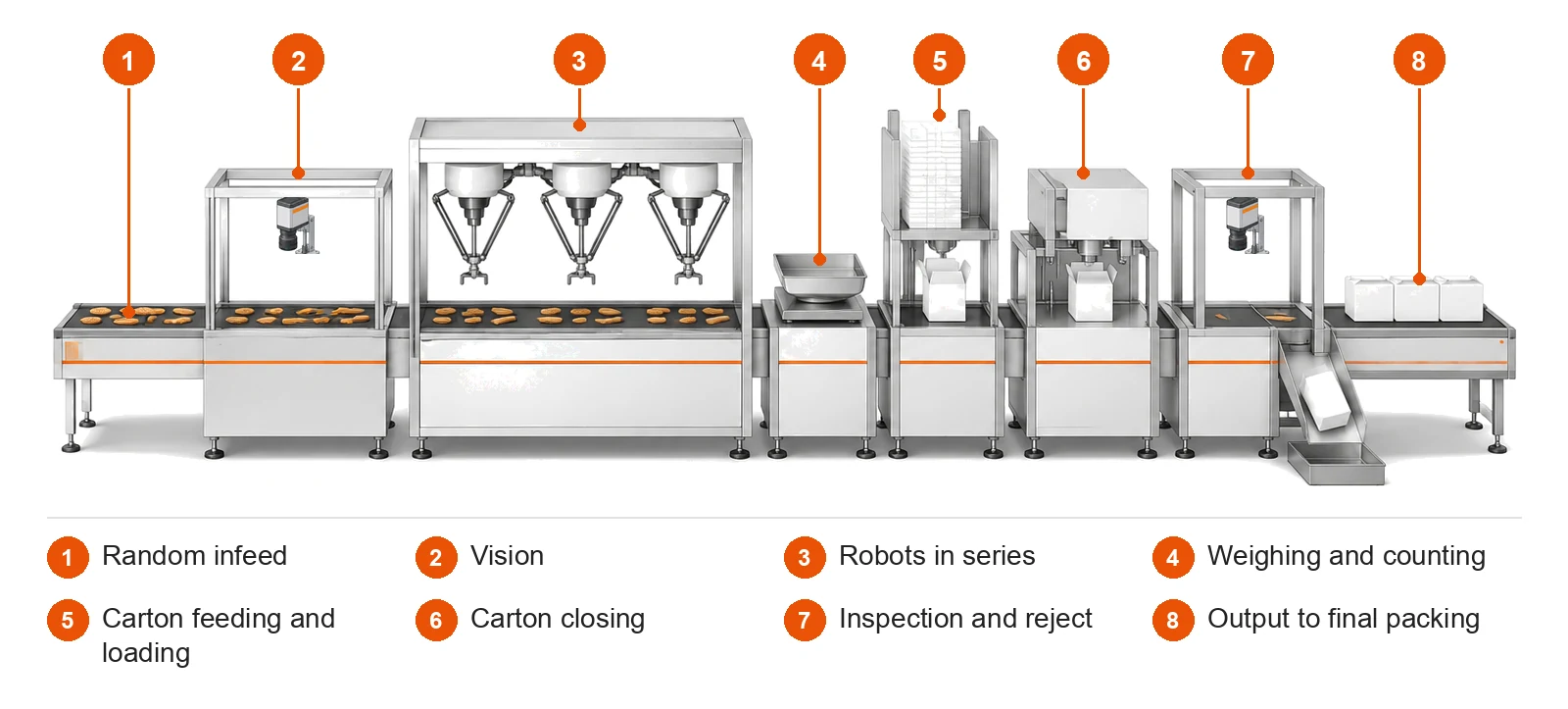
On a snack and baked-goods line we have built, the steps are:
- Random infeed: products come from production in no fixed order or orientation.
- Vizyon a camera locates each piece on the belt.
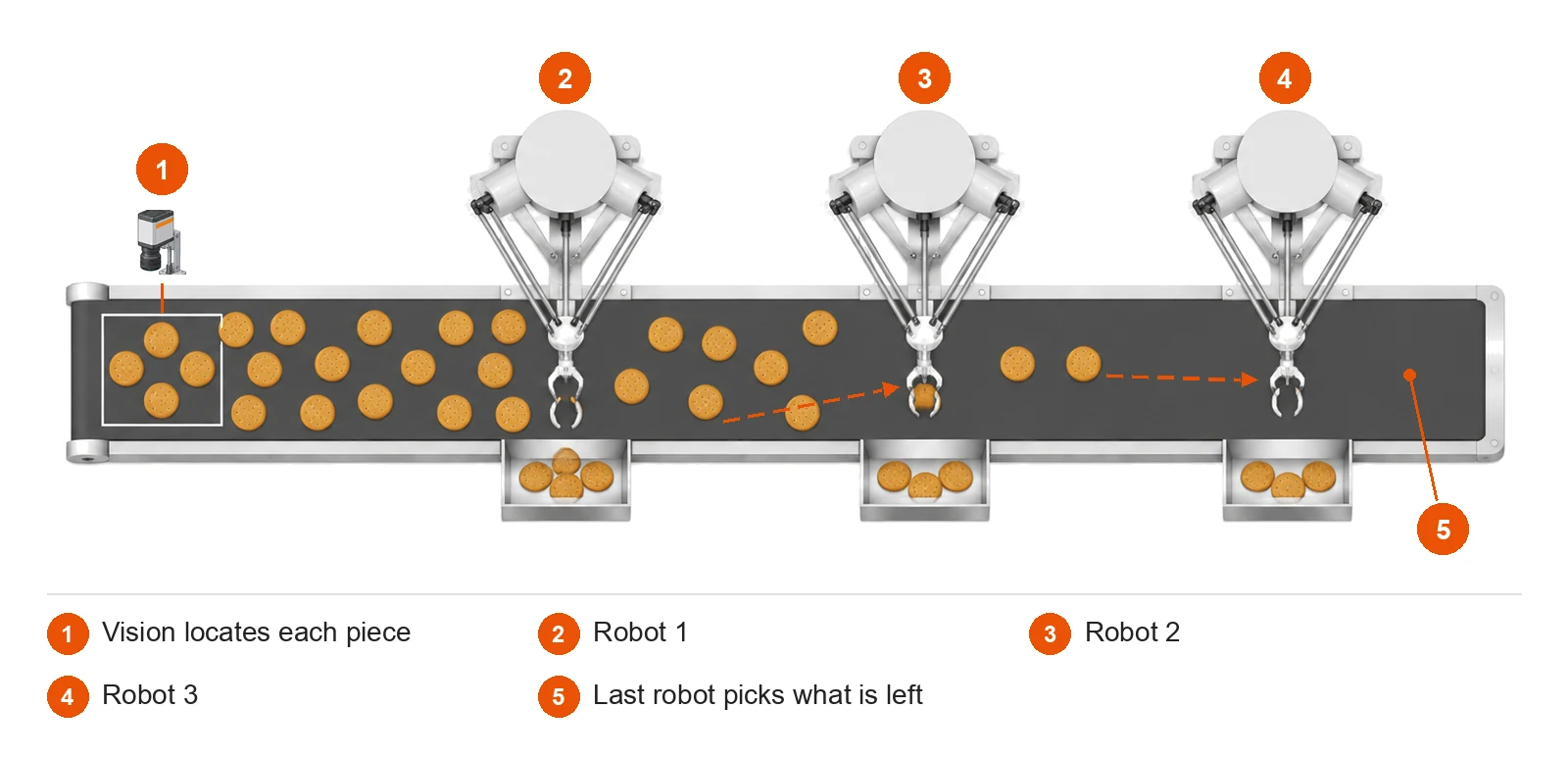
- Robots in series: several high-speed picking robots pick the pieces, and what one robot misses, the next one picks.
- Weighing and counting: a weighing module counts the pack by weight and tops up a short pack.
- Carton feeding and loading: cartons are fed out and the product is loaded.
- Carton closing: the carton is closed.
- İnceleme ve reddetme: packs that fail the checks are rejected.
- Output to final packing: finished cartons go on to final packing.
Downstream, food cartoning lines often connect to checkweighing, coding, wrapping or case packing. The exact process steps are configured for each product and project. For the step after the cartoner, see Kutu paketleme için parça toplama veya grup transferi.
Why several robots in series instead of one?
Snacks, cookies and biscuits do not arrive neatly. Pieces sit at different angles and vary in shape, and cookies and biscuits are uneven on the surface. A single robot has a limit: any piece it cannot reach in time goes past it. On the lines we build, several robots work along the same belt, all under vision coverage. The first robot picks what it can, the next one picks what the first one left, and the last robot picks what is still on the belt. Uneven surfaces do not stop the picking: the camera finds each piece’s position and angle, and the gripper is chosen for the product’s surface.
Some jobs put two different products in one carton from a random infeed; that case is covered on the kartonlama makineleri page. How high-speed picking robots work, and how they pick from a moving belt, is explained in high-speed robots for sorting and packaging hem de picking off a moving belt.
How are fragile snacks handled?
Crisp twisted dough snacks and similar products break easily, and some breakage happens however gently they are picked. On one line for an extra-crisp twisted snack, the customer kept one person at the end of the line to put broken pieces back into the packs, because broken pieces do not change the taste and every piece is worth money. Some plants also send broken pieces to a separate line of their own; that is set by the plant, not built into the packaging line. The gripper type, from soft flexible grippers to other designs, and where breakage is handled are decided on your product samples.
Oily products leave residue on the gripper heads, which is one reason the grippers are wiped down at the end of every shift; see the hygiene section below.
Hygienic design: what touches the food, and how it is cleaned
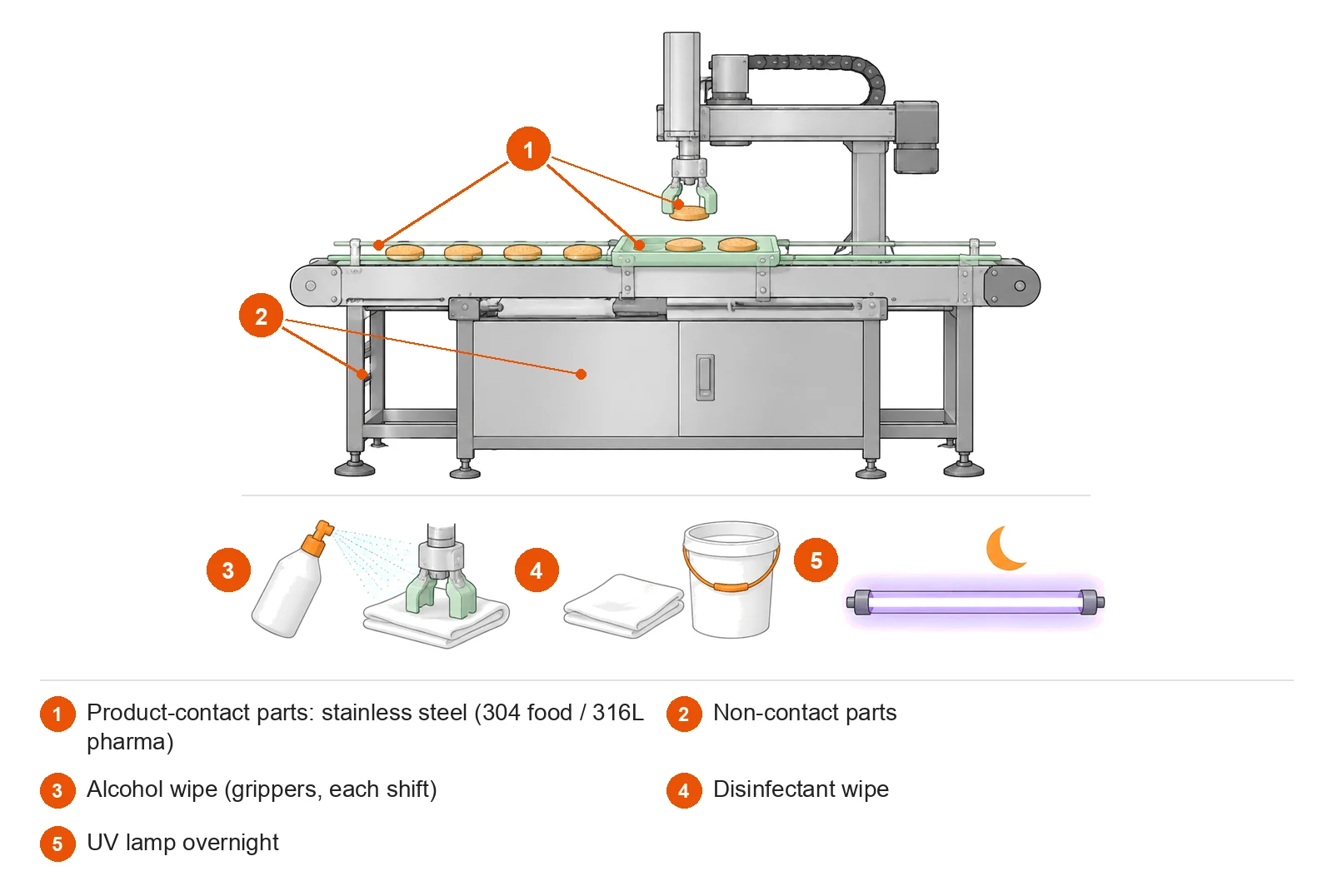
The hygiene requirement depends on what touches the product. Where food contacts the machine directly, the parts are stainless steel. For food, 304 stainless steel is typically enough; pharmaceutical lines usually call for 316L. Parts that never touch the product do not need the same grade. The material of each contact part is confirmed for each product and project.
Cleaning follows the plant’s hygiene plan. On lines we have built, the methods have included:
- gripper heads wiped with alcohol at the end of each shift;
- contact surfaces wiped with disinfectant;
- ultraviolet (UV) lamps left on inside the machine overnight after production.
Where a plant also uses room-level sanitizing such as ozone or chlorine dioxide, the machine’s materials and protection are matched to it for each project.
Candy, gummies and seasoning sachets
Bagged candy and gummy pouches
Bagged candy and gummy pouches are cartoned on a continuous horizontal cartoner. Where a leaflet or insert is required, a leaflet folder or a block-leaflet feeder adds it; the cartoner opens the carton, several pushers load the product without stopping, and the carton is closed and inspected. No carton is opened when there is no product, and the machine stops with an alarm when cartons are missing. An electronic cam links the stations, so the speed is changed in one setting instead of station by station. The continuous horizontal cartoner is rated at up to 120 cartons per minute, depending on carton size; see the yatay kartonlama makinesi. Other food lines we have built have cartoned dried tofu snacks and instant soup packs, and packed spout-pouch drinks into shipping cases.
Gift boxes and trays
For gift boxes and food trays, a carton sleeving machine adds the paper sleeve: it locates the box, takes a sleeve, feeds it and forms it around the pack, at up to 60 packs per minute depending on the product shape. Odd-shaped gift boxes, such as octagonal candy boxes, need their own carton handling; see the kartonlama makineleri sayfamızı ziyaret edin.
Seasoning sachets and instant food
For seasoning sachets packed one per carton, the sachets arrive in no fixed order, vision locates each one and a high-speed picking robot places it into the carton.
What sets the speed of a food cartoning line?
Line output for your product is confirmed on request. In practice it is set by three things: how many pieces the robots must pick for each carton, how the product arrives (at random or in lanes), and whether packs are counted or weighed. Single-machine ratings, such as the continuous cartoner’s 120 cartons per minute, are the upper limit of the cartoning step, not the output of the whole line.
What to send for a food packaging line quote
- Product samples, including the irregular and broken ones, and the carton
- Pieces or weight per carton, and the tolerance
- How the product arrives from production: at random, in lanes or already wrapped
- Leaflets, inserts or sleeves that go with the pack
- Your hygiene plan: contact-material requirements and cleaning method
- Target output per shift, the number of products and how often they change
- What follows the cartoner: case packing, sleeving or palletizing
- Floor space and ceiling height; in one small workshop the conveyors were raised overhead
EVST, based in Chengdu, China, builds food cartoning lines to the specification you send. Product samples help confirm the picking, weighing and cartoning setup before the line is fixed.
Yaygın sorular
What is a food packaging line?
It is the cartoning end of a food plant. Loose products such as crisp snacks and biscuits are found by a camera and picked by several robots along one belt, while bagged candy and gummy pouches are cartoned on a continuous cartoner. It does not include the flow wrapper or bag maker that makes the primary pack.
Can one line pack cookies, snacks and candy?
Different products usually need different grippers, counting methods and carton formats. Which products can share one line is assessed on your samples and product list.
How are fragile snacks kept from breaking?
Each piece is located by vision before it is picked, and the gripper is chosen for the product, including soft flexible grippers. Some breakage still happens on very crisp products, so the project also plans where broken pieces go: back into the pack by hand at the end of the line, or to a separate line the plant runs for them.
What stainless steel is used for food-contact parts?
For food, 304 stainless steel is typically enough on the parts that touch the product; pharmaceutical lines usually call for 316L. The material of each contact part is confirmed for each product and project.
How is a food packaging line cleaned?
To the plant’s hygiene plan. On lines we have built, gripper heads are wiped with alcohol after each shift, contact surfaces are wiped with disinfectant, and some plants leave ultraviolet (UV) lamps on inside the machine overnight.
How fast is a food cartoning line?
Line output is confirmed on request for your product. The continuous horizontal cartoner is rated at up to 120 cartons per minute, depending on carton size, but the whole line is usually set by picking, counting or weighing.
İlgili bağlantılar
- Otomatik paketleme hatları: doldurma, kartonlama, kontrol ve koli paketleme
- Kartonlama makineleri: yatay ve dikey
- Yatay kartonlama makinesi
- Automation for food and beverage production
- High-speed robots for sorting and packaging
Line configurations on this page are those built to date; the line for your product is configured and confirmed for each project.