
When precision shaft plants evaluate automating cylindrical grinding, most first-pass spreadsheets only count operator wages saved—and miss the larger financial lever. On capital-intensive cylindrical grinders, spindle idle time during manual part exchange, shift handovers, and unattended breaks usually dominates unit grinding cost. Before quoting a one-robot, two-grinder cell, verify that one complete robot service loop (travel, dual-gripper unload/load swap, and slotted-tray exchange) fits comfortably inside a single grinder’s cutting cycle; only then model payback from two verified buckets: reduced operator hours and recovered productive grinding hours.
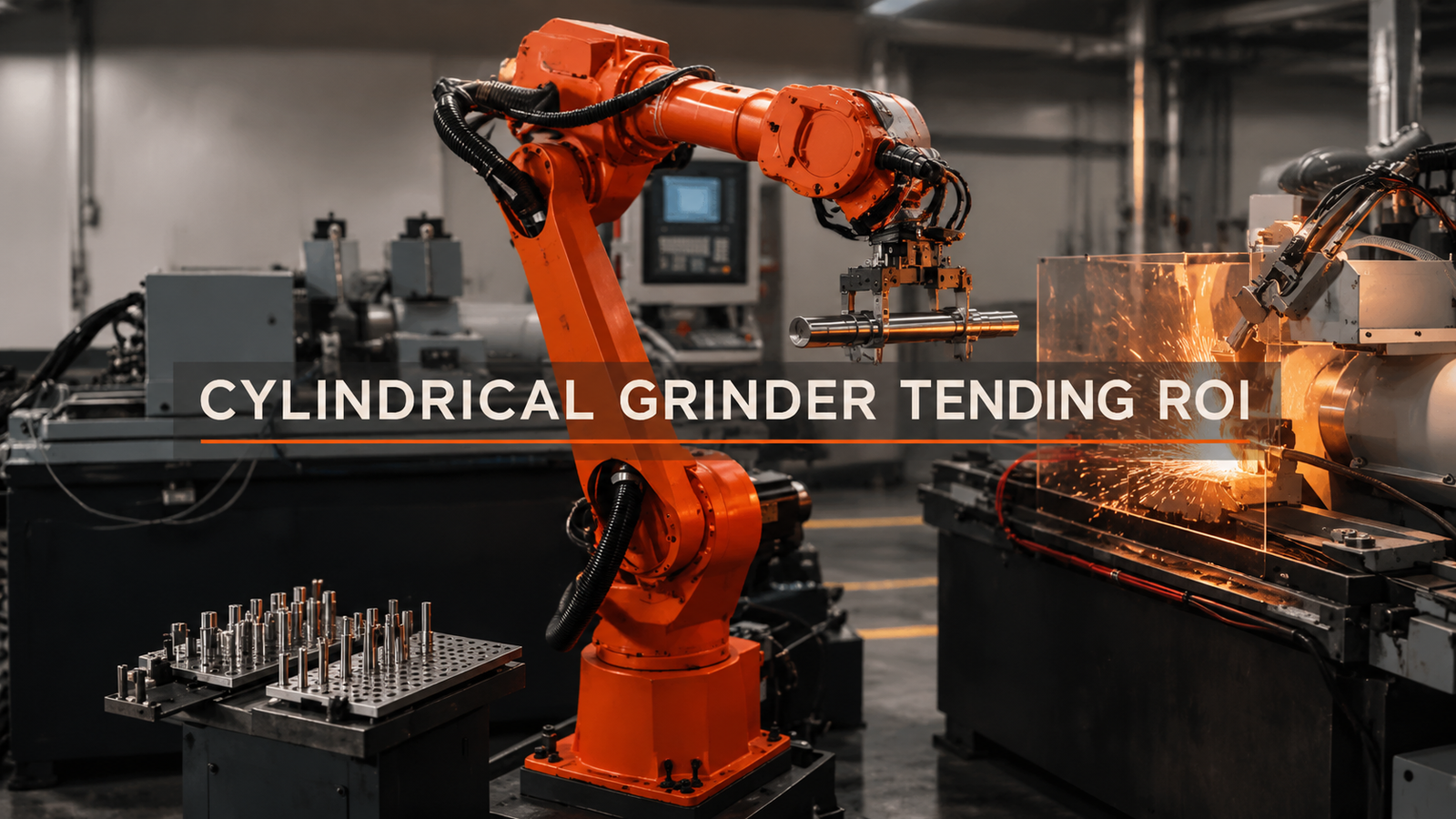
Step 1: Check the Two-Machine Service-Loop Inequality First
Pairing one industrial robot with two cylindrical grinders only saves capital if the robot never leaves either grinding wheel waiting with its door open. Write the balance condition directly in seconds per shaft:
- Single-machine cutting time (T_grind): Total wheel-engaged cycle including roughing, finishing, spark-out, and automatic gauging inside the machine.
- In-machine part-swap time (T_swap): Door open, unload finished shaft, load raw shaft, chuck/center clamp confirmation, and door close.
- External tray and transfer time (T_ext): Dropping the finished shaft in the outfeed slot, picking the next raw blank, air blow-off if required, and slewing to the opposite grinder.
For one robot to tend two identical grinders without starving either machine, Machine A’s closed-door grinding time must cover Machine A’s external tray transfer, Machine B’s in-machine swap, and Machine B’s external tray transfer (equivalently, full cycle T_grind + T_swap >= 2 × (T_swap + T_ext) + T_margin), which simplifies to:
T_grind >= T_swap + 2 × T_ext + T_margin
When T_grind is short (under roughly one minute), a single-gripper arm that makes two separate entries per machine—once to unload, return to the tray, and once to load—inflates both swap and tray-transfer overhead and fails the inequality. A dual-hand mechanical gripper eliminates the round-trip between unload and load, executing the part exchange in one machine entry so the robot returns to the opposite grinder before its spark-out finishes.
What the Filmed Dual-Grinder Cell Demonstrates in Practice
In the workshop cell recorded above, a floor-mounted red-orange six-axis industrial robot stands between two CNC cylindrical grinding machines on a clean epoxy floor, with two slotted metal shaft trays positioned directly at the front-left of the robot base.
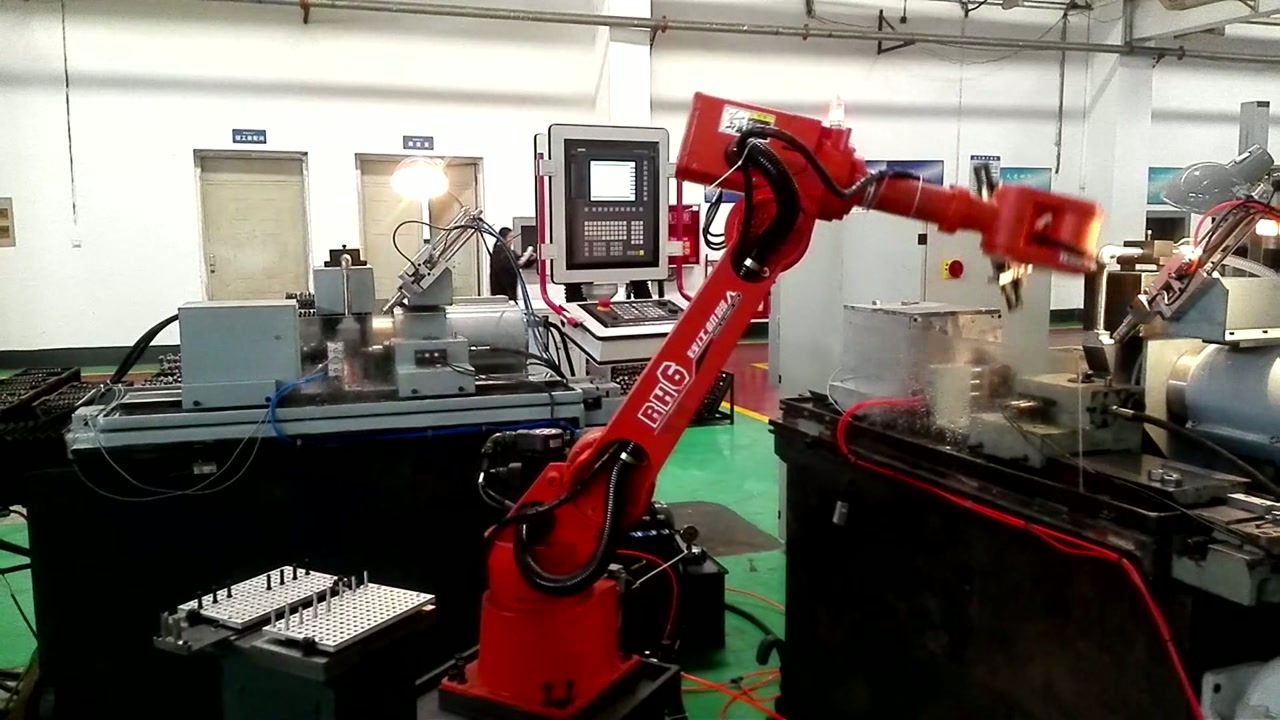
Live grinding sparks inside the right-hand splash guard while the robot services the opposite station illustrate parallel machine-cycle overlap.
Notice the wrist configuration in the mid-cycle view below: a back-to-back dual-hand parallel mechanical gripper lets the robot carry both an incoming blank and an outgoing ground shaft cleanly across the aisle between machines without pausing at the slotted tray between unload and load. Because the footage displays no live cycle timer, shaft mass, surface finish specification, or hourly count, treat the cell strictly as architectural proof of the 1-robot-to-2-grinders physical layout rather than as a measured throughput benchmark.
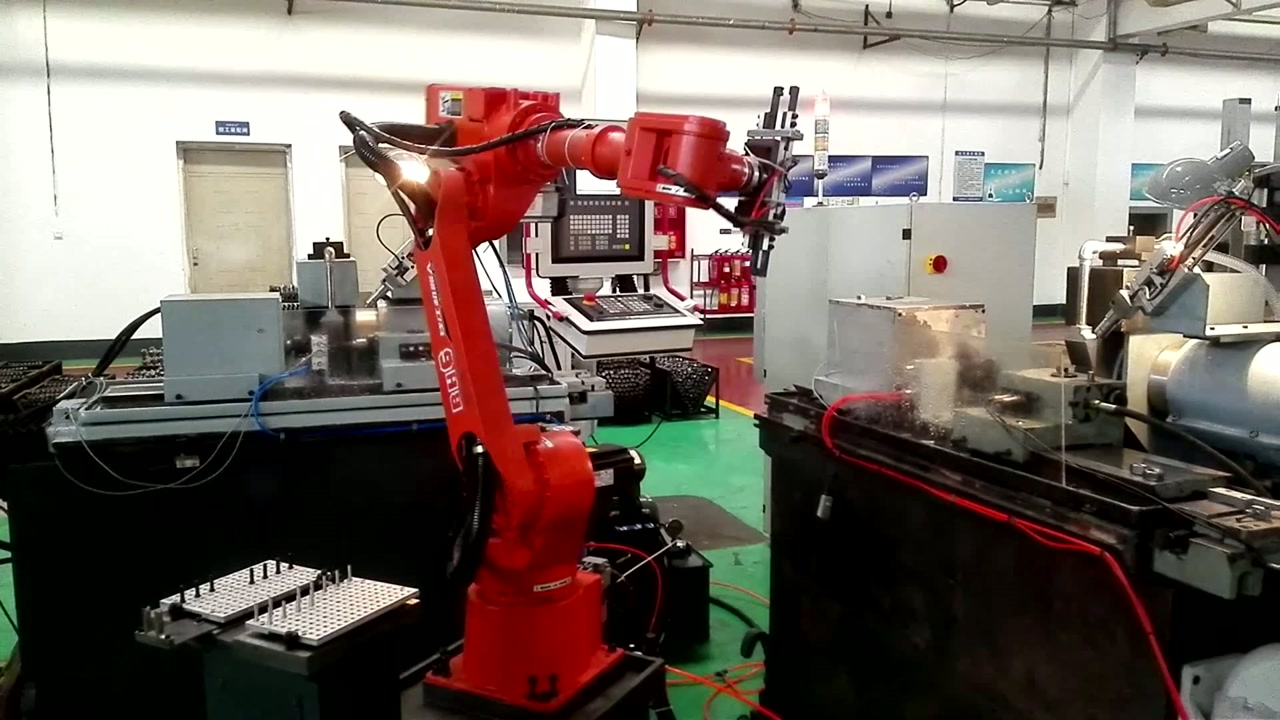
Indexed upright shaft trays paired with a dual-hand wrist keep part presentation repeatable without complex vision hardware.
Step 2: Build a Scoped Payback Model Without Guessing
Because local labor rates, shift schedules, and machine hourly recovery rates vary dramatically by country and shop class, never copy a generic vendor ROI percentage into a capital request. Instead, structure your internal estimate around two transparent annual benefit lines and compare published external benchmarks strictly within their stated scope:
| Budget / Model Line | How to Estimate With Your Own Plant Data | Published External Reference & Exact Scope |
|---|---|---|
| Machine-to-Robot Cycle Fit | Compare your actual T_grind (plus wheel-dressing frequency) against measured robot swap + tray loop time | One US CNC tending integrator reports single-machine cells commonly fit cycles over 60 saniye, while multi-machine cells (2–4 makine) typically fit cycles of 3 dakika ve üzeri |
| Recovered Spindle Utilization | Added Grinder Hours/yr = Scheduled Hours/yr × (U_robot – U_manual), multiplied by your internal machine hourly contribution rate | That same US CNC tending integrator cites typical utilization climbing from roughly 50% under manual attendance toward 88% under automated tending across multi-shift shops |
| İşgücü Yeniden Dağıtımı | (Manual Tending Hours/yr – Tray Refill & Audit Hours/yr) × Fully Burdened Hourly Wage | Two-shift operations often reallocate operators from door-watching to tray replenishment, wheel checks, and SPC gauging rather than eliminating supervision completely |
| Indicative Payback Horizon | Payback (Years) = Total Installed Cell Cost ÷ (Labor Savings + Added Machine Margin) | In US two-shift CNC environments, the same integrator publishes 8 – 16 ay as a typical payback band; single-shift shops or lower-wage regions stretch payback proportionally |
Illustrative unit sanity check: If two cylindrical grinders run 4,000 scheduled machine-hours each (8,000 combined machine-hours/year) and automation raises effective spindle utilization by 25 percentage points, you recover 2,000 productive grinding hours/year (expressed cleanly as machine-hours gained per year, not robots per machine). Plugging your own shop’s hourly grinder recovery rate and burdened operator wage gives a defensible payback range before you ever sign a purchase order.
Step 3: Budget the Three Hidden Integration Costs Upfront
Many first-time tending budgets cover the robot arm and gripper accurately, then overshoot materially during installation because three peripheral items were omitted from the initial estimate:
- CNC Machine Communication and Handshake Interlocks: As machine-tending integration guides consistently warn, linking different CNC control generations—whether over discrete I/O, RS-232, or industrial Ethernet—for automatic door actuation, hydraulic tailstock/chuck clamping confirmation, and cycle-start interlocks is frequently the single biggest deployment hurdle. Verify whether your existing cylindrical grinders already carry automatic doors and robot-ready I/O before locking cell CapEx.
- Coolant, Swarf Blow-Off, and Datum Cleanliness: Cylindrical grinding runs heavy flood coolant and fine metallic abrasive slurry. Include an air-knife or blow-off step and sealed pneumatic/mechanical grippers in the budget so swarf does not lodge against grinder centers or spoil post-process bore/OD measurements.
- Abrasive-Wheel Guarding and Energy Isolation Compliance: Automated cells around grinding wheels still require full perimeter safeguarding, interlocked operator access gates for tray loading, and compliant lockout/tagout energy isolation. In the United States, OSHA highlights general machinery guarding (29 CFR 1910.212), abrasive-wheel machinery requirements (29 CFR 1910.215), and hazardous energy control (29 CFR 1910.147); plants in Europe or Asia must budget equivalent CE/ISO or national safety guarding and risk-assessment sign-off.
Map Your Two-Grinder Service Loop Before Quoting
Cell payback and machine-to-robot ratio depend strictly on your shaft cycle time, dressing cadence, and existing CNC interface readiness. If you are weighing a dual-gripper tending cell across two cylindrical grinders against adding another standalone machine, share your shaft grinding cycle time, shift schedule, shaft dimensions, and machine door/chuck interface details with EVST for a grounded service-loop balance and integration budget checklist.