
By Zhang Wei, Senior Welding Applications Engineer · EVST Applications Engineering Team · · Reviewed by EVST robotics integration engineering
A thick-plate multi-pass welding cell pairs an industrial robot with arc and seam tracking, locking the torch to the joint centerline within ±0.5 mm in real time so multi-pass beads are laid at constant parameters from the first part to the thousandth — and adding external axes (a welding positioner, a travel rail) lets one robot cover heavy structural steel that a skilled welder needs hours to reposition. This guide explains the seam-tracking, multi-pass control and external-axis decisions behind the cell, and how EVST scopes one for structural steel, engineering machinery, pressure vessels and railway bogies.
Key takeaways
- Skilled welders are hard to hire and harder to keep consistent across long, multi-pass joints on thick plate; a robot with seam tracking holds the centerline within ±0.5 mm (typical achievable on EVST-integrated cells with calibrated arc + vision tracking) and reaches a ~99% first-pass acceptance rate on standard thick-plate joints (industry-typical range under ISO 3834 Class B fabrication, sized per project).
- Multi-pass layers fail when interpass temperature or weave parameters drift — the robot holds both steady, so slag inclusion, lack of fusion and undercut drop sharply.
- A dual-axis U-type positioner rotates the part into the optimal flat-gravity weld position; a travel rail extends reach; together the cell scales to up to 16 external axes.
- Two skilled welders displaced per cell (typical on a single-shift baseline; varies with part mix and inspection class), with two-shift continuous operation.
- The industrial arm runs guarded to ISO 10218 inside its cell.
This article is for production managers, welding engineers and plant owners automating thick-plate structural welding. It covers multi-pass thick-plate joints with external axes; it does not cover thin-sheet or aluminum work, which have different parameter regimes.
What thick-plate multi-pass welding involves
On heavy structural steel — H-beams, box girders, frames, pressure-vessel shells, railway bogies — joints are long, the plate is thick, and a single pass cannot fill the gap or develop full penetration. Welders lay the bead in layers: a root pass, fill passes, and a cap, each at controlled heat input and bead placement. Across a thousand parts the human hand drifts: late-shift fatigue softens the travel speed, the centerline wanders, and inspection rejects the seam. The cell exists because the joint is too repetitive for a person to hold to spec, and too critical to inspect away later.
 Figure 1 — Multi-pass weld bead cross-section: a root pass at the bottom, fill passes building up, and a cap pass with visible heat tint. The pass count and interpass parameters decide whether the joint passes inspection.
When thick-plate welding automation pays off — and when it doesn’t
The decisive factors are joint complexity, part size and inspection class. Use this frame:
| Choose a multi-pass robot cell when… | Reconsider when… |
|---|---|
| Plate is thick enough to require multiple passes | Single-pass thin-sheet work is the bulk |
| Joints are long or repeat across many parts | Geometry changes every part with no logic |
| Inspection demands consistent first-pass quality | Visual-only inspection on light-duty work |
| Skilled welders are scarce or aging out | Existing welders meet throughput easily |
| Large parts need reorientation between passes | Small parts a welder handles in one go |
EVST scopes a thick-plate cell with what our engineers call the Centerline-First method: lock the torch to the joint centerline with real-time arc and seam tracking, then build pass after pass at constant interpass temperature and weave — because a multi-pass joint fails on parameter drift far more often than on robot pose.
Manual vs robot thick-plate multi-pass welding
| Factor | Manual welding | Robot multi-pass welding |
|---|---|---|
| Joint position accuracy | Hand-to-eye, drifts with fatigue | Locked to centerline ±0.5 mm by seam tracking |
| Layer parameter consistency | Welder estimates interpass temp | Held steady by program; less slag and undercut |
| Defect rate (first-pass acceptance) | Variable, drops late shift | ~99% under seam tracking and stable parameters |
| Welders displaced | — | Two per cell (typical) |
| Continuous running | One shift with fatigue | Two-shift with no operator drift |
| Reach on large parts | Welder repositions and re-clamps | Positioner rotates; travel rail extends |
How a thick-plate cell is built
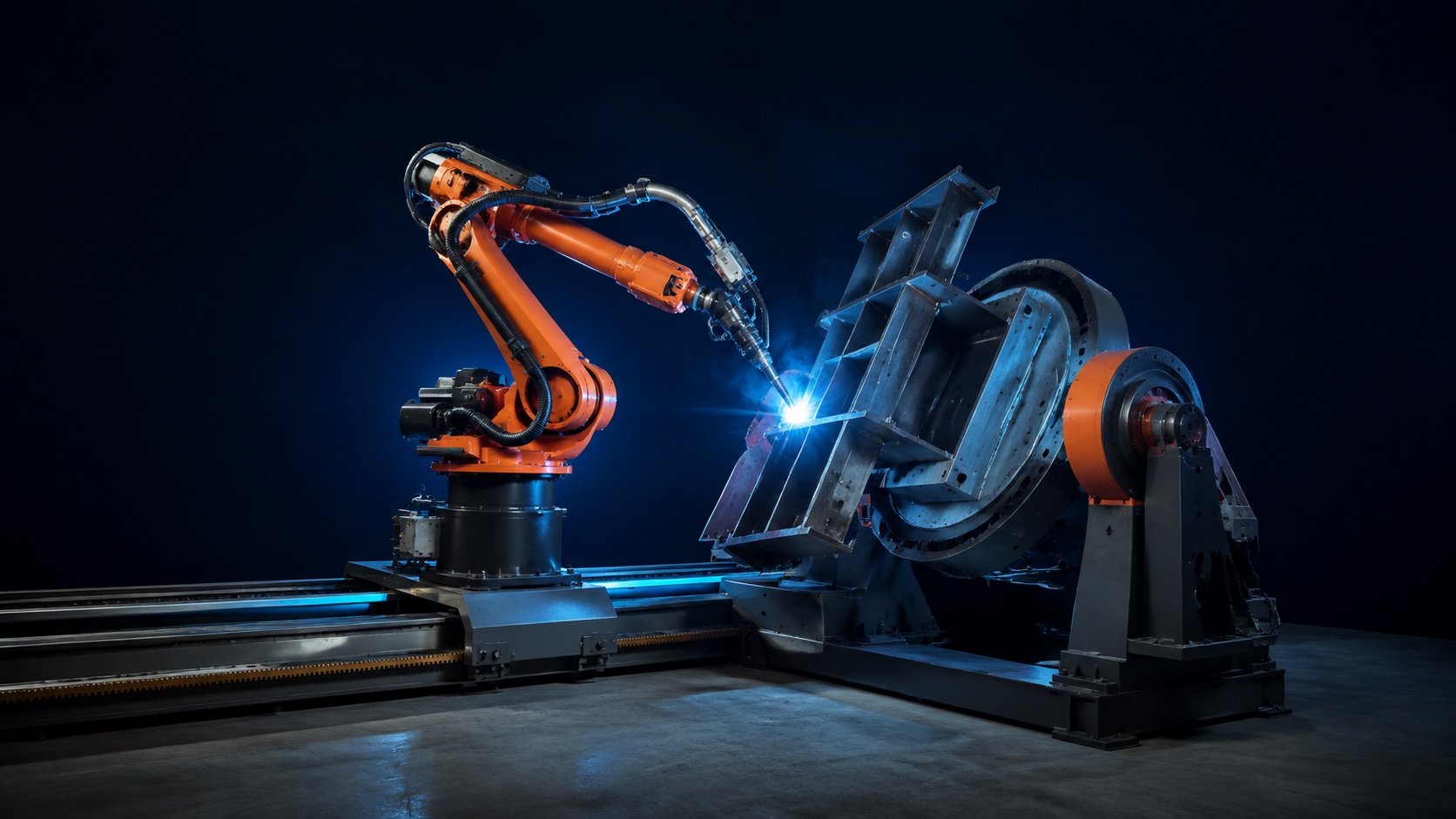 Figure 2 — Centerline-First method in one cell: the robot welds, the positioner rotates the part to flat-gravity, the travel rail extends reach. All three are coordinated external axes on a single controller.
Three engineering details decide whether the cell holds tolerance over months of production:
- Real-time seam tracking. Arc tracking and vision-based seam tracking lock the torch to the joint centerline within ±0.5 mm, in real time, across the full bead. The robot does not just follow a programmed path — it corrects to the actual joint as it lays the weld. This is the floor below which multi-pass quality cannot survive.
- Multi-pass parameter control. The cell sequences root, fill and cap passes at controlled interpass temperature and weave; heat input stays steady. Slag inclusion, lack of fusion and undercut — the failure modes that defeat multi-pass on thick plate — drop sharply when the program holds these constant.
- External axes that reach the joint. A dual-axis U-type positioner rotates the part into the optimal flat-gravity position so each pass is laid downhill; a travel rail moves the robot along the line for joints longer than a fixed-base arm can reach. The cell scales to up to 16 external axes, which is what large structural frames need to be welded all around in one setup.
In practice the failure we see most is treating the positioner as optional: a robot welding awkward, off-flat positions runs slower and accumulates micro-defects, while the same robot on a rotated part welds clean. EVST sizes the positioner and rail to the actual part envelope, not to a category.
The ROI: quality, throughput and skilled-labor displacement
The first lever is inspection yield: holding the centerline to ±0.5 mm and the parameters steady takes first-pass acceptance toward 99%, which removes rework that downstream X-ray or UT would otherwise force. The second is throughput: two-shift continuous welding without operator fatigue lifts output from the same cell envelope. The third is skilled-labor displacement: two welders per cell are freed up, addressing the structural shortage of certified hands. Payback depends on inspection class, part mix and current staffing, and EVST sizes it per project.
Where it applies across industries
- Structural steel and prefab buildings — H-beams, box girders, column-beam connections; long repetitive welds where seam tracking is the differentiator.
- Engineering machinery and earth-moving — heavy frames and underchassis with multi-pass joints on thick plate.
- Pressure vessels — circumferential and longitudinal seams on thick shells, where inspection class is unforgiving and consistency pays.
- Railway bogies and rolling stock — repeated thick-plate joints with strict first-pass acceptance requirements.
The same logic carries because the workload is identical: a long, multi-pass, full-penetration joint on plate too thick for a single pass. As long as those three conditions hold, the cell pays.
Standards the cell runs under
Robot welding cells for thick-plate structural work are scoped against three families of standards:
- ISO 3834 — Quality requirements for fusion welding of metallic materials. ISO 3834-2 (Comprehensive), 3834-3 (Standard) and 3834-4 (Elementary) classes set documentation, procedure-qualification and inspection requirements that the cell’s WPS (welding procedure specification) is built to satisfy.
- ISO 14732 — Welding personnel qualification for fully mechanized and automatic welding of metallic materials. Covers operator and adjuster qualification on robotic welding cells; required by many EU and OEM specifications.
- AWS D1.1 — Structural Welding Code: Steel. North American structural-steel standard, with prequalified WPS, qualification testing and inspection rules. Most U.S. structural-steel and bridge work specifies D1.1.
- ISO 10218 — Robot safety. The industrial arm runs guarded inside its cell per ISO 10218-1 (robot) and ISO 10218-2 (system integration).
Seam tracking and multi-pass parameter control are tools that help meet these standards — they are not substitutes for the WPS, the operator qualification or the inspection plan.
FAQ
How accurate is seam tracking on thick plate? Arc and vision-based seam tracking lock the torch to the joint centerline within ±0.5 mm in real time on EVST-integrated cells (typical achievable under calibrated tracking; varies with surface condition, fit-up and procedure), correcting to the actual seam as the bead is laid rather than relying on the programmed path alone.
Why does first-pass acceptance reach 99%? Because centerline drift and parameter drift — the two failure modes — are both removed. Seam tracking fixes the first; programmed interpass temperature and weave control fix the second. Combined, the multi-pass joint is laid the same way every time. The figure is an industry-typical range achievable on ISO 3834 Class B-equivalent fabrication; the actual rate is sized per project.
Do I need a positioner and a travel rail? A positioner is almost always paid for by yield: rotating the part to flat-gravity position cuts micro-defects and lets the robot weld faster. A travel rail is paid for by reach — needed when the joint is longer than the robot’s envelope. The cell scales to up to 16 external axes when both apply, such as on large structural frames.
What standards does it run under? The industrial arm operates guarded to ISO 10218 inside its cell; weld procedures are set per project to ISO 3834, ISO 14732 or AWS D1.1 as the customer’s inspection class requires. Tracking is a tool that helps meet those standards, not a substitute for them.
Does it work for changeover between part types? Yes — a new part is a program and fixture change, and the welding-process library carries reusable weld procedures. Seam tracking corrects for fit-up variation within a part family, but step-change geometry needs a real reprogramming pass.
Bringing it into your plant
Thick-plate multi-pass robot welding turns the hardest, hardest-to-staff joint in the heavy fabrication shop into a consistent, two-shift, inspection-grade standard process — locking the torch to the centerline, holding parameters constant, and using external axes to reach what a fixed-base arm cannot. The decision hinges on plate thickness, joint length and inspection class, not robot brand. EVST designs thick-plate cells with the Centerline-First method and integrates the welding robot, seam tracking, dual-axis U-type positioner and travel rail as one cell — see our guides to how to pick a robot travel rail, welding positioner selection and robot + rail + positioner cell coordination, or talk to EVST about scoping a thick-plate cell.
About the author — Zhang Wei is a Senior Welding Applications Engineer on the EVST Applications Engineering Team, with over 12 years of experience integrating robotic welding cells for thick-plate structural steel, engineering machinery, pressure vessels and railway rolling stock. He leads cell scoping around joint complexity, inspection class and reach — sizing seam tracking, multi-pass program control, positioner and travel-rail axes per part envelope — using the Centerline-First method described above. Reviewed by EVST robotics integration engineering for technical accuracy; figures are typical achievable ranges, not guarantees, and are sized per project. Corrections and updates: see the Last Updated date.