
Feed mills, grain processors, and dry-chemical plants rarely miscalculate a robotiskt palleteringssystem on the bare robot price—they miscalculate on effective bags per hour after pallet swaps, end-of-arm tooling mass, and omitted peripheral equipment. Rather than relying on generic payback slogans, build your business case from three concrete equations: your real sustained cycle time including bag-flattening and pallet changeover, combined payload capacity (filled bag plus heavy mechanical claw tooling), and total installed cell cost across all six equipment buckets.
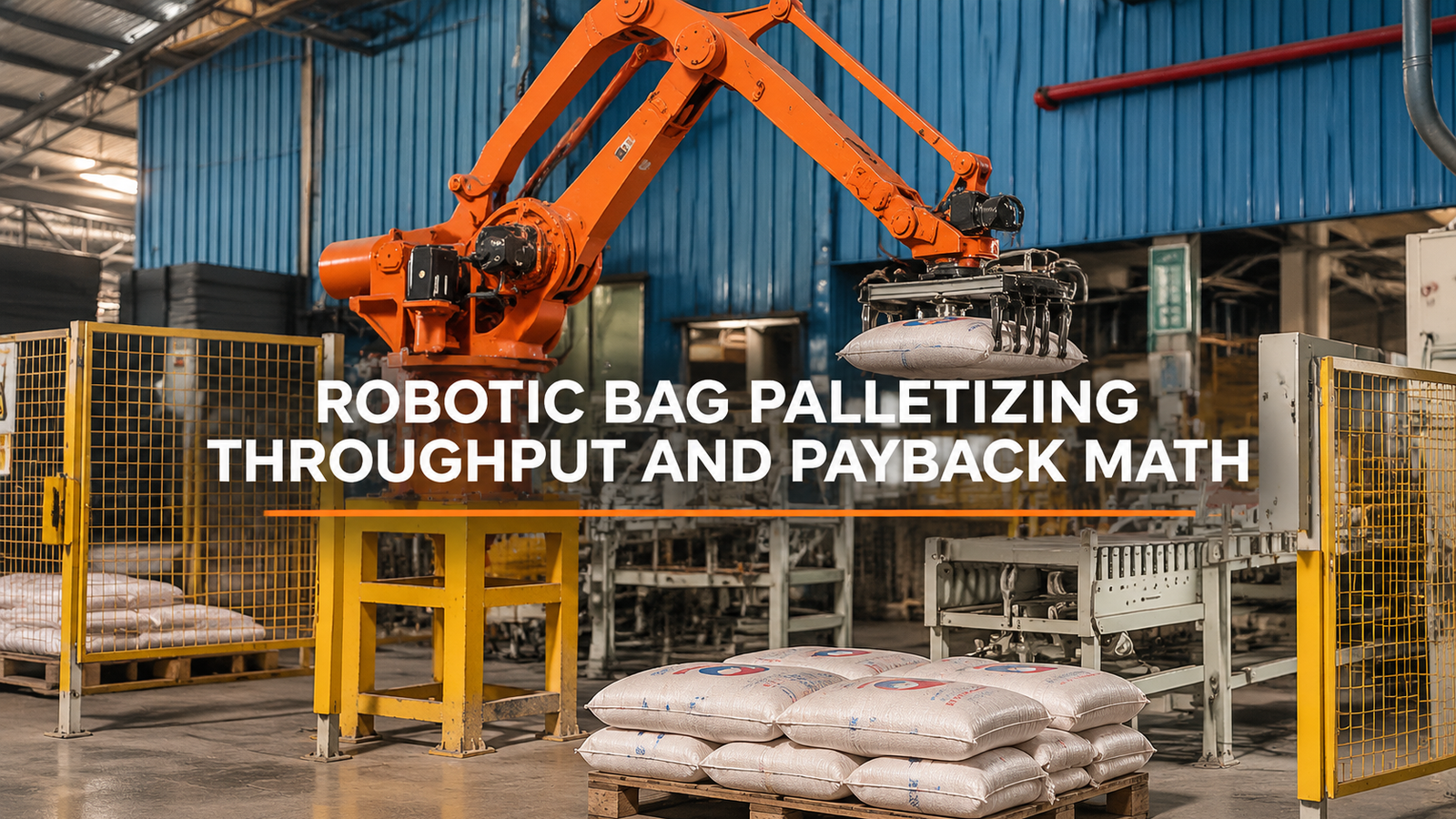
Anatomy of a Heavy-Bag Palletizing Cell (Filmed Reference)
In the high-bay packaging cell recorded above, an orange four-axis heavy-duty industrial palletizing robot stands on a yellow steel pedestal behind yellow wire-mesh safety fencing. Filled white woven feed bags arrive singly on an elevated steel roller infeed conveyor on the right side of the arm.
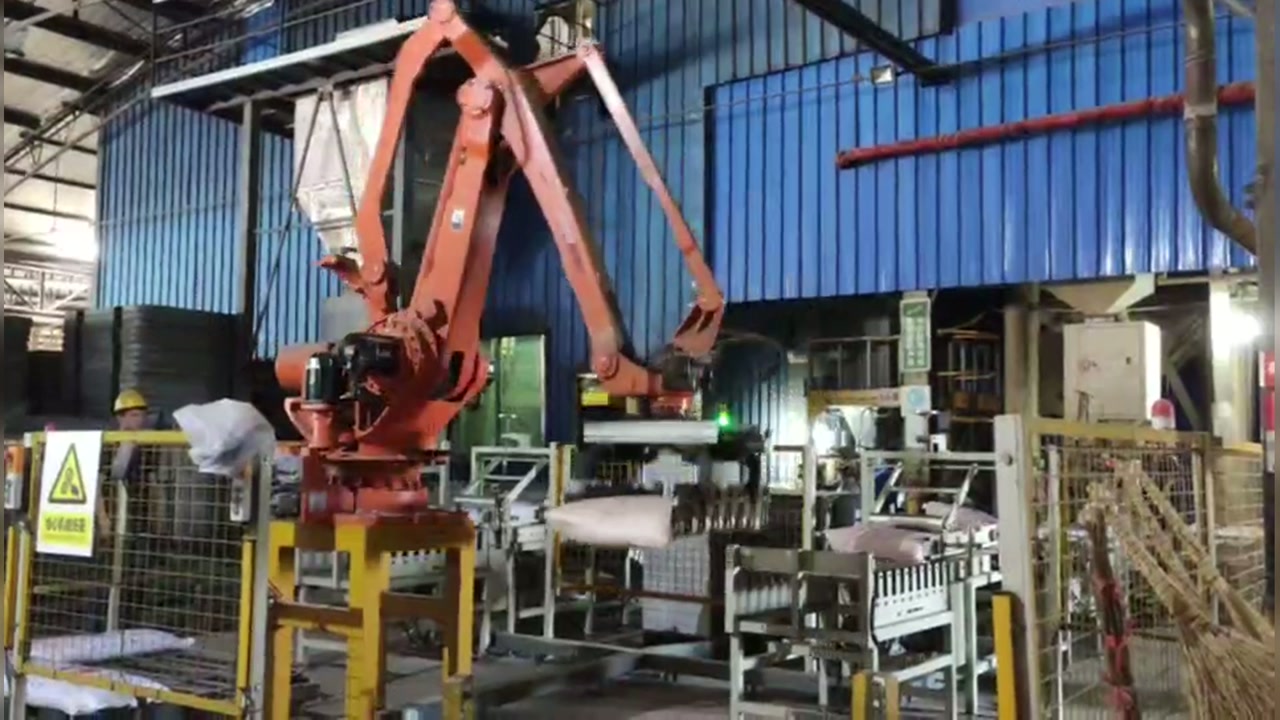
Curved mechanical clamping fingers wrap underneath each woven sack at the roller infeed before lifting it clear of the guard perimeter.
The arm swings smoothly across the cell to build interlocking layers onto wooden floor pallets, with a foreground pallet build zone and a second pallet position visible on the left behind the mesh fence.
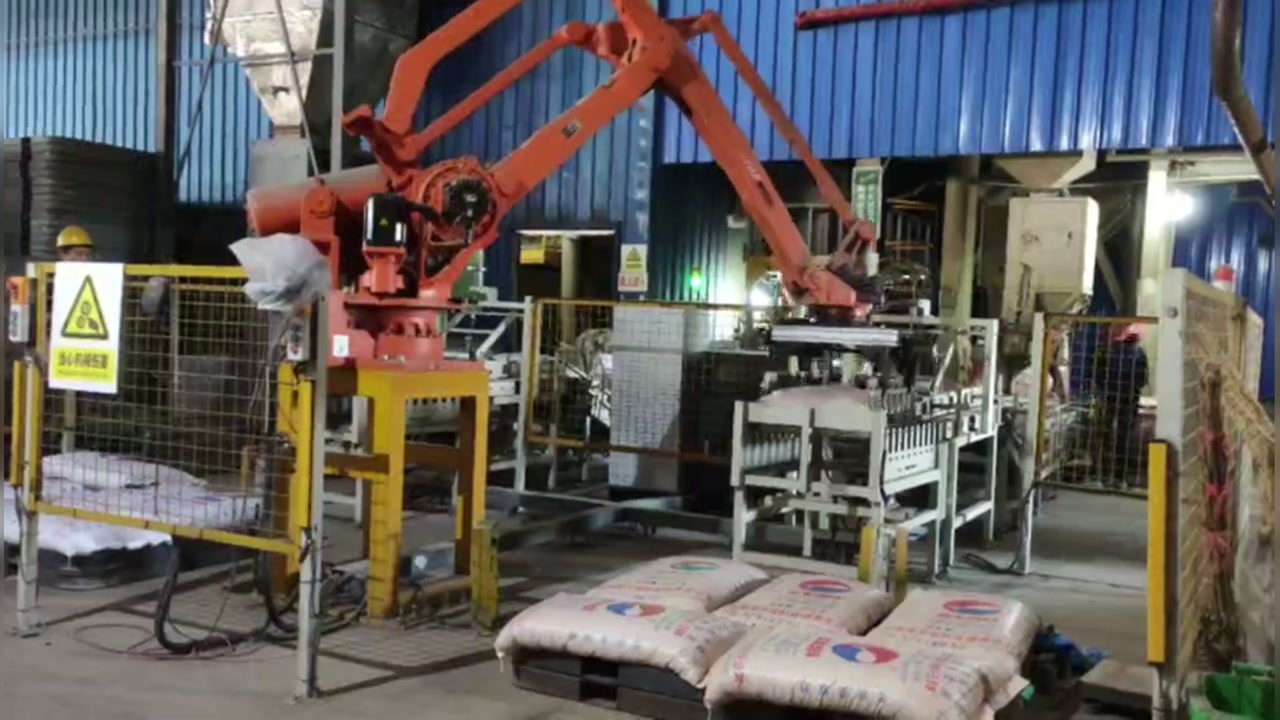
Interlocking cross-tier bag placement stabilizes tall stacks while keeping pallet corners square for downstream stretch wrapping.
Step 1: Calculate Effective Bags per Hour (Not Peak Brochure Cycles)
Brochure robot speeds measure unloaded, short-stroke pick-and-place moves in a lab. On a heavy woven-bag line, real sustained output depends on every mechanical delay between the bagger discharge and the finished pallet:
Effective Bags / Hour = (3,600 / T_cycle_sec) × N_bags_per_pick × (1 − Pallet_Swap_Loss_Ratio)
Ha sönder T_cycle_sec into five measurable shop-floor terms before comparing vendor throughput claims:
- Infeed settling & squaring (
T_present): Time for the bag to travel across the bag flattener/shaker, reach the roller pick stop, and settle flat. - Mechanical gripper clamp (
T_clamp): Pneumatic cylinder closing time for multi-finger jaws (plus top stabilizer plate compression on loose granular sacks). - Loaded swing and drop (
T_transfer): Travel from roller pick point to the farthest corner of the top pallet layer—always calculate against the worst-case far corner, not the nearest layer. - Release & clear (
T_release): Jaw opening time plus vertical retract clearance so fingers do not snag adjacent woven sacks. - Pallet exchange & slip-sheet loss (
Pallet_Swap_Loss_Ratio): In a single-pallet floor bay, the robot sits completely idle while a forklift removes the full pallet and drops an empty one. Dual floor bays (as seen in the filmed cell) or automatic pallet dispensers cut that idle loss dramatically.
Step 2: Size Robot Payload for Bag + Heavy Mechanical Tooling Together
Industrial palletizing engineering guidance emphasizes that robot selection must combine product mass, end-of-arm tool (EOAT) weight, and dress-pack cabling alongside reach, duty cycle, and floor space. That distinction matters enormously for woven sacks:
- Collaborative lightweight tier: Heavy-lifting collaborative palletizers (for example, a 30 kg-class cobot model in published vendor catalogs) fit compact, lower-speed carton or light-bag lines operating in shared human workspaces.
- Dedicated heavy industrial bag tier: Porous woven polypropylene or dusty open-mouth paper sacks frequently leak vacuum and require steel multi-finger mechanical clamping grippers—tooling that adds substantial dead weight and wrist inertia on its own, pushing 25–50 kg single- or dual-bag lines firmly into heavy-payload four-axis industrial palletizers.
| Verktygsval | Bästa väsktyp | Upfront Tooling & Maintenance Cost | Primary Throughput / Uptime Risk |
|---|---|---|---|
| Multi-Finger Mechanical Bag Claw (Shown) | Porous woven polypropylene, dusty kraft paper, heavy granular sacks | Higher custom mechanical build; periodic cylinder, bushing, and finger alignment checks | Slightly slower jaw actuation than instant suction, but positive underside support prevents dropped loads |
| Foam / Cup Vacuum Gripper | Sealed non-porous PE film or tightly coated flat bags | Lower initial EOAT cost; recurring vacuum filter and seal replacement | Dust clogging filters and porous weave leakage trigger mid-swing bag drops and unplanned stops |
Step 3: Account for All Six Installed Cost Buckets Before Computing Payback
Many internal CapEx spreadsheets accidentally compare bare robot quotes against gross annual wages and arrive at unrealistic payback months. Include every line item required to run safely on day one:
| Kostnadskategori | What Belongs in the Budget | Why Omitting It Breaks Payback Math |
|---|---|---|
| 1. Robot Arm & Controller | Heavy 4-axis palletizing robot, controller cabinet, palletizing pattern software | Only part of total project spend—never treat it as turnkey price |
| 2. End-of-Arm Tooling & Dress Pack | Multi-finger bag clamp, pneumatic valves, optional slip-sheet cups, heavy dress pack | Undersizing EOAT rigidity or actuator speed caps real bags per hour |
| 3. Upstream Bag Conditioning | Bag flattener/vibrator, pacing belt, roller pick station with photo-eyes | Deformed or uneven sacks jam fingers and ruin stack squareness |
| 4. Pallet Handling Hardware | Dual floor-pallet guides, or automated pallet magazine + chain outfeed conveyors | Determines whether pallet swaps halt the bagging line |
| 5. Safety Perimeter & Interlocks | Steel mesh fencing, muted light curtains at pallet exit, safety PLC / E-stops | Mandatory to protect forklift drivers and operators during pallet removal |
| 6. Integration, Site Prep & Commissioning | Pedestal anchoring, compressed air/power drops, PLC handshake, operator training | Often represents a major share of real turnkey deployment cost |
Once you sum those six buckets (Total_Deployed_CapEx), test payback honestly against your plant’s actual shift structure:
Simple Payback (Years) = Total_Deployed_CapEx / (Annual_Replaced_Manual_Labor + Overtime_and_Turnover_Savings − Annual_Power_Air_and_Maintenance_OpEx)
Notice the hidden multiplier: shift count. Running two or three shifts doubles or triples annual labor offset on the exact same capital asset while simultaneously removing continuous heavy lifting—a core ergonomic driver that occupational safety agencies highlight for reducing musculoskeletal disorder (MSD) injuries in high-volume packaging rooms.
Actual cycle speed, tooling weight, and payback period depend on bag weight, fill density, bagging-line peak rate, shift schedule, and local labor rates.
Vanliga frågor om partihandel med mat och dryck
Why can’t we use the bagging machine’s rated speed as our robot cycle target?
Bagging lines often surge above average hourly output when hoppers run full or accumulate queues after brief stops. Always size the robotic palletizer to handle peak surge bags per minute (plus pallet-swap catch-up) rather than eight-hour shift averages.
Does a dual-pallet floor layout eliminate the need for automatic pallet conveyors?
For moderate-speed lines where a forklift operator can safely swap one bay while the robot stacks the other behind muted light curtains or zone interlocks, dual floor bays keep CapEx far lower than full chain-conveyor systems. High-speed multi-line mills typically graduate to automated pallet magazines and outfeed accumulation conveyors.
What numbers should we gather to get a realistic throughput and budget estimate?
Prepare your bag dimensions (length, width, filled thickness), weight per bag, bag material (woven PP, paper, or plastic), peak bags per minute, target layers per pallet, and shift count per day. Send them via the EVST-förfrågningssida eller e-post sales@evsrobot.com for a cycle and layout worksheet.