
Estimate a hanging-part spray cell from the arrival of the next hanger, the time the current work remains reachable, and the robot’s complete assigned work. These are different limits. A short spray pass does not establish a line rate if the gun still has to turn, reach another face and return for the next hanger. First decide whether the proposed conveyor moves continuously or stops for spraying.
Start with the movement the proposal actually uses
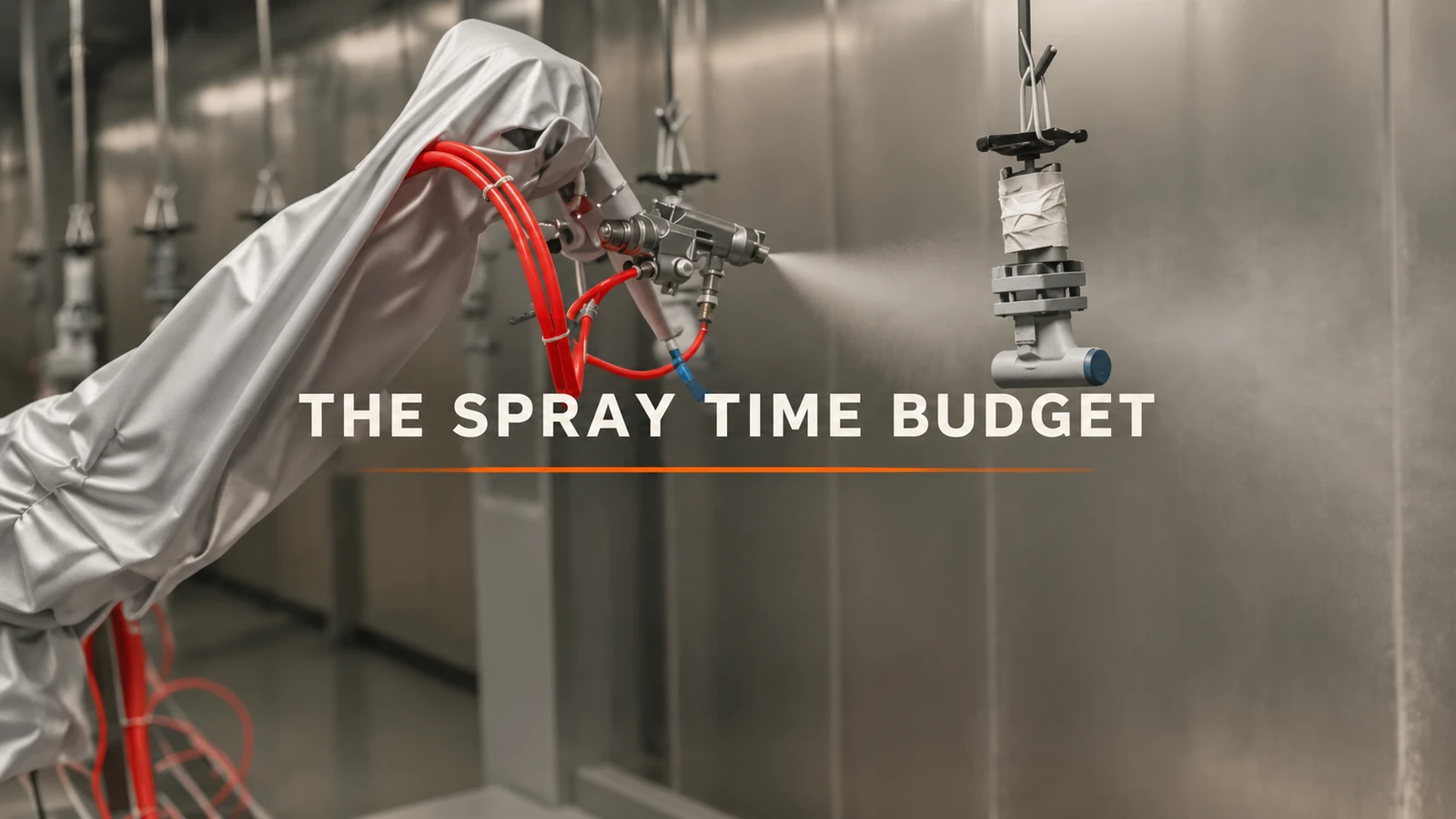
The accompanying application shows a robot spraying beside suspended metal components. It provides a practical setting for the estimate. For a new proposal, specify the conveyor movement before choosing the calculation: constant-speed travel through a working zone and a stationary spraying dwell require different time budgets.
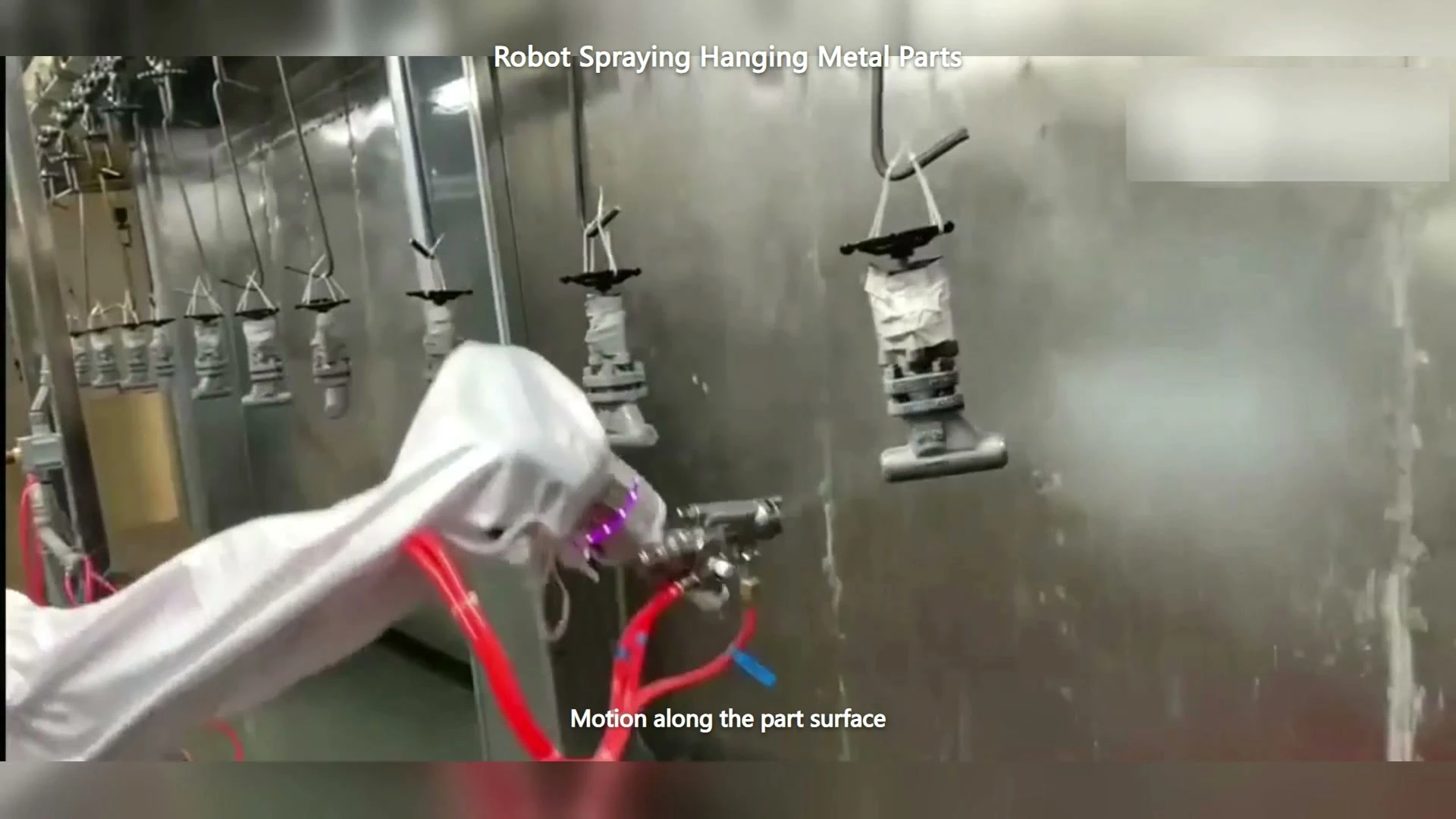
Video at 00:07 — Spray gun beside suspended metal components.
In a continuous, evenly spaced line, use tonhöjd to mean the distance along the conveyor between equivalent points on successive hangers. Use consistent units. With speed in metres per minute:
| Antal | Ideal-model calculation | Vad det svarar på |
|---|---|---|
| Hanger arrival interval, seconds | 60 × hanger pitch ÷ conveyor speed | How often does another assigned hanger arrive? |
| Transport rate, hangers per hour | 60 × conveyor speed ÷ hanger pitch | How many hanger positions pass, before allowing for empty positions or losses? |
| Reachable-window duration, seconds | 60 × usable travel length ÷ conveyor speed | How long is the required work inside the defined working zone? |
The usable travel length belongs to a feasible tool-and-part route, not simply the length of the booth. A robot may reach a hanging part at the booth entrance while being unable to maintain the required gun approach there. Define the usable zone from the proposed motion and application conditions.
Put the whole robot assignment on the time chart
For a robot assigned every hanger, list the spray passes, movement between faces, approach and withdrawal, and the move that makes it ready for the next hanger. Include any repeated tool operation assigned to that robot. Distinguish time with the spray enabled from time the robot is occupied.
Under the stated repeating, single-robot model, that complete occupancy must fit the hanger arrival interval. The required work on a particular hanger must also fit its reachable window. A long working zone can provide more time beside one part without reducing the frequency of arriving hangers; it cannot remove a sustained workload overload.
Use a cycle chart to place the end of one hanger’s work beside the start of the next. If the next assignment begins before the robot is ready, examine the declared layout and work allocation. Possible proposals include a different pitch or speed, a revised feasible route, or another robot sharing the work. Compare them against the required coating result rather than merely deleting spray passes to fit the chart.
Several parts on a hanger add another distinction. Multiplying hanger rate by loaded parts gives a transport count, while the spray assignment must include the surfaces of all those parts. Closer loading is not free capacity if it changes access or adds movements.
A stop-and-go line needs a different budget
When a carrier stops for painting, record its stationary dwell, indexing movement and the actions that permit the next index. Work that can overlap should appear on parallel rows of the time chart, rather than being added twice. Work that occupies the same robot remains sequential unless the proposed design demonstrates otherwise.
Do not substitute continuous-line pitch divided by speed for this complete station cycle. Likewise, a stopwatch reading from one stationary sample cannot determine the capability of a continuously moving arrangement.
Turn the estimate into a useful trial
Time the proposed complete assignment with representative hanger loading and the intended conveyor behaviour. Then inspect the required surfaces using the agreed coating acceptance method. Keep theoretical hanger transport, completed robot cycles and accepted coated parts as separate counts. Record empty hangers, interrupted work and rejected parts so the observed output can be explained.
For an early discussion with EVST, begin with a conveyor sketch, pitch and speed range, parts per hanger, and photographs showing the surfaces to be sprayed. Those inputs support a focused review of the timing model and the actions that need to be measured. Discuss a hanging-part spray application.