
By Uredniška ekipa EVST · Pregledal/a Uredniška ekipa EVST · Zadnja posodobitev 30. septembra 2026 · Uredniška politika · Politika popravkov · Pogoji
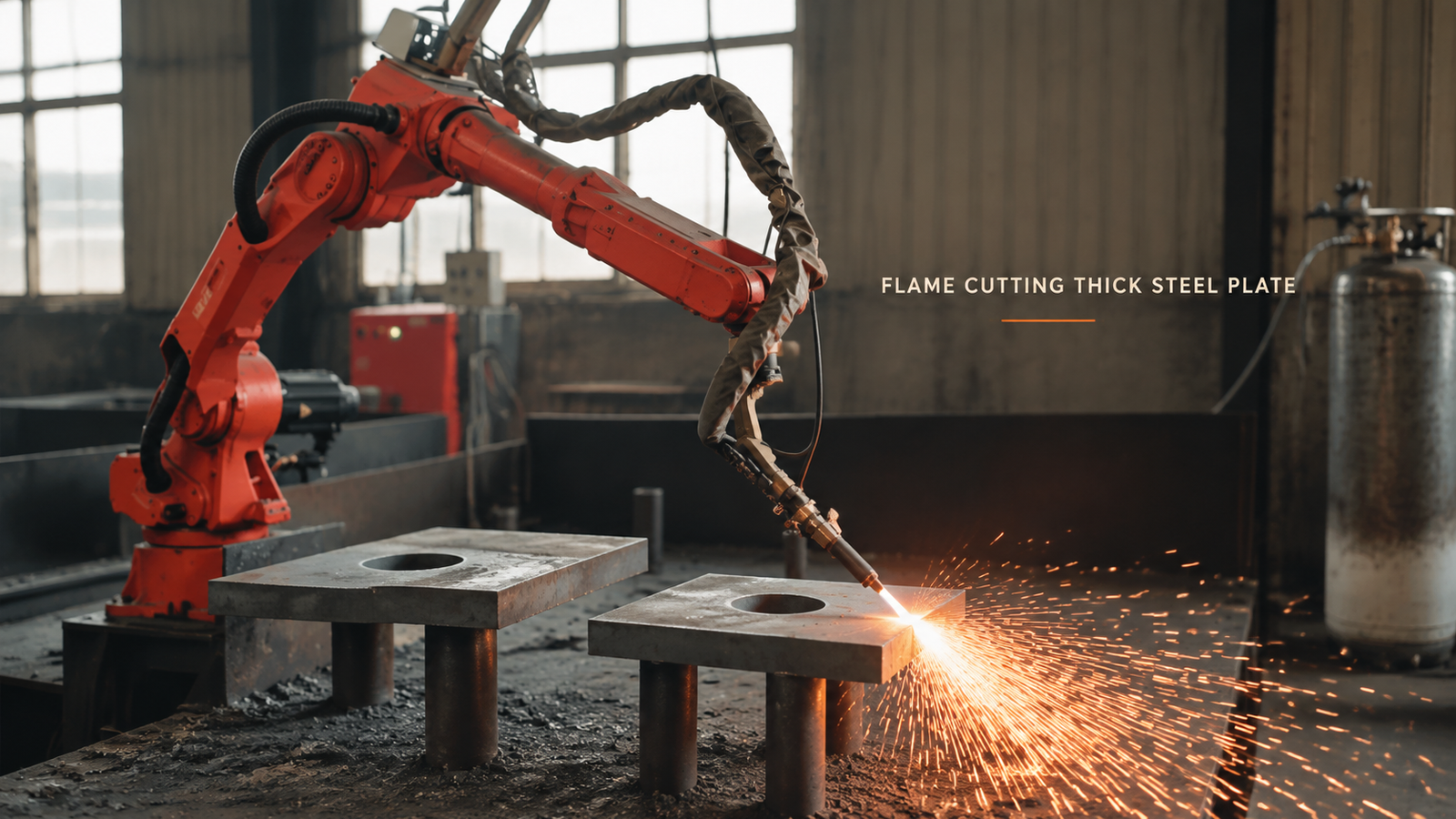
Thick-plate flame cutting can move from a handheld torch to a robot when three conditions are settled together: the plate is supported so the space under the cut line stays open, the torch holds a steady height as it travels along an edge whose position repeats, and nobody has to stand in the spark and gas zone while the flame is lit. The three depend on each other, and all of them depend on the shape of the parts and the size of the batches. In the cell discussed here, a six-axis robot carries an oxy-fuel cutting torch along the edge of thick steel plate parts that rest on a few support posts, and the sparks and slag fall through the open space below.
Cutting thick plate parts by hand today? Send us your part drawing and daily output, and we will reply with a cell concept and a cycle-time estimate.
Why the decision is often made in the wrong order
Most evaluations start with the robot: can it hold the torch and reach the edge? It usually can. The harder questions sit around the torch: what the plate rests on, whether its edge is in the same place every time, and where people stand while the flame burns.
A skilled cutter answers all three without thinking: the plate is propped on whatever is to hand, the eye keeps checking the gap between nozzle and steel, and the body leans away from the sparks. The price is an operator working next to sparks and fumes, and a straight cut that depends on a steady hand. A robot removes both problems but answers none of the three questions on its own. Each has to be designed into the cell, and the answer to one limits the others.
How this cell runs, step by step
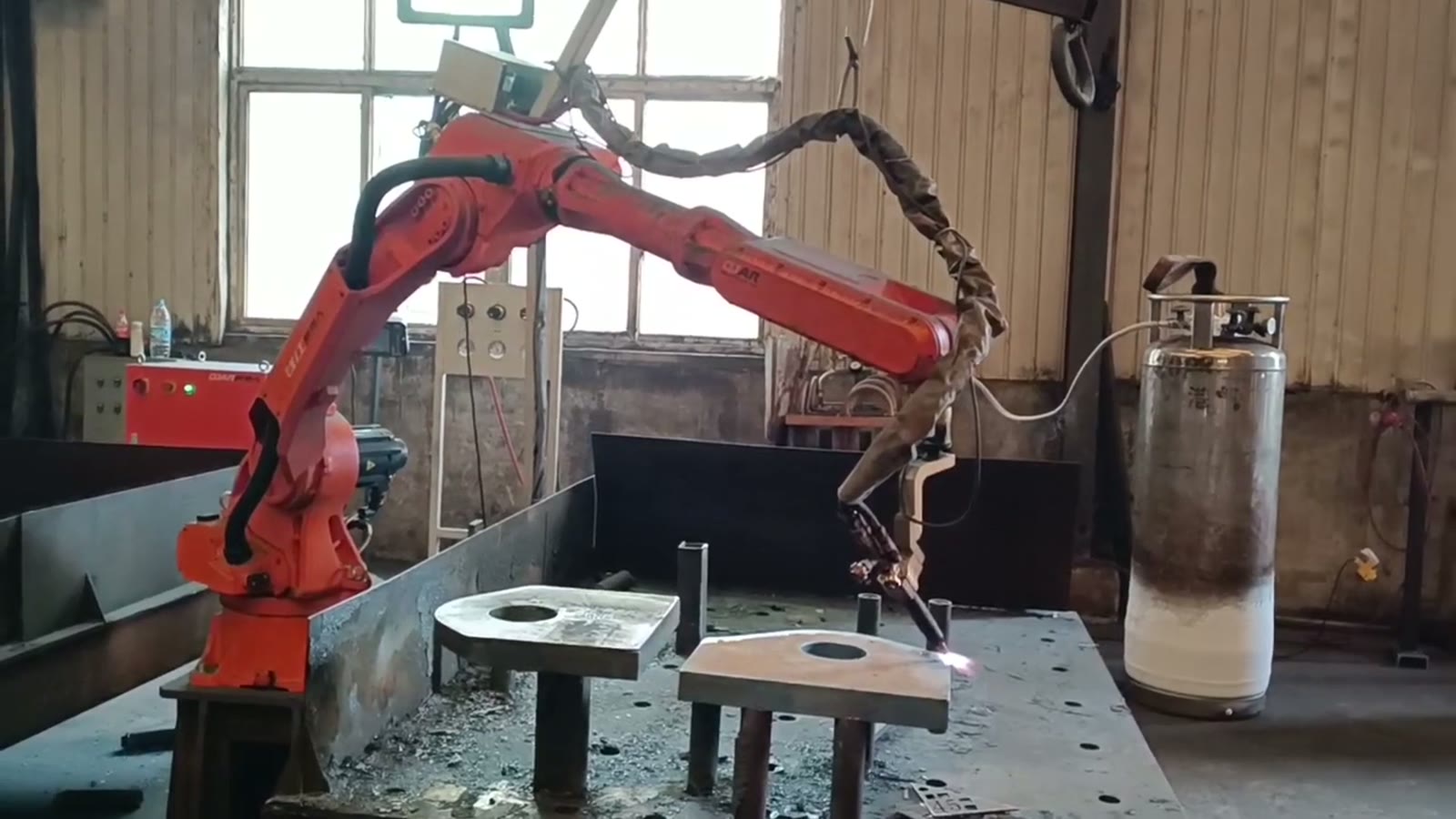
- The plate sits on posts. A thick steel plate part, which already carries a round hole, rests on several vertical posts on the cutting table. The space under the plate is open.
- The torch comes to the edge. The robot brings the flame cutting torch, with its gas hoses, close to the plate edge and aims the flame at the cut position. A gas cylinder stands beside the cell.
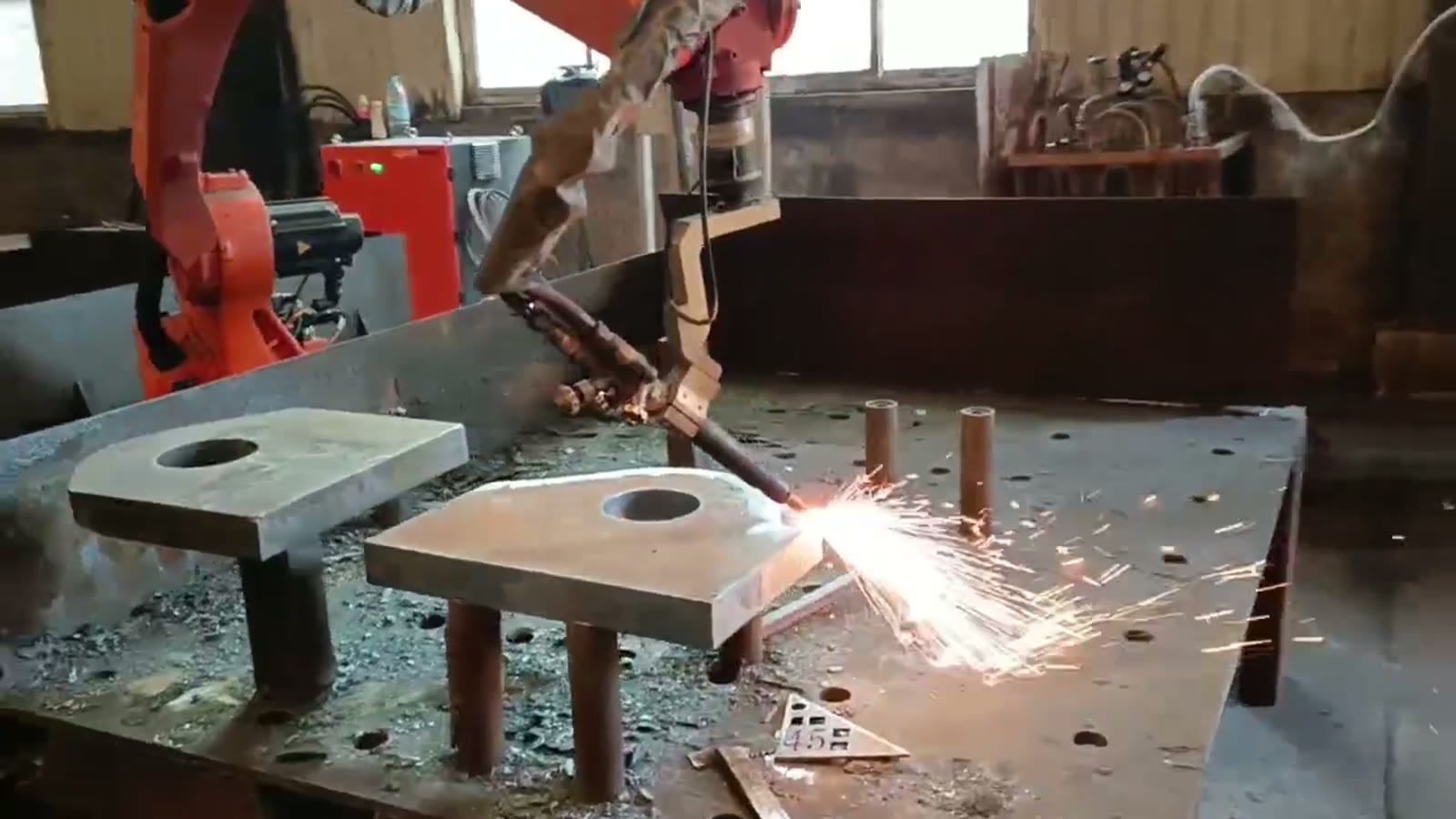
- The cut starts. Sparks begin to stream outward and downward from the edge.
- The robot travels along the edge. It carries the torch along the plate edge, and the sparks follow the cut down and away.
- Slag falls clear. Slag and cut-off pieces collect on the table below. A second plate with the same round hole sits on its own posts beside the first.
Three constraints that have to be settled together
Support: keep the cut line open underneath
Flame cutting heats the steel and then blows it out through the cut as molten slag, which has to go somewhere. If a solid surface or a support sits under the cut line, slag builds up against the underside, the part can fuse to the support, and the robot’s path meets an obstacle it was never taught about. Point supports such as posts leave the underside open. The design task is to place them where the plate is stable but where no cut line passes above them.
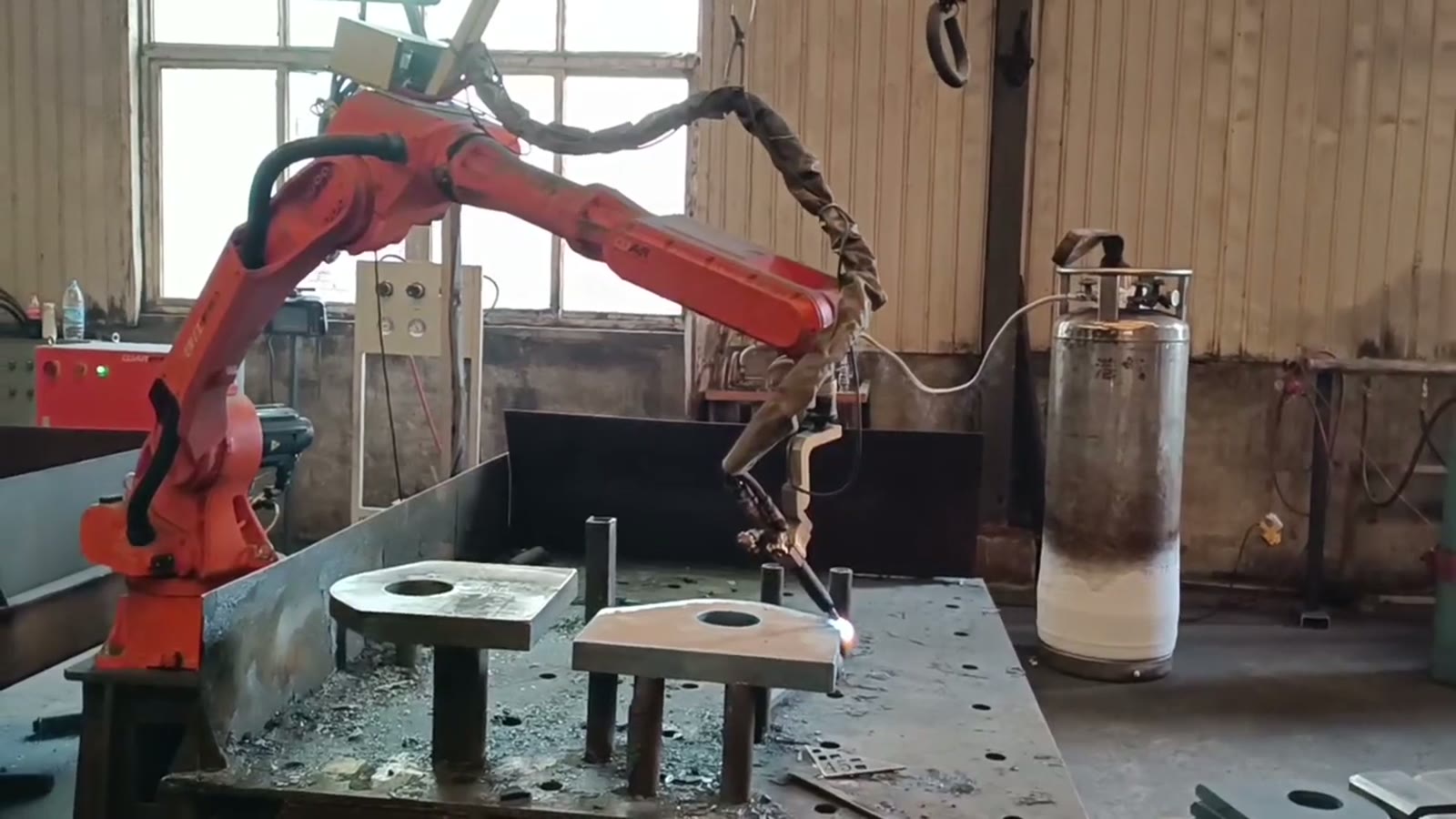
This is where part shape enters. One outline can sit on a fixed post pattern batch after batch. A family of outlines needs a post pattern that clears every cut line, or movable supports, and every move is a chance for the plate to land somewhere new. Slag also builds up on the table and posts, so clearing it belongs in the routine.
Torch height and travel along the edge
For a consistent flame cut, the nozzle-to-steel distance and the travel speed both have to stay steady. Steady travel is where a robot clearly beats a hand-held torch: it does not slow or wander toward the end of a long edge. But it follows its taught path exactly. If a plate sits a little higher, lower or further over than the last one, or is not flat, the torch height drifts with it.
Torch height is therefore really a question about the supports and the incoming plates. When plates come from the same stock and land on the same posts, a taught path can hold. When position or flatness varies, the cell needs a way to deal with it: stops that push each plate into the same place, a routine that finds the plate before cutting, or automatic height control that corrects the torch as it moves. A cut that can begin at the plate edge also avoids piercing thick steel in the middle of the plate, which is the harder start for any flame cut.
Keeping people out of the spark and gas zone
A handheld flame cut puts the operator inside the hazard: sparks, hot slag, fumes and the glare of the flame, with gas hoses on the floor. Handing the torch to a robot only removes that exposure if nobody needs to be in the zone while the flame is lit. That usually means spark screens around the cutting area, fume extraction close to the cut, a guarded boundary that stops the robot and shuts off the gas when someone enters, and hoses routed along the arm so they stay out of the slag.
The link back to the other two constraints is loading. If every plate is placed by hand where it is cut, someone enters the zone once per part, and every placement can shift the plate. Two support positions let one plate be loaded while another is cut, with the loading side outside the spark zone. Whether that earns its floor space depends on cut time versus loading time.
How part shape and batch size tip the decision
| Vaša situacija | Kaj običajno odloči | Verjetna smer |
|---|---|---|
| The same plate part in repeat batches, simple edges | Fixed supports clear of every cut line; a taught path holds | Strong candidate for a robot cell |
| Many different outlines in small batches | Support changes and programming time per part | Robot only if parts can share supports and programs are quick to make |
| Large flat sheets with many profiles nested in them | Sheet handling and nesting | A gantry cutting machine is usually the better tool |
| Formed parts, or edges a gantry cannot reach | Torch angle and reach | The six axes are the reason to choose a robot |
| Plates whose position or flatness varies | Višina gorilnika | Robot with plate finding or height control |
Vprašanja, ki jih zastavljajo kupci
Is a robot or a gantry flame cutting machine better for thick plate?
For profiles cut from large flat sheets, a gantry machine is usually the simpler choice. A robot earns its place when parts are already separate pieces that need an edge cut, when the torch has to tilt, or when the parts are not flat.
Does the torch need automatic height control?
Not always. If plates come from the same stock and land on the same supports, a taught height can hold. If position or flatness varies, plan for it from the start rather than adding it later.
What wears first in a cell like this?
The supports under the cut area collect slag and take heat. Plan for supports that can be cleaned or swapped quickly, and a table or slag tray that can be emptied without taking the cell apart.
Kaj nam poslati
- Part drawings with the cut lines marked, plus the plate material and thickness range
- How the plates arrive: separate blanks, full sheets or formed parts, and how flat they are
- Daily output and how many different parts will share the cell
- How parts are loaded and unloaded today, and the floor space available
- Any bevel requirement on the cut edge
Planning to take flame cutting off the handheld torch? Send your part drawing and daily output ali e-pošta prodaja@evsrobot.com. We will reply with a cell concept and a cycle-time estimate.
This article describes one flame cutting cell as filmed; plate thickness, cutting speed and cut quality depend on your parts and must be confirmed in a trial.