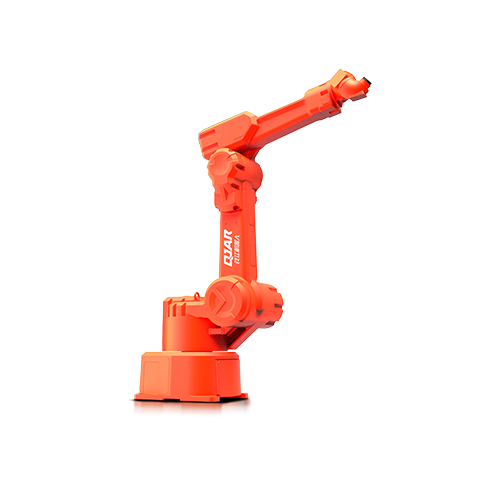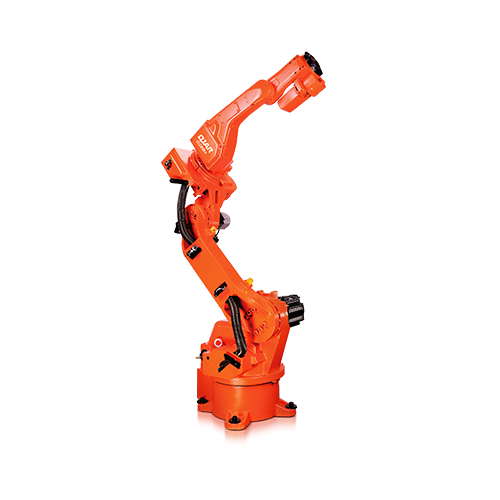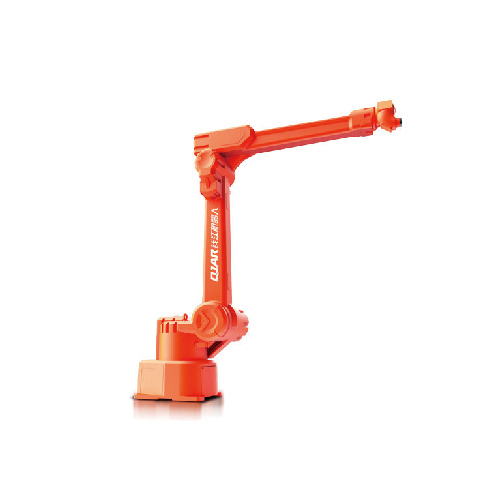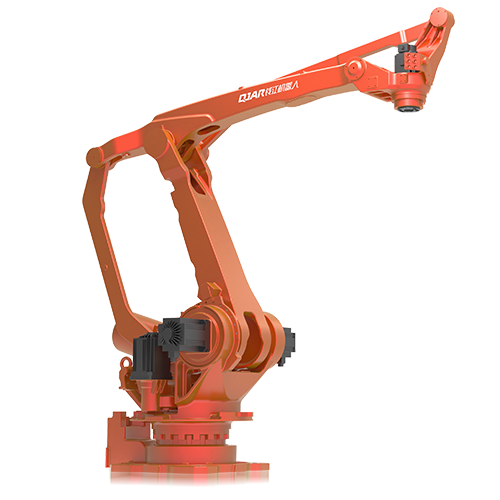
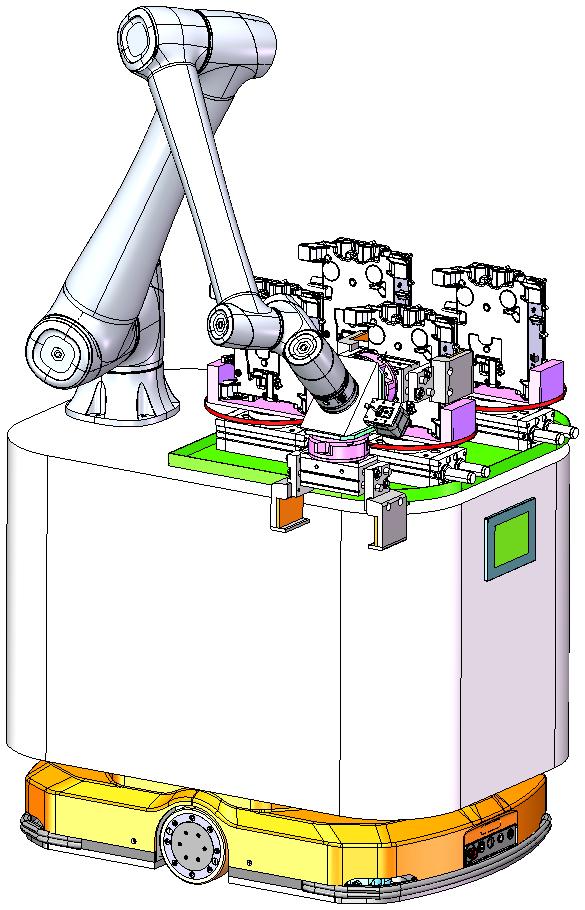
Choose the series by what the robot handles: EVST-Alpha for standard CNC parts with a 20 kg / 1700 mm arm, EVST-Beta for precision components that need force-controlled placement, and EVST-Gamma for full bins and large parts on a chassis rated up to 1000 kg.
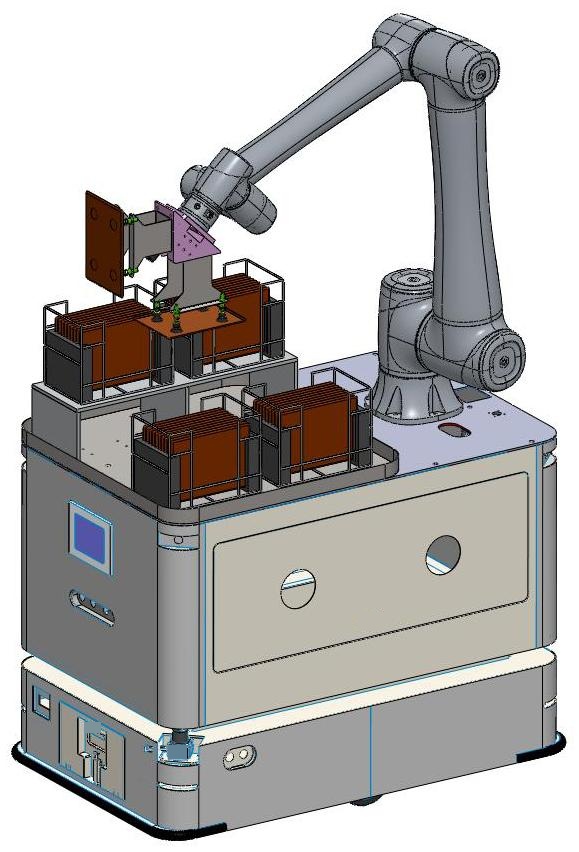
Flexible CNC tending. A 20 kg / 1700 mm collaborative arm with a four-position storage fixture (contoured nests plus a drip tray) on the base.
Handling of chips and other precision components. End-effector force control for compliant pick-and-place; quick changeovers for high-mix, low-volume work.
Full-bin transfer and large-part tending, with chassis payload up to 1000 kg. An onboard powered roller conveyor holds two bins and transfers them to and from buffer stations.
Arm, chassis payload, base dimensions and battery capacity can be configured per project.
A mobile manipulator is a reasonable answer when CNC machines wait for an operator rather than for machining, each machine needs a robot only for a short part exchange, and the floor and Wi-Fi can support a robot that drives between them.
| Sign on the shop floor | Običajni vzrok | When a mobile manipulator fits |
|---|---|---|
| Machines cannot run lights-out: they stop on night shifts, weekends or breaks because nobody is there to unload them | Loading depends on an operator being at each machine when its cycle ends | Several machines run cycles long enough to be served in turn. How long a mobile manipulator can run without an operator is limited by how many parts its onboard fixture or storage holds and by its 6-hour battery rating. Loading is only one part of unattended running: the machines still need tool-life monitoring, probing and alarm alerts. |
| Operators are hard to hire, and one person already watches several machines | Most of the job is repetitive loading and unloading | Loading and unloading is the main task. Operators still refill trays, check quality and clear alarms. |
| A robot for every machine would stand idle most of the cycle | Each machine needs a robot only for a short part exchange | One robot is shared: it drives to whichever machine has finished its cycle. |
| High-mix, low-volume work with frequent changeovers makes a fixed robot cell hard to justify | A cell built around one machine and one part waits when the work moves elsewhere | The robot can be re-assigned to other machines on its map; each new part still needs grippers, a fixture position and station setup. |
| Automation has to fit the existing layout: there is no room to add fences, rails or a gantry | Machines stand apart, with aisles between them | Aisles are at least 950 mm wide, the floor meets the flatness and slope limits, and safety zones can be agreed for the routes. |
| A cobot on a cart already moves between machines, but someone has to push and re-dock it each time | The cart changes machines only when an operator is free to move it | The robot drives to the next machine and docks itself, so it can change machines during a shift without an operator. The routes and docking points still have to meet the floor and Wi-Fi conditions above. |
Choose a mobile manipulator when one robot must serve scattered machines on its own, a cobot on a cart when an operator can move it between jobs, a fixed cobot cell when one machine keeps a robot busy, and a seventh-axis rail robot or gantry loader for a row of machines on short, high-volume cycles.
| Mobilni manipulator | Cobot on a cart | Fixed cobot cell | Robot on a seventh-axis rail | Portalni nakladalnik | |
|---|---|---|---|---|---|
| Najboljše prileganje | Several machines whose cycles leave time for one robot to serve them in turn; high-mix work | A few machines in different areas, with batch jobs that change often and an operator free to move the cart between runs | One machine, or two adjacent machines, with a stable job | A row of adjacent machines that one robot tends in turn, automatically, on steady jobs | High-volume parts on short cycles, on a dedicated line |
| Postavitev stroja | Machines can stand apart along a route | Any machine the cart can be wheeled up to; the cart stays docked at one machine for a run | Robot stands beside the machine | Machines in a straight line along the rail | Machines in a row under an overhead structure |
| Positioning at the machine | Base parks to ±10 mm and ±1°; vision and mechanical compliance re-locate the arm at every stop | An operator rolls the cart up and locks it to docking pins or mechanical locators at each machine | Fixed mount, calibrated to the machine once | The robot travels on a fixed rail; stop positions are set at installation, with no re-docking | Fixed rails; positions set at installation |
| Site needs | Flat floor (tighter at docking points), Wi-Fi along routes, a charging position, aisles of at least 950 mm | A repeatable docking point at each machine and aisle space to wheel the cart in | Power and air at the machine; space for guarding or a safety zone | Floor space for the rail along the machine fronts, plus guarding or a safety zone along its length | Overhead structure and a fixed layout |
| When the work changes | Re-assign the robot to other machines on its map; add stations | Wheel the cart to another machine and re-dock; each new part still needs its own gripper and setup | Move and re-calibrate the cell, or add another robot | Re-assign the robot among machines on the rail; machines off the rail need the rail extended or moved | Changing the line layout means changing the gantry |
| Glavne omejitve | Travel and charging take time from the cycle; positioning is re-established at every stop | The cart changes machines only when an operator moves it, so it cannot move on its own during a shift | The robot waits while its machine cuts | The robot reaches only the machines along its rail, and the rail takes floor space in front of them | Fixed footprint; poorly suited to scattered machines |
The comparison above is qualitative. The right option for a specific line comes from a cycle-time and layout review.
At each CNC machine, a mobile manipulator repeats the same basic sequence: it docks beside the machine, picks a part from the fixture it carries, reaches through the open door to load the work area, and returns to the fixture for the next part.
Kaj prikazuje posnetek
Video chapters
The footage shows the sequence; it does not establish accuracy or cycle time, which depend on the part, fixture and machine. Clearances, docking repeatability and recovery logic are validated for each application. How the robot reaches fixture accuracy after docking is explained in the positioning section.
The EVST mobile manipulator does not rely on navigation for accuracy: the base parks to within ±10 mm and ±1°, two-stage vision then brings the arm to ±0.1 mm at every machine, and mechanical compliance absorbs what remains.
Navigation alone brings the base to within ±10 mm and ±1° of its docking point. A machine fixture needs far less error than that, so the robot locates itself again at every stop, in two stages:
| Stage | Kaj počne | Postavitev |
|---|---|---|
| 1 · Wide-angle camera | Finds the target and sets a global reference for this stop | ± 0.25 mm |
| 2 · Precision vision | Measures in a small field of view and corrects the arm path | do ±0.1 mm |
| 3 · Mechanical compliance | A floating coupling (XYZ translation plus angular compensation) and contoured gripper fingers absorb the remaining error as the part seats on locating pins | - |
Two stages are used because one camera cannot do both jobs: a wide field of view gives up accuracy, and a narrow, accurate view can miss the target after the base has drifted.
Three accuracy figures are often confused in supplier comparisons: the navigation accuracy of the base (here ±10 mm and ±1°), the positioning of the arm after vision correction (down to ±0.1 mm), and the repeatability of the arm itself (±0.1 mm). When a supplier quotes a single accuracy number, ask which of the three it is and how it was measured at the machine fixture.
Five site factors decide whether a mobile manipulator works on a given floor: the slope at its docking points, charging time in the cycle plan, the payload of the whole vehicle, a clean vision target, and Wi-Fi along the route.
Floor slope matters most where the robot docks. The site specification allows a floor gradient below 0.05 along the route, but below 0.01 at precision docking points. The reason is leverage: a tilt at the base becomes a larger offset at the tool. As a rough calculation, a 1% slope under the base shifts a tool held 1 m out by about 10 mm, which the vision stage then has to find and correct. Floors also need to be flat to within 3 mm per square meter, with steps under 5 mm and gaps under 8 mm.
The robot’s battery is rated for about 6 hours of operation, and a full charge (5% to 100%) takes up to 2 hours at the automatic dock. In a multi-machine line, charging time has to be scheduled like any other task. In the gear-grinding example below, returning to the charging station is a step in the robot’s routine. How many robots a line needs depends on both machine cycle times and this charging time.
The standard chassis is rated for 400 kg. That has to cover the arm, the storage fixture, grippers and parts. With the arm extended toward its 1700 mm reach and carrying a part, the vehicle’s center of gravity moves outward, which is why the base uses a reinforced frame and modified suspension. When you size a cell, give the part’s mass and center of gravity together with the gripper and fixture, not just the part weight.
On CNC machines, coolant, chips and changing light can make a single camera image unreliable. The robot’s camera targets are therefore covered by a pneumatic shield that stays closed during machining and opens only for imaging, and an air knife can clear residual cutting fluid before the robot takes the part.
A mobile manipulator receives machine calls, dispatching and map synchronization over Wi-Fi. The site specification asks for at least −60 dBm along travel routes and −65 dBm at the AP, at least 20 dB signal-to-noise ratio, and an average ping below 100 ms.
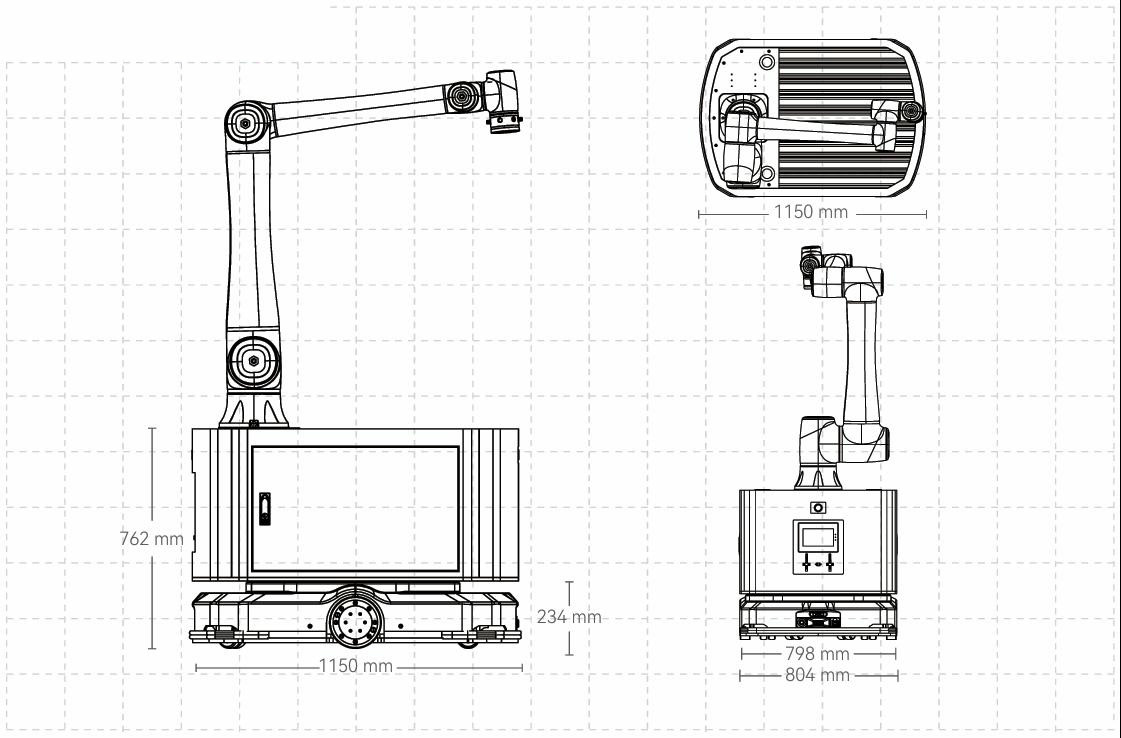
The standard EVST mobile manipulator combines a 1150 × 800 × 760 mm differential-drive base with laser SLAM navigation, a 20 kg / 1700 mm six-axis collaborative arm, two-stage vision positioning, and a 48 V LiFePO4 battery rated for 6 hours.
| Mobilna baza | Arm, power and environment | ||
|---|---|---|---|
| Base dimensions (L × W × H) | 1150 × 800 × 760 mm (standard) | Roka | 6-axis collaborative arm (standard configuration) |
| Lift-type base | 1400 × 800 × 830 mm | Arm payload / reach | 20 kg / 1700 mm |
| Nosilnost šasije | 400 kg; up to 1000 kg (EVST-Gamma) | Arm repeatability | ± 0.1 mm |
| Drive | Dvokolesni diferencial | Vision positioning | ±0.25 mm (wide-angle) → down to ±0.1 mm (precision) |
| ostalo | Laser SLAM; optional QR code / reflector | baterija | 48 V / 80 Ah LiFePO4 (some models 48 V / 60 Ah) |
| Natančnost navigacije | ±10 mm, ±1° | Runtime / charging | 6 h rated; ≤ 2 h (5–100%), automatic dock or manual |
| Hitrost | ≤ 1.5 m / s | Delovna temperatura | 0–40 °C, indoor |
| Premer obračanja | 1220 mm | Vlažnost | 10–90 %, brez kondenzacije |
| Minimum aisle width | 950 mm | Varnost | Front and rear laser scanners (360°), contact bumpers, emergency stops on four sides |
| Gradebilnost | ≤ 3 ° | Vmesniki | Wi-Fi; RS485 / CAN / I/O; MES / WMS; open API / SDK |
| Traversable gap / step | ≤ 30 mm / ≤ 5 mm | Machines per robot | 3–5 (subject to cycle-time calculation) |
| Osnovna struktura | Integrated frame, reinforced supports, modified suspension | Tending cycle | Cycles from seconds to minutes (calculated for the actual part) |
| Tires and grounding | Anti-slip tires; underbody antistatic chain | Zamenjava | Pneumatic tool changer / quick-change grippers |
| Zaznavanje ovir | Real-time obstacle detection; robot collision detection | Vision functions | Calibration, positioning, presence detection, measurement (diameter, width, grayscale area); OCR, barcode and QR code recognition |
| Uporabniški vmesnik | Touchscreen, audible and visual alerts, marker lights | Strojni signali | I/O: material request / clamp / cycle complete |
Specifications and performance figures on this page are typical or nominal values for the standard configuration. Actual cycle time, accuracy and battery runtime depend on site conditions, including the floor, lighting, parts, fixtures, machining cycle and the machine interface, and are confirmed for each project after a site assessment.
Download spec sheet (PDF)Prenesi brošuro (PDF)
Before a mobile manipulator is installed, the site needs a flat, clean floor, Wi-Fi along every route, a power point for the charging dock, and machines with automatic doors and an I/O link.
EVST supplies the mobile manipulator as a defined scope: mobile platform, arm and grippers, vision, control and electrical systems, deployment and dispatching software, plus project-specific stations such as storage fixtures or bin transfer modules.
| Moduli | Standardni predmeti |
|---|---|
| Mobilna platforma | Differential-drive mobile base; laser SLAM / QR code / reflector navigation; automatic charging station; onboard roller conveyor or buffer station; marker lights, emergency stops, bumpers |
| Manipulacija | 6-axis collaborative arm (20 kg / 1700 mm); pneumatic tool changer and gripper rack; contoured pneumatic grippers or vacuum cups; floating coupling; robot mount, cable ducts, air lines |
| Zaznavanje | Wide-angle and precision vision positioning; position and presence sensors |
| Control and electrical | Industrial PC, air pump, valve island; I/O modules (RS485 / CAN / I/O); Wi-Fi router / AP; 48 V LiFePO4 battery with BMS; audible and visual alarms |
| Software | Deployment software (mapping, station setup); fleet dispatching (work orders, route planning, traffic control); monitoring, statistics and alarms; machine call / MES / WMS interfaces; open API / SDK |
| Auxiliary stations (project-specific) | Storage fixtures, smart material storage, 3-axis gantry, loading conveyors, bin transfer module, chip blow-off and code scanning, air knife, target protection |
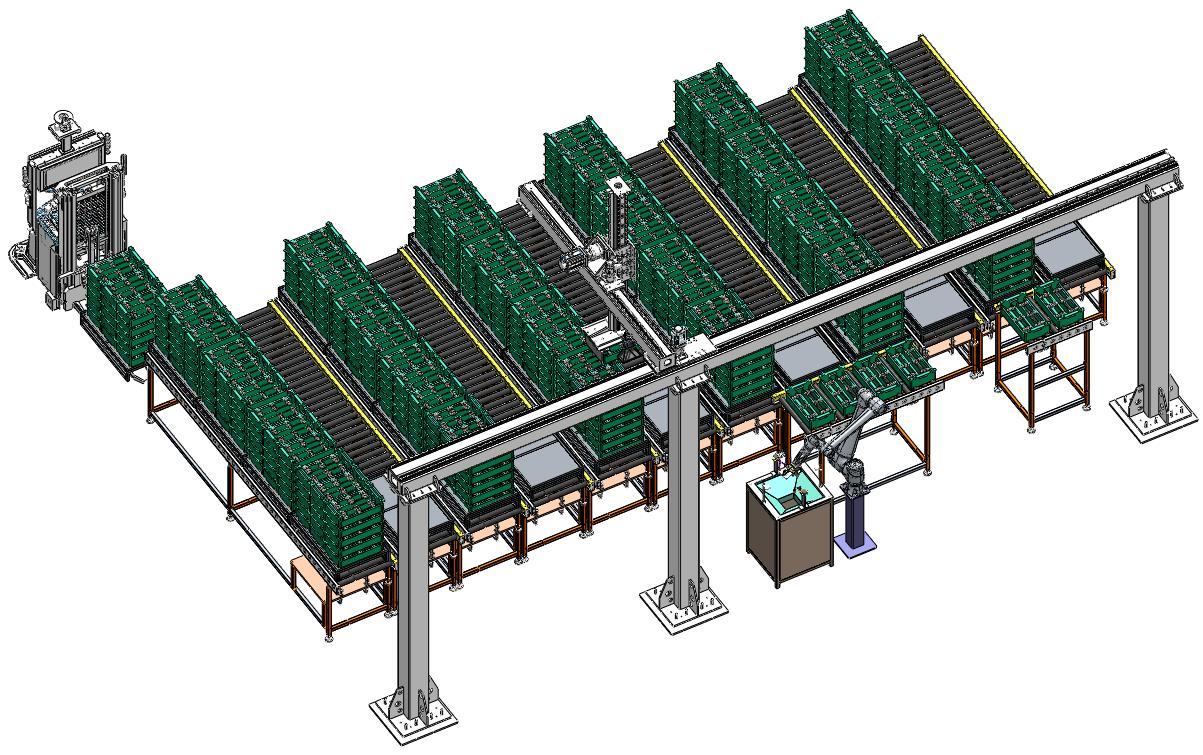
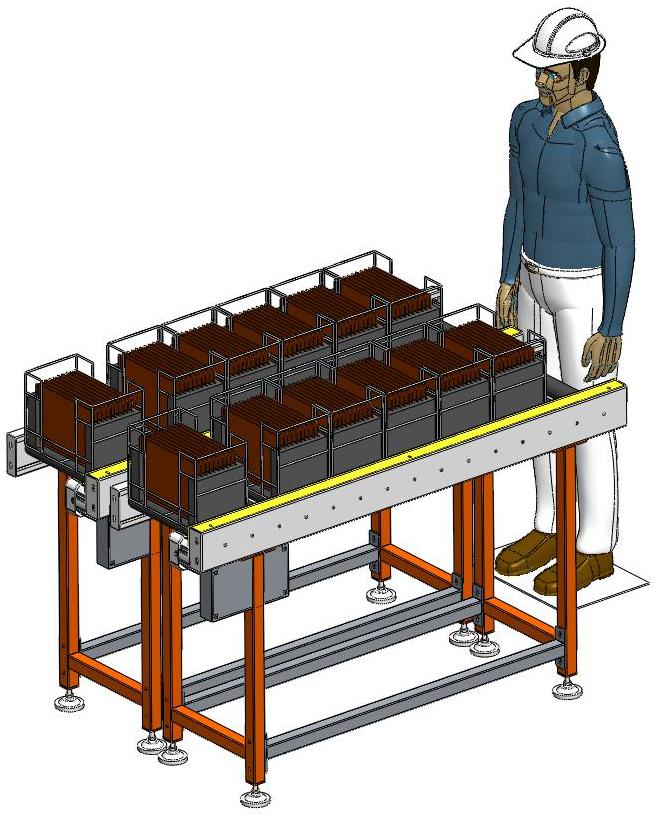
Three application examples show how the platform is configured for different parts: two-operation machining of 2 kg aluminum parts, a gear grinding line where five robots serve 16 grinders, and rear-cover machining with full-bin transfer.
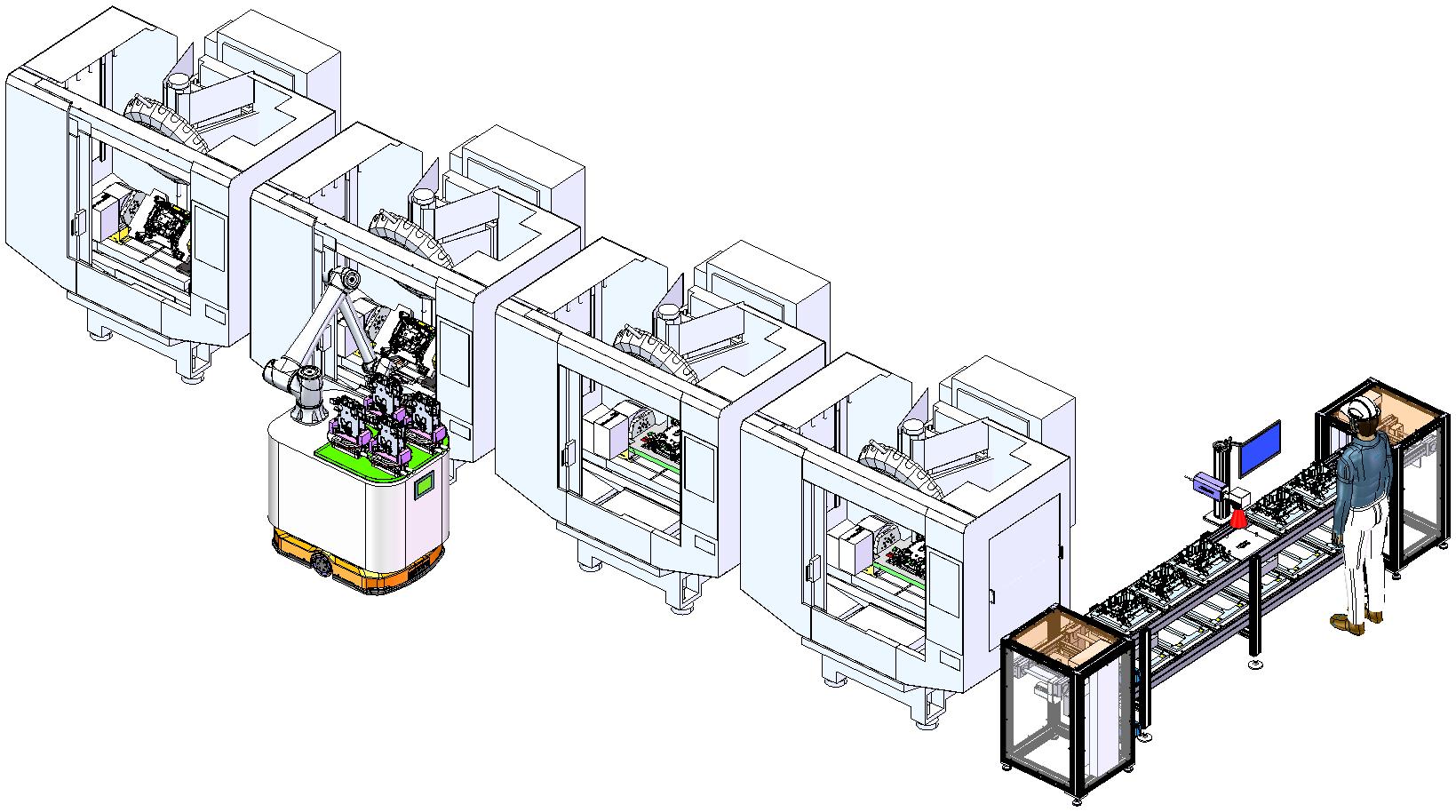
A 2 kg aluminum part runs through two operations on vertical machining centers, with a machining cycle of 130 s for two parts (about 65 s per part). Parts arrive on a two-tier pallet conveyor with lift-and-locate stops and are laser-marked before pickup. An EVST-Alpha Series robot carries a four-position storage fixture and uses dual grippers, picking one part and placing another in a single visit. Machine fixtures locate the part on pins.
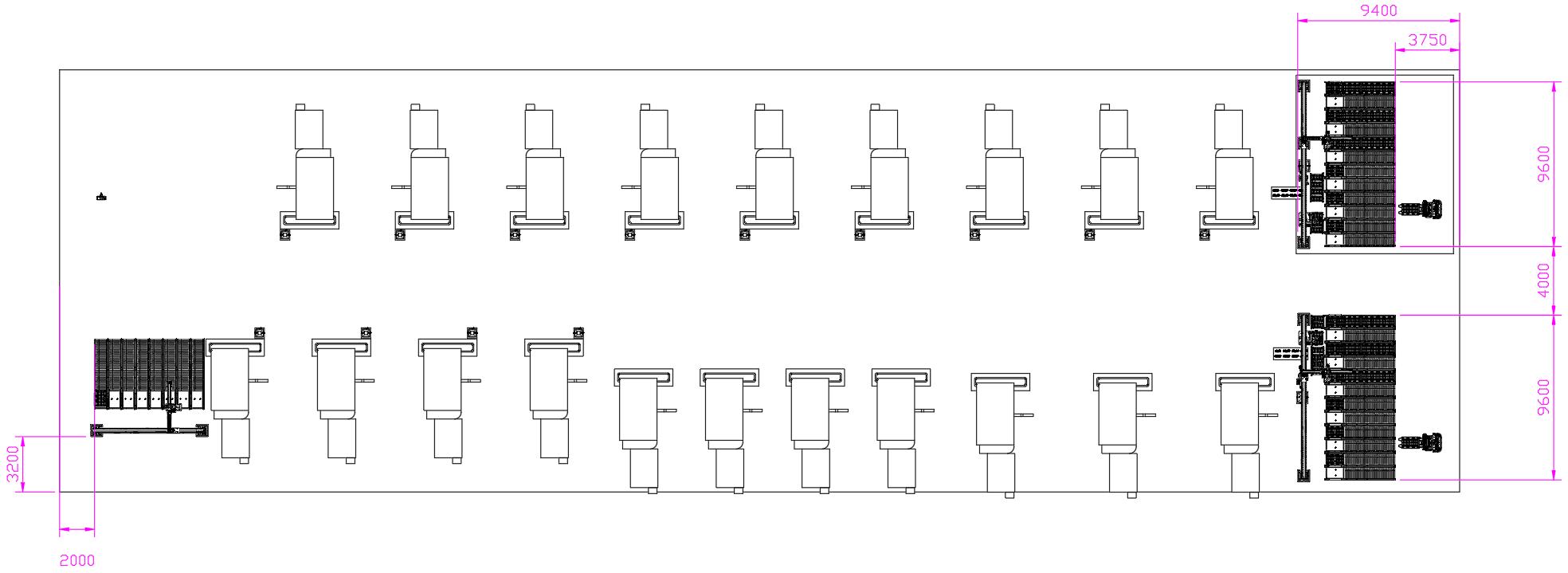
Five mobile manipulators and two smart storage systems serve 16 gear grinders in high-mix, low-volume production. Each bin holds six parts at about 130 s per part (780 s per bin). EVST-Gamma Series robots carry two bins on an onboard roller conveyor, change grippers automatically from a tool rack, and use a probe mechanism to confirm part orientation before loading.
Operators load full trays of rear covers; an X/Y/Z bin transfer module moves full bins onto the vehicle. An EVST-Gamma Series robot uses dual suction cups to pick one part and place another, picking from the outside in and placing from the inside out. After machining, an air knife clears cutting fluid, and a pneumatic cover protects the camera target during machining.
Beyond CNC tending, the same platform is offered for these directions:
These are typical directions for the platform; feasibility for a specific line is confirmed in a project review.
A feasibility review for a mobile manipulator needs five inputs: the part, the machines, the cycle times, the floor plan and the Wi-Fi coverage.
A mobile manipulator is a robot arm, usually a collaborative arm, mounted on an autonomous mobile base, so one robot can work at several stations instead of one fixed cell. It is also called a mobile cobot or an AMR with a robot arm. In CNC work, a mobile manipulator drives between machines, docks, and loads and unloads parts from a tray or fixture it carries.
A cobot on a manual cart is not the same as a mobile manipulator. A cart has to be pushed to each machine and docked by an operator, usually against fixed locating points. A mobile manipulator drives itself: the EVST platform navigates by laser SLAM, parks within ±10 mm and ±1°, and uses two-stage vision to re-locate the arm at every stop. Carts suit occasional moves; an autonomous base suits a robot shared between machines through a shift.
One mobile manipulator can serve as many CNC machines as it can visit within one machining cycle. Add up travel between machines, door opening and part exchange at each stop, and the share of time spent charging; if the total is shorter than the machining cycle, no machine waits for the robot. The product documentation plans for 3–5 machining centers per robot; the number for your line comes from this calculation.
After a mobile manipulator moves to another machine, the base parks to within ±10 mm and ±1°, which is not accurate enough for a machine fixture on its own. Two-stage vision then locates the target, first to ±0.25 mm and then down to ±0.1 mm, and a floating coupling and contoured fingers absorb the remaining error as the part seats on locating pins. When comparing suppliers, ask whether a quoted figure is base, vision or arm accuracy.
A fixed cobot cell is usually the simpler choice when one machine, or two side by side, keeps a robot busy for most of the machining cycle. A fixed cell is calibrated once, needs no charging, Wi-Fi or floor preparation for travel, and has no re-positioning step. A mobile manipulator makes sense when machines stand apart and each needs a robot only for a short part exchange.
A mobile manipulator needs a floor with unevenness under 3 mm per m², a gradient under 0.05 along routes and under 0.01 at docking points, steps under 5 mm and gaps under 8 mm. The surface should be static-dissipative and kept free of water, oil and debris. Aisles must be at least 950 mm wide, and the EVST base needs a 1220 mm turning diameter.
The EVST mobile manipulator’s 48 V LiFePO4 battery is rated for about 6 hours of operation, and a full charge from 5% to 100% takes up to 2 hours at the automatic charging dock; manual charging is also possible. Charging has to be planned into the line’s schedule like any other task, and it counts when you calculate how many machines one robot can serve.
In most cases, CNC machines need automatic doors and air connections, or a retrofit, before a robot can tend them, plus an I/O link for signals such as machine request, clamp confirmation and cycle complete. Machine calls and dispatching then reach the robot over Wi-Fi. Send machine models and door types early, because they decide how much retrofit work the project needs.
A mobile manipulator can work around coolant and chips if its vision target and the floor are protected. Coolant and chips can spoil a camera image, so the target sits under a pneumatic cover that opens only for imaging, and an air knife can blow residual cutting fluid off the part before pickup. Routes must still be kept free of water and oil, so chip and coolant control at the machine matters.
The EVST mobile manipulator carries front and rear laser scanners covering 360°, contact bumpers and emergency stops on four sides, and uses a collaborative arm. That does not make every installation safe by itself: routes, pedestrian crossings, fencing and safety zones are planned with your team, and the complete application, including grippers and parts, needs its own risk assessment.
EVS TECH CO., LTD (EVST), based in Chengdu, China, supplies this mobile manipulator in EVST-Alpha, EVST-Beta in EVST-Gamma series for loading and unloading CNC machines. To quote, EVST reviews part drawings and mass, machine models and I/O, cycle times, a floor plan with routes and slopes, and Wi-Fi coverage, then defines the scope of supply for your line.
The cost of a mobile manipulator depends on the series, the arm, grippers and fixtures, auxiliary stations such as storage or bin transfer, the number of machines and how much machine retrofit is needed. EVST quotes per project after a feasibility review rather than from a list. Kontaktirajte nas with your part and machine details to start the review.
All figures on this page are typical or nominal values; actual performance is confirmed for each project after a site assessment.