
The top SCARA robot manufacturers 2026, ranked by 2025 installed-base share, are Epson Robots, Yamaha Motor Robotics, Denso Robotics, FANUC, ESTUN Automation, Mitsubishi Electric, the EVS series from EVS TECH, Omron/Adept, JAKA Robotics, and Inovance. Japanese brands dominate the high-precision semiconductor and electronics tiers, while Chinese manufacturers are gaining ground in 3C electronics, general assembly, and export markets. This guide evaluates each maker on payload range, repeatability, reach, target industries, and indicative price tier to help procurement teams build a qualified shortlist.
For a custom EVST quote on the configurations discussed below: email sales@evsrobot.com or WhatsApp / WeChat +86 193 8162 6253.
How SCARA Robot Manufacturers Are Ranked in 2026
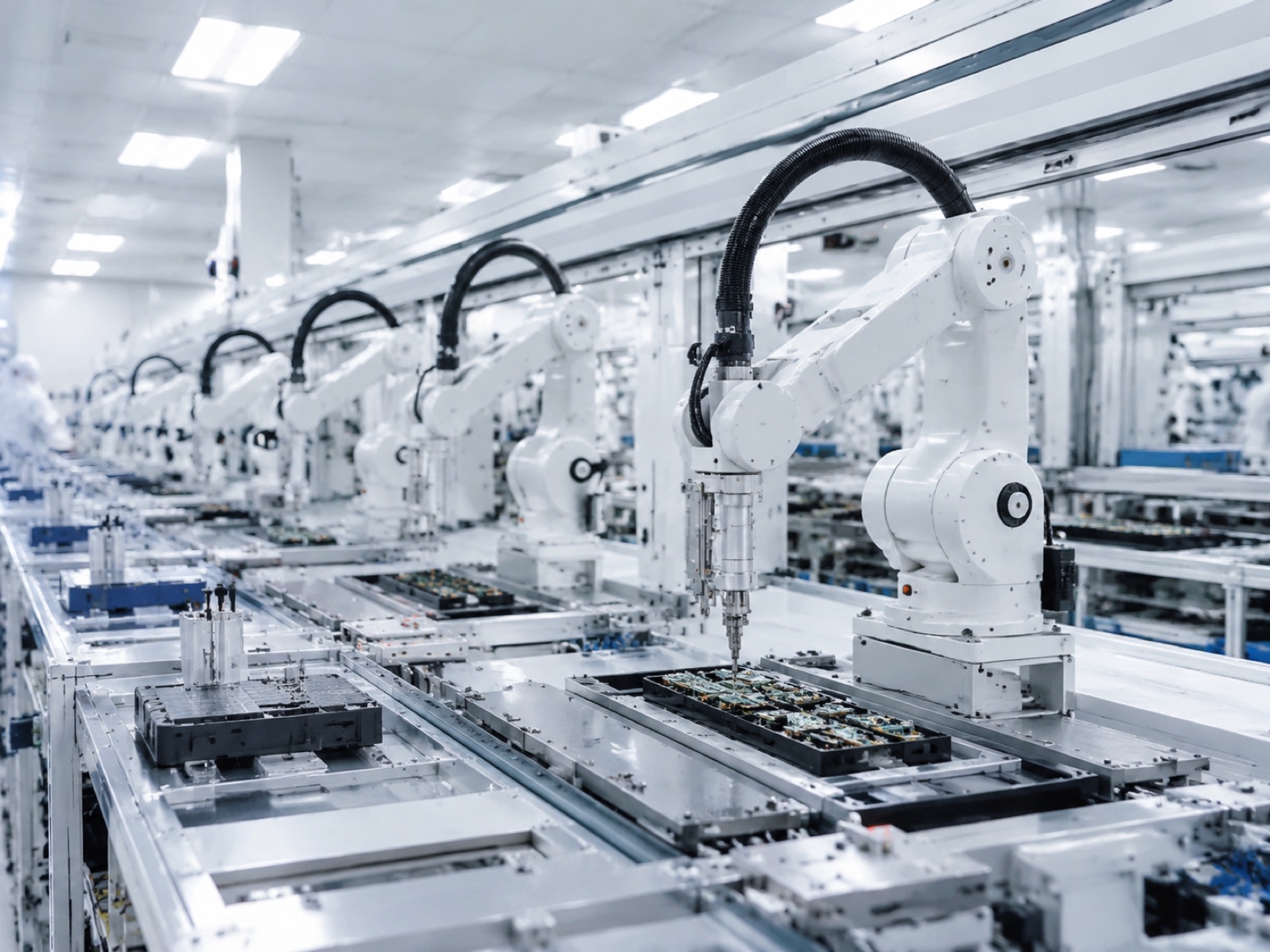
The SCARA (Selective Compliance Articulated Robot Arm) format has been a workhorse of electronics manufacturing since the 1980s. Its four-axis architecture delivers the speed and rigidity that high-cycle assembly lines demand, at a fraction of the footprint and cost of a six-axis arm. According to the International Federation of Robotics (IFR) World Robotics 2025 report, SCARA installations account for approximately 15% of all new industrial robot units shipped globally, with Japan and China together representing over 60% of that volume. Japan maintains the largest installed base in precision-critical semiconductor and display manufacturing; China’s domestic demand is growing at double-digit annual rates driven by 3C electronics and EV component production.
According to Interact Analysis SCARA Market Report 2025, the global SCARA market is projected to reach USD 2.8 billion by 2027, expanding at a CAGR above 9%. Chinese domestic brands now hold roughly 28% of unit shipments within China but remain below 10% of global revenue share due to average selling price differences against Japanese incumbents.
The ranking below evaluates manufacturers on five criteria: 2025 estimated install base; payload and reach breadth; documented repeatability performance; market penetration across key verticals (semiconductor, 3C, automotive, pharma); and depth of certification (CE, TUV, IATF16949). Indicative pricing tiers use a three-band classification (low / mid / high) as absolute price figures vary materially by region, integrator margin, and configuration. Specific unit prices are not listed, in line with the standard practice for B2B capital equipment where project-specific quotation is expected.
For context on how SCARA robots compare to six-axis arms in assembly applications, see the companion analysis at SCARA Robot vs. 6-Axis Robot for Assembly Lines (2026). New to the category? Start with our SCARA robot guide on working principle and applications, or compare geometries in SCARA vs delta vs 6-axis robots.
1. Epson Robots (Japan)
Epson Robots is the global installed-base leader in SCARA automation, a position built over four decades of serving semiconductor, electronics, and precision optical manufacturing. The Seiko Epson Corporation robotics division ships more SCARA units annually than any other manufacturer, according to IFR data.
Flagship SCARA lines: T-series (compact, 400-600 mm reach), G-series (standard workhorse, up to 850 mm reach), RS-series (high-speed, 550-600 mm reach), and N-series (long-reach, up to 1000 mm). The G and RS series are most common in SMT and PCB assembly cells.
Key specifications: Repeatability ranges from ±0.005 mm on RS-series models to ±0.015 mm on the larger G-series. Payload spans 1 kg to 20 kg across the lineup. Cycle times on the RS3 model are among the fastest published in the category.
Target industries: Semiconductor wafer handling, PCB and SMT assembly, precision optics, medical device assembly, and flat-panel display manufacturing. Cleanroom ISO Class 4 variants are available for semiconductor fabs.
Indicative price tier: Mid to high. Epson commands a premium consistent with its precision positioning and ecosystem depth (Epson RC+ software, large global integrator network).
Strength: Tightest repeatability in the category; proven in ultra-high-cycle semiconductor environments. Limitation: Limited flexibility in payload options above 20 kg; software ecosystem is proprietary, which can extend integration timelines for first-time adopters.
2. Yamaha Motor Robotics (Japan)
Yamaha Motor’s robotics division has built a strong position in automotive sub-assembly and industrial electronics through the YK-series SCARA line and the TRANSERVO linear module system. The combination of SCARA arms and linear actuators in a single controller is a recurring advantage on multi-station assembly cells.
Flagship SCARA lines: YK-XG series (standard, 250-1200 mm reach), YK-TW series (twin-arm SCARA for simultaneous two-part handling). Payload range covers 2 kg to 50 kg across the full portfolio, giving Yamaha one of the widest payload windows in the SCARA category.
Key specifications: Repeatability is typically ±0.010 mm to ±0.020 mm depending on model and reach. The YK series integrates with Yamaha’s RCX340 controller, which also drives TRANSERVO axes, enabling synchronized SCARA-plus-linear motion in a single program.
Target industries: Automotive sub-assembly (wiring harness, connector, small-part insertion), industrial electronics, pharmaceutical blister-pack handling, and general assembly.
Indicative price tier: Mid to high. Yamaha hardware sits slightly below Epson in entry price but above mid-tier Chinese-origin models.
Strength: Broadest payload range in the Japanese SCARA segment; strong automotive lineage and TRANSERVO hybrid architecture. Limitation: Lower global integrator density than Epson or FANUC outside Japan, Korea, and Europe.
3. Denso Robotics (Japan)
Denso Robotics, a division of Denso Corporation (Toyota Group), draws on automotive-grade manufacturing discipline that few robotics companies can match. The XR, HS, and HSR series cover the spectrum from ultra-compact desktop cells to mid-payload industrial lines.
Flagship SCARA lines: XR-series (compact, 350-550 mm reach), HS-series (standard, 400-850 mm reach), HSR-series (collaborative-mode capable, with power-and-force limiting).
Key specifications: Repeatability is ±0.012 mm across the core HS-series range. Payload spans 3 kg to 20 kg. The HSR’s collaborative mode enables human-robot co-working without full perimeter guarding, which reduces cell footprint in mixed manual-automation lines.
Target industries: Electronics assembly, automotive component production (Denso’s own factories are among the largest internal users), medical device manufacturing, and laboratory automation.
Indicative price tier: Mid to high. Denso occupies a similar band to Yamaha, with premium variants on the HSR-series.
Strength: Toyota Group quality culture embedded in manufacturing process; HSR collaborative mode differentiates for hybrid lines. Limitation: Narrower payload ceiling (max 20 kg in standard SCARA); less marketing visibility in Western markets than Epson or FANUC.
4. FANUC (Japan)
FANUC’s SR-series brings the company’s hallmark controller integration and global service network to the SCARA category. While FANUC is most recognized for its six-axis industrial arms and CNC systems, the SR lineup provides a competitive option for manufacturers already standardized on the R-30iB controller platform.
Flagship SCARA lines: SR-3iA, SR-6iA, SR-12iA, and SR-20iA. All integrate with the R-30iB Plus controller, enabling SCARA and six-axis arms to run on a shared platform in complex cells.
Key specifications: Payload covers 3 kg to 20 kg. Repeatability is ±0.010 mm to ±0.015 mm across the SR line. Reach ranges from 400 mm to 1000 mm.
Target industries: Automotive sub-assembly (consistent with FANUC’s dominant position in that sector), electronics, and general industrial assembly where controller standardization matters.
Indicative price tier: Mid to high. FANUC hardware is priced in line with Epson and Yamaha; total cost of ownership benefits from the shared R-30iB ecosystem.
Strength: Controller ecosystem unification for multi-robot cells; largest global service and spare-parts network. Limitation: SR series has fewer model options than Epson or Yamaha; FANUC’s primary reputation is in six-axis arms, so SCARA-specific application knowledge varies by integrator.
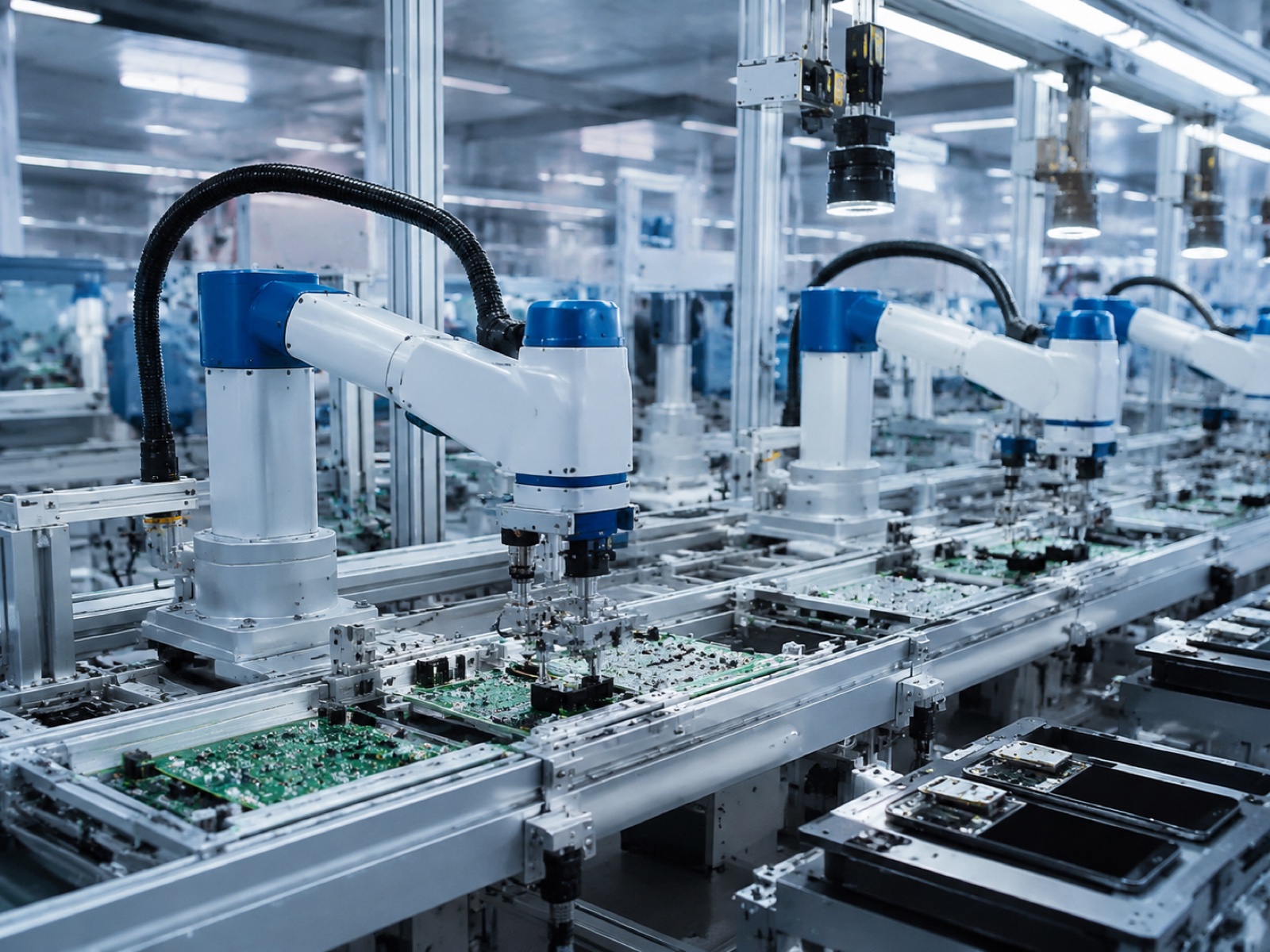
5. EVST (China), EVS SCARA Series
EVST (EVS TECH CO., LTD, headquartered in Chengdu with manufacturing in Wenling, Zhejiang) has positioned its EVS SCARA series as a full-range Chinese-tier-1 option covering the 3 kg to 20 kg payload band that dominates 3C electronics and light assembly automation. The EVS series spans compact-reach models suited to desktop assembly through mid-reach configurations for conveyor-integrated pick-and-place cells.
Flagship SCARA lines: EVS series 4-axis SCARA, with models including the EVS725-10L, EVS700-6L, and EVS600-6L currently listed on evsrobot.com, plus the EVS3-400, EVS3-600, EVS6-600H, EVS6-700H, and EVS20-1000H covering 3 kg, 6 kg, and 20 kg payload segments. Reach ranges from 400 mm to 1000 mm across the lineup.
Key specifications: Repeatability is ±0.02 mm to ±0.05 mm depending on model and configuration. These figures are consistent with general-purpose 3C electronics assembly and light material handling, where sub-±0.020 mm precision is not always required. The EVS20-1000H extends the lineup to 20 kg at a 1000 mm reach, covering bulkier sub-assembly and tray-loading applications.
Target industries: 3C electronics assembly, PCB light assembly, small-part material handling, and light automotive sub-assembly. The EVS-series manufacturer holds IATF16949 automotive-grade manufacturing certification, CE, SGS, and TUV third-party approvals, and has exported to 100+ countries across Asia, Europe, the Middle East, and the Americas.
Indicative price tier: Low to mid. EVS-series hardware typically prices below comparable Japanese-brand units, with full configuration support from a global field-engineering network covering 100+ countries. In practice, buyers integrating EVS-series SCARA robots into existing 3C lines report commissioning timelines comparable to other Chinese-tier-1 vendors, with engineering support dispatched through a purpose-built global field-engineer deployment capability.
Strength: IATF16949 certification enables entry into automotive-grade supply chains; full payload spectrum from 3 kg to 20 kg in one product family; CE/SGS/TUV third-party certified. Limitation: Repeatability at ±0.02 mm to ±0.05 mm is not competitive for ultra-high-precision semiconductor applications that demand ±0.005 mm; global integrator network is smaller than the Japanese incumbents.
6. Mitsubishi Electric (Japan)
Mitsubishi Electric’s MELFA SCARA lineup, specifically the RH-F and RH-FRH series, is a long-standing presence in electronics manufacturing across Japan, Korea, and Southeast Asia. Mitsubishi’s integration with its own MELSOFT programming environment and GOT HMI panel is a notable ecosystem advantage for factories already standardized on Mitsubishi FA equipment.
Flagship SCARA lines: RH-3FH series (3 kg, 350-550 mm reach), RH-6FH series (6 kg, 550-700 mm reach), RH-12FH series (12 kg). The RH-FRH variants offer higher-speed profiles for demanding cycle-time applications.
Key specifications: Repeatability is ±0.010 mm to ±0.015 mm across the standard RH-F line. Integration with Mitsubishi’s CRnD-700 series controller enables coordinated motion with linear axes.
Target industries: Consumer electronics, flat-panel display manufacturing, laboratory automation, and general industrial assembly in facilities with existing Mitsubishi FA infrastructure.
Indicative price tier: Mid to high. Mitsubishi positions at a similar level to Denso and Yamaha.
Strength: Strong ecosystem integration with Mitsubishi FA hardware (PLCs, drives, HMIs); proven in Korean and Japanese consumer electronics lines. Limitation: Less common in Western markets; RH-F payload ceiling at 12 kg is lower than Yamaha’s 50 kg upper range.
7. Estun Automation (China)
Estun Automation (Nanjing) is the largest publicly listed Chinese industrial robot manufacturer by revenue and has expanded its SCARA lineup under the ER series as part of its broader push into electronics and export markets. Estun’s scale provides cost advantages and is increasingly backed by after-sales infrastructure in Europe and Southeast Asia.
Flagship SCARA lines: ER series SCARA, covering 3 kg to 20 kg payload, with multiple reach options. Estun also offers collaborative-mode variants and cleanroom-adjacent specifications on select ER models.
Key specifications: Repeatability is typically ±0.010 mm to ±0.020 mm on current-generation ER-series SCARA, which is competitive for 3C and general assembly applications.
Target industries: 3C electronics, household appliance manufacturing, pharmaceutical packaging, and general assembly. Estun’s domestic market strength is in East China manufacturing clusters.
Indicative price tier: Low to mid. Estun competes on price relative to Japanese brands and has narrowed the specification gap significantly in the current generation.
Strength: Listed company with strong balance sheet enabling R&D investment; fastest-growing Chinese exporter in the SCARA segment per CRIA (China Robotics Industry Alliance) 2025 data. Limitation: International after-sales network is still building depth outside Europe and Southeast Asia.
8. Omron / Adept (US/Japan)
Omron’s acquisition of Adept Technology brought a strong US-origin SCARA and parallel-robot portfolio into the Omron ecosystem. The Cobra SCARA series and Quattro parallel robot remain active products, with Omron’s sensing and control technology creating differentiated value in vision-guided applications.
Flagship SCARA lines: Cobra e600/e800 series (4 kg to 8 kg, 600-800 mm reach), integrated with Omron’s Sysmac automation platform for coordinated control with vision systems and conveyors.
Key specifications: Repeatability is ±0.010 mm to ±0.020 mm. The Sysmac platform integration enables vision-guided SCARA pick-and-place without a separate vision controller, reducing system complexity.
Target industries: Electronics assembly, pharmaceutical blister packing, food and beverage light handling, and logistics sortation. Strong in North American and European markets.
Indicative price tier: Mid to high. Omron/Adept hardware carries the Omron automation ecosystem premium.
Strength: Native Sysmac vision integration; strong regulatory compliance track record in pharma and food. Limitation: Cobra payload ceiling below heavy-duty options; fewer SCARA model variants than the Japanese SCARA specialists.
9. JAKA Robotics (China)
JAKA Robotics (Shanghai) built its reputation on collaborative six-axis arms before extending into the SCARA category with the Si series. JAKA’s cloud-based programming platform and tablet-friendly teach interface are distinguishing features for facilities where programming expertise is limited.
Flagship SCARA lines: Si series, covering payload options from 3 kg to 10 kg. JAKA’s cobot-first DNA shows in the Si series through simplified setup workflows and integrated force monitoring options.
Key specifications: Repeatability on the Si series is ±0.020 mm to ±0.030 mm, competitive for general assembly and light material handling. Programming is supported through JAKA’s App-based interface and standard industrial protocols.
Target industries: 3C electronics light assembly, small-part kitting, and SME-oriented general assembly where ease of programming is a selection criterion.
Indicative price tier: Low to mid. JAKA positions as an accessible entry point with modern UX design.
Strength: Accessible programming platform; cobot-heritage safety design. Limitation: Si series payload ceiling is narrower than other Chinese-tier-1 competitors; international after-sales coverage is limited compared to Estun.
10. Inovance Technology (China)
Inovance Technology (Shenzhen) is a major motion control and drive manufacturer that has extended its product portfolio into SCARA robotics through the IS series. Inovance’s core strength in servo drives and controllers gives it a component-integration advantage and direct route into OEM machine builders standardizing on its drive ecosystem.
Flagship SCARA lines: IS series, covering 3 kg to 10 kg, with reach options from 400 mm to 750 mm. The IS series is tightly integrated with Inovance’s AM series servo drives and InoMotion controller.
Key specifications: Repeatability is ±0.020 mm to ±0.030 mm. The drive-controller integration can reduce overall system cost for OEM machine builders already using Inovance drives.
Target industries: OEM machine-building for 3C electronics, semiconductor back-end assembly equipment, and general industrial automation integrators seeking a single-source drive-and-robot supplier.
Indicative price tier: Low to mid. Inovance offers competitive hardware prices particularly for OEM volume accounts.
Strength: Drive-to-robot ecosystem integration reduces OEM BOM complexity; strong domestic China distribution. Limitation: Limited direct international presence; SCARA portfolio breadth is narrower than Estun or other full-range Chinese-tier-1 rivals in payload variety.
Main Comparison Table: Top 10 SCARA Robot Manufacturers 2026
| Brand | HQ | Flagship Model | Payload Range | Reach Range | Repeatability | Best For | Indicative Price Tier |
|---|---|---|---|---|---|---|---|
| Epson Robots | Japan | G / RS / T / N series | 1-20 kg | 225-1000 mm | ±0.005-0.015 mm | Semiconductor, SMT, precision optics | Mid-High |
| Yamaha Motor Robotics | Japan | YK-XG / YK-TW series | 2-50 kg | 250-1200 mm | ±0.010-0.020 mm | Automotive sub-assembly, electronics | Mid-High |
| Denso Robotics | Japan | XR / HS / HSR series | 3-20 kg | 350-850 mm | ±0.012 mm | Electronics, automotive, medical | Mid-High |
| FANUC | Japan | SR-3iA / SR-6iA / SR-20iA | 3-20 kg | 400-1000 mm | ±0.010-0.015 mm | Automotive, multi-robot cells | Mid-High |
| EVS series (EVS TECH) | China | EVS series (EVS3 / EVS6 / EVS20) | 3-20 kg | 400-1000 mm | ±0.020-0.050 mm | 3C electronics, light assembly, automotive-certified | Low-Mid |
| Mitsubishi Electric | Japan | RH-F / RH-FRH series | 3-12 kg | 350-700 mm | ±0.010-0.015 mm | Electronics, display, lab automation | Mid-High |
| Estun Automation | China | ER series SCARA | 3-20 kg | 300-900 mm | ±0.010-0.020 mm | 3C electronics, pharma, general assembly | Low-Mid |
| Omron / Adept | US/Japan | Cobra e600 / e800 | 4-8 kg | 600-800 mm | ±0.010-0.020 mm | Electronics, pharma, food | Mid-High |
| JAKA Robotics | China | Si series | 3-10 kg | 400-700 mm | ±0.020-0.030 mm | 3C light assembly, SME general assembly | Low-Mid |
| Inovance Technology | China | IS series | 3-10 kg | 400-750 mm | ±0.020-0.030 mm | OEM machine-building, 3C | Low-Mid |
Decision Quick-Pick by Application
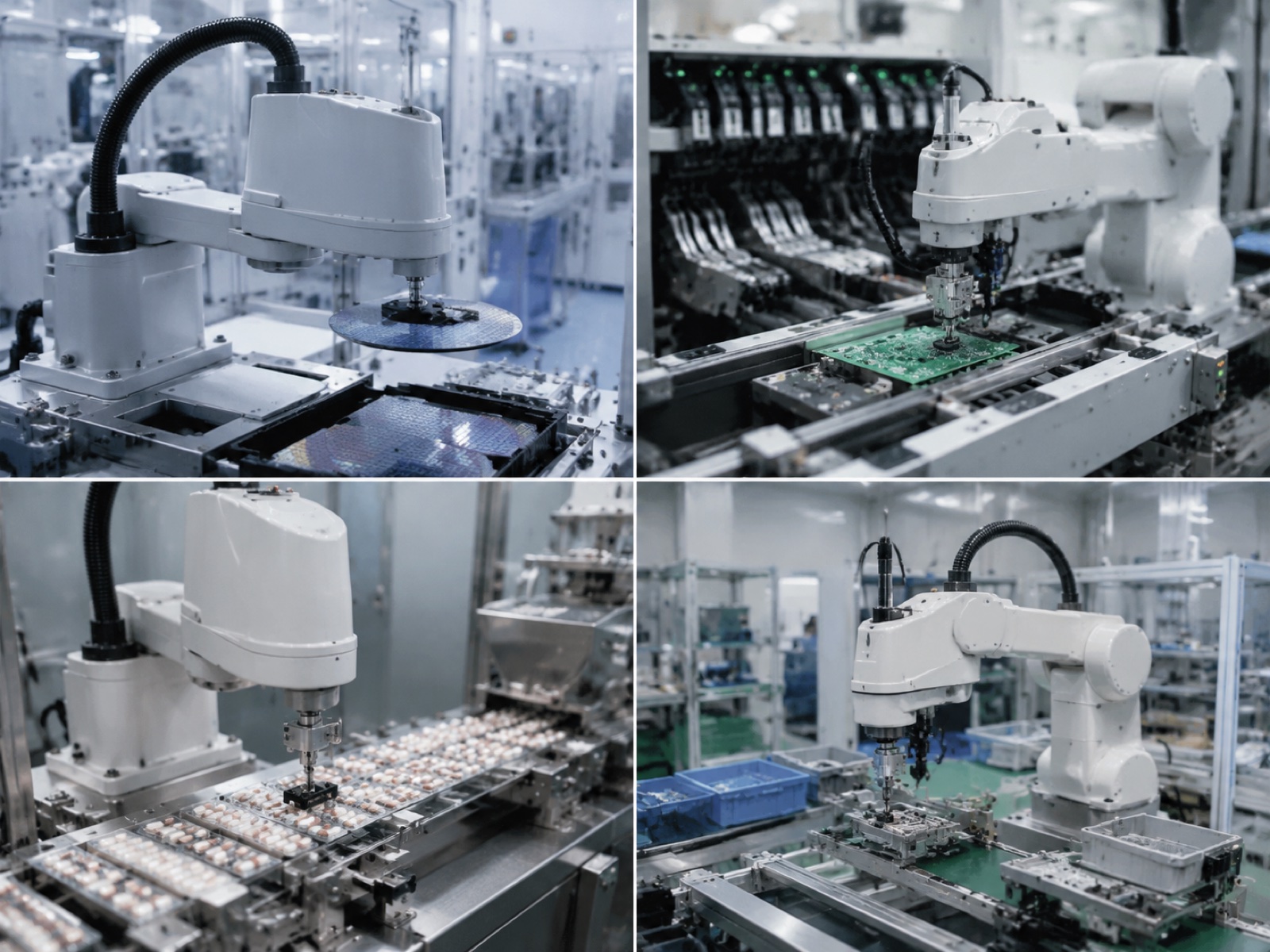
Application requirements vary substantially across SCARA use cases. The table below maps five primary application categories to the top three recommended brands, based on industry-standard requirements for repeatability, cleanliness, speed, and total cost of ownership.
| Application | Key Requirement | Recommended Brands (in order) |
|---|---|---|
| Semiconductor wafer handling | ±0.005-0.010 mm repeatability; cleanroom ISO Class 4-5 | 1. Epson (RS/G series) 2. Yamaha (YK-XG) 3. Denso (HS series) |
| 3C electronics / PCB assembly | ±0.010-0.020 mm; high cycle speed; cost efficiency | 1. Epson (G series) 2. FANUC (SR-6iA) 3. EVS series |
| Automotive sub-assembly (IATF-certified line) | IATF16949-certified mfg; 3-20 kg; ±0.015-0.020 mm | 1. Yamaha (YK-XG) 2. Denso (HS/HSR) 3. EVS series |
| Pharmaceutical / cleanroom light handling | Sealed joints; ISO Class 5-6; CE/FDA-compatible | 1. Epson (cleanroom variants) 2. Omron/Adept (Cobra) 3. Yamaha (cleanroom YK) |
| General assembly / SME light production | Low entry price; ease of programming; 3-10 kg | 1. JAKA (Si series) 2. Estun (ER series) 3. Inovance (IS series) |
China SCARA OEM Landscape: What Has Changed in 2026
According to the China Robotics Industry Alliance (CRIA) 2025 annual report, Chinese-origin SCARA manufacturers now account for approximately 35% of domestic China SCARA unit shipments, up from roughly 18% in 2021. This shift is driven by three factors: certification parity (leading Chinese brands now carry CE, TUV, and in some cases IATF16949 approvals), component supply chain maturity (domestic harmonic drives and servo systems have improved significantly), and price competitiveness that resonates in price-sensitive manufacturing clusters in Southeast Asia, South Asia, and Eastern Europe.
According to IPC/SEMI 3C electronics manufacturing surveys, the 3C sector accounts for approximately 40% of all new SCARA installations globally. This is the primary battleground for Chinese SCARA OEMs competing against Japanese incumbents. In practice, buyers in Tier-2 and Tier-3 Chinese cities deploying 20 to 100 SCARA units for phone-assembly sub-lines report that Chinese-origin brands meet their repeatability and throughput targets while reducing capital expenditure per cell by 25% to 40% compared to equivalent Japanese configurations.
The segment where Japanese brands retain a durable lead is ultra-precision: semiconductor front-end and back-end equipment where ±0.005 mm or better is mandatory, cleanroom Class 4 or cleaner is required, and the cost of a single defective wafer exceeds the cost of the robot. In that tier, the installed base, certified field-engineer network, and decades of application data from Epson, Yamaha, and Denso are still decisive selection factors.
For a broader discussion of the quality gap between Chinese and Japanese/European industrial robots, see Chinese Robot Manufacturers vs. European Quality Standards 2026.
E-E-A-T Analyst Note: How to Evaluate a SCARA Manufacturer
Based on field deployment observations across multiple 3C electronics clients, four evaluation steps consistently separate a well-matched SCARA supplier from one that causes problems at commissioning:
- Verify repeatability under load. Published repeatability figures are measured at rated payload and mid-reach. Request the vendor’s test data at your specific payload and reach combination; accuracy degrades toward the outer reach envelope, sometimes by 30% to 50% of the rated figure.
- Check controller compatibility. SCARA robots that integrate with your existing PLC via EtherCAT or ProfiNet reduce integration hours. Verify the specific fieldbus version, not just the protocol name.
- Confirm certification scope. CE marking on a robot does not automatically mean the complete cell is CE compliant. Ask for the Declaration of Conformity and confirm it covers the robot body, controller, and cable set that will actually be delivered.
- Run a cycle-time trial. A 25-300-25 mm pick-and-place benchmark at your actual payload and Z-axis stroke, run for at least 2 hours on the vendor’s demo unit, gives you empirical cycle-time data that marketing cycle-time tables cannot replace.
According to industry observations, integrators who skip the cycle-time trial step report cycle-time shortfalls of 10% to 20% against projected throughput in roughly one in three SCARA cell deployments, particularly where arm inertia at higher payloads was not accounted for.
For a broader understanding of how top SCARA manufacturers fit within the wider Chinese industrial robot ecosystem, see Top 10 Industrial Robot Manufacturers in China 2026. For the SCARA-vs-six-axis decision framework, the Industrial Robot Reducer Comparison 2026 covers the harmonic drive technology that determines SCARA repeatability limits. And for teams evaluating SCARA alongside collaborative-robot options, Top Cobot Manufacturers 2026 provides a parallel ranking framework.
Frequently Asked Questions: SCARA Robot Manufacturers 2026
Which SCARA robot is best for SMT and PCB assembly applications?
Surface-mount technology and PCB assembly demand repeatability at or below ±0.010 mm and high cycle speeds. Epson’s G-series and RS-series SCARA models are the most widely deployed in this segment, with repeatability figures as tight as ±0.005 mm on select models. Yamaha’s YK-X series and Denso’s HSR series are also common choices in SMT lines. For lower-density PCB assembly where ±0.020 mm repeatability is acceptable, several Chinese-origin SCARA models offer a competitive price-to-performance ratio.
How do Japanese and Chinese SCARA robots compare for reliability in 2026?
Japanese SCARA robots from Epson, Yamaha, Denso, and FANUC carry decades of field data in semiconductor and electronics applications, and their mean time between failure (MTBF) figures in high-cycle environments are industry benchmarks. Chinese-origin SCARA manufacturers have invested heavily in component quality since 2022, with leading brands now achieving IATF16949 or ISO 9001-certified manufacturing processes, CE and TUV third-party certification, and export track records in 50 or more countries. The reliability gap has narrowed for general-purpose 3C electronics and light assembly applications. For ultra-precision semiconductor fabrication requiring ±0.005 mm or cleaner room ratings above ISO Class 5, Japanese brands retain a clear lead.
What is the maximum speed of a SCARA robot?
Maximum tip speed for SCARA robots typically ranges from 5,000 mm/s to 10,000 mm/s depending on model and arm length. Cycle-time benchmarks such as a standard 25 mm up, 300 mm across, 25 mm down pick-and-place cycle can be completed in as little as 0.3 seconds on high-speed SCARA models from Epson and Yamaha. Speed diminishes with payload and reach arm length; heavier payloads and longer arms reduce achievable tip speed due to inertia constraints. Always verify the vendor’s cycle-time curve at your specific payload and reach combination rather than relying on peak-speed figures.
Are SCARA robots available in cleanroom-rated versions?
Yes. Epson, Yamaha, Denso, and Mitsubishi all offer cleanroom-rated SCARA variants, typically designed for ISO Class 4 or ISO Class 5 environments used in semiconductor wafer handling and pharmaceutical tablet dispensing. These models feature sealed joints, low-outgassing materials, and downward-directed exhaust. Cleanroom SCARA models carry a significant price premium of 30% to 80% above standard models. Chinese-origin manufacturers have begun introducing cleanroom-compatible variants but field adoption in semiconductor fabs remains limited in 2026.
What is the typical lead time for SCARA robots from Japanese vs. Chinese manufacturers?
Japanese SCARA manufacturers typically quote 8 to 20 weeks lead time for standard configurations, with shorter timelines available for stocked high-volume models. Lead times have stabilized after the supply chain disruptions of 2022 to 2024. Chinese-origin SCARA manufacturers generally quote 4 to 10 weeks for standard models, with some offering 2 to 4 weeks for in-stock units. Both categories can extend significantly for customized variants, non-standard reach or payload combinations, or orders requiring special certifications such as cleanroom or ATEX ratings.
Last Updated: May 10, 2026
For a quote tailored to your SCARA application, including configuration review and model selection across the EVS series payload range, email sales@evsrobot.com or message us on WhatsApp / WeChat. Typical response within 24 hours.
New to the category? Read what a SCARA robot is before comparing manufacturers.