

By the EVST Editorial Team · Last updated: June 4, 2026
A delta robot is a parallel-arm robot mounted overhead, with three light arms driving a single platform so it can move a small end-effector at very high speed, often more than 100 picks per minute. Because the heavy motors stay fixed at the base, only the light arms move, which is why deltas dominate high-speed sorting and packaging of light parts. They trade payload and reach for that speed.
How a Delta Robot Works
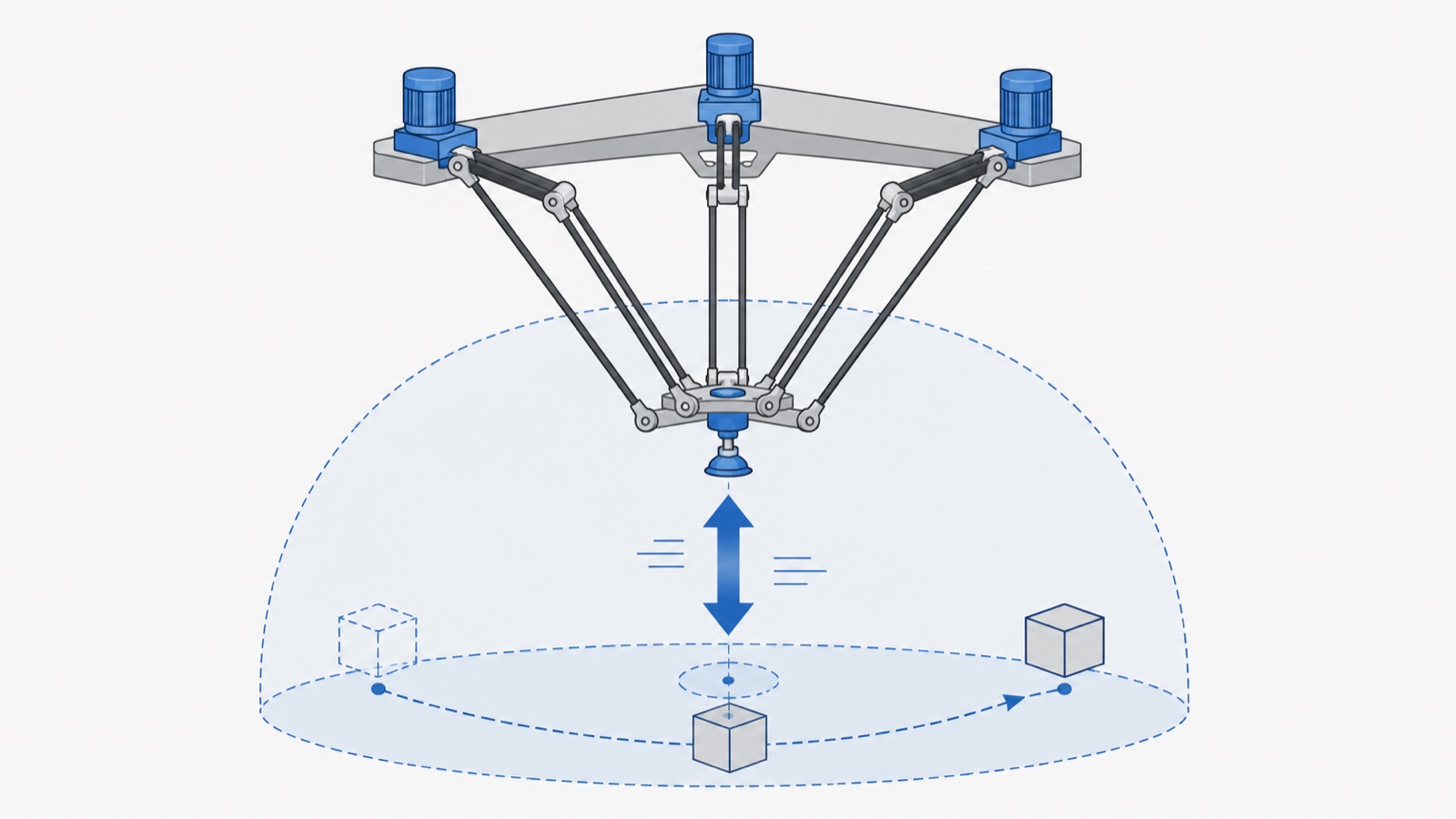
Unlike an articulated arm, where each motor carries the weight of the joints beyond it, a delta keeps all three motors fixed at the top frame. They drive three pairs of lightweight linkages that meet at a small moving platform. The result is very low moving mass and very high acceleration. According to industry observations, this parallel kinematics is what lets deltas reach pick rates that serial arms cannot match for light parts.
The platform typically carries a vacuum cup or small gripper, and a fourth rotary axis can be added to orient parts. Vision usually guides the robot, identifying parts on a moving conveyor so the delta picks on the fly without stopping the belt.
Where Delta Robots Fit
| Application | Why delta fits |
|---|---|
| High-speed sorting | Vision-guided picking of light items from a moving belt |
| Primary packaging | Placing products into trays, cartons, or flow-wrap at high rate |
| Pick and place | Transferring small parts between conveyors at speed |
| Light assembly feeding | Presenting parts quickly to a downstream station |
According to industry observations, food, pharmaceutical, and consumer-goods lines are the heaviest users of delta robots because their products are light, numerous, and move continuously. EVST’s EVSD delta series, for example, is built for sorting, stacking, pick-and-place, and packaging, with cycle rates suited to high-volume lines. For how delta compares with other types, see our SCARA vs delta vs 6-axis comparison.
The Limits of Delta Robots
Deltas are specialists, not generalists. Their payload is low, usually a few kilograms up to around 15 kg, and their working envelope is a shallow dome rather than a tall volume, so they cannot reach into deep bins or around obstacles. They also do not tilt parts beyond the optional wrist rotation. When a task needs higher payload, full orientation, or a large vertical envelope, a 6-axis robot is the better tool, and for rigid flat assembly a SCARA usually wins.
In practice, deltas earn their place on the fastest, lightest, most repetitive picking, and they are frequently paired with other robot types: a line of deltas picking from a belt can feed a 6-axis robot that cases and palletizes downstream.
Specifying a Delta Cell
- Part weight and size: confirm the part plus end-effector stays within delta payload.
- Pick rate target: picks per minute drives the number of robots over the belt.
- Vision: belt-tracking vision is almost always needed for moving-product picking.
- Envelope: verify the dome reach covers the belt width and placement points.
According to industry observations, throughput is usually set by the combination of vision detection rate and the number of deltas over the belt, not by a single robot’s top speed. EVST supplies delta cells with the robot, vision, and tooling integrated; for model specifics see the EVST delta robot selection guide.
Frequently Asked Questions
What is a delta robot used for?
Delta robots are used for high-speed sorting, primary packaging, and pick-and-place of light parts, especially in food, pharmaceutical, and consumer-goods lines. Their parallel-arm design moves a light end-effector very fast, often more than 100 picks per minute, usually guided by vision tracking products on a moving conveyor.
How fast is a delta robot?
Delta robots commonly exceed 100 picks per minute for light parts, faster than serial arms for the same task, because their motors are fixed at the base and only lightweight linkages move. Actual rate depends on part weight, pick and place distance, and how quickly vision can detect parts on the belt.
What is the payload of a delta robot?
Delta payloads are low, typically a few kilograms up to around 15 kg, because the design optimizes speed over load. EVST’s EVSD delta series covers this range for sorting, stacking, pick-and-place, and packaging. Heavier parts call for a SCARA or 6-axis robot instead.
What is the difference between a delta and a SCARA robot?
A delta is a parallel robot built for top-end speed with light parts in a shallow dome envelope, ideal for picking from a belt. A SCARA is a serial 4-axis robot that is more rigid and better for precise flat assembly and insertion with higher payload. Deltas favor speed; SCARAs favor rigidity and assembly force.
Does a delta robot need a vision system?
For picking products from a moving conveyor, yes, almost always. Belt-tracking vision identifies each part’s position and orientation so the delta picks on the fly without stopping the line. For fixed-position pick-and-place, vision may not be required, but most high-speed sorting applications depend on it.
About the author: This guide was prepared by the EVST Editorial Team. EVST (EVS TECH CO., LTD) is a Chengdu-based robotics manufacturer founded in 2018, producing delta, SCARA, 6-axis industrial, and collaborative robots exported to more than 100 countries, with CE, SGS, and TUV third-party certification.
Last updated: June 4, 2026. Performance figures are indicative industry ranges; confirm payload, reach, and cycle against current product data before specifying.