
By the EVST Editorial Team · Last updated: June 8, 2026
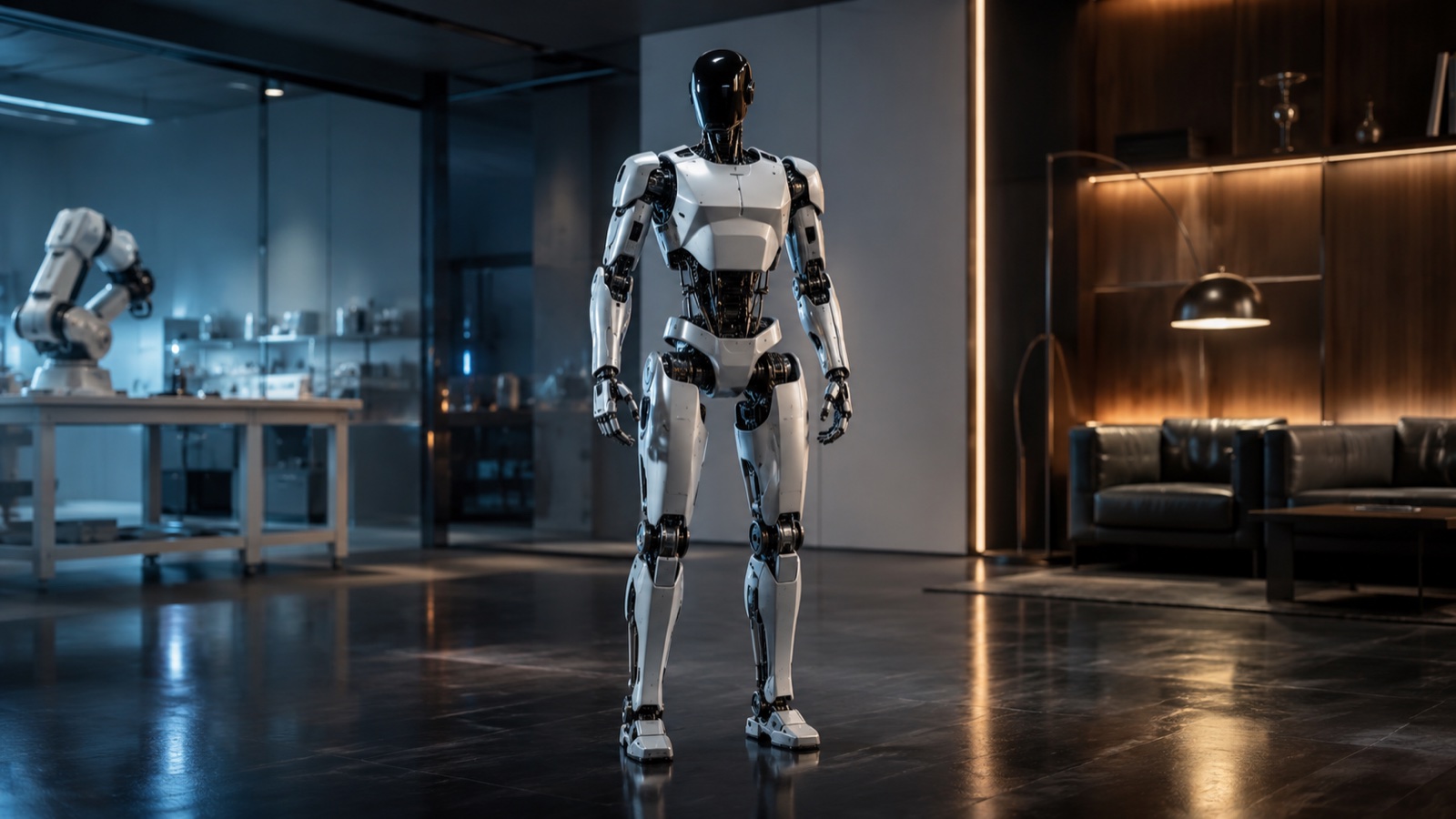
As of 2026, a small number of humanoid robot companies are directly accessible to public-market investors, while a larger group of well-funded private names are approaching IPO territory. This guide maps the listed and pre-IPO landscape, covers the investor-relevant facts for each company, and explains what metrics actually matter when evaluating humanoid robot stocks at their current stage of commercial development.
Key Takeaways
- As of 2026, only a small number of humanoid robot companies are directly accessible to public-market investors, while most leading names remain privately held.
- The clearest listed exposures are Tesla (TSLA), UBTECH Robotics (9880.HK), Xiaomi (1810.HK), and Hyundai Motor (005380.KS, which owns Boston Dynamics); UBTECH is the most direct pure-play humanoid robot stock on a major exchange.
- Figure AI, Agility Robotics, Apptronik, 1X Technologies, Unitree Robotics, and Sanctuary AI are the leading pre-IPO names to watch, but no major humanoid company has confirmed an IPO date as of mid-2026.
- No humanoid robot has yet been deployed above the low hundreds of units in a sustained, commercially priced production environment as of mid-2026; the GXO/Agility and BMW/Figure programs are the clearest early data points.
- The metrics that matter most at this stage are paid commercial deployments (not funded pilots), bill-of-materials cost trajectory, uptime and MTBF in real factory conditions, and partner contract quality, rather than traditional backlog, ASP, or margin.
Why Humanoid Robots Are a 2026 Investor Conversation
According to the International Federation of Robotics (IFR), global robot installations crossed 590,000 units per year in its most recent annual report, with the vast majority being traditional industrial arms. Humanoid robots represent a fraction of that installed base today, but the technology has moved faster in the 2023-2026 period than most capital-allocation frameworks anticipated. Tesla unveiled Optimus Gen 2 on its production line, Figure AI raised capital at a multi-billion valuation with a BMW pilot underway, and UBTECH Robotics became the first standalone humanoid company to list on a major public exchange.
For investors, the question is not whether humanoid robots will eventually matter in factories. The more useful question is: which companies have the capital structure, technology stack, and commercial partnerships to survive the three-to-seven-year window before humanoid platforms reach cost parity with purpose-built industrial arms for high-volume tasks?
According to industry observers, the humanoid robot market is at a stage analogous to electric vehicles circa 2017: proof-of-concept deployments exist, a handful of companies have real customer commitments, but no one has yet shown that a humanoid can do a full shift on a production line at economics that make sense vs. conventional automation.
In our 7+ years building and deploying industrial automation across more than 600 projects, EVST has observed the same pattern with every generation of “next-generation” robotics: factory adoption follows a sigmoid curve where the early-majority uptake comes only after BOM cost, software reliability, and maintenance costs all cross a threshold simultaneously. For humanoids, that threshold has not yet been crossed at scale as of mid-2026.
Public-Listed Humanoid Robot Companies
The table below covers companies where humanoid robots are a material part of the equity story on a public exchange, as of 2026. Pure-play industrial robot manufacturers are excluded unless they have a committed humanoid program.
| Company | Ticker / Exchange | Flagship Humanoid Platform | 2026 Status |
|---|---|---|---|
| Tesla | TSLA / NASDAQ | Optimus (Gen 1, Gen 2) | In-house pilot deployment; production-cost target reported at approximately $20,000 per unit |
| UBTECH Robotics | 9880.HK / HKEX | Walker S | Listed December 2023; Walker S in commercial pilot with automotive and electronics customers |
| Xiaomi | 1810.HK / HKEX | CyberOne / Iron | Humanoid as a platform demonstration alongside EV and IoT stack; no standalone revenue line reported |
| Hyundai Motor (via Boston Dynamics) | 005380.KS / KRX | Atlas Electric (Boston Dynamics) | Boston Dynamics operates as a Hyundai subsidiary; Atlas Electric transitioned to electric actuation in 2024 with pilot deployments in 2025-2026 |
Tesla (TSLA)
Tesla is the only U.S.-listed company with a humanoid robot directly deployed on its own manufacturing floor. The Optimus program targets a bill-of-materials cost of approximately $20,000 per unit as production scales, which would put it price-competitive with some purpose-built industrial arms for certain tasks. Optimus Gen 2 demonstrated improved hand dexterity and faster walking speed in public presentations, and Tesla has stated it is testing autonomous task execution in its Fremont and Texas factories. Investor visibility is limited because Tesla does not break out Optimus as a separate revenue segment; it is currently reported as part of the broader “Other” category. The equity case rests on vertical integration: Tesla designs the motor actuators, the AI inference chips (Dojo), and the software stack, which could compress cost curves faster than pure-play humanoid startups buying components on the open market.
UBTECH Robotics (9880.HK)
UBTECH is the most direct publicly traded pure-play on humanoid robots available to investors in 2026. Listed on the Hong Kong Stock Exchange in December 2023, UBTECH develops the Walker S, a full-size bipedal humanoid with 41 degrees of freedom, designed for logistics, assembly, and inspection tasks in factories. According to public filings, UBTECH had established commercial pilot agreements with automotive and electronics manufacturers in China as of its most recent reported period. Investors should note that revenue from humanoid deployments remains relatively modest compared to R&D expenditure, and the company has reported operating losses consistent with its investment phase. UBTECH is the clearest reference point for anyone tracking a standalone humanoid robot stock on a major exchange.
Xiaomi (1810.HK)
Xiaomi’s CyberOne and the subsequent Iron platform are better understood as platform demonstrations that reinforce the brand’s positioning in the consumer-and-manufacturing AI stack than as near-term commercial products. Xiaomi has a credible robotics engineering team and access to its own supply chain for actuators and sensors, but as of 2026 the humanoid program does not represent a material revenue line in its public reporting. For investors, the humanoid angle at Xiaomi is exposure to a broader AI-hardware ecosystem story rather than a direct bet on humanoid commercialization timelines.
Boston Dynamics (via Hyundai Motor, 005380.KS)
Hyundai Motor acquired Boston Dynamics in 2021 and completed a majority stake transaction that made it a subsidiary. Atlas Electric, unveiled in 2024, replaced the hydraulic Atlas with an all-electric actuation system and improved payload-to-weight ratio. Pilot deployments at Hyundai manufacturing facilities began in 2025. The investor framing here is that Hyundai is testing humanoids on its own production line, which gives it a captive deployment environment unavailable to startups. However, Hyundai is a large automotive group and the Boston Dynamics contribution to its consolidated financials is not yet reported as a separate segment. Investors seeking exposure to Atlas Electric are effectively buying Hyundai’s automotive and mobility business with a humanoid option attached.
Pre-IPO Humanoid Names to Watch
According to industry reporting and public announcements, several high-profile humanoid robot companies have raised significant private capital and are either on IPO watch lists or have signaled public-market ambitions within the next two to three years.
Figure AI
Figure AI raised capital at a reported valuation of several billion dollars in a round that included OpenAI, Microsoft, and Nvidia as investors, alongside a manufacturing partnership with BMW at its Spartanburg plant. The BMW pilot is one of the most consequential commercial proofs-of-concept in the humanoid space because it involves a real production environment, not a lab demonstration. Figure’s Figure 02 platform uses an in-house foundation model trained on video data of human movement. An IPO has not been confirmed as of mid-2026, but Figure is widely cited in investor circles as a potential offering when the commercial pipeline matures further.
Agility Robotics
Agility Robotics, which counts Amazon’s Industrial Innovation Fund among its investors, deployed its Digit platform at GXO Logistics facilities in a commercial contract. Digit is currently the most commercially deployed humanoid robot by unit count that has been publicly documented. Agility has also announced a partnership with Schaeffler for drivetrain components. The strategic-investor profile and the GXO partnership shape the IPO path; market observers debate whether Agility would pursue an independent listing, deeper integration with a strategic backer, or remain private for an extended runway. The GXO deployment is the most investor-relevant proof point in the pre-IPO category: it shows a humanoid doing repetitive logistics tasks in an actual warehouse under real operating conditions.
Apptronik
Apptronik’s Apollo platform has a pilot program with Mercedes-Benz, giving it a second automotive-OEM proof point alongside Figure’s BMW relationship. Apollo is designed with swappable batteries and a modular design intended to reduce maintenance downtime in factory settings. Apptronik has announced a collaboration with Google DeepMind on AI for humanoids and closed a Series A in 2025 that gave it runway through its planned commercial scale-up phase. No IPO timeline has been publicly announced.
1X Technologies
1X Technologies, backed by OpenAI and others, develops the Neo platform with a focus on bipedal dexterity for household and light-commercial tasks. 1X has been more transparent than most about its data-collection methodology, publishing information about its teleoperation training pipeline. Commercial deployment timelines beyond pilot scale have not been confirmed as of mid-2026.
Unitree Robotics
Unitree, based in Hangzhou, is the most cost-aggressive player in the humanoid space, with its G1 and H1 platforms priced well below comparable systems from U.S. or European competitors. IPO rumors have circulated in Chinese financial media, and Unitree’s quadruped robots already have significant commercial traction. For investors, Unitree represents the downside-pressure scenario for humanoid hardware margins: if a Chinese manufacturer can deliver a capable humanoid at a fraction of the price of Western equivalents, it restructures the entire competitive landscape. Unitree is private as of mid-2026.
Sanctuary AI
Sanctuary AI’s Phoenix platform focuses on general-purpose manipulation with a proprietary AI system called Carbon. Sanctuary has not announced a major manufacturing partnership at the scale of Figure or Agility as of mid-2026. The company differentiates on its AI-first approach: Carbon is designed to transfer task knowledge across physical configurations, which is relevant to the foundation-model stack investors should be tracking (see the EVST guide to top robotics foundation model companies).
What Metrics Investors Should Track
Traditional industrial robot investment analysis centers on backlog, ASP (average selling price), and gross margin. Humanoid robots are not at that stage. The metrics that actually matter in 2026 are:
- Units deployed in commercial (non-pilot) environments: The distinction between a paid commercial deployment and a funded pilot is critical. A pilot where the humanoid company is effectively paying the customer to host the robot is not evidence of market demand.
- Bill-of-materials cost trajectory: Actuator costs, particularly for high-torque joints, remain the largest single cost driver. Tesla’s $20,000 BOM target is achievable only at significant volume. Track actuation cost per degree-of-freedom as a proxy.
- Foundation model and software stack: A humanoid running proprietary software with in-house trained models has higher switching costs and potential for software margin. A hardware-only play has no OS leverage. Figure, 1X, and Sanctuary are investing here; Agility is more hardware-focused. See also the EVST piece on embodied AI data collection and sim-to-real transfer for the technical background on why this matters.
- Partner quality and contract terms: A paid commercial contract with a major OEM (BMW, Mercedes, GXO) is a stronger signal than a letter of intent or a co-development agreement where payment is not yet confirmed.
- Uptime and MTBF in real deployments: Mean time between failures in actual factory conditions is the most honest proxy for whether the technology is production-ready. Almost none of the humanoid companies publish this data publicly, which is itself an information signal investors should note.
According to industry analysis, the humanoid robot market could reach $38 billion annually by 2035 under optimistic adoption scenarios, but the path from here to there requires crossing cost and reliability thresholds that no company has yet demonstrated at volume. Investors should apply the same scrutiny to humanoid deployment claims that they would apply to any pre-revenue hardware platform.
Risk Factors
The humanoid robot investment thesis carries several distinct risk categories that differ from traditional industrial robot stocks.
R&D Burn Without Commercial Proof
Most humanoid companies are spending heavily on engineering, data collection, and platform iteration without a defined path to gross-margin-positive unit economics. Runway management is a key risk: if capital markets tighten before commercial milestones are reached, the next funding round may come at dilutive terms or not at all. The companies with the strongest position are those with strategic corporate investors (Amazon/Agility, Hyundai/Boston Dynamics) that have both the capital and the deployment environments to absorb extended development timelines.
No Commercial Proof at Scale
As of mid-2026, no humanoid robot has been deployed in quantities above the low hundreds in a sustained, commercially priced production environment. The GXO/Agility deployment and the BMW/Figure pilot are the clearest data points, and both are still in early-stage commercial phases. Scale means thousands of units running hundreds of shifts per year. No company is there yet.
China-US Technology Bifurcation
The humanoid robot supply chain is subject to geopolitical fragmentation. UBTECH and Unitree operate on Chinese supply chains with domestic actuator and semiconductor suppliers, while U.S. and European companies rely on global component networks that are increasingly subject to export controls and regulatory scrutiny. According to public reporting, the U.S. has considered or implemented controls on specific semiconductor exports relevant to robot AI inference chips. Investors with exposure to both Western and Chinese humanoid names should model a scenario where these supply chains become permanently separated, which would affect cost structures and addressable markets differently for each group.
How EVST Reads the Humanoid-vs-Industrial Robot Divide
For anyone considering capital allocation across the robotics spectrum, the contrast between humanoid robots and conventional industrial automation is worth stating plainly. Traditional industrial robots are already profitable, scalable businesses. According to IFR data, the global market for industrial robots exceeded $23 billion in annual revenues in its most recently reported year, with major manufacturers carrying gross margins well above 30%. These are businesses with decades of commercial deployment data, established service networks, and predictable upgrade cycles.
Humanoid robots are pre-revenue at scale. They offer a much larger potential addressable market than purpose-built industrial arms because they can, in principle, operate in environments built for humans without re-tooling the factory. But that addressable market is theoretical until the cost, reliability, and software stack reach a threshold that factory operators will accept.
EVST’s own view, shaped by hands-on commissioning work across more than 600 industrial automation projects, is that humanoid robots will first prove their value in logistics and low-complexity assembly, where task variety is high and the cost of purpose-built automation is difficult to justify. High-precision manufacturing, where cycle times are tight and consistency requirements are stringent, will remain the territory of purpose-built industrial arms for the foreseeable future. For a broader view of the humanoid company landscape beyond the investor lens, see the EVST guide to the leading humanoid robot companies in 2026.
Industrial robot manufacturers with active humanoid programs (EVST is bringing its industrial robot manufacturing experience into the embodied-AI category, with humanoid robots, data-collection dexterous hands, and quadruped robots in its product roadmap) are positioned differently from pure-play humanoid startups: they have existing factory relationships, field service networks, and integration experience that can accelerate commercial adoption once the humanoid hardware matures.
Frequently Asked Questions
What publicly traded companies are directly exposed to humanoid robots in 2026?
The clearest public-market exposures in 2026 are Tesla (TSLA), which is deploying Optimus on its own production lines; UBTECH Robotics (9880.HK), the most direct pure-play humanoid stock on a major exchange; Xiaomi (1810.HK), with CyberOne and Iron as platform demonstrations; and Hyundai Motor (005380.KS), which owns Boston Dynamics and is piloting Atlas Electric in its own factories. Most other prominent humanoid companies remain private.
Is there a pure-play humanoid robot stock I can buy?
UBTECH Robotics (9880.HK on the Hong Kong Stock Exchange) is the most direct listed pure-play as of 2026. It develops the Walker S humanoid and has commercial pilot agreements in place. Investors outside Hong Kong can access it through international brokerage accounts that support HKEX. Tesla provides U.S. market exposure, but humanoid robots are one component of a much larger business.
Which humanoid robot companies are closest to IPO?
Figure AI is the most frequently cited pre-IPO name given its valuation, the OpenAI/Microsoft/Nvidia investor base, and the BMW commercial pilot. Agility Robotics, which counts Amazon’s Industrial Innovation Fund among its investors and has a commercial GXO Logistics deployment, has not announced an independent IPO timeline. Unitree has circulated IPO signals in Chinese financial media but has not confirmed a timeline. No IPO dates have been officially announced for any major humanoid company as of mid-2026.
What is the biggest risk in humanoid robot stocks right now?
The primary risk is the gap between proof-of-concept deployments and commercially scaled, gross-margin-positive production. Most humanoid companies are spending significantly more on R&D and deployment support than they are earning from robot sales or rentals. If capital markets become less accommodating before commercial milestones are reached, dilutive funding rounds or consolidation are the likely outcomes.
How do humanoid robot stocks compare to traditional industrial robot manufacturers as investments?
Traditional industrial robot manufacturers (ABB, FANUC, KUKA, Yaskawa) are profitable, dividend-paying businesses with decades of deployment data and predictable revenue cycles. Humanoid robot companies are pre-revenue at scale, carry substantial R&D burn, and have unproven unit economics. The investment theses are structurally different: one is a mature industrial business, the other is a venture-style bet on a technology transition with a multi-year horizon.
What should investors track to judge progress in humanoid robots?
The most reliable indicators are: paid commercial deployments (not funded pilots), bill-of-materials cost per unit over time, uptime and MTBF data from real factory environments, and the quality of manufacturing partnership contracts. Revenue from robot sales or rentals is the cleanest signal, but most companies do not yet break this out separately.
About the author: This guide was prepared by the EVST Editorial Team. EVST (EVS TECH CO., LTD) is a Chengdu-based robotics manufacturer founded in 2018, with 7 years of industrial automation experience across 600+ projects in 100+ countries. EVST supplies certified industrial and collaborative robots under the QJAR series, alongside turnkey automation cells, and is expanding into humanoid robots, data-collection dexterous hands, and quadruped robots on evsint.com. Certifications include IATF16949, CE, SGS, and TUV.
Last updated: June 8, 2026. This article is for informational purposes only and does not constitute investment advice. Confirm all financial data and company status against current public filings before making investment decisions.