
An automatic capping machine is a capper built into a filling line. Filled bottles arrive on the conveyor, caps are sorted and fed, each cap is placed and tightened, and the bottle moves on to sealing, labeling or inspection. Fallen bottles, bottle jams and loose caps are detected, and the affected bottles are rejected automatically. This page covers in-line capping for production lines; handheld and benchtop cappers that one operator feeds by hand are a different class of machine.
EVST builds two types: a multi-head capping machine for high-volume bottles, and a tracking capping machine for 1–5 L bottles that are capped without stopping. Both run alone or as a station of an geautomatiseerde verpakkingslijn.
The choice starts from the cap. The table shows the cap types and output of the machines built to date.
| Machine | Captype | Heads | uitgang |
|---|---|---|---|
| Multi-head capping machine | Schroef doppen | 4 / 8 / 12 | 2,500 / 5,000 / 7,200 pcs/h |
| Multi-head capping machine | Drukdoppen | 8 | 6,000 stuks/u |
| Multi-head capping machine | Pompdoppen | 12 | 9,000 stuks/u |
| Tracking capping machine | Screw and pump caps on 1–5 L bottles | 1 | 2,200 flessen/uur |
| Tracking capping machine | Screw and pump caps on 1–5 L bottles | 2 | 4,000 flessen/uur |
Tracking capper output depends on bottle size. The rate on your bottles is confirmed on samples.
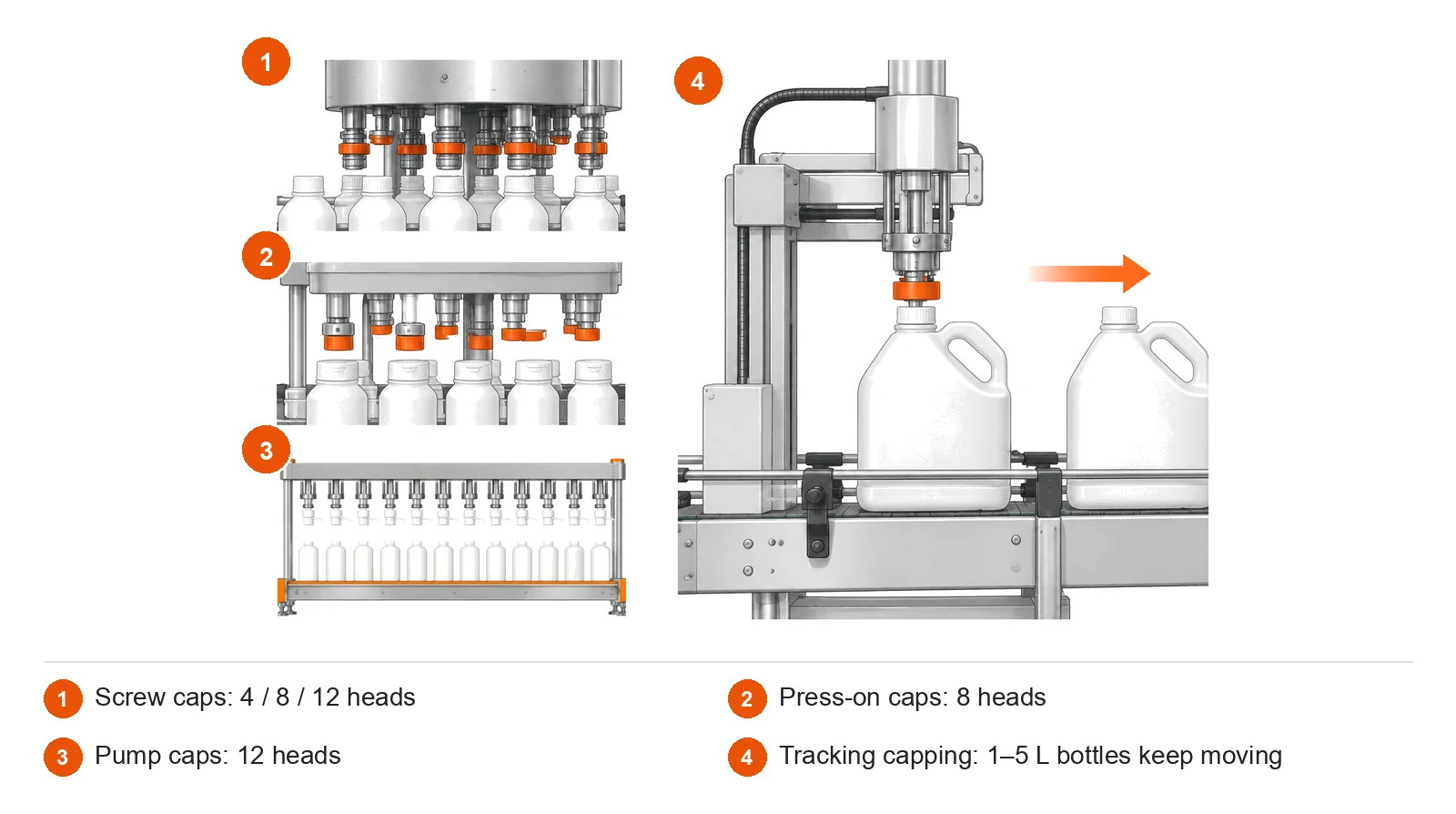
Round screw caps are the most common case. On the multi-head machine, output scales with the number of heads: 2,500 pcs/h with 4 heads, 5,000 pcs/h with 8 heads and 7,200 pcs/h with 12 heads. Typical containers include household-chemical bottles and agrochemical bottles with round caps.
Caps that snap on rather than screw on are pressed into place. The 8-head configuration presses 6,000 caps per hour.
Pump dispensers, as on hand-wash bottles, are capped at up to 9,000 pcs/h with 12 heads. On the filling lines we have built, capping torque is controlled by an independent servo motor, which lets the same line handle both pump caps and round caps.
Angled duck-bill spout caps, used on household cleaner bottles and jugs, are one of the cap types on the multi-head machine’s application list. Cap orientation and feeding are set up for the specific cap during the project.
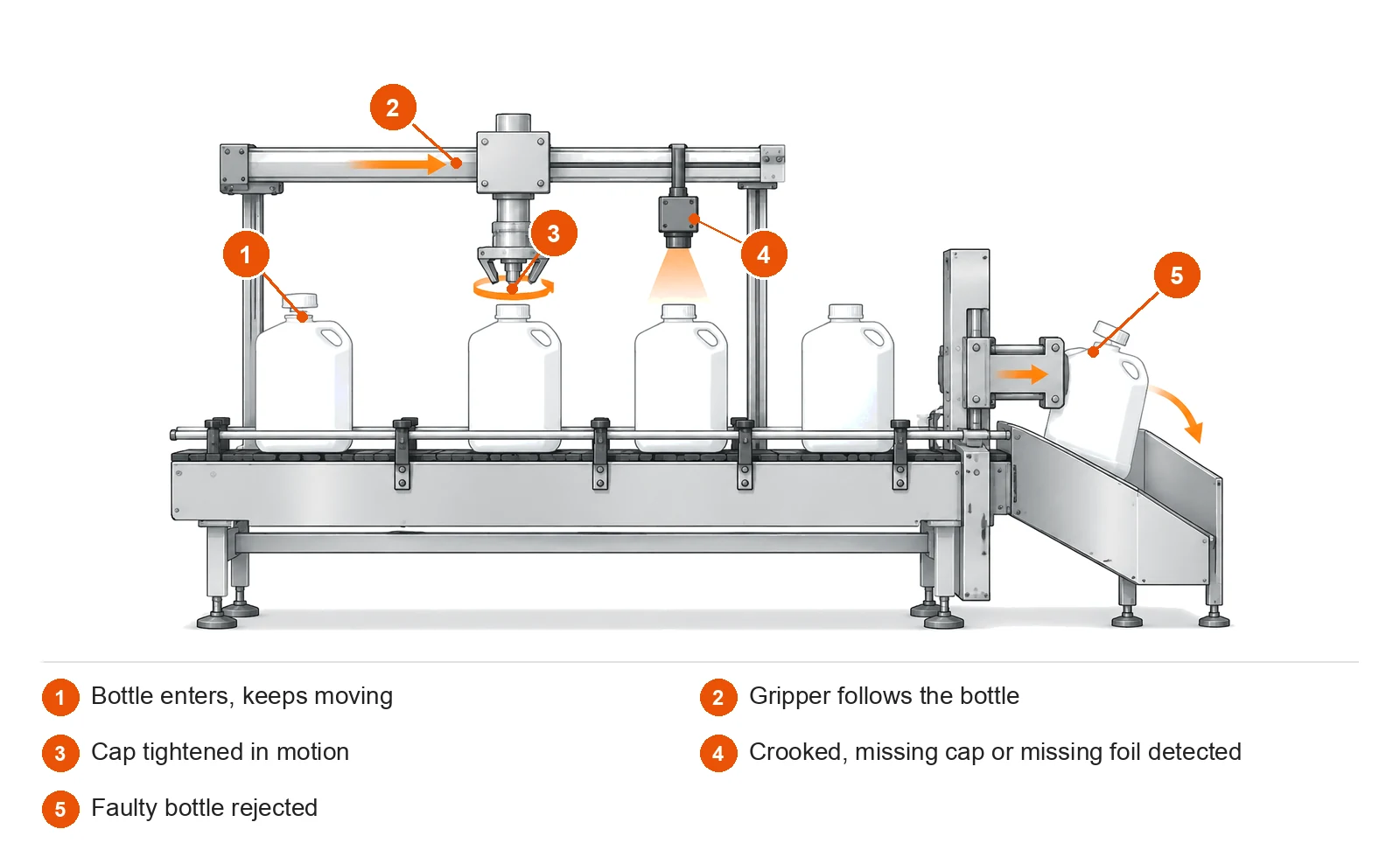
On a tracking capping machine, mechanical grippers follow the bottle along the conveyor and tighten the cap while the bottle keeps moving. Because the bottle never stops and restarts, the product does not splash, which matters on full 1–5 L bottles. The gripper holds the cap firmly without damaging it.
The capper follows the filler directly. On the liquid filling lines we have built:
The exact process steps are configured for each product and project. Complete line configurations for 100 ml to 30 L containers are on the vloeibare vullijn page; cartoned products continue to a kartonneermachine.
On projects where the budget does not stretch to a full line, filling and capping are the stations a plant cannot do without, so they are automated first. Labeling and other downstream stations can be added later when the budget allows. If you plan to grow the line this way, say so when you request the quotation.
Sample bottles and caps help confirm the cap feeding and gripper tooling before the configuration is fixed.
| Item | Waarde |
|---|---|
| Machinetypes | Multi-head capping machine; tracking capping machine |
| Multi-head output, screw caps | 2,500 / 5,000 / 7,200 pcs/h (4 / 8 / 12 heads) |
| Multi-head output, press-on caps | 6,000 pcs/h (8 heads) |
| Multi-head output, pump caps | 9,000 pcs/h (12 heads) |
| Tracking capper bottle size | 1–5 liter |
| Tracking capper output | 2,200 bottles/h (single head); 4,000 bottles/h (double head), depending on bottle size |
| Dopsoorten | Screw caps, press-on caps, pump caps, duck-bill spout caps |
| Koppelregeling | Independent servo motor (filling line configurations) |
| Controles en afwijzingen | Fallen bottle, bottle jam, loose cap (multi-head); crooked cap, missing cap, missing foil (tracking) |
| omschakeling | Quick-mount capping mechanisms, one-touch touchscreen adjustment; format templates on the tracking capper |
Configurations listed are those built to date; the capper for your bottles is selected for each project based on your caps and output targets.
A handheld or benchtop capper tightens one cap at a time while an operator places each bottle. An automatic capping machine sits on the production conveyor: it feeds and places caps, tightens them, and rejects bottles with loose, crooked or missing caps without an operator touching the bottle. It is chosen when bottles come off a filler continuously.
Screw caps, press-on caps, pump caps and duck-bill spout caps. Screw caps run on 4, 8 or 12 heads at 2,500, 5,000 or 7,200 pcs/h; press-on caps on 8 heads at 6,000 pcs/h; pump caps on 12 heads at 9,000 pcs/h. Cap feeding is set up for your specific cap during the project.
Choose a tracking capper for 1–5 L bottles that should not stop on the line. Grippers follow each bottle and tighten the cap while it keeps moving, so full bottles do not splash. Output is 2,200 bottles/h with one head and 4,000 bottles/h with two, depending on bottle size.
On the filling lines we have built, capping torque is set by an independent servo motor. The multi-head machine detects fallen bottles, bottle jams and loose caps; the tracking capper detects crooked caps, missing caps and missing foil. Faulty bottles are rejected automatically. Torque settings are confirmed for your caps on samples.
The price depends on the machine type, the number of heads, the cap types and change parts, the bottle range, and whether the capper comes with a filler and conveyor. EVST quotes per project after reviewing your bottles and caps; contact with samples or photos and your target output. Lead time and warranty are confirmed in the quotation.
Output figures on this page are the values for each configuration; the rate and setup for your bottles are confirmed for each project.


