
Shoe-contour gluing is worth assessing as a division of work, not an all-or-nothing replacement of people. A robot can be considered for a repeatable application path while people retain loading or changeover tasks. The boundary depends on how each style is located and prepared, and how often that preparation must be repeated—not on production volume alone.
Begin with the work that changes between styles
List the differences that affect the tool path: contour, size, required application region and the way the workpiece is presented. Then ask what a change of style requires in the proposed cell. Does the locating arrangement change? Is a stored path still applicable? What trial confirms the new combination before production resumes?
A published footwear application describes the burden of teaching paths for different variants and presents a vision-generated alternative. It is an example of another technical route, not evidence that every footwear cell needs vision or can accept new styles without preparation. The useful lesson for a buyer is to include path preparation in the comparison.
Loading and applying material are separate decisions
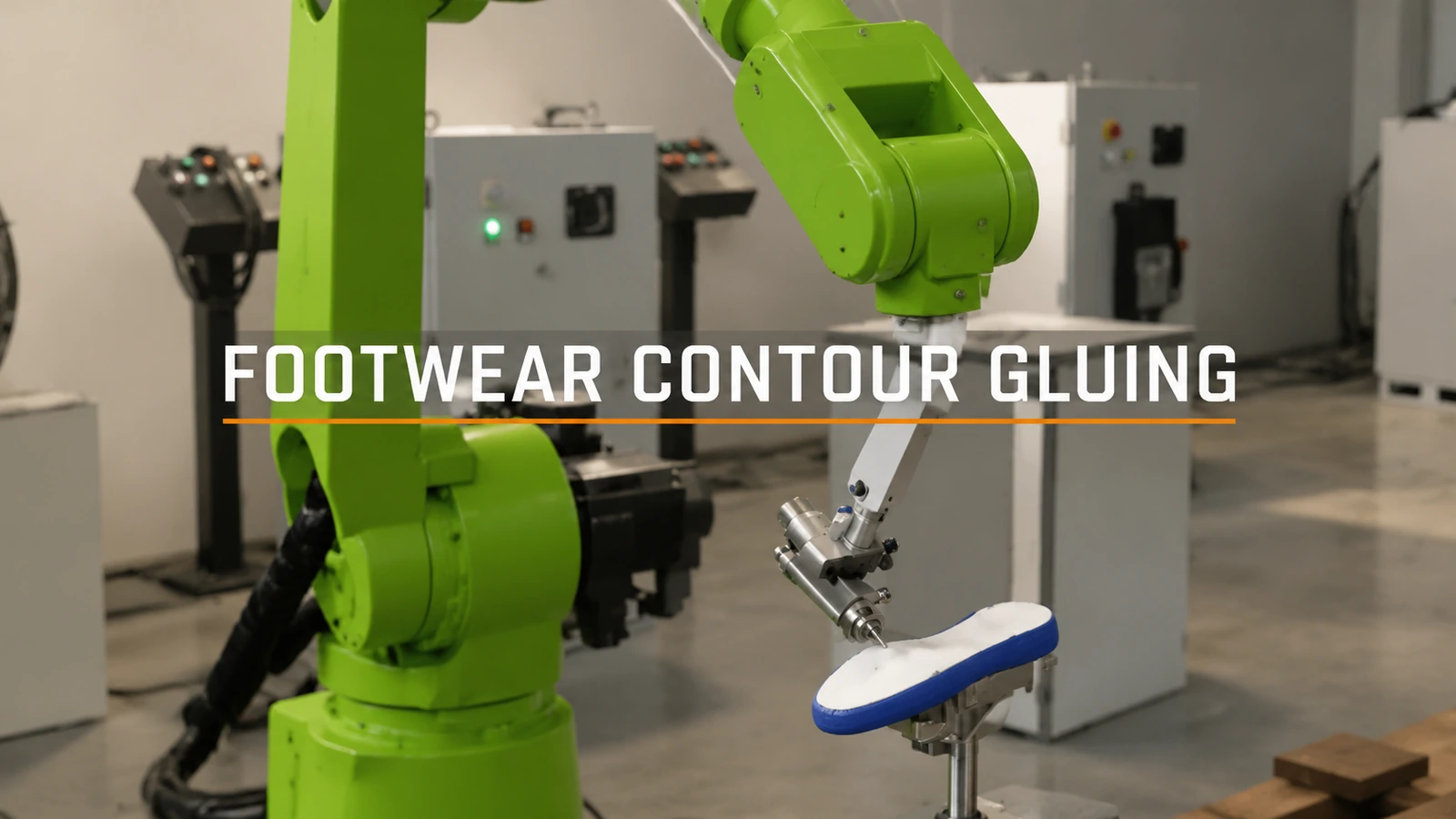
The filmed robot carries an applicator through a long white extension and moves it around the underside contour of a fixed shoe-shaped workpiece. The workpiece is supported from below. This arrangement makes the relationship between presentation and tool movement visible.
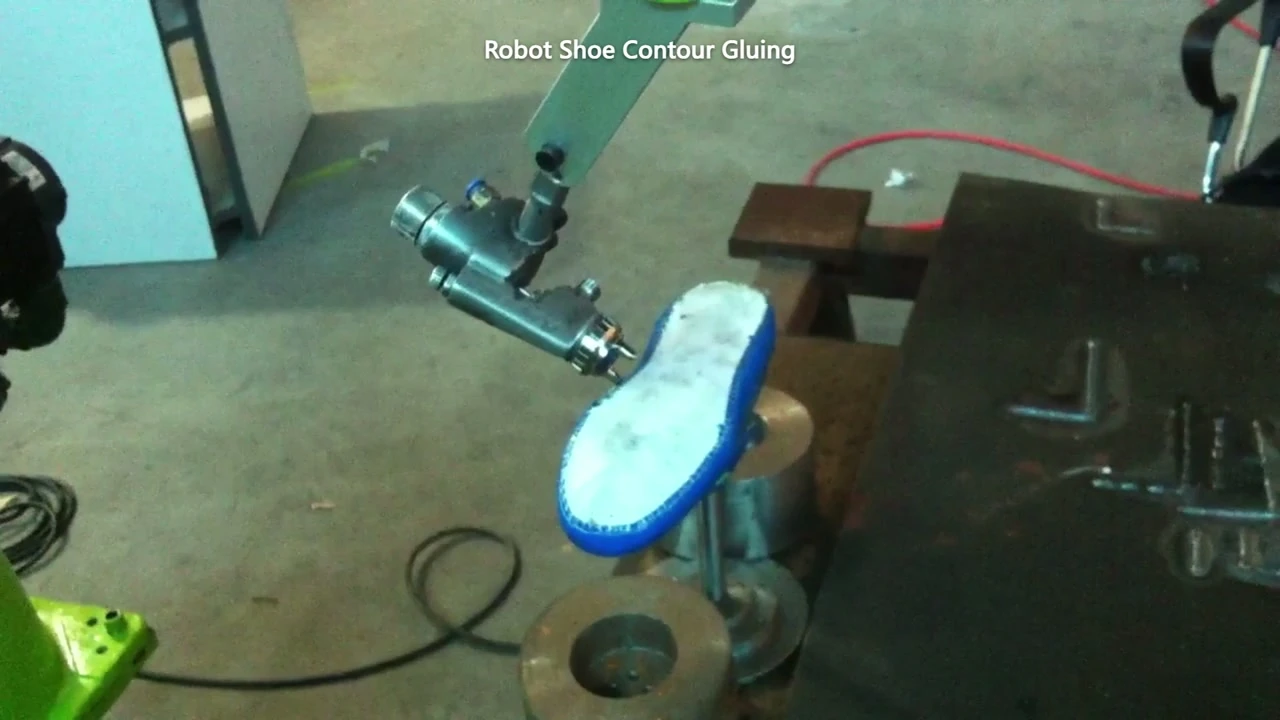
Applicator beside the underside edge of the fixed shoe-shaped workpiece.
For a new application, first decide what the loading task must establish: the intended locating contact, correct style and orientation, and readiness for the application path. If an operator performs that task, include it openly in the proposed staffing and sequence. Retaining manual loading can be a deliberate scope choice rather than an unfinished automation project.
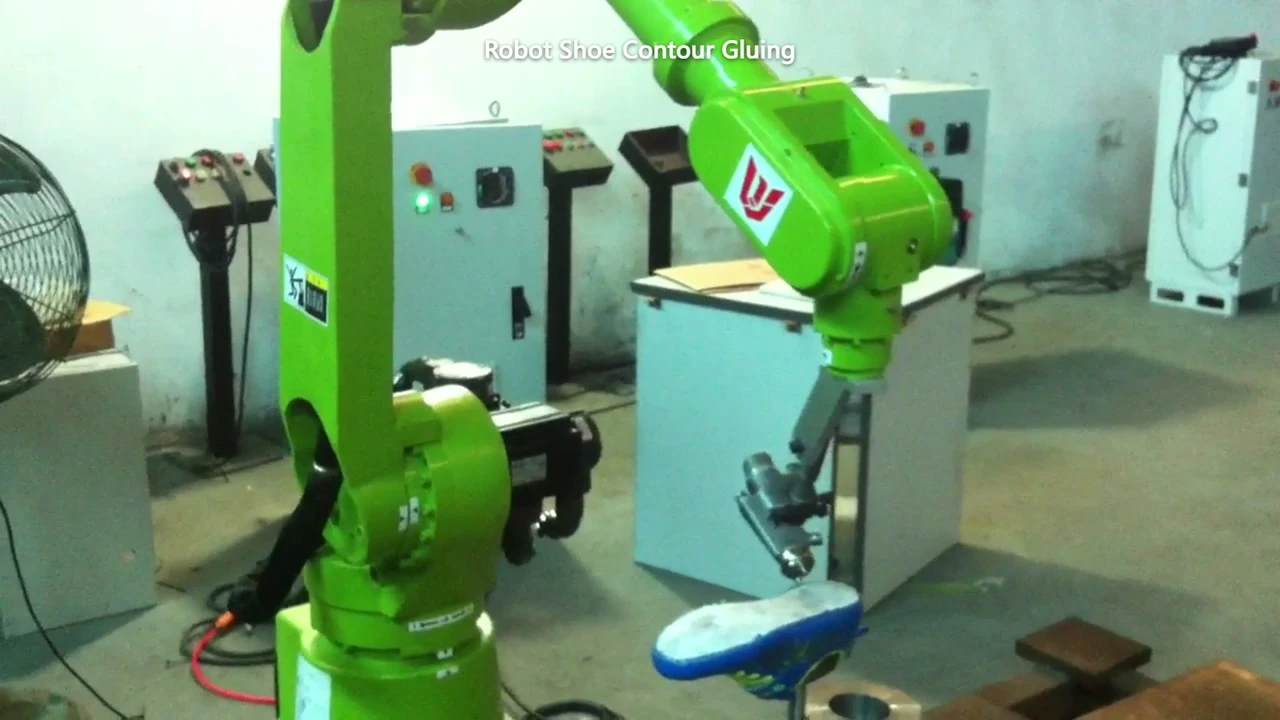
Green robot and white extension carrying the applicator beside the supported workpiece.
The trial should also determine whether the workpiece stays in the intended position as the applicator follows the contour. A taught path and an inconsistent locating method do not become a repeatable process simply because the same program is selected.
Compare the preparation burden with the repeat work
| წარმოების სიტუაცია | A useful scope to investigate |
|---|---|
| Repeated styles with stable locating and a reusable accepted path | Robotic application with a defined loading and changeover method |
| Frequent variations that need substantial path or fixture preparation | A limited representative-style trial before expanding scope |
| Short, irregular work where preparation dominates the repeat task | Retaining manual application while documenting the difficult cases |
These are conditional starting points, not quantity thresholds or an ROI calculation. The relevant comparison includes path preparation, fixture changes, trial parts and loading work as well as application time.
Choose representative styles because they expose meaningful differences, rather than selecting only the easiest contour. Record what can be reused and what must be changed. That result gives a production team a clearer automation boundary than an annual volume figure by itself.
If you are considering this division of work, share typical styles, the current locating method and the changeover tasks with EVST. The first discussion can focus on which work is repeatable enough to trial and which should remain manual in the initial scope.