
Choose the presentation route from the surfaces that must receive coating, rather than from the number of robot arms. Keeping a part stationary can work when the complete spray tool can approach those surfaces. Controlled workpiece rotation is worth comparing when it exposes otherwise awkward areas without losing a repeatable hold. Neither route removes the need to examine the hanger contact region.
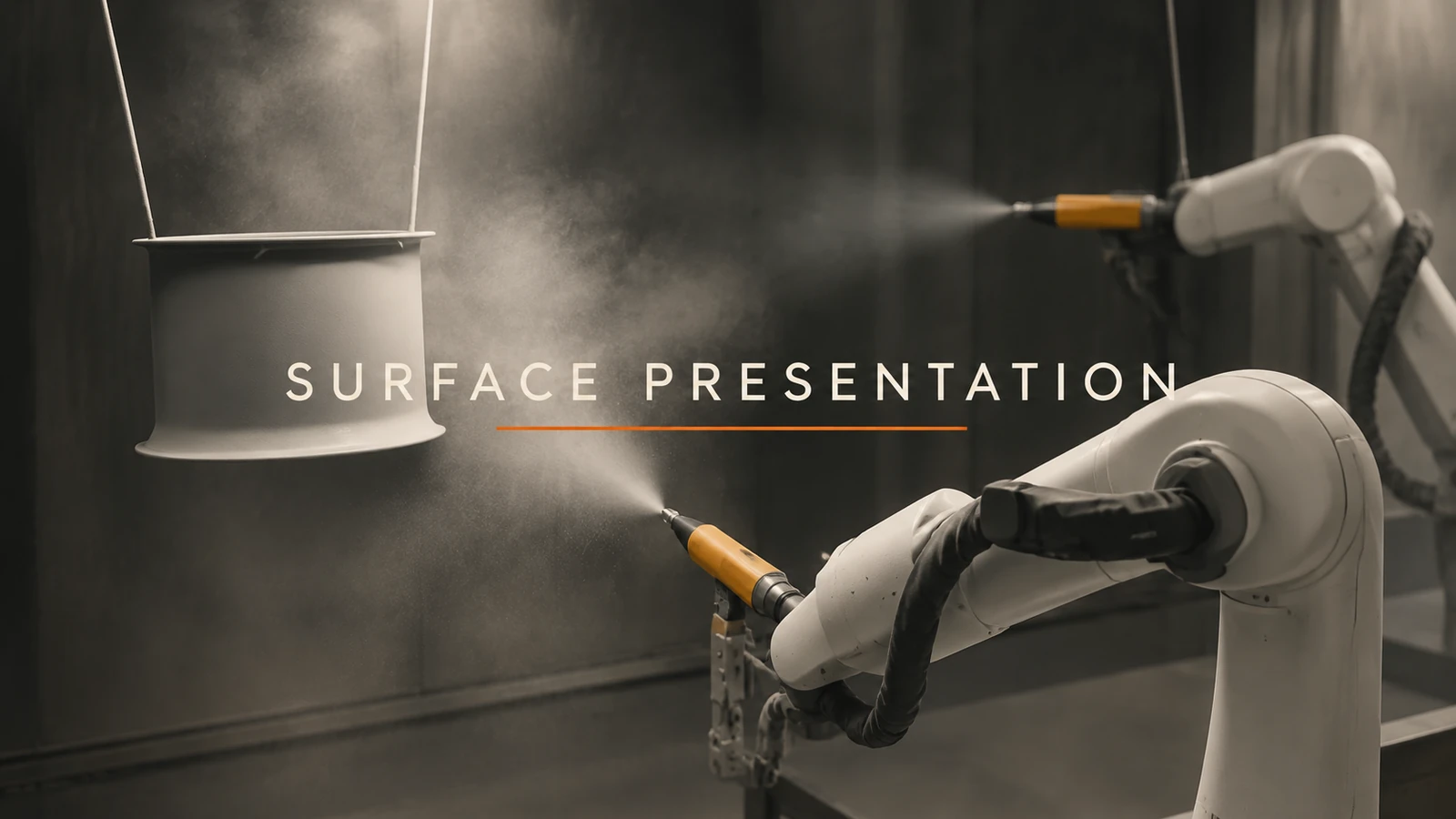
Mark the coating boundary before choosing the movement
On a part drawing or a sample, distinguish surfaces that need coating, surfaces that must remain clear and regions hidden by the hanger. This simple map changes the mechanical question. If the contact patch is outside the required finish, the fixture may remain there throughout the operation. If that same patch must be coated, merely turning the part will not expose the surface still pressed against its support; the holding arrangement or the processing sequence needs a separate decision.
The process example shows two robot arms around suspended cylindrical workpieces. One spray tool follows a workpiece exterior while an arm retracts and sweeps back and spray remains visible. It provides a useful starting point for discussing access around a hanging shape.
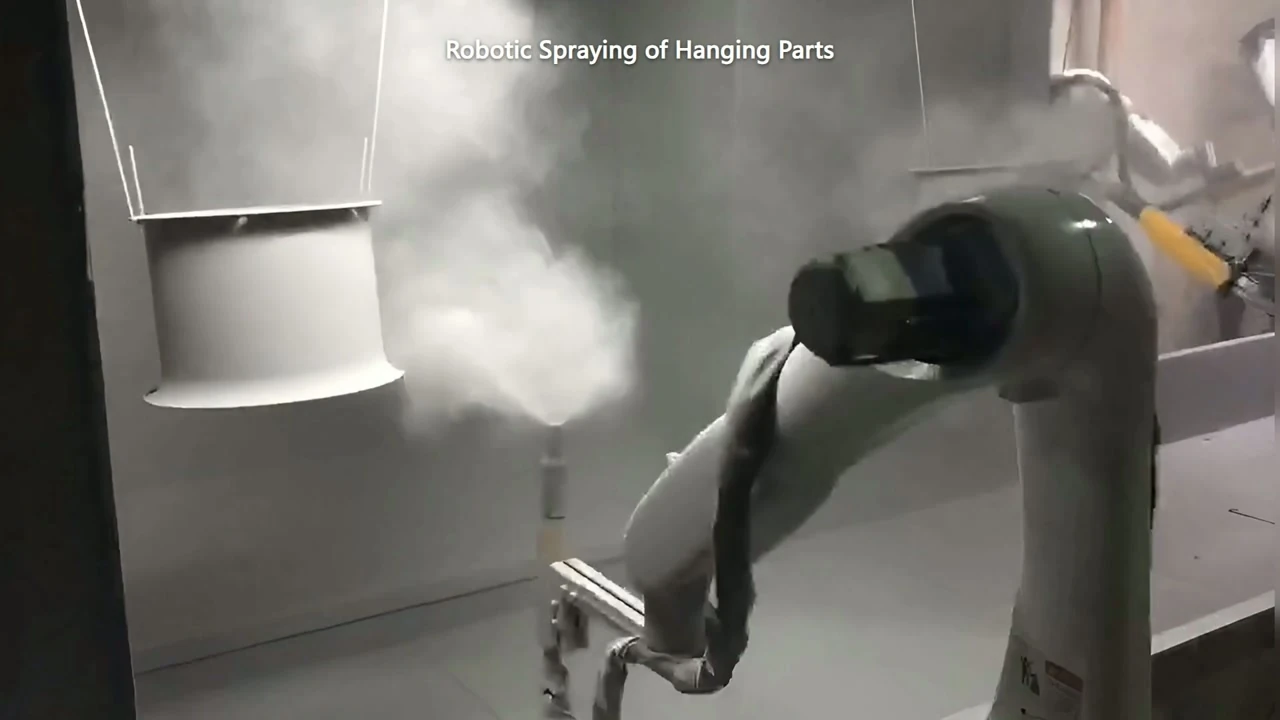
Robot spray tooling beside suspended cylindrical workpieces.
Compare what each route asks of the fixture
| Presentation route | Conditions to test | What can change the choice |
|---|---|---|
| Keep the workpiece still and move the gun | Approach each required region with the complete gun and hose arrangement | A reachable robot point may still leave the gun body blocked by a hanger or neighboring part |
| Index or rotate the workpiece under control | Retain a repeatable hold as the required regions turn into view | A holding arrangement that allows the part to shift needs attention before a repeatable spray path can be assessed |
A dedicated positioning axis is one available architecture for presenting workpieces to a paint robot. Its existence does not make every suspended fixture a controlled rotary fixture. If rotation is proposed, include the workpiece, attachment and intended motion in the trial. Define where it starts and finishes, and check the presented position again after loading a fresh part.
Keeping the part still avoids adding that positioning task, but the tool must then cover the required approach directions. Test the gun body and service lines through the whole route, including movement between surfaces. Do not compare only the path of the nozzle tip.
Let difficult regions decide the next trial
Use the same required coating map to compare both proposals. Inspect the hanger-adjacent area, the rear-facing region and transitions between the regions treated by different passes. Record the fixture setting and the surface location with the sample so that a visible difference can be traced to the presentation being tested.
If the difficult region becomes accessible only by changing the hold, resolve that workholding step before refining a spray program. If the hold is acceptable and the tool can approach every required region, test the simpler stationary arrangement before adding an axis. The final choice still uses the actual coating process and its agreed acceptance requirements.
Discuss hanging-part presentation with EVST. A marked surface drawing, hanger photos and the permitted part movement are useful starting inputs for comparing the routes.