
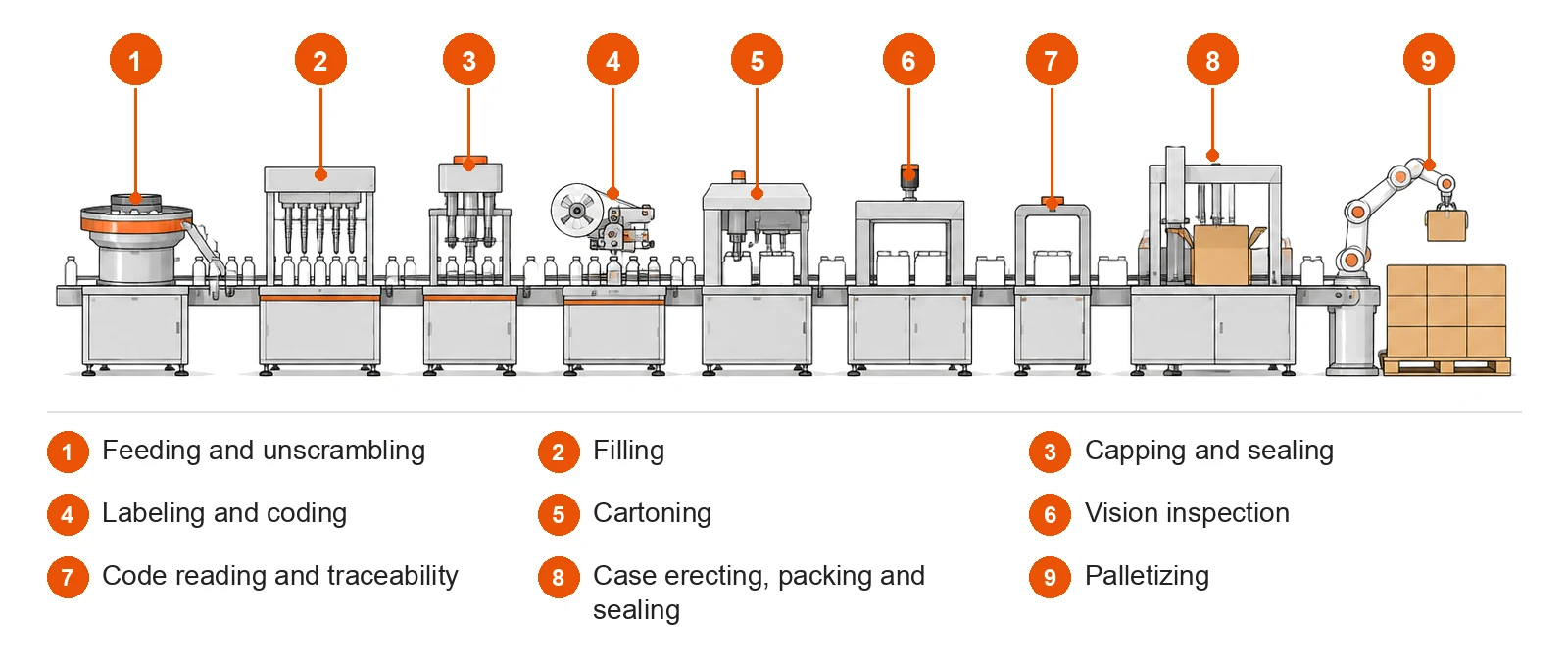
An automated packaging line links the machines that take a product from bulk to a sealed shipping case: feeding, filling, capping, labeling and coding, cartoning, vision inspection, code reading and case packing, with palletizing at the end. EVST builds these lines for medical devices, cosmetics, food, household chemicals and agrochemicals. Lines are built from modular stations: start with the steps you need first, add the rest later, and configure each line to your products and target output.
What does an automated packaging line include?
Most lines are a selection from nine process steps. The table lists what each step does and the machine figures we build to; speeds depend on container or carton size. Not every line uses every step: a medical device line has no filling, and a liquid line may stop at case packing.
| # | Etape | Ce qui se produit | Machine figures |
|---|---|---|---|
| 1 | Feeding and unscrambling | Bottles come in from a hopper and unscrambler; caps are sorted and fed; sachets climb an incline conveyor | Configuré par projet |
| 2 | Dossage | Gear-pump or weighing fillers dose the liquid into each container | Gear pump: 50–1,000 ml, 5,000 pcs/h (50 ml bottles, 12 heads). Top weighing: 1–5 L, 2,800 pcs/h (5 L bottles, 12 heads) |
| 3 | Capuchonnage et scellement | Screw, press or pump caps go on; a tracking capper follows the moving bottle; an induction sealer closes foil liners | Screw caps: 2,500 / 5,000 / 7,200 pcs/h (4 / 8 / 12 heads). Press caps: 6,000 pcs/h (8 heads). Pump caps: 9,000 pcs/h (12 heads). Tracking capper for 1–5 L: 2,200 or 4,000 bottles/h (single or dual head) |
| 4 | Étiquetage et codage | Labels are applied to round bottles, flat faces or carton corners; inkjet coders print codes and dates | Round-bottle labeling: 12,000 pcs/h. Corner labeling: 7,200 pcs/h. Double-side labeling: 2,000 pcs/h |
| 5 | Cartonnage | Cartons are opened, loaded with product and leaflet, closed and coded | 40–120 cartons/min, depending on cartoner type and carton size |
| 6 | Contrôle visuel | Cameras check foil seals, printed characters, seal integrity, caps, labels and case contents; failed items are rejected | Inspection images and logs saved |
| 7 | Lecture et traçabilité des codes | Codes on sachets, bottles and cases are read and linked to the batch and the shipping case | Sachets: 25,000/h. Round bottles: 15,000/h. Full cases: 500 cases/h |
| 8 | Montage, emballage et scellage de la caisse | Cases are erected, filled by an all-in-one machine or a pick-and-place case packer, and sealed | All-in-one: 12 cases/min (case 160–205 × 160–250 × 150–280 mm) |
| 9 | Palettisation | A collaborative robot palletizer stacks the sealed cases | Configuré par projet |
Where a machine has its own page, it covers sizes, options and the questions buyers ask: the encartonneuse overview with the encartonneuse horizontale et encartonneuse verticale, le machine de capsulage automatique et la étiqueteuse automatique.
Details that decide how a step is built
- Glass bottles are usually fed tray by tray. In an unscrambler, glass bottles knock against each other and can chip, so lines for glass are normally loaded by pushing in one tray of bottles at a time.
- Coding is checked, not just printed. On coding and gluing lines, an OCR check reads back the printed production date, batch number and expiry date after the coder.
- Case orientation can be done without vision. On one line for two-spout spray bottles, the spray heads had to face up in the case. The case is sleeved over the bottles and then turned, a purely mechanical layout with no camera.
How fast is an automated packaging line?
The speed of a line is set by its slowest station and by how many checks it carries. That is why we give single-machine figures (above) and configure the line to your target output, rather than quoting one number for a “line”.
Inspection density matters as much as machine speed. On the Class III medical device lines described on this site, every step carries a camera check and every failed unit is rejected, so these lines run at modest speeds by design. So count the checks your product needs when you set the target output.
Packaging lines by industry
Dispositifs médicaux
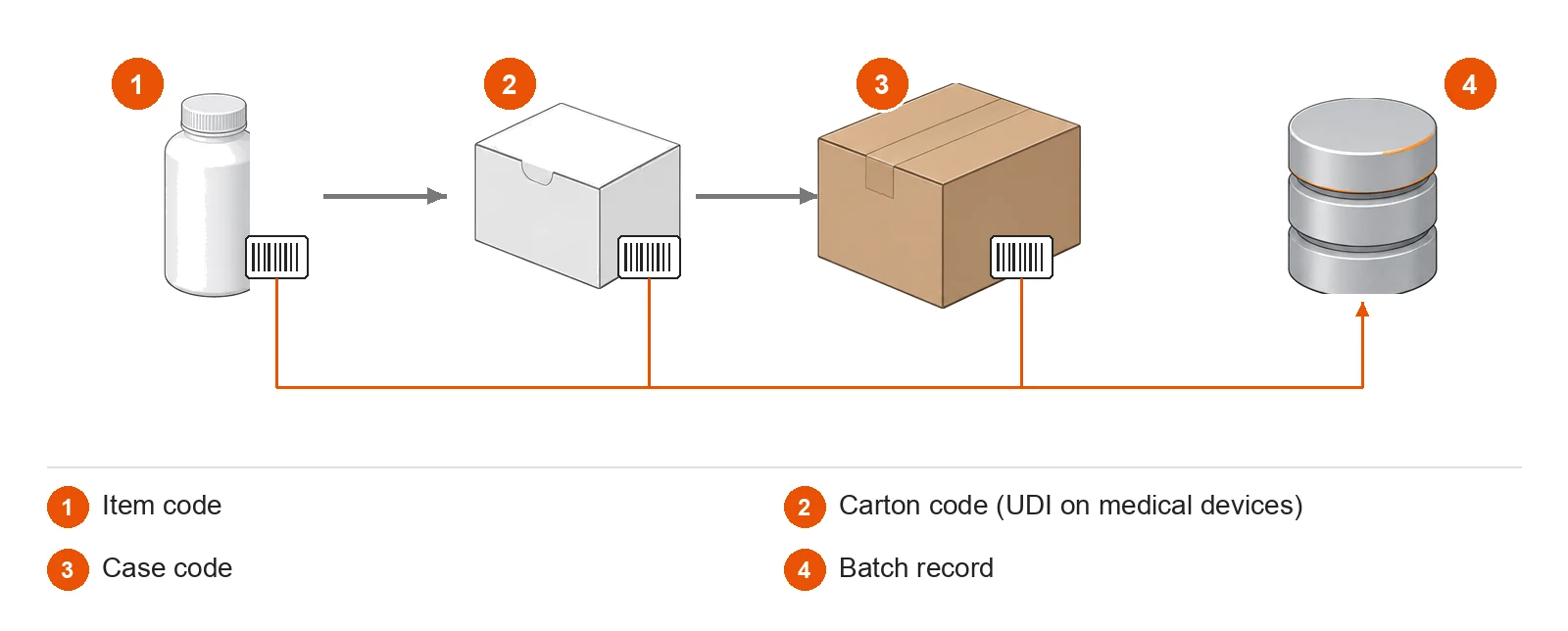
Our medical device cartoning lines count and present the parts, open the carton, load the product and leaflet with a servo cartoner, then laser-code and print-and-apply labels. A UDI (Unique Device Identification) system links the outer carton, the inner pouch and the traceability card, and the configured inspection points have a vision check with automatic rejection. Cartoning lines of this kind have been built for CGM sensor kits, Class III devices such as contact lenses and dental implants, and regenerative repair membranes. Dental instrument kits run on a different line: loose instruments are sorted, placed into trays by robots and packed into shipping cases. See the ligne d'emballage de dispositifs médicaux.
Liquids: household chemicals, agrochemicals and cosmetics
Three standard liquid lines are split by container size: 5–30 L drums and cans, 1–5 L bottles and cans, and 100–1,000 ml bottles. Each combines filling, tracking capping and labeling, with inspection, code reading, cartoning or case packing added as the product requires. For flammable liquids, the whole line can be configured for explosion-proof operation. See the ligne de remplissage de liquide.
Cosmétiques et soins personnels
Cosmetic lines cover the run from filling to cartoning. Vertical cartoners load bottles, tubes and lipsticks with a leaflet, print a batch number and close the carton. For gift-style packs, liner cartoning places an inner liner box into the outer carton, then glues and closes it.
Aliments et confiseries
For snacks and baked goods that arrive in no fixed order, a vision system locates each piece and several pick-and-place units in series pick them, with the next unit catching what the previous one missed. Weighing or counting, cartoning, sealing and inspection follow. Food-contact materials are confirmed for each product and project.
Sachets and small packs
Sachet lines for herbal granules, supplements and similar small packs read and reject each sachet by its code, count the sachets in a magazine, load them with a horizontal cartoner, apply a corner label, and pack and seal the cases.
Traceability and line data
Traceability on these lines works at three levels: the item, the carton and the shipping case. Our code platform links order, batch, raw-material, packaging-material, quality-check, traceability and logistics codes, so one scan answers where a unit came from and where it went. On medical device lines, a UDI coding system takes work orders from the customer’s ERP, sends them to the printers on the line, and ties the outer carton, inner pouch and traceability card together.
Vision systems save the images, defect records, operator actions and communication logs. Every reject is logged with its reason, so when a defect is reported later the data shows whether the line caught it and what happened next. Data retention is agreed for each project.
How a packaging line project runs
- Des échantillons d'abord. The line is designed and tested on your real products, cartons, labels and leaflets. Without samples, feeding, cartoning and inspection cannot be proven.
- List every SKU. Factory testing time grows with the number of product and carton variants to be run. A complete SKU list keeps the test plan and schedule honest.
- Configure to target output. Machine counts, heads and speeds are chosen from your target output and the slowest step, then confirmed in testing.
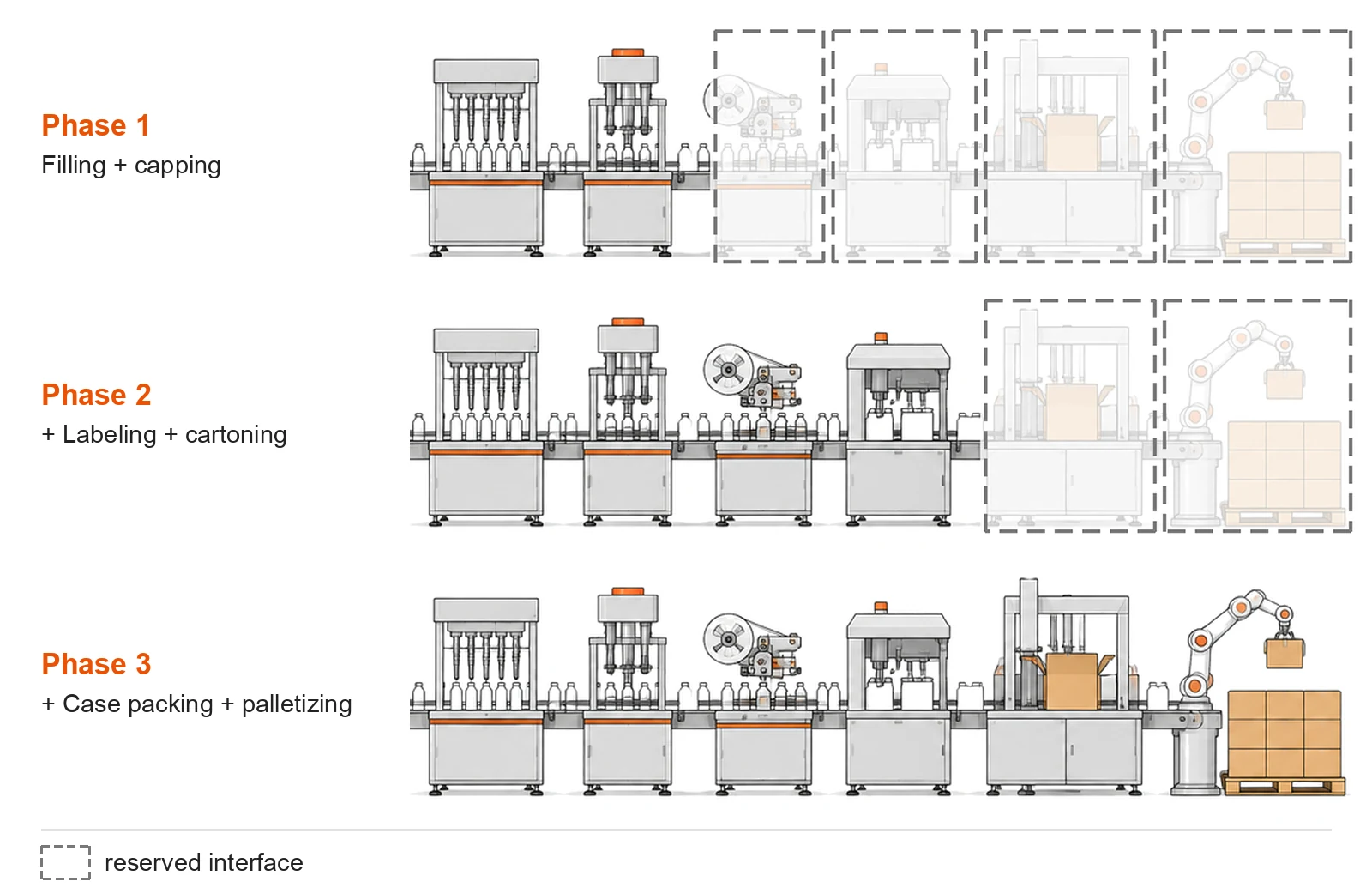
- Automate in phases if needed. Filling and capping are usually the must-have first stage; labeling, cartoning and case packing can be added when budget allows. Room and interfaces for later steps can be reserved in the first layout. On one medical device line, a docking point for an AGV was built in from the start, while operators still load by hand today.
- One team for the whole design. A line like this needs mechanical, electrical, vision and software engineering working on the same design.
For what to check when the line is accepted, see automatic case packing equipment acceptance.
Questions courantes
What is an automated packaging line?
An automated packaging line is a set of linked machines that fill, close, label, carton, inspect, code and case-pack a product with little manual handling. EVST builds lines from up to nine steps, from feeding and filling to case packing and palletizing, and configures each line to the product and target output.
Can I automate my packaging line in stages?
Yes. Most projects start with the must-have steps, usually filling and capping on liquid lines, and add labeling, cartoning or case packing later. The stations are modular, machines such as the labeler can run alone or linked into the line, and the first layout can reserve room and interfaces for the next stage.
How many units per hour will the line produce?
It depends on the container or carton size and on the slowest station. Single machines we build run, for example, up to 12,000 round bottles per hour on labeling and 40–120 cartons per minute on cartoning. The line is configured to your target output, and lines with a camera check at every step, such as the Class III medical device lines described here, run slower by design.
What do you need from us to quote a packaging line?
Product samples, cartons, labels and leaflets; a list of every SKU with its sizes; the target output; and the steps you want automated now and later. Samples let us prove feeding, cartoning and inspection on your actual products, and the SKU list sets the factory test plan.
How does traceability work on the line?
Codes are read on each item, carton and case and linked to the batch and the shipping case. For medical devices, a UDI system receives work orders from your ERP, prints the codes on the line and links the outer carton, inner pouch and traceability card. Reject records and inspection images are saved so they can be pulled up later.
Articles connexes
- Machines d'encaissement : encartonneuses horizontales et verticales
- ligne de conditionnement de dispositifs médicaux
- Ligne de remplissage de liquides
- Piece picking or group transfer for case packing
- Light palletizing: connecting cobots to packing lines
- Palettisation
- Robot cells for packaging and handling
Machine figures on this page depend on container or carton size. The configuration and output of each line are confirmed for each project.