
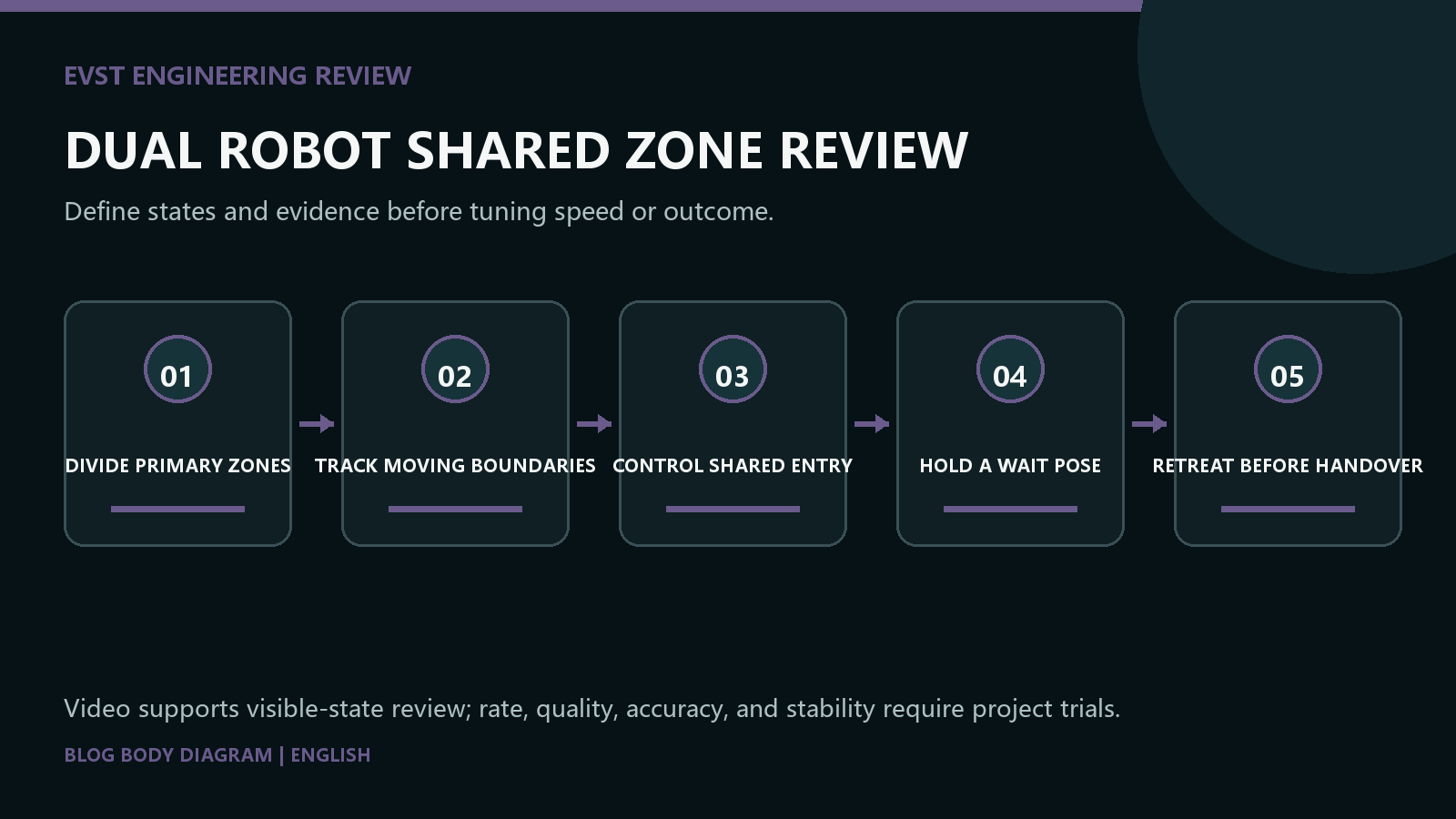
Direct answer: Dual-robot welding should define the shared zone before cycle time is optimized. EVST gives each arm a primary region, treats the other wrist and cable pack as moving boundaries, controls which robot enters the overlap, holds the other in a predictable waiting pose, and releases the next entry only after retreat. Interlocks and weld results still require validation.
Who this is for: Welding engineers and automation managers planning two robots around one long member with overlapping tool, wrist and cable envelopes.
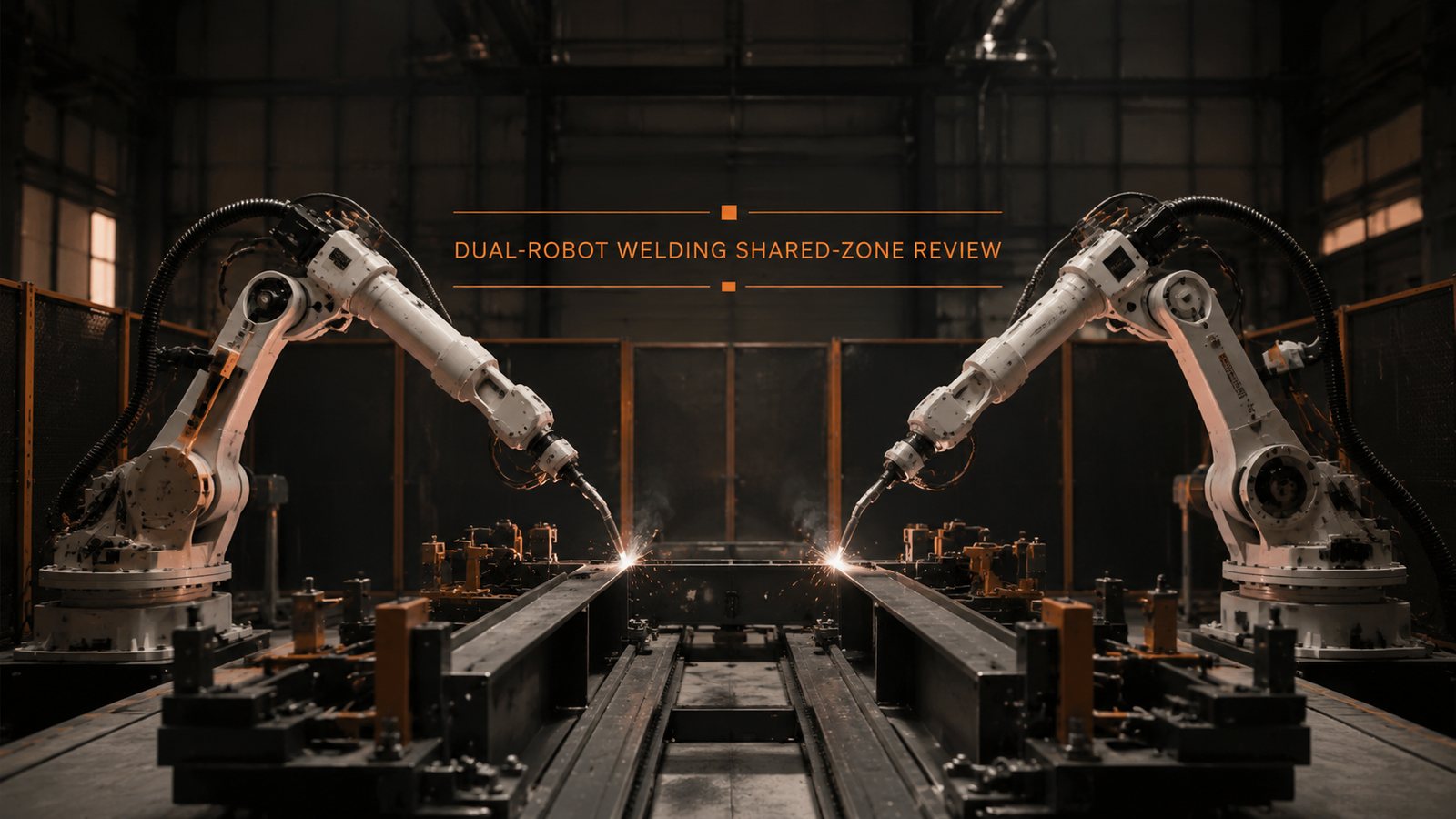
Scope: This guide uses footage of two robots working from opposite sides of one long member and approaching a shared central region. It covers zone ownership, entry order, waiting and retreat; it does not prove interlocks, cycle time, heat input, distortion or weld acceptance.
Why dual-robot welding treats the overlap as a controlled resource
Two robots can each pass an isolated path check and still conflict when they work beside the same member. The reviewed footage shows arms on opposite sides, separate approaches and moments when both systems operate near the central portion of the fixture. That supports a shared-space planning discussion. It does not disclose the controller logic or prove that an interlock is present.
The useful abstraction is not simply two reach envelopes. Space changes ownership over time. Each robot receives a primary region in which the other arm is expected to remain clear, while any overlap becomes a controlled resource with an entry condition and a release condition. In practice, EVST writes those conditions before trying to compress the cycle.
According to ISO 12100:2010, limits, hazards and foreseeable operating situations are identified as part of risk reduction. A dual-robot cell therefore considers automatic production, startup, interruption and recovery rather than evaluating only the nominal simultaneous sequence.
Dual-robot welding is not two independent programs running beside each other. The robots share a fixture, a workpiece and time-dependent space, so each torch, wrist and cable pack becomes a moving boundary for the other arm. A robust plan gives both robots primary zones, identifies the smaller overlap, assigns entry ownership, and defines a waiting pose that remains clear during normal motion and recovery. The active robot releases the shared zone only after it reaches a verified retreat state. Footage can show coordinated motion, but it cannot prove interlock coverage, cycle-time gain, heat distribution, distortion or weld quality. Those outcomes require the complete seam split, safety logic, process sequence, restart tests and inspection evidence on representative workpieces.
Model the other robot as a moving boundary
A static collision model of the fixture is incomplete because the second wrist, torch and cable pack change position throughout the cycle. The first review combines both complete tool envelopes on one time line and identifies where clearance depends on sequence rather than fixed geometry.
An automatic welding system solutions review should include the member, fixture, both robot bases, tools and services. The central seam region may be small, yet an elbow or cable loop can enter the other robot’s approach long before either torch reaches that region.
According to ISO 10218-2:2025, the industrial robot application is evaluated as an integrated system. This supports checking interacting equipment and the cell boundary together; it does not certify the actual dual-robot program shown in the footage.
Write entry ownership as observable states
A practical shared-zone definition names an outside state, an entry request, permission to enter, the active work state, verified retreat and release. The waiting robot does not infer availability from elapsed time alone. It remains in a declared pose until the release condition is true.
The large workpiece pose and reach test remains necessary for both arms, but it is performed within those ownership states. A pose that is clear when the other robot is parked can be unsafe or impossible during a different handoff state. The check must include all allowed combinations, not an animation of the preferred cycle only.
According to ISO 10218-1:2025, robot behaviour and safety-related characteristics are defined for the machine, while the integrated application assigns the surrounding control measures. The project must document which signals and monitored conditions enforce the zone sequence; they cannot be read from video.
Design the waiting pose for production and recovery
A waiting pose is useful only if it is outside the active envelope, keeps cables controlled and leaves a recoverable route. Parking an arm at the nearest convenient point may block the other robot’s withdrawal or make a restart depend on an unverified manual motion.
Positioner guidance for long parts illustrates the broader rule that workpiece state and robot posture must be evaluated together. This footage shows a shared fixture rather than proving any positioner motion. The project-specific review therefore uses the actual fixture state and never imports an axis assumption from a different cell.
| Observed interaction | Control decision | Evidence required |
|---|---|---|
| Primary zones remain disjoint | Allow independent work | Combined dynamic-envelope check |
| Either arm may enter one overlap | Grant exclusive ownership | Request, grant, retreat and release states |
| One robot waits near the boundary | Define a protected waiting pose | Clearance in normal and recovery motion |
| Sequence resumes after a stop | Revalidate position and ownership | Interrupted-cycle and restart tests |
Test interrupted cycles before optimizing takt
Nominal coordination can hide the difficult cases. If one robot stops inside or near the overlap, the other must not continue from an assumption that time has expired. Recovery needs a known position state, a confirmed owner and a route that does not pass through the partner’s unresolved envelope.
The performance model is built after those cases are stable. It separates welding time, travel in primary zones, shared-zone waiting, handover and recovery exposure. A faster nominal path can reduce resilience if it removes the clear retreat or forces both arms to wait in constrained postures.
According to ISO 10218-2:2025, validation covers the installed application and its safeguarding functions. The actual validation plan needs the implemented control architecture, signal list and fault responses; smooth coordinated motion in a recorded cycle is not equivalent evidence.
Keep weld acceptance outside the coordination claim
The footage confirms two robots, opposite-side access, a common long member and coordinated movement near a shared region. It cannot prove mutual exclusion, safety-function performance, achieved cycle improvement, heat-input balance, dimensional result, weld procedure compliance or final joint quality.
According to ISO 3834-1:2021, welding quality requirements are selected and managed beyond robot motion. The review closes with the seam split, fixture states, dynamic-envelope model, ownership logic, restart tests, applicable procedures and inspection records. A cycle-time claim is considered only after those inputs are measured on representative workpieces.
Frequently asked questions
Why can two individually clear paths still interfere?
Because the other robot, torch and cable pack become moving obstacles during coordinated operation.
Should both robots enter the shared zone together?
Only where a verified coordination design explicitly permits it; otherwise ownership is mutually exclusive.
What makes a waiting pose predictable?
It is outside the active envelope, monitored by the control logic and usable during normal and recovery states.
Does a smooth dual-robot video prove higher output?
No. Throughput needs the real seam split, process times, handovers, recovery and inspection data.
Project inputs for an application review
A dual-robot welding review starts with the complete seam map and every moving envelope around the shared fixture.
- Member envelope, datum and fixture states
- Seam ownership by robot and process order
- Primary work zones and shared-zone geometry
- Waiting, handover, retreat and recovery conditions
- Interlock evidence, procedure and inspection criteria
Send those project inputs to EVST for an evidence-led review of zone ownership, interference and coordinated recovery. Related reading: positioner guidance for long parts.