
A contact lens packaging machine for secondary packaging takes lenses that are already sealed in their blisters and turns them into finished, coded cartons. It checks that each blister is present, scans every blister, loads the carton, prints the carton label linked to the scanned data and checks the Unique Device Identification (UDI) code on the outer carton before the carton leaves the line. EVST builds these lines for clear and colored contact lenses, and packs the shipping cases for lens care solution. Each line is configured for your lens range, your cartons and the data your quality system requires.
Discuss your contact lens packaging line
Where does a contact lens packaging line start and end?
Contact lens packaging happens in two stages. The first stage forms the blister, doses the saline, places the lens and seals the foil lid; that is part of lens manufacturing and is not part of the lines described here. The line on this page starts when sealed blisters arrive and ends when coded cartons, bagged packs or sealed shipping cases leave. If you are looking for a contact lens blister packaging machine, this is the part of the process after the blister is sealed.
What does a contact lens packaging line do, step by step?
On the contact lens line we have built, the steps are:
- Blister feeding: sealed blisters are fed in and arranged for the carton.
- Presence check: the line confirms that each blister is there before it goes any further.
- Scanning every blister: the code on each blister is read, so the line knows which lens, and which power, it is holding.
- Kartonering: on this line, an intermittent horizontal cartoner loads the blisters into the carton.
- Carton turning: the carton is turned for labeling.
- Print-on-demand mærkning: the carton label is printed on the line, linked to the scanned data for that carton, and applied.
- Outer carton UDI check: a camera reads the UDI code on the outer carton, and a carton whose code fails the check is rejected; the reject rules are configured to your inspection requirements.
- Linjedata: the line’s information system holds the run data and every scan result.
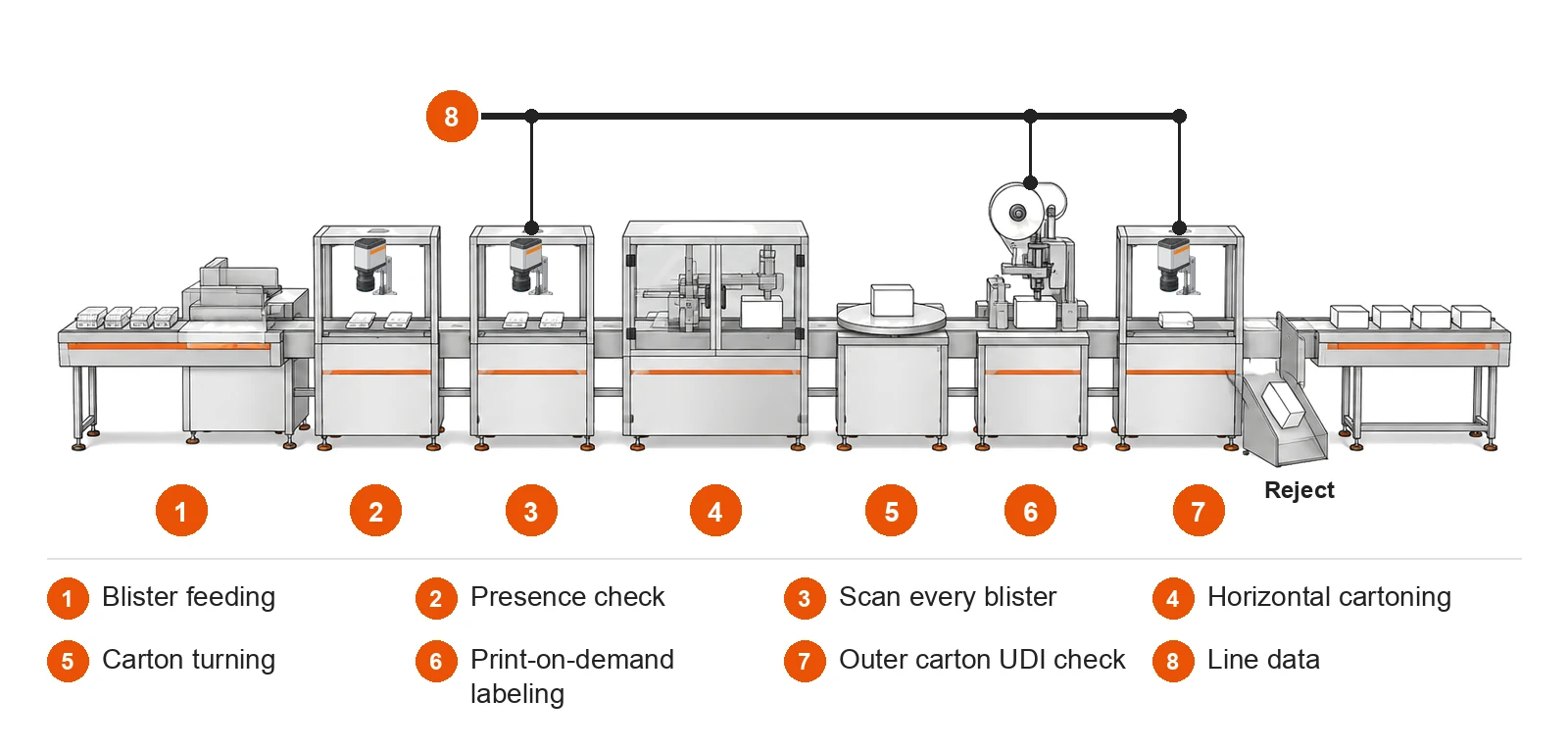
The cartoning station is an intermittent horizontal cartoner, the type suited to blisters that lie flat; carton sizes and ratings are on the horisontal kartoneringsmaskine page. The exact steps are configured for each lens range and project.
How does the line manage data when the lens power changes?
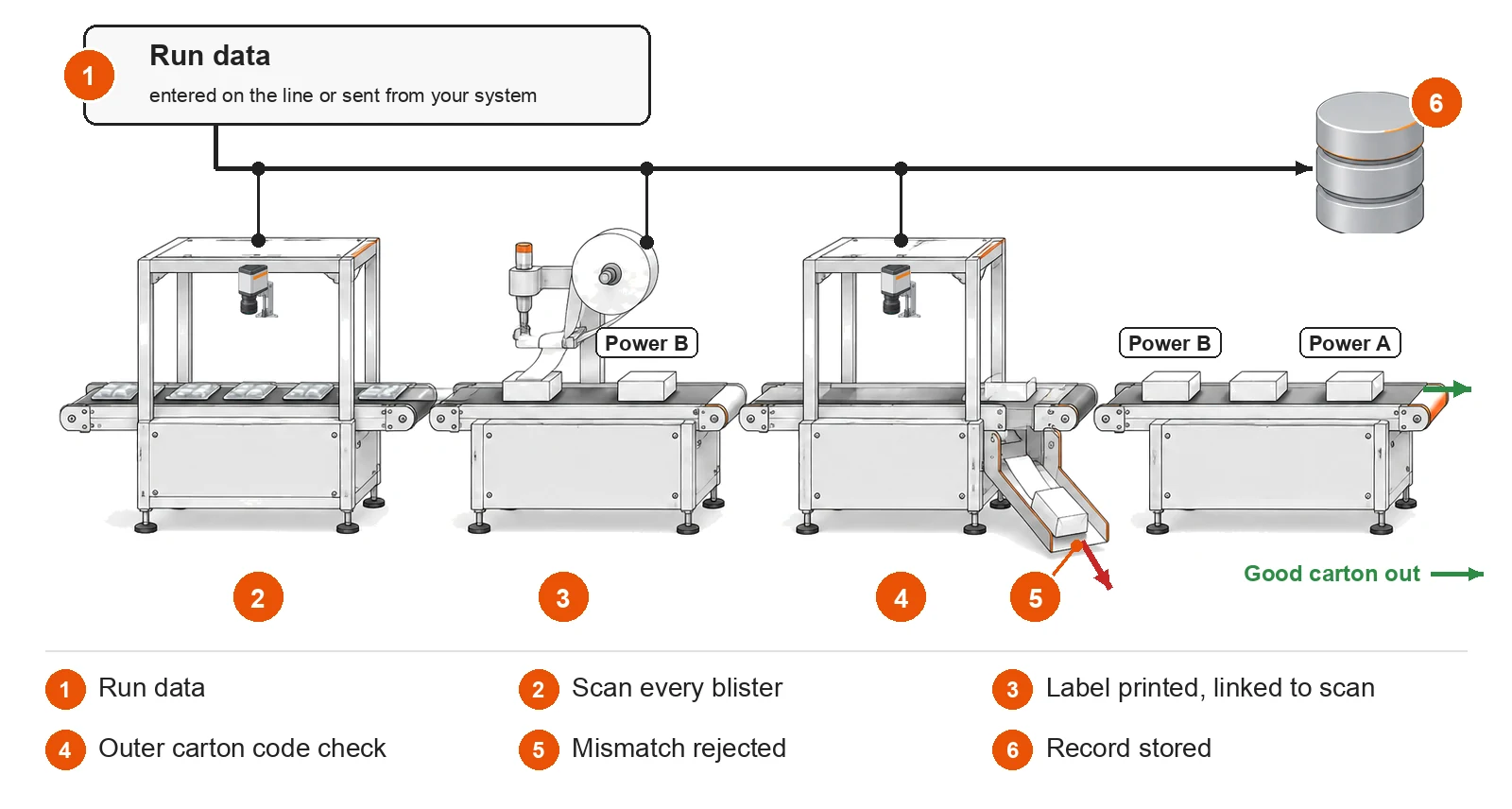
Lenses of different powers go into outer cartons that look the same, so nothing mechanical changes when the run moves from one power to the next. What keeps every carton correct is data, and the line is built around it. During a power change, the data does five jobs:
- Define the run: the run data, entered on the line or sent from your system where the line is connected to it, tells the line which products to pack.
- Know what is in each carton: every blister is scanned as it goes in, so the contents of each carton are known, not assumed.
- Print linked to the scan: the label and UDI data are printed on the line, linked to the scanned contents of that carton.
- Check before the carton leaves: the outer carton code is read, and a carton that does not match is rejected.
- Keep the record: scans, inspection results and rejects are stored; what is recorded, and for how long, is agreed in the project.
Because each carton in process carries its own scanned data, the old power and the new power can be on the line at the same time, and the run passes from one to the next without stopping. Without this information management, a power change would mean emptying the line first.
Colored contact lenses: bagging with a color check
Colored contact lenses add a check that clear lenses do not need: the lens color. For colored lens lines, EVST builds a bagging machine with an inline color check, so the color is confirmed as the packs are bagged. A standard bagging machine only bags the pack, which is why a dedicated machine is used where the color has to be confirmed. The color check is set up for the colors in your range, and how a failed pack is handled is agreed for each project.
Lens care solution: erecting, packing and sealing the shipping case
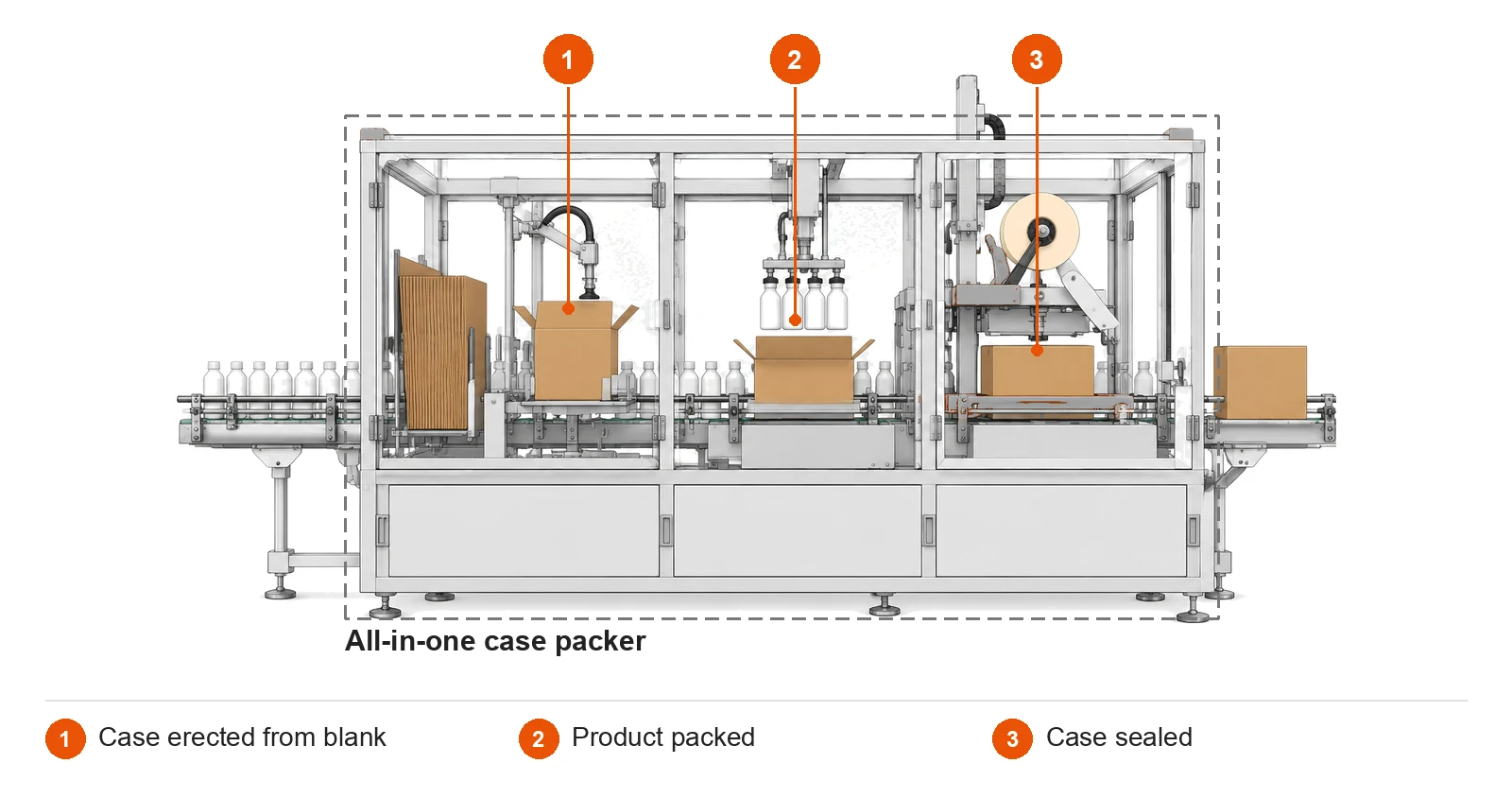
For multipurpose lens care solution, EVST supplies the case-packing stage. An all-in-one case packer erects the shipping case from a flat blank, packs the product and seals the case in one machine, instead of three separate machines for erecting, packing and sealing. It handles cases of about 160–205 mm long, 160–250 mm wide and 150–280 mm high and is rated at 12 cases per minute, depending on case size. Filling, capping and cartoning the solution bottles are not part of this line.
Why does a balcony-style frame help cleaning?
Contact lens lines run in clean production areas and are wiped down routinely, so the frame is built for cleaning. Some Class III device lines we have built, of the kind used for implants and contact lenses, have a balcony-style frame. In a balcony-style design, the main drives and mechanisms are kept behind or below a machine wall, which leaves a more open product zone in front of it. That zone is easier to wipe down, and format parts are easier to reach for adjustment. Whether your line uses this frame is confirmed in the project.
Plan site qualification from the start
On the contact lens lines we have built, the lenses are Class III medical devices, so the packaging line goes through installation, operational and performance qualification (IQ/OQ/PQ) at your site before you release it for production. Qualification is run on the line in its final position, with your quality team; the protocols and the approval stay with your quality system.
The line cannot go into production until qualification is done, so plan its time and budget from day one, not after shipment. When you compare quotes, check whether qualification support, on site or remote, is included and how it is scoped: it is a real part of the project’s cost and time. Scope, schedule and responsibilities are agreed for each project.
What to send for a contact lens packaging line quote
- Sealed blister samples and the carton, or their drawings
- Blisters per carton and every carton format you run
- Your lens range: the powers, and the colors for colored lenses
- The UDI and label content for each pack level, and whether the line should connect to your system for run data
- De inspektioner, dit kvalitetssystem kræver, og hvordan kasseringer skal håndteres
- Whether you need bagging with a color check, or case packing for care solution
- Target output per shift, and how often the power or product changes
- Renrumsklasse og gulvareal på stedet
EVST, based in Chengdu, China, builds contact lens packaging lines to the specification you send. Sample blisters and cartons help confirm the feeding, cartoning and inspection setup before the line is fixed.
Almindelige spørgsmål
What is a contact lens packaging machine?
It is a secondary packaging line that turns lenses already sealed in blisters into coded cartons, with every blister scanned and the UDI code on the outer carton checked. It starts after the blister is sealed, and can add bagging with a color check for colored lenses and case packing for care solution.
Does the line form and seal the blister?
No. Blister forming, saline dosing, lens placement and foil sealing are part of lens manufacturing, upstream of the lines described here. The packaging line starts with sealed blisters.
How fast does a contact lens packaging line run?
Line output is confirmed on request for your lens range. On the contact lens lines we have built, the checks at each step set the pace rather than the cartoner, so EVST sizes the line to your output per shift with every check included.
Can the line pack colored contact lenses?
Yes. For colored lenses, the line adds a bagging machine with an inline color check, so the color is confirmed as the packs are bagged. The color check is set up for the colors in your range.
Does the line pack lens care solution?
It packs the shipping cases. An all-in-one machine erects, packs and seals the case. Filling the solution bottles is not part of this line.
Who is responsible for IQ/OQ/PQ?
Your quality system owns the qualification protocols and the approval. EVST can support installation, operational and performance qualification, on site or remotely. Scope, schedule and responsibilities are agreed for each project.
Relaterede
- Emballeringslinje for medicinsk udstyr med UDI-kodning og synsinspektion
- Horisontal kartoneringsmaskine
- Kartoneringsmaskiner: horisontale og vertikale
- Automatiserede pakkelinjer: påfyldning, kartonering, inspektion og kartonpakning
- Automatisering til medicinsk og farmaceutisk produktion
Line configurations on this page are those built to date; the line for your lenses is configured and confirmed for each project.