
A workable robotic tailgate spray path has to keep the applicator in a controlled relationship with a three-dimensional part while the robot changes posture around faces, edges, and masked boundaries. The path cannot be designed as a single flat sweep. It must account for the applicator body and top-mounted paint cup, the covered robot, the tailgate fixture, nearby booth structures, and the transition from one surface region to the next.
Send the tailgate drawing, coating-process requirements, and daily output for a solution and cycle-time evaluation. Můžete také kontaktovat sales@evsrobot.com.
One part creates several path problems
In the recorded booth, a covered robot carries a spray tool with a visible black cup mounted above it. The workpiece is a masked vehicle rear area with a tailgate surface exposed for the operation. The tool moves around the part, changes orientation, and continues into another region rather than remaining parallel to one plane.
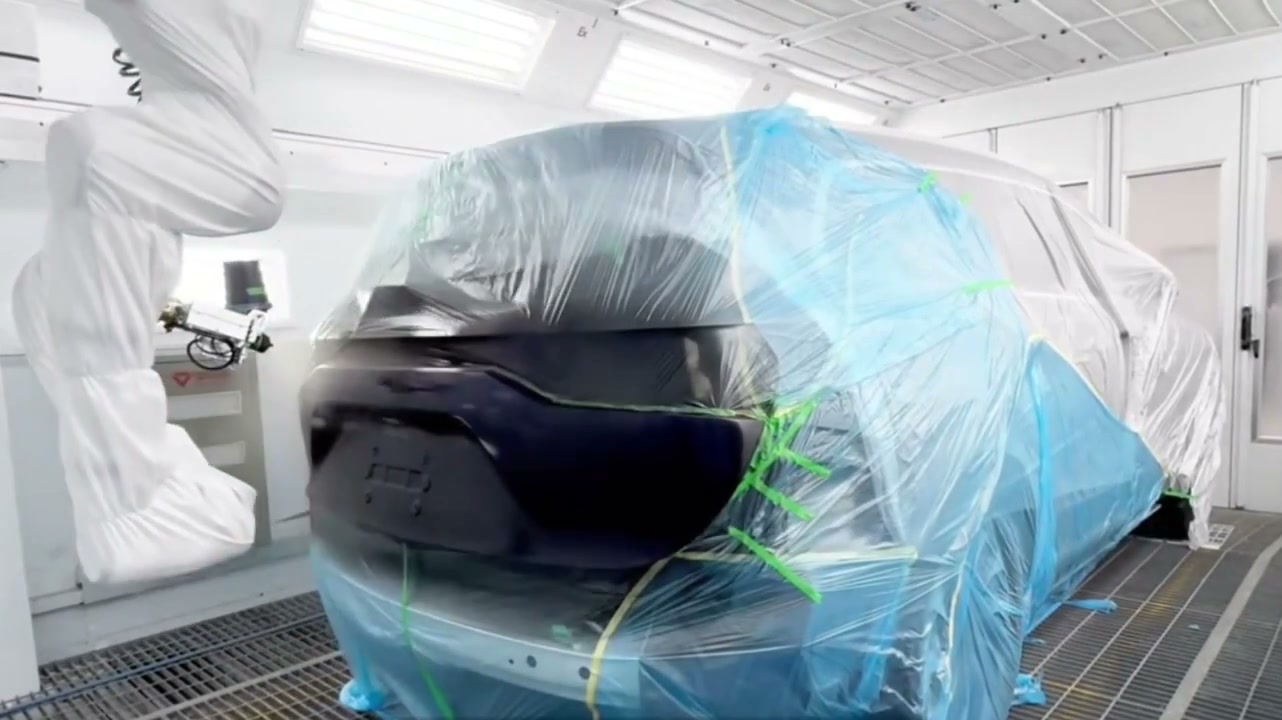
The applicator, cup, robot cover, masked workpiece, and booth form one shared clearance problem.
This geometry changes the planning question. A broad central area may permit a relatively direct sweep, while a return edge or recessed area can require a different wrist orientation and approach direction. The transition matters because the applicator still needs a workable stand-off, angle, and travel direction while the robot avoids the mask, fixture, part, and booth.
The path study should therefore divide the tailgate into meaningful surface regions. Each region needs an entry, working pass, exit, and transition to the next region. That structure makes it easier to see where the robot must reorient, where the hose or cover may tighten, and where a direct motion could bring the cup or tool body too close to the workpiece.
Follow the tool, not only the robot arm
Robot simulation can show arm reach and joint motion, but the complete process envelope includes the applicator, cup, connections, protective cover, and any moving hose. The black cup visible above the tool is a clear example: it increases the space needed above and behind the applicator. A wrist position that appears clear can still create interference when those process components are added.
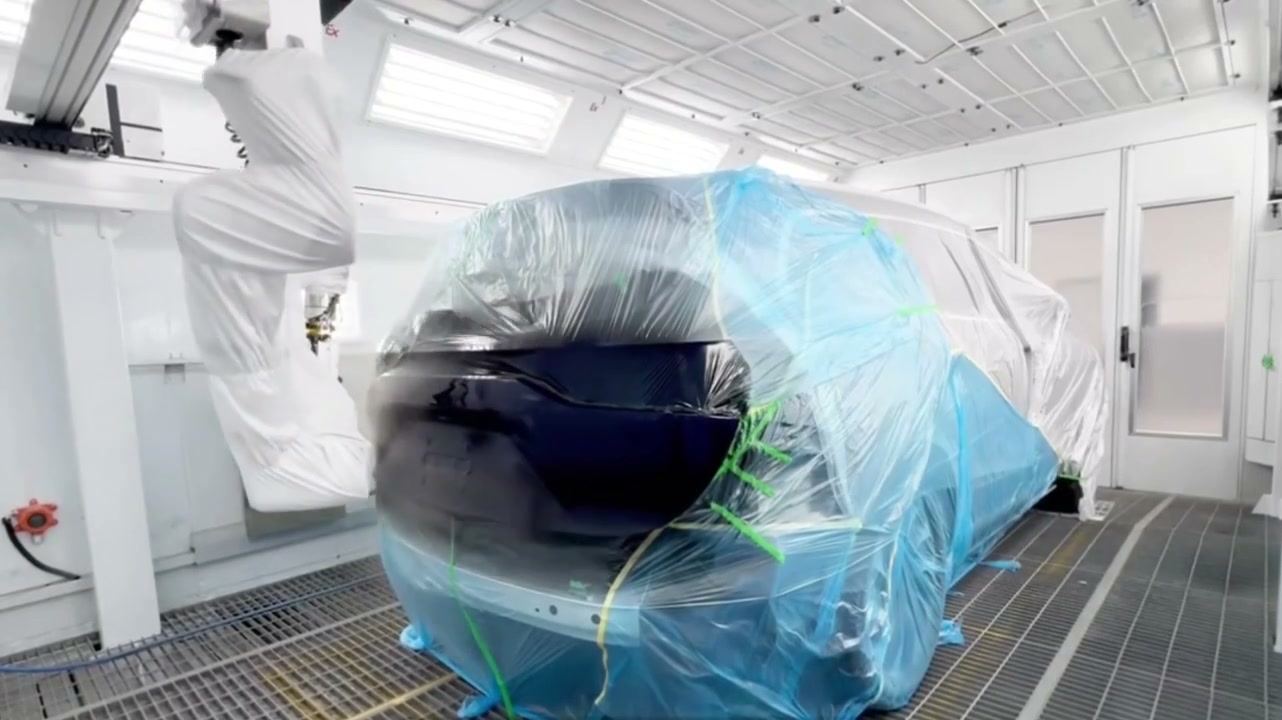
The covered arm is shown in another position relative to the masked workpiece and booth.
A useful path review places the full tool model in every critical pose. It then checks the nearest distance to the part, fixture, masks, booth wall, rails, and robot cover. Transitions deserve the same attention as the main working passes. The shortest connection between two passes may force a sharp wrist rotation or bring the cup across a restricted zone; a slightly longer transition can be easier to execute and maintain.
Hose and cover behavior should also be tested through repeated motion. Their shape can change with joint position, so a static clearance check at the beginning of a pass is not enough. The trial should observe whether routing remains supported, whether the cover bunches near a joint, and whether any process connection approaches the wet or masked area.
Masking is part of the path interface
Masking defines the boundary of the intended working area, but it also introduces physical edges and loose material that the tool must avoid. In the recorded scene, the masked rear area remains visible as the applicator changes position. That relationship should be used to plan how the path enters and leaves each exposed region.
The mask itself should be represented in trials as it will be installed in production. Differences in how it is folded, fixed, or tensioned can alter the available clearance. The engineering review should ask whether the applicator body, cup, hose, and robot cover stay clear through the complete sequence, including reorientation outside the active pass.
Masking also affects access for loading, removal, inspection, and cleaning. A path that clears the workpiece during automatic motion may still leave awkward access for preparing the next part or handling a stopped cycle. These activities should be included in the layout review rather than treated as tasks outside the cell design.
Convert coating requirements into trial variables
The robot program cannot be separated from the selected coating process. Applicator distance, angle, travel speed, trigger points, material delivery, booth airflow, and part condition all interact. Their acceptable values must come from the coating specification and process trials, not from the robot motion alone.
The following review table keeps the geometry and process questions connected without assuming unverified settings:
| Path region | Geometry to review | Zkušební otázka |
|---|---|---|
| Broad tailgate face | Working distance, angle, and steady travel | Can the tool maintain the required relationship across the usable face? |
| Edge and return area | Wrist orientation, tool-body clearance, and transition space | Can the robot enter and leave the region without interference? |
| Masked boundary | Mask position, loose material, and overspray-control interface | Does the production mask remain clear of the complete tool package? |
| Reorientation move | Cup, hose, cover, joint motion, and booth clearance | Does the process envelope stay clear between working passes? |
| Start and finish area | Trigger timing, approach, exit, and safe destination | Can the process start and end without an abrupt or obstructed motion? |
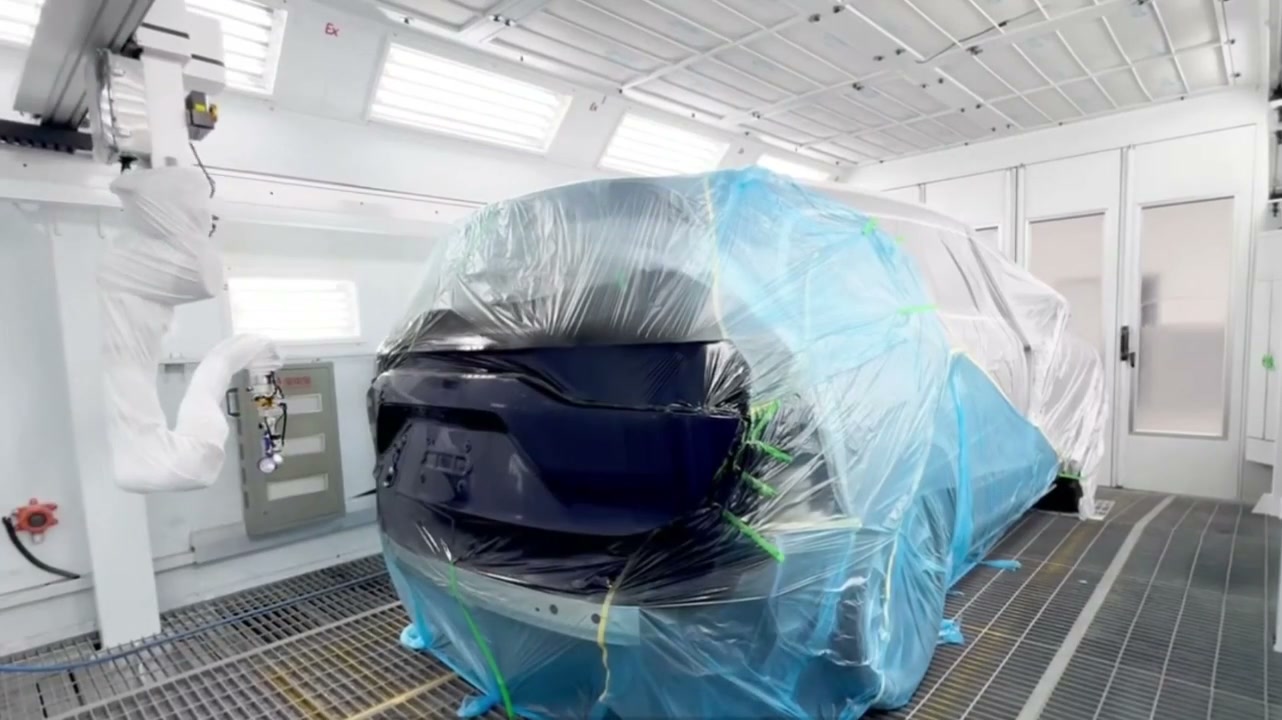
This later arm position shows why lower regions and the transitions into them need their own clearance checks.
Process trials should record the selected variables and the inspection method used for each sample. If a result changes, the team needs to know whether the change came from path geometry, applicator settings, material delivery, booth conditions, part preparation, or masking. Changing several variables at once makes a successful sample difficult to repeat.
Build the validation sequence around risk
The fastest route to a stable application is usually to resolve the largest physical constraints first. Begin with the real part or a representative fixture, the complete applicator package, production-style masking, and the intended robot cover. Run the path dry to inspect reach, joint posture, clearances, and hose behavior. Then introduce the coating process under the required booth and operating controls.
The first process trials should focus on distinct surface regions and transitions rather than immediately optimizing the entire cycle. Once the path relationship is stable, the team can tune motion and process variables, inspect results using the agreed method, and confirm repeatability across representative parts. Cycle-time work follows after the critical regions no longer require large geometric changes.
Stop and restart cases should be planned at the same time. The team needs a defined response for an interrupted pass, a part that cannot continue, an applicator condition that requires attention, or a robot stopped near the workpiece. The correct response depends on the process equipment and quality plan, so it belongs in the application specification.
When robotic tailgate spraying is a suitable candidate
This approach fits applications where the tailgate or vehicle rear can be fixtured repeatably, the working regions can be reached with the complete tool package, and the masking and booth arrangement can be standardized. It is especially valuable when the surface geometry requires repeatable posture changes that are difficult to perform consistently by hand.
Additional development is needed when part presentation moves, masking varies widely, a fixture blocks critical approach directions, the cup or hose cannot clear the booth, or the required coating process has not yet been defined. These conditions can often be addressed, but they change the tooling, fixture, path, or booth concept and should be identified before a final cycle estimate.
What to provide for an application review
Send the part drawing or surface data, fixture concept, masked and exposed regions, coating-process specification, applicator package, booth layout, required inspection method, changeover cases, and daily output. Photos or samples of the production mask and the actual part presentation help the team evaluate access and transitions. The review should also include how parts enter and leave the booth and how operators handle setup, cleaning, and interrupted cycles.
Send the tailgate drawing, booth layout, coating-process requirements, and daily output for a solution and cycle-time evaluation. Email sales@evsrobot.com with the applicator and masking details.
This article describes the visible masked-tailgate spray motion and the engineering questions for a proposed application; coating settings, inspection results, safety functions, and final performance require project-specific validation.