
Dividing your peak cartons-per-minute target by a robot brochure’s best-case cycle time is the fastest way to under-size an end-of-line palletizing cell. Real net palletizing throughput equals picks per minute multiplied by cartons per pick, discounted by the minutes lost every hour to empty-pallet placement, slip sheets, and full-pallet discharge—and realistic project budgeting must sum all six deployed CapEx buckets alongside payload margin for both cartons and heavy multi-bar tooling.
Step 1: Model Net Hourly Throughput With Pallet-Changeover Losses
Before comparing robot models, compute your required stacking rate using three variables:
Effective Cartons/Hour = (Active Picks/Min × Cartons/Pick) × (60 − Pallet-Swap Minutes/Hour)
Hypothetical Worked Example (Appliance Packaging Line)
The following example uses illustrative plant assumptions to demonstrate the calculation method; it is not measured output from the filmed cell below.
- Assumed line demand: 16 cartons/min (960 cartons/hour) of 14 kg corrugated appliance cartons, stacked 48 cartons per pallet (4 layers × 12 cartons/layer).
- Pallet changeover frequency:
960 ÷ 48 = 20 full pallets/hour(one pallet swap every 3.0 minutes). - Changeover time penalty: Suppose the robot itself picks and sets each empty wooden pallet (15 seconds) and full-pallet roller discharge plus indexing takes another 15 seconds—a combined 30 seconds per pallet, or 10 minutes lost per hour (
20 × 30 s = 600 s). Only 50 minutes per hour remain for carton stacking. - Required active carton rate:
960 ÷ 50 = 19.2 cartons/minduring active stacking windows. - Single-pick vs. twin-pick outcome: A single-carton gripper running 12 picks/min delivers only 12 cartons/min—falling well short of
19.2. Upgrading to a 2-carton multi-pick frame gripper running at 11 picks/min delivers11 × 2 = 22 cartons/minduring active stacking, or22 × 50 = 1,100 cartons/hournet capacity—leaving 14.6% surge headroom above960 cartons/hour. - Combined wrist payload check: Carrying two 14 kg cartons (28 kg) plus an assumed 35 kg aluminum multi-bar frame gripper totals 63 kg at the flange before inertia safety factors—ruling out light 30–50 kg arms and pointing toward an 80–120 kg payload class.
What the Filmed Appliance Carton & Pallet Handling Cell Shows
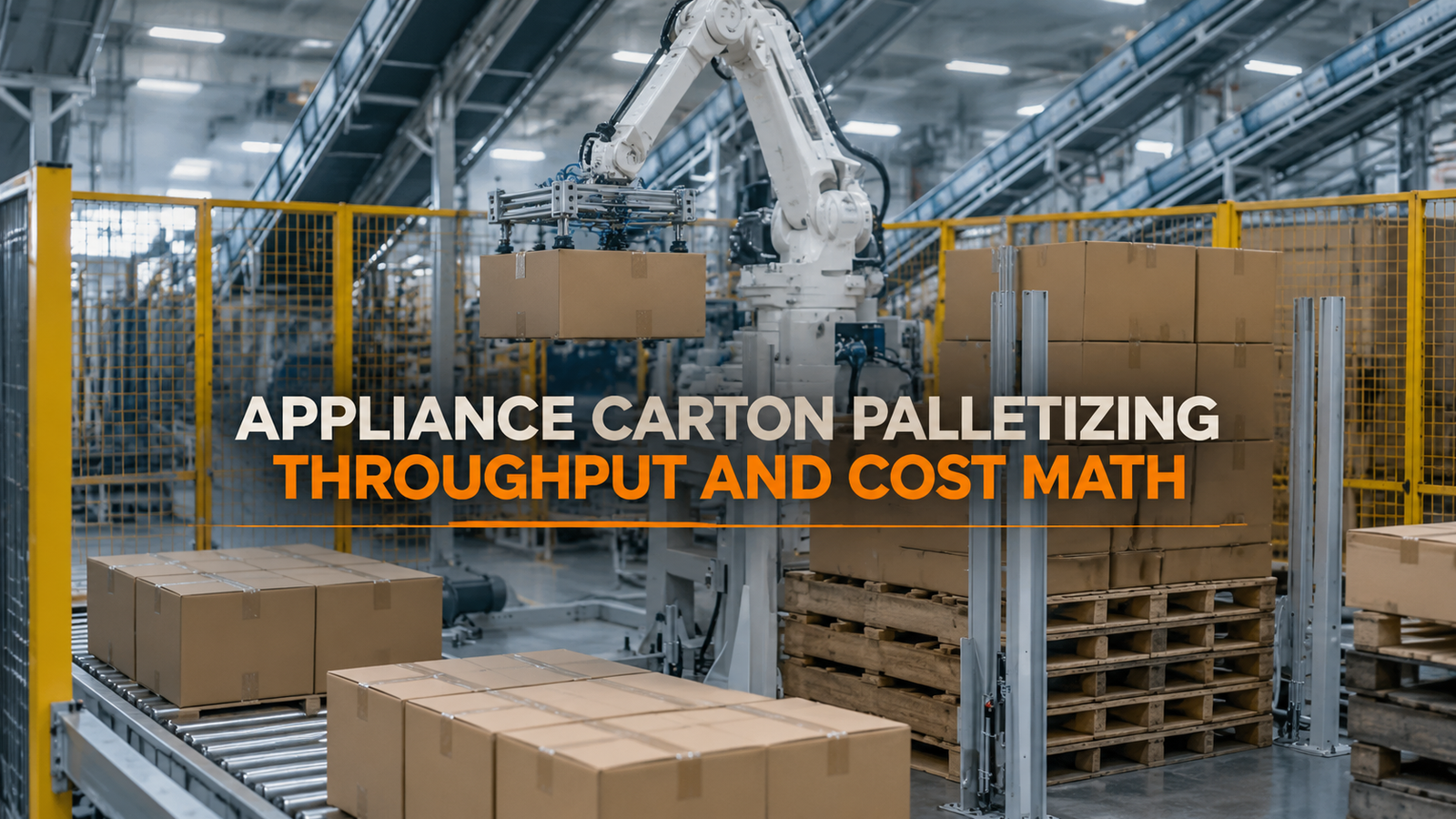
In the high-bay packaging facility recorded above, a white pedestal-mounted heavy industrial palletizing robot works inside yellow-and-clear perimeter guarding fed by floor-level powered roller conveyors, with inclined overhead carton transport lines visible in the background.
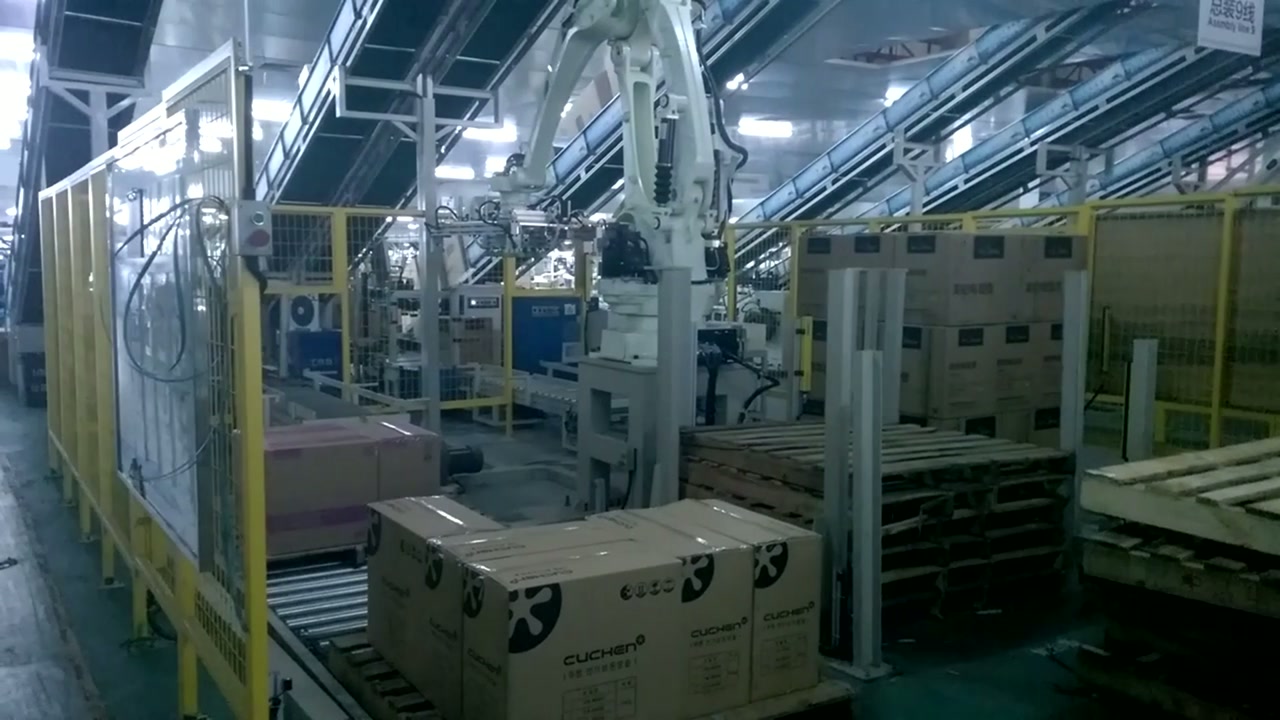
At 00:10, sealed brown corrugated appliance cartons queue on powered floor-level roller conveyors beside tall multi-tier finished carton stacks.
A closer view highlights an aluminum multi-bar clamping/fork end effector with pneumatic hoses lowering cleanly onto a stack of wooden pallets between vertical steel alignment posts—handling empty pallets directly with the same robot arm rather than installing a separate dedicated pallet dispenser.
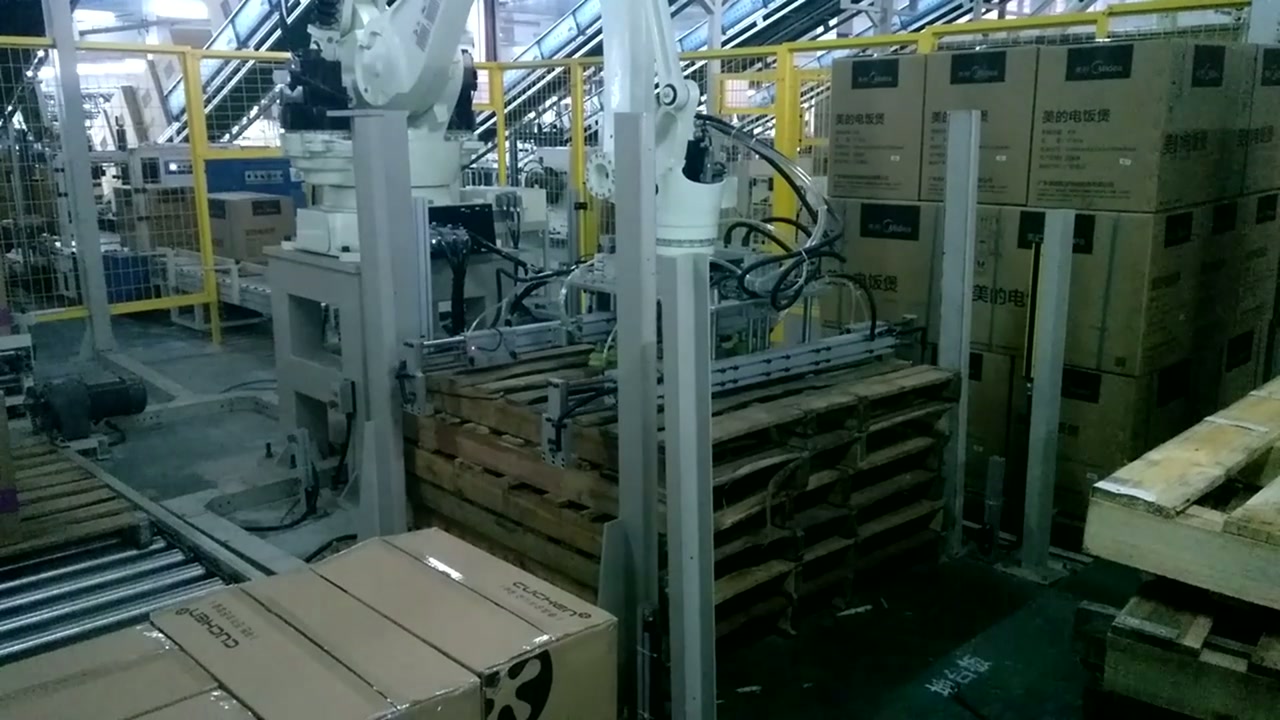
At 00:05, robot-handled empty wooden pallets simplify floor hardware—and illustrate exactly why empty-pallet cycle seconds must be deducted from available carton-stacking minutes.
Step 2: Match Gripper Style to Carton Rigidity and Speed
Palletizing end-of-arm tooling choices hinge on throughput tier and package structure:
- Single-carton vacuum or clamp grippers fit slower, low-to-medium output lines and lighter, well-sealed cases.
- Multi-carton clamp/fork frame grippers become mandatory once active carton demand outpaces single-pick arm speed, especially when cartons have glued bottom flaps, heavy internal appliance weights, or dual duties like wooden-pallet handling.
- Full-layer grippers justify their cost only on very high-speed, uniform-SKU lines where multi-case picks still saturate robot cycles.
Step 3: Quantify Manual Ergonomic Limits Honestly
When building an internal justification for two- or three-shift packaging halls, labor headcount is only half the operational reality—chronic turnover and lifting strain near floor level and top tiers drive unscheduled overtime. Under North American ergonomic lifting guidance (the Revised Lifting Equation), the ideal manual lifting load constant starts at 23 kg (51 lb) under perfect posture and drops steeply under real palletizing reaches:
- Horizontal reach multiplier: drops to 0.63 at 40 cm reach and 0.50 at 50 cm reach.
- Vertical height multiplier: drops to 0.78 when lifting at 0 cm (floor level) or stacking at 150 cm, and falls to 0.00 above 175 cm.
- Torso twist multiplier: drops to 0.71 at a 90-degree trunk turn.
Even a 12–15 kg appliance box quickly crosses safe manual lifting thresholds once operators twist between a roller conveyor and the bottom or top corners of a tall wooden pallet across an eight-hour shift. Plug your own plant’s carton mass, reach distance, and shift frequency into your local ergonomic standard rather than copying foreign thresholds verbatim.
Step 4: Account for All Six Deployed CapEx Buckets
Bare robot arm pricing often represents less than half of an installed palletizing cell. Require every integrator quote to break out all six buckets transparently:
| Cost Bucket | Key Scope Items That Drive Budget Variance | What Happens If Omitted From Initial Estimate |
|---|---|---|
| 1. Robot Arm & Pedestal | Payload class (cartons + EOAT + moment), reach envelope, elevated steel riser | Robot cannot clear top layer height or trips overload on twin-carton picks |
| 2. Custom EOAT & Valves | Multi-bar clamp/fork frame, vacuum generator, pallet hooks, air-loss holding valves | Mid-project redesign when cartons sag or robot cannot grip wooden pallets |
| 3. Infeed & Outfeed Conveyors | Accumulation rollers, carton squaring/orientation stops, heavy pallet discharge rollers | Upstream case sealer backs up during every full-pallet swap |
| 4. Pallet & Slip-Sheet Handling | Manual floor magazine with guide posts vs. automated pallet dispenser | Unplanned operator forklift trips every 3–5 minutes defeat lights-out goals |
| 5. Safeguarding & Controls | Perimeter mesh fencing, muted light curtains at pallet exit, safety PLC, HMI recipe screen | Delayed safety sign-off or awkward manual resets after routine pallet removal |
| 6. Installation & Commissioning | Floor anchoring, line-speed stress run across every SKU pattern, operator training | Unstable interlocking stacks shift during downstream stretch wrapping |
Actual cycle rate, total cell cost, and payback timeline depend on carton dimensions, SKU changeover count, existing conveyor layout, local shift wage rates, and plant safety requirements.
Build Your Own Carton Palletizing Estimate
Share your carton length, width, height, weight range, peak cartons per minute, pallet dimensions, and daily shift count with EVST to check single-pick versus multi-pick EOAT sizing and receive a structured cell-scope worksheet. Submit your line parameters through the EVSINT quote request page or email sales@evsrobot.com.