
By Chen Lei, Senior Applications Engineer · EVST Surface Finishing Team · · Reviewed by EVST robotics integration engineering
Polishing is the dirty, loud, wrist-wrecking post nobody wants on a shop floor — and it sits near the top of every shop’s injury log. Robot polishing now scales because the hard part is not the workpiece; it is the combination of vision, force-control and abrasive consumables. Once those three are solid, swapping from a vacuum mug to a steel plate to a brake disc is a parameter packet, not a redesign. This guide walks the three product clusters where it has scaled, the typical 2–3× abrasive belt life gain, and where it does not yet fit.
Key takeaways
- The hard part of polishing is vision + force-control + abrasive consumables — not the part shape. Swap the part, swap the recipe; the cell stays.
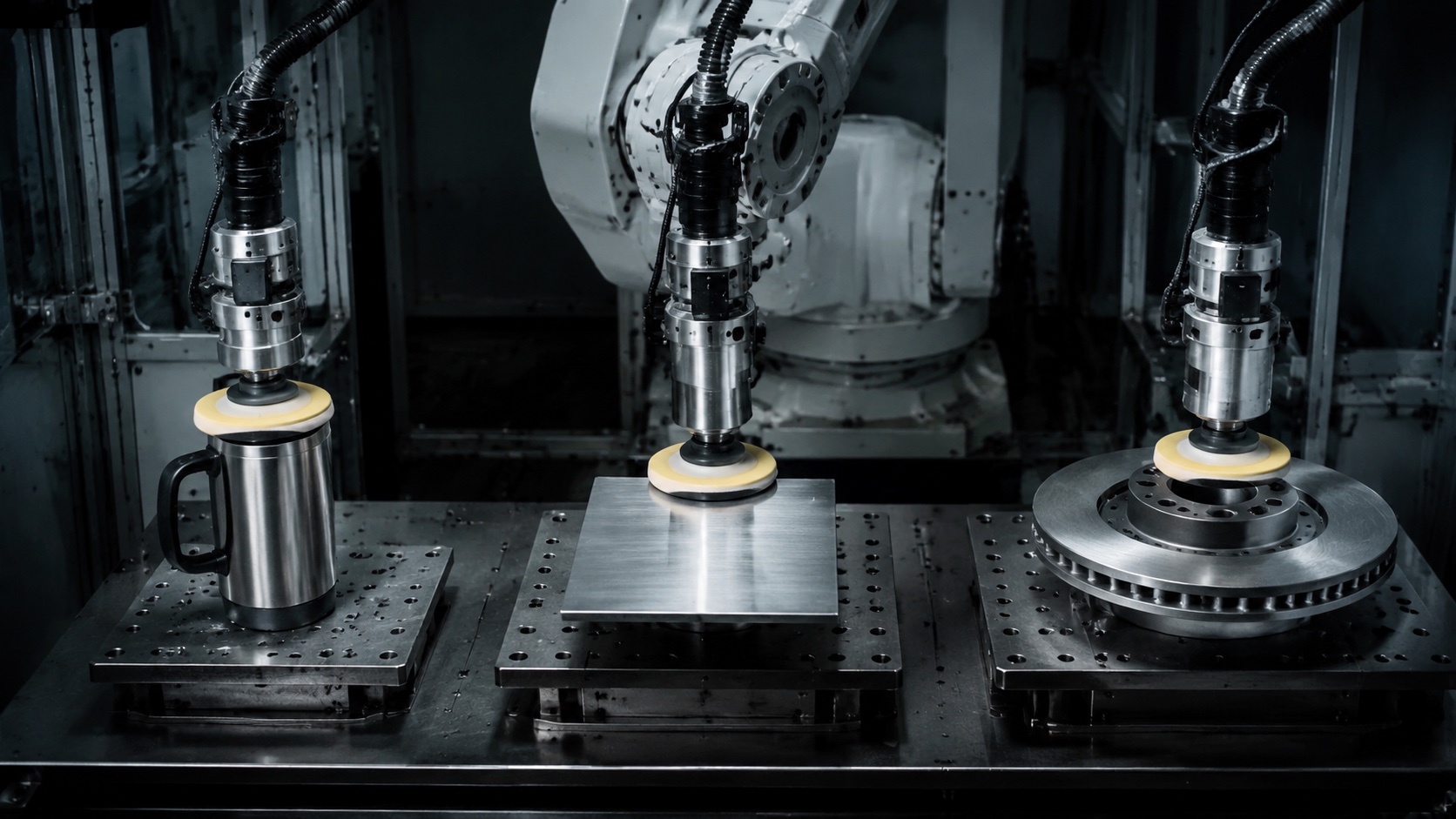
- Cookware scaled first — vacuum mugs, lids and pan bodies run multi-arm parallel polish straight to shipping grade.
- Plates run single-cell fine polish — vision finds the centre, compliant float head sweeps the rim, abrasive belts last 2–3× longer than manual polish.
- Auto parts are the toughest case — brake discs, hubs, gearbox housings collapse polish + load/unload into one station via a vision-guided robot.
- Cobot polishing fits sub-10 kg medium-precision parts; heavy castings stay on industrial six-axis with force-controlled spindles.
This article is for plant owners, production managers and process engineers evaluating robot polishing on cookware, household appliance plates, or automotive components. It covers process logic and the three product clusters; it does not cover specific spindle/belt SKU selection, which is sized per project.
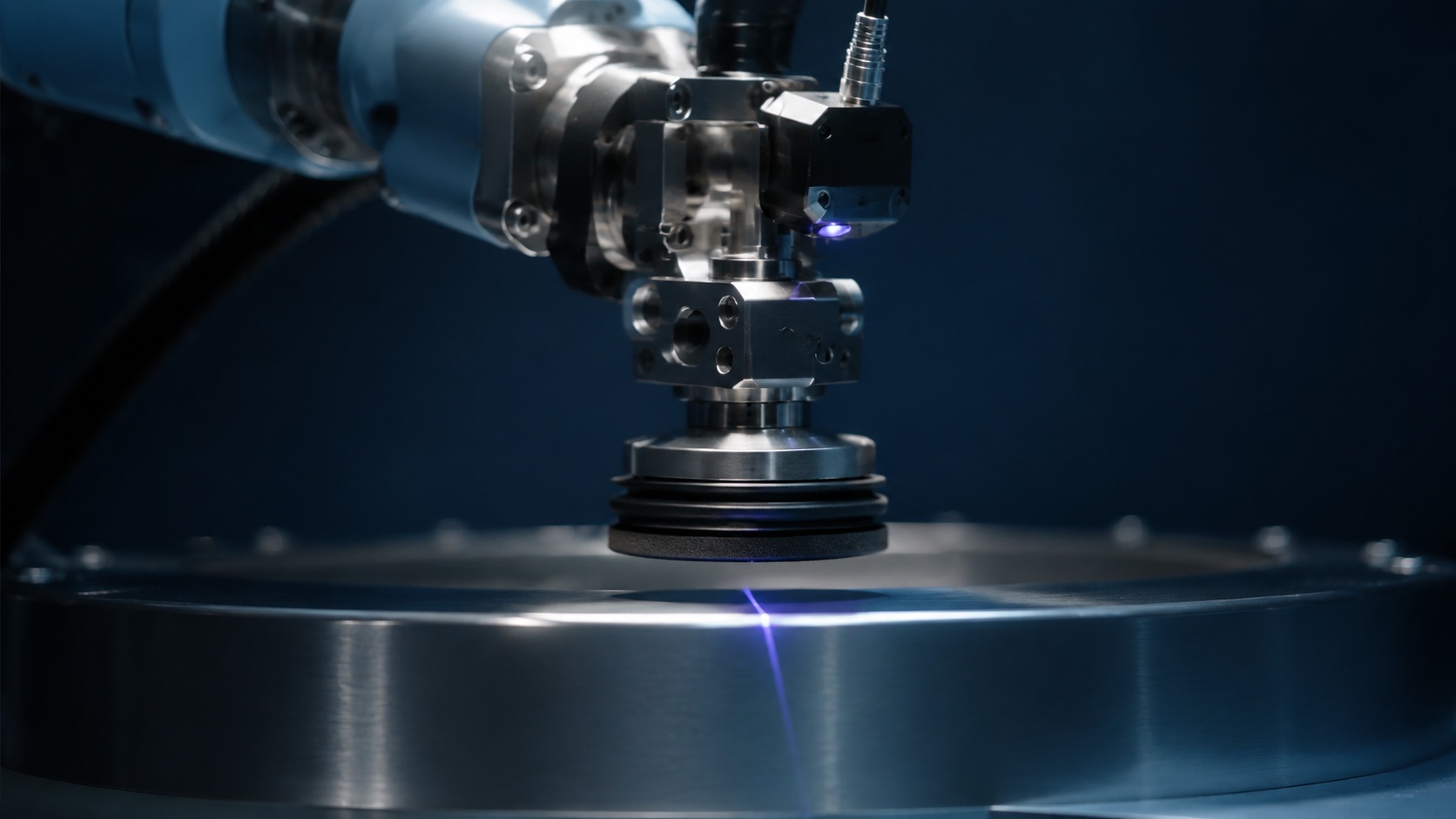
Why polishing resists standardisation
Every workpiece has a different surface profile, hardness and final-feel requirement. A plain industrial robot dropped onto a polishing post will hold the head at the programmed XYZ, but the abrasive bites unevenly: too hard and you gouge, too soft and you do not cut. The art of manual polishing is the operator constantly adjusting wrist pressure based on how the workpiece feels — and that is exactly what a fixed-XYZ robot cannot replicate.
The fix is not faster robots. It is closing three loops that together approximate what a skilled operator’s wrist does without thinking.
The three loops that make a real polishing cell
A robot polishing station that scales across industries closes three independent loops:
- Vision locates the workpiece position and orientation before contact. Surface curvature deviates by part-to-part casting tolerance; the vision step adapts the planned path each cycle.
- Force-control (compliant float head) maintains target contact pressure as the surface profile changes under the abrasive. The float collapses on hard contact and extends on light contact, holding pressure constant.
- Automated feed matches the line’s takt without operator intervention — incoming parts arrive on a conveyor or fixture, outgoing parts leave on another. Without auto-feed, the polishing post is still a manned post even if a robot is doing the polish.
Stack all three and you have a real polishing robot. Skip any one and you have a brittle demo.
Cookware was first to scale
Vacuum mugs, water bottles, pan lids and pan bodies were the first cluster to run robot polishing at scale, for three reasons:
- Geometry is forgiving — round curved surfaces let the float head track easily, and the abrasive contact patch stays consistent around the rotation
- Surface specification is visible to consumers — outer polish is the buying decision, so the ROI on consistent surface finish is direct
- Multi-arm parallel is the layout default — one station hosts 4–6 arms working in parallel on incoming parts, throughput multiplies linearly
A typical cookware polishing station processes vacuum mug bodies at 8–12 seconds per piece per arm, with 4 arms running in parallel — line-rate matches downstream packaging. The polish goes straight to shipping grade with no manual touch-up.
Plates run single-cell fine polish — 2–3× belt life
Ceramic and stainless steel dinner plates use a different layout: one robot, one fine polishing head, one workpiece at a time, with vision finding the plate centre and the float head sweeping the rim in a single circular pass.
The headline gain here is abrasive belt life — 2 to 3 times longer than manual polish. A manual operator pushes inconsistent pressure on every stroke, glazing the belt prematurely. The float head holds pressure constant, so the belt cuts at design rate for its full lifecycle.
The secondary gain is feel consistency. Customer feedback on ceramic plates flags pressure variation as “feels rough on one side” — a manual polishing artefact that vanishes when force-control is automatic.
Auto parts are the toughest case — but collapse two stations into one
Brake discs, wheel hubs, gearbox housings — these are heavy, fast-cycle, and the polishing post traditionally sits downstream of a load/unload post. The two posts both need staffing, both touch the part.
A vision-guided polishing robot can collapse polish + load/unload into one station. The robot picks the part from the conveyor with the same arm that holds the polishing head, transports it to the polishing fixture, runs the polish pass, then places the finished part on the outbound conveyor. Two posts collapse to one robot cell.
The savings compound:
- One less manned post per line
- One less handover where parts get dropped or mis-oriented
- One less cycle-time gap between polish and load
For a multi-shift auto parts line, the difference is typically 1.5–2 staff per shift across three shifts — payback inside 12 months on labour alone.
Where robot polishing does not yet fit
The frame is not universal. Three cases stay manual or stay on dedicated machines:
- Mirror-finish optical components — sub-micron surface finish on glass or optics still needs precision lapping machines, not robot polish
- Heavy castings above ~50 kg — workpiece weight exceeds typical cobot payload; goes to industrial six-axis with dedicated force-controlled spindle
- Single-piece artisanal items — programming time per part exceeds the part’s value, manual stays cheaper
How EVST scopes polishing deployments
We evaluate three things before quoting: workpiece geometry (curved/flat/complex), surface specification (functional/cosmetic/safety), and line takt (cycle time + changeover frequency). Cookware lines usually map straight to multi-arm parallel, plate lines map to single-cell fine, and auto parts map to vision-guided pick-and-polish — but variations show up, and the right layout changes the math by 30–40% on capex.
For multi-product lines, we score each product class independently and let the line average drive layout. A cookware line that adds a plate SKU later usually still wins with the multi-arm parallel layout if the plate SKU shares the same float head; switching layouts only pays off if more than one third of volume crosses product class.
FAQ
Why does abrasive belt life go up 2–3× under robot polish? Belt wear is a function of contact pressure × contact time. Manual polishing varies pressure ±50% across a single stroke; the belt glazes (heat-loaded with workpiece debris) wherever pressure spikes, and the glazed zones stop cutting. A float head holds pressure within ±5%, so the belt cuts at design rate for its full lifecycle — life roughly doubles, and on hardened workpieces can triple.
Can the same cell handle cookware and auto parts? Usually not — the abrasive head, fixture and vision parameters differ enough that you would design the cell for one cluster. But the control logic is identical, and software/recipes port across cells without rewriting from scratch.
Is robot polish good enough to skip manual touch-up? For cookware and plate clusters, yes — the polish goes to shipping grade. For auto parts with safety-critical surfaces (e.g. brake disc rotor face), final inspection still runs, but rework rates are low single-digit percent and trending down as vision models improve.
Does the float head handle complex curved surfaces like cookware lids? Yes for shallow curves (radius of curvature ≥3× the float head working radius). Sharp inner corners and re-entrant surfaces remain hard — a five-axis polish path or a smaller dedicated tool helps in those cases.
What about polishing dust and worker safety? Polishing dust is the most-cited injury driver, and one of the strongest reasons to robotise the post. Robot polish stations are typically enclosed with downdraft extraction; operators reload incoming parts at a separate post in clean air.
Bringing it into your plant
Robot polishing is no longer a research demo — it is a standard process on cookware lines, increasingly on plate and household appliance lines, and now spreading into automotive component finishing. The hard part is closing the three loops (vision, force-control, auto feed) cleanly. Once they are closed, the cell carries across product classes with parameter changes, not redesigns. See our guides to vision-guided pickup, compliant force-control and abrasive belt management, or talk to EVST about scoping the three loops on your station.
About the author — Chen Lei is a Senior Applications Engineer on the EVST Surface Finishing Team, with 8+ years deploying robot polishing cells across cookware (vacuum mugs, pan bodies), household appliance (plates, ceramic glaze), and automotive components (brake discs, wheel hubs). He scopes process layout, abrasive consumables and vision sensors for new customer engagements. Reviewed by EVST robotics integration engineering for technical accuracy; performance figures are typical achievable ranges, not guarantees, and are sized per project. Corrections and updates: see the Last Updated date.