
Metal-forming support should be reviewed through the changing workpiece shape, from loading to forming and removal. A final-part drawing alone leaves those intermediate conditions undescribed. Flat sheet and a rotating cylindrical workpiece raise different support and access questions, so each station needs its own account of what holds the part and what moves around it.
Read the sheet and the rolls together
At 00:03, metal sheet is visibly curved around horizontal rolls. The sheet shape and contact arrangement are observable, but the view contains no material specification, thickness measurement or required final contour. It cannot establish the machine’s capacity for another component.
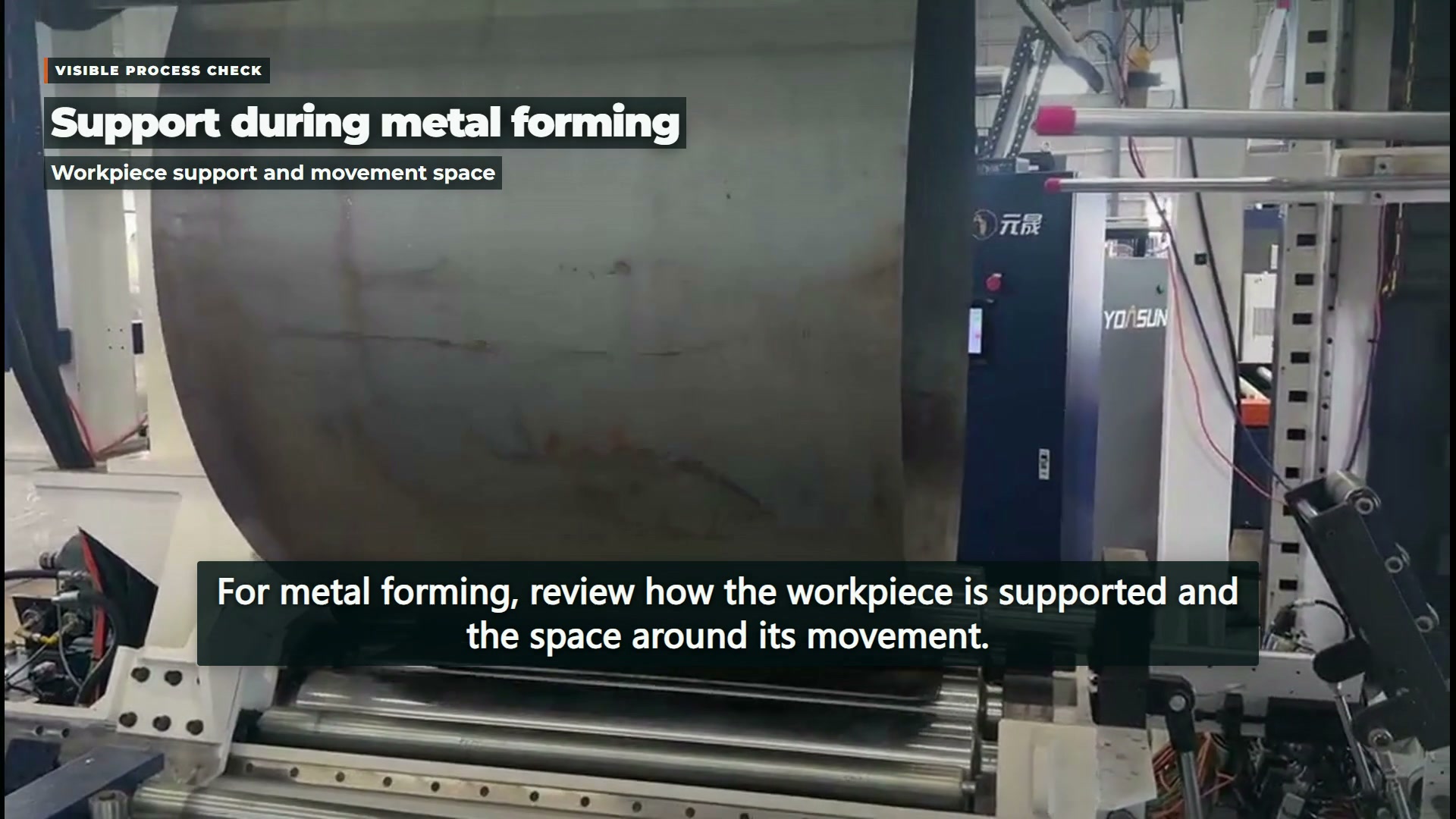
For a forming proposal, describe the incoming blank as well as the intended finished shape. Identify the loading direction, the areas that may be contacted and the intended removal method. If the part changes how it rests during forming, include those intermediate states in the discussion rather than representing the process with only its two endpoints.
Support examples have application limits
DAVI’s HVAC application page describes side and overhead support options in relation to thin material and narrow cylindrical workpieces. This is an example within that manufacturer’s application range, not evidence that the equipment shown here has those options or that another project requires them.
It provides a specific question for an equipment discussion: which support arrangement addresses the proposed workpiece condition at each stage? The answer needs the selected machine’s information and the actual part requirements. An apparently smooth movement cannot establish that the support remains suitable after a material or geometry change.
A cylindrical station changes the question
At 00:16, the video shows a cylindrical workpiece turning in contact with a tool at its side. This comes from a different station than the sheet-rolling scene. The two views do not establish consecutive operations on the same product, and the visible side contact does not identify a particular finished feature or prove its dimensions.
For a comparable cylindrical operation, the review would need to explain how the part is held, where the tool approaches and how the part is loaded and removed. The flat-sheet support description cannot simply be carried across. Keep the cylinder’s local contour and the relevant tool space on the same drawing so that the required operation can be discussed at that location.
Name the roll arrangement before transferring assumptions
DAVI’s plate-roll overview describes different roll configurations, including a four-roll arrangement in which the lower roll clamps material against the upper roll while the side rolls participate in forming. That is a configuration-specific description. A short view of rolls does not establish all the machine’s axes or its operating sequence.
When considering another machine, request its actual arrangement before assuming that a familiar clamping or feeding method applies. If the arrangement changes, revisit where the material is constrained and how the intended shape passes through the equipment. This keeps a visible resemblance from becoming an unsupported process specification.
Make the result inspectable
For any proposed trial, identify the contour or fit that must be checked, the inspection reference and the condition of the sample when it is measured. Surface requirements and later assembly needs should also be stated where relevant. Support and motion can then be evaluated against a defined result instead of a general impression that the workpiece travels steadily.
The broader HVAC forming-step analysis considers forming within an automation scope. The narrower issue here is how to describe support as the workpiece changes shape and moves between held conditions. The video helps identify that issue; it contains no dimensional inspection or acceptance record that closes it.