
A long-pipe transfer needs a handling system that supports the pipe and delivers its full length through the required route. An overhead gantry is a useful option when stations share a rectangular working area and the transfer mainly preserves orientation. An articulated system becomes worth comparing when the pipe must turn, tilt or approach around equipment. Payload alone cannot settle that choice.
Draw the supported pipe before choosing the robot
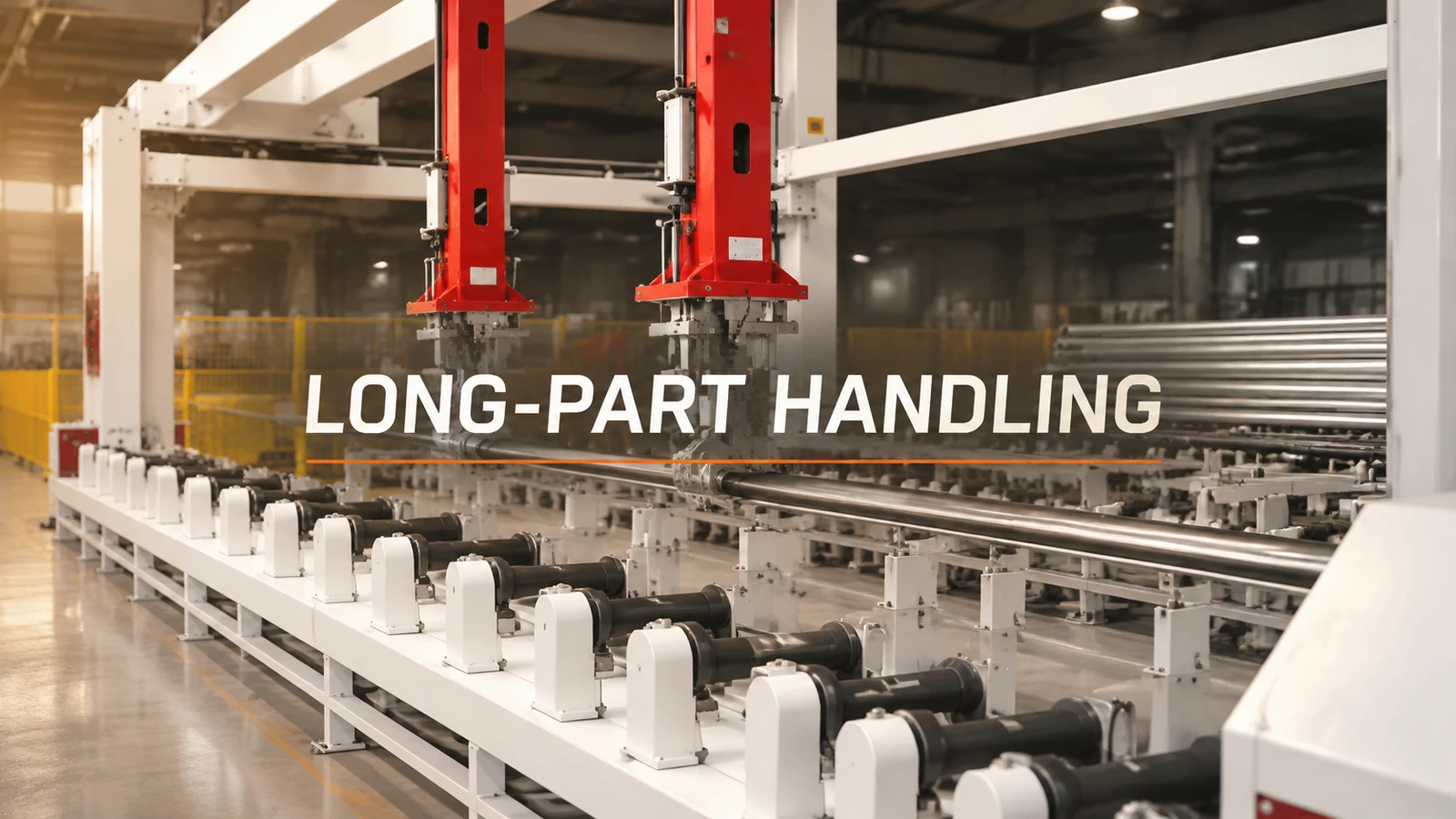
The application shows two red vertical-axis assemblies below a white overhead gantry, carrying a dark long pipe between roller fixtures. Its useful feature for this discussion is the relationship between an extended workpiece, its handling arrangement and several receiving positions.
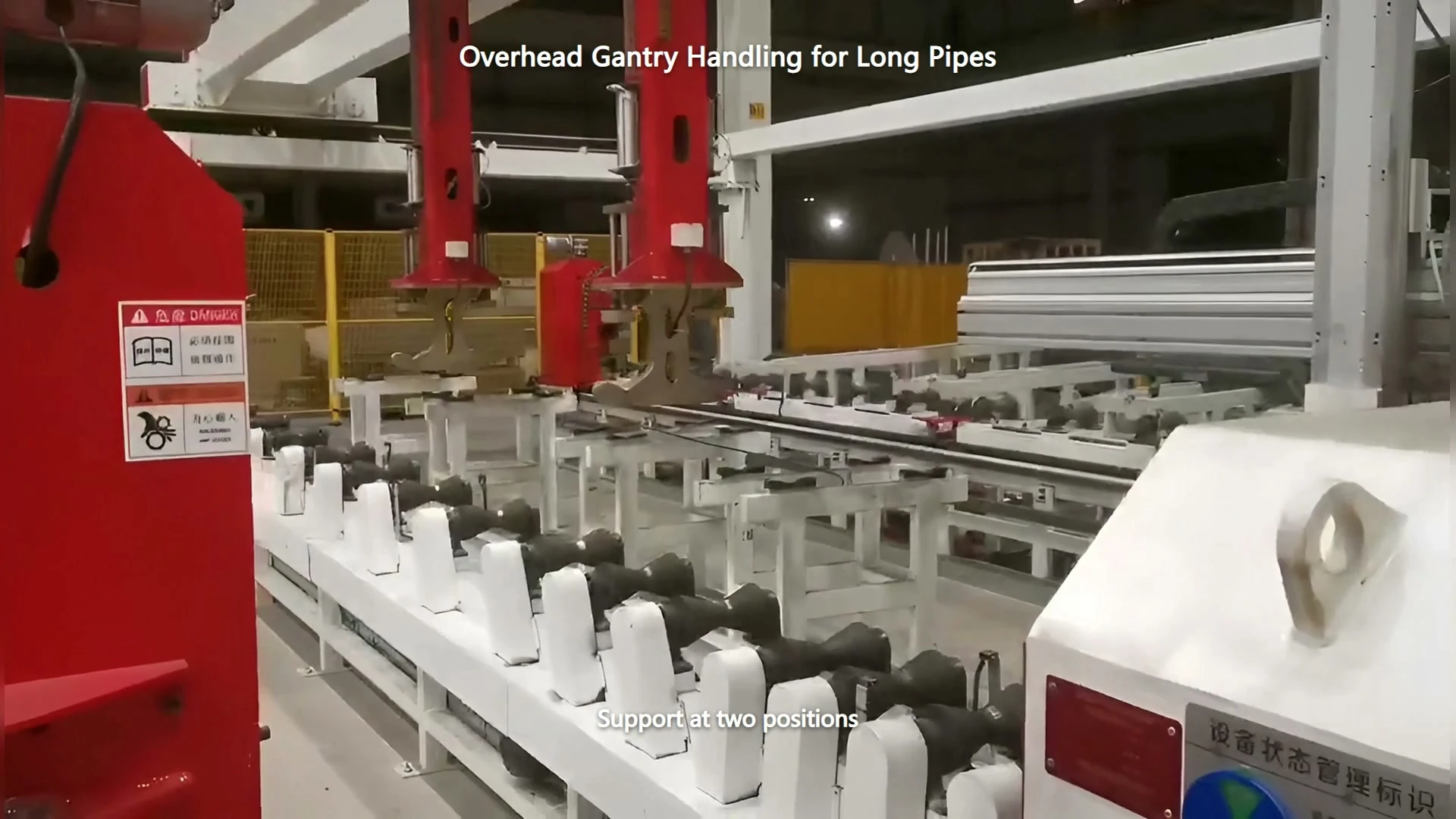
Video at 01:07 — Long pipe carried below the overhead gantry above roller fixtures.
For a proposed system, mark permitted gripping and supporting regions on the pipe drawing. Include the pipe’s mass, centre of gravity, permitted contact and acceptable deflection during transfer. A lifting arrangement that clears a station at its centre can still leave a pipe end close to a roller, guard or neighbouring part.
Draw the entire pipe-and-tool envelope through lift-off, transfer and landing. That envelope is larger than a tool-centre path. At the receiving station, show when the rollers or other supports take the load and when the handling tool can withdraw. Support and release are part of the comparison, whichever robot moves the tool.
Compare the motion the system must provide
A Cartesian arrangement uses linear-axis motion to cover its defined working space. That makes it a candidate for overhead lifts and transfers between aligned stations. The specific system still needs the travel, structure and tool arrangement required by the pipe.
An articulated arm offers wrist-orientation options that can be useful for a change of approach. Its actual suitability depends on the loaded tool and workpiece through the route, rather than on whether an empty wrist can reach the destination.
| Услов | Option to examine | What can change the decision |
|---|---|---|
| Lift and transfer while retaining pipe orientation | A gantry spanning the station arrangement | Required lift clearance, supporting structure and receiving positions |
| Tilt, turn or enter from a different direction | An articulated arm or a gantry with a suitable rotary tool | The complete pipe’s swept space and the tool’s allowed orientation |
| Reach several separated stations | Extended gantry travel or an articulated arm on an external axis | Loaded route, transfer interfaces and access around the entire installation |
These are system options, not rigid robot categories. An arm can travel on an external axis; a gantry can carry additional orientation axes. Compare the resulting arrangement instead of assuming that every gantry lacks rotation or every articulated robot serves only a short distance.
Ask both proposals to solve the same landing
Give suppliers the same pipe range, support restrictions and station layout. Ask each proposal to show the approach to the receiving rollers, the transfer of support and the withdrawal of the tool. Include the longest or otherwise most restrictive declared workpiece in the route review.
If the pipe must arrive in a particular orientation, identify that requirement explicitly. If its rotational position is irrelevant, say so; the proposal should not add an orientation task that the process does not need. Conversely, do not leave an essential alignment task for an operator to correct after every automatic transfer.
Check tool mass and the manufacturer’s applicable load and moment conditions together. A nominal payload figure without the proposed tool, support spacing and carried geometry does not establish that the system meets the task. Use the vendor’s conditions for the specific proposed mechanism rather than a generic limit for “long pipes”.
The most useful starting package for EVST is a station sketch, pipe length and diameter ranges, mass information, permitted support locations and photographs of pickup and delivery. Add whether turning or tilting is required. Discuss the pipe-transfer arrangement so the conversation can compare routes and handoffs, not only robot payloads.